Part 1 · Chapter 8
The Reproduction Right—Part II
This chapter addresses some advanced topics in relation to establishing a violation of the reproduction right.
Copying in Fact
Access is not an element of the plaintiff’s prima facie case
In Feist the Supreme Court said: “to establish infringement, two elements must be proven: (1) ownership of a valid copyright, and (2) copying of constituent elements of the work that are original.” This second element entails both copying in fact (or factual copying) and wrongful copying (or improper appropriation). As mentioned in the previous chapter, copying in fact means that there is a causal connection running from work A to work B and this can be established by admission, stipulation, direct observation, or indirect evidence.
The plaintiff in an action for copyright infringement must show that B was actually copied from A in the sense that there is a causal connection running from A to B. Courts refer to this requirement as either “copying in fact,” “factual copying,” or “actual copying.” Such actual copying can be deliberate, unintended, or even subconscious. If two works are similar, but were in fact independently created, there is no copyright infringement. The classic statement to this effect comes, again, from Judge Learned Hand, this time in Sheldon v. Metro-Goldwyn Pictures Corporation, 81 F.2d 49 (1936):
… but if by some magic a man who had never known it were to compose anew Keats’s Ode on a Grecian Urn, he would be an “author,” and, if he copyrighted it, others might not copy that poem, though they might of course copy Keats’s.
Of course, most of us don’t believe in magic and so we are usually prepared to draw an inference from very high levels of similarity that B probably was copied from A. We will return to this topic below.
Sometimes, quite often in fact, a defendant will simply admit that the plaintiff’s work influenced their work and fight the case on lack of wrongful copying or a defense of fair use. Sometimes, but rarely, some third party will be in a position to say, “I saw the defendant composing his novel with a detailed summary of the plaintiff’s novel in hand.” If that testimony is believed, it should establish factual copying. However, in a large number of cases, the plaintiff cannot rely on an admission or direct evidence and must establish copying in fact by indirect evidence: that is, the plaintiff must persuade the judge or jury of the ultimate fact of copying it can’t prove directly by drawing inferences from the facts it can prove. In such cases, plaintiffs invariably rely on some theory of how the defendant could have had access to the work and on similarities between the works that make copying from the plaintiff—as opposed to copying from a common source or just plain coincidence—seem the most likely explanation. Hopefully, this strikes the reader as mundane common sense, but courts have struggled with it over the years.
As discussed in the previous chapter, in Sid & Marty Krofft the Ninth Circuit framed the test for infringement in terms of ownership, access, and substantial similarity despite the fact that it said it was applying the two-part test in Arnstein. Many cases following Krofft treat access and substantial similarity as elements that establish infringement rather than components of copying in fact. This approach is mistaken. Access is a way to prove copying in fact, not something that must be proved for its own sake, and certainly not something that dispenses with the need to prove the ultimate question of copying in fact.
Probative similarity is different to substantial similarity
Another problem that Sid & Marty Krofft contributed to is the perennial confusion between similarities that make copying in fact more likely and similarities that make copying wrongful, assuming it occurred. One reason why courts get confused between copying in fact and wrongful copying is that a factual determination of similarity can play some role in both issues in many cases. Similarities between A and B may be evidence that there was copying in fact because all other things being equal, the closer A is to B, the greater the chances that B was copied from A. But a certain threshold of similarity (as to protectable expression) is also required to show that if there was copying, it was wrongful. As a result, courts sometimes lose sight of the distinction between copying in fact and wrongful copying and apply a singular threshold of substantial similarity to determine both.
In fact, courts regularly lump the entire inquiry, copying in fact and wrongful copying under the single term “substantial similarity.” This not only makes it confusing to read the cases, but it also leads courts themselves to conflate the two distinct elements. Courts should try to keep the question of whether B really did copy from A and the question of whether such copying went too far, quite separate. The extent of similarities between A and B will be important in answering both questions, but we are actually dealing with two very different concepts of similarity here. The two kinds of similarity are different and they deserve different names: the most logical nomenclature differentiates between probative similarity that supports an inference of copying in fact and substantial similarity which addresses wrongful copying.
As Alan Latman observed in his definitive article published several years after his death:
“Substantial similarity,” while said to be required for indirect proof of copying, is actually required only after copying has been established to show that enough copying has taken place. A similarity, which may or may not be substantial, is probative of copying if, by definition, it is one that under all the circumstances justifies an inference of copying. In order to emphasize the function of such similarity and avoid the confusion of double usage, this Article suggests use of the term “probative similarity” in place of “substantial similarity” in this context.
For more, see Alan Latman, “Probative Similarity” as Proof of Copying: Toward Dispelling Some Myths in Copyright Infringement, 90 Columbia Law Review 1187 (1990).
There is no fixed relationship between probative similarity and substantial similarity
The following examples will demonstrate that there is no simple relationship between the level of similarity that supports an inference of copying in fact and that which sustains a conclusion of wrongful copying.
Example 1
Consider two photos with more than a passing similarity as depicted below.1 Photographs A and B are similar in subject, composition, lighting, and almost any other dimension one cares to think about. The only real difference between them appears to be in the photographer’s choice of color filters and the level of contrast, both of which could be changed in post-production.
Photographs A and B


Image description: Left, a large, bright blue iceberg floats in calm, reflective water under a cloudy gray sky. The ice has jagged ridges and varying shades of blue, with a more intense hue near the waterline. Right, the same iceberg as in the previous image, but with altered color saturation. The blues in the ice and water are much more intense, while the sky and clouds have been desaturated to near black-and-white, creating a striking contrast.
Suppose that Photo ‘A’ was taken in 2006 and made available on the photographer’s website. In 2009, photo ‘B’ is entered in a newspaper photography competition and now the author of A alleges that B infringed her copyright. There is no doubt that if B had been copied from A and simply modified in some subtle way, B would be an infringing copy of A. But as it turns out two women standing beside one another on a cruise to the San Rafael Glacier in the Northern Patagonian Ice Field took both photos independently at almost the exact same time. Here we have similarity that would be enough in some circumstances to reach a threshold of wrongful copying, but not enough to prove copying in fact.
Given the subject matter, the possibility that both photos were taken at the same place and time seems only too apparent. As the Seventh Circuit noted in Ty Inc. v. GMA Accessories, Inc., 132 F.3d 1167, 1170 (7th Cir. 1997):
… two works may be strikingly similar—may in fact be identical—not because one is copied from the other but because both are copies of the same thing in the public domain. In such a case—imagine two people photographing Niagara Falls from the same place at the same time of the day and year and in identical weather—there is no inference of access to anything but the public domain, and, equally, no inference of copying from a copyrighted work.
Example 2
But it is easy to imagine the opposite. Suppose A is a well-known and widely appreciated work of literature. Author B, takes the essential story of A, changes the setting in both time and culture, adopts a different narrative style and perspective to obtain a different point of view but retains the same essential conflict. To put a little more distance between the works, B changes names and combines characters. B also extends the timeline of the original story, so that her account captures events she imagines might have taken place before and after the sequence of events in A. From this process of deliberate mutation, B may produce a work that is thoroughly original but still discernably influenced by A. Here we have a causal connection between the works, and we have similarity that is sufficient to establish copying in fact, but this is still insufficient to establish wrongful copying.
Example 3
A produces a telephone directory of the best restaurants in the Atlanta Metro area. To catch plagiarists in the act, A includes four fictional listings for restaurants that do not exist. A can use evidence that B’s telephone directory also contains the exact same fake listings to prove beyond any real doubt that B copied from A, but that won’t go very far in establishing that B has infringed A’s copyright. As we saw in the notes on Feist in a previous chapter, even if A can show that her directory contained enough creative spark to merit copyright protection, her copyright will still be “thin”, and she will also have to show that B copied her almost exactly to prevail.
***
As seen in each of the examples, there is no simple relationship between probative and substantial similarity. In application, the similarities that establish wrongful copying are often the same as those that tend to prove that there was copying in the first place, but the kinds of similarity are fundamentally different. Substantial similarity and probative similarity intersect, but they are not the same, nor is one necessarily a subset of the other.
Probative similarity is any similarity at all between the works that makes it more likely that the accused work was copied from the plaintiff’s original work. Similarities in subject matter, genre, perspective, general idea, and concept are unlikely to meet this test, and they should also be filtered out from any assessment of substantial similarity for reasons to be explained shortly. However, probative similarity can be established by identical features that are inconsequential and unlikely to be noted by the ordinary observer but for which copying seems the more likely explanation than sheer coincidence. As noted, the fact that two works contain identical deliberate mistakes is great evidence of copying in fact, but it will usually mean nothing in terms of wrongful copying. If two maps feature the same nonexistent town, it stands to reason that either one was copied from the other or both were copied from the same source. The duplication of a single errant entry would not cross the threshold of improper appropriation, but it can be strong evidence of copying in fact.
Nonetheless, there is also a significant overlap between probative similarity and substantial similarity—if two works are sufficiently similar in terms of protectable expression that the ordinary observer would regard them as the same in their aesthetic appeal, that one conclusion may establish that one was indeed copied from the other and that such copying went too far.
Independent creation
Evidence of independent creation is evidence that there was in fact no copying. While in general it is hard to prove a negative, evidence in the form of logs, drafts, and eyewitness accounts can go some way to proving independent creation. However, courts and juries can always discount such evidence, on the view that the defendant’s belief in independent creation is perfectly consistent with subconscious copying. As discussed in a previous chapter, in Bright Tunes Music v. Harrisongs Music the court ruled that George Harrison had subconsciously copied the earlier song, the Chiffons’ song “He’s So Fine” given he had likely been exposed to it in the many weeks it spent in the top-100 chart and the similarity of the melodies. A similar theory prevailed in Three Boys Music v. Bolton, although with much weaker evidence of access.
The death (and likely rebirth) of the inverse ratio rule
In the absence of an admission of copying or direct evidence, the plaintiff must rely on circumstantial evidence to establish that her work was in fact copied. Two vital such circumstances are that the defendant had access to the work and that there are similarities between the works suggestive of copying.
Imagine that in one case the defendant actually possessed a copy of the plaintiff’s work and in another, there was no evidence that she had ever seen it, much less had convenient access to a copy. Assuming some moderate level of similarity between the plaintiff’s and the defendant’s works, it seems reasonable to say that there is better evidence of actual copying in the former case. If the defendant possessed a copy of the plaintiff’s work, it is easy to see how she could have copied it. Given that degree of access, a certain level of similarity we can call X% might be enough to persuade the finder of fact that she did actually copy the work. Now imagine in the second case that there are a great many more unexplained similarities between the works, so the level of similarity is Y% (where Y is greater than X). The stronger the evidence of similarity (especially as Y approaches 100%), the more likely the work was copied, even if there is no specific evidence of access. This makes sense as long as there is a bare possibility of access and the similarities don’t have some other explanation.
Based on the foregoing, there is something to the intuition that there is some kind of tradeoff between evidence of access and evidence of similarity, but the status of the “inverse ratio rule” is now in doubt.
Skidmore v. Led Zeppelin, 952 F.3d 1051 (9th Cir. 2020) (En Banc)
McKeown, Circuit Judge:
… THE INVERSE RATIO RULE
Copyright infringement cases often boil down to the crucial question of substantial similarity. We have stated that “substantial similarity is inextricably linked to the issue of access,” and have adhered to “what is known as the ‘inverse ratio rule,’” which requires “a lower standard of proof of substantial similarity when a high degree of access is shown.” Three Boys Music, 212 F.3d at 485. That is, “the stronger the evidence of access, the less compelling the similarities between the two works need be in order to give rise to an inference of copying.” Rentmeester, 883 F.3d at 1124.
Skidmore proposed an inverse ratio rule instruction, but the court chose not to give the instruction. The court reaffirmed this decision when Skidmore raised the question again after the close of testimony: “We’re not going to give that instruction.” Because the inverse ratio rule, which is not part of the copyright statute, defies logic, and creates uncertainty for the courts and the parties, we take this opportunity to abrogate the rule in the Ninth Circuit and overrule our prior cases to the contrary.
The circuits are split over the inverse ratio rule, but the majority of those that have considered the rule declined to adopt it. The Second, Fifth, Seventh, and Eleventh Circuits have rejected the rule. Peters v. West, 692 F.3d 629, 634-35 (7th Cir. 2012) (noting that the circuit has never endorsed the idea that “a ‘high degree of access’ justifies a ‘lower standard of proof’ for similarity”); Positive Black Talk, Inc. v. Cash Money Records, Inc., 394 F.3d 357, 371 (5th Cir. 2004) (acknowledging the rule but explicitly not adopting it); Beal v. Paramount Pictures Corp., 20 F.3d 454, 460 (11th Cir. 1994); Arc Music Corp. v. Lee, 296 F.2d 186, 187-88 (2d Cir. 1961). Only our circuit and the Sixth Circuit have endorsed it. See Stromback v. New Line Cinema, 384 F.3d 283, 293 (6th Cir. 2004).
But even within our circuit, our embrace and application of the rule have had a checkered application. [The court discussed Sid & Marty Krofft Television Prods., Inc. v. McDonald’s Corp., 562 F.2d 1157 (9th Cir. 1977) and Aliotti v. R. Dakin & Co., 831 F.2d 898, 902 (9th Cir. 1987), embracing and rejecting the inverse ratio rule, respectively.] Revitalizing Krofft, we several times affirmed that the rule guided our analysis of similarity. Even so, we did not explain how to apply the rule.
The lack of clear guidance is likely due in no small part to our use of the term “substantial similarity,” both in the context of copying and unlawful appropriation, muddying the waters as to what part of the infringement analysis the rule applies. See 3 William F. Patry, Patry on Copyright (“Patry”) § 9.91 (2017) (“The inverse ratio theory confuses fundamental principles of infringement analysis: access is relevant only in establishing the act of copying, not in establishing the degree thereof. Once copying is established, access is irrelevant and the inquiry shifts to the final stage of the infringement analysis, material appropriation.”). In Rentmeester, we pointed out the term’s dual use and ultimately stated that the inverse ratio rule “assists only in proving copying, not in proving unlawful appropriation.” 883 F.3d at 1124.
Capping off this period of expansion, we even pushed past the rule’s outer limits set forth in Krofft, i.e., that “no amount of proof of access will suffice to show copying if there are no similarities.” 562 F.2d at 1172. In Metcalf v. Bochco, though we did not explicitly name the rule, we held that because access was not disputed, we “could easily infer that the many [generic] similarities between [the works] were the result of copying, not mere coincidence.” 294 F.3d 1069, 1074-75 (9th Cir. 2002).
Confusion followed in Metcalf’s wake. In one case, we tried to cabin Metcalf to cases where there was a clear “concession of access.” Rice v. Fox Broad. Co., 330 F.3d 1170, 1178-79 (9th Cir. 2003). In other cases, where access was assumed (though not conceded), we side-stepped Metcalf and held that the similarities between works were insufficient to support a conclusion of copying. The result?—confusion about when to apply the rule and the amount of access and similarity needed to invoke it.
Our jurisprudence in recent years brought additional uncertainty. In 2000, we circumscribed the rule by explaining that it is not a two-way street: while the rule “requires a lesser showing of substantial similarity if there is a strong showing of access,” it does not mean that “a weak showing of access requires a stronger showing of substantial similarity.” Three Boys Music, 212 F.3d at 486. In 2018, it seems, the rule goes both ways: it also provides that the “more compelling the similarities supporting an inference of copying, the less compelling the evidence of access need be.” Rentmeester, 883 F.3d at 1124. In the face of tangled precedent, the Rentmeester panel tried to carefully thread the needle, but ended up adding another indecipherable stitch.
Just two years ago, we again sowed doubt whether the rule ought to apply at all. In Williams v. Gaye, which dealt with the song Blurred Lines, the majority initially defended use of the rule against the dissent’s criticism because the rule is “binding precedent” that “we are bound to apply.” But in an amended opinion, the court deleted all references to the rule. Williams v. Gaye, 895 F.3d 1106 (9th Cir. 2018).
As we struggled with the inverse ratio rule over the years, the Second Circuit rejected it as early as 1961, describing the idea as a “superficially attractive apophthegm which upon examination confuses more than it clarifies.” Arc Music, 296 F.2d at 187. The court reasoned that “access will not supply [similarity’s] lack, and an undue stress upon that one feature can only confuse and even conceal this basic requirement.” Id. at 187-88. Importantly, the Second Circuit noted that there is “no such principle” in “the federal law of copyright.” Id. at 187.
The Second Circuit also identified the problematic implications of this principle where access is very high and similarity very low: “[t]he logical outcome of the claimed principle is obviously that proof of actual access will render a showing of similarities entirely unnecessary.” Id. However, “it does not follow that ‘more’ access increases the likelihood of copying.” Aronoff, supra, at 126. Yet that is what the rule compels. Complete access without any similarity should never result in infringement liability because there is no infringement. Even so, the rule suggests that liability may be imposed in such a case. “There is,” however, “simply no logic in presupposing that the mid-points of [the rule] give rise to a ‘ratio’ of access to similarity constituting proof of” infringement. Id. at 141. Indeed, even “when the inverse ratio rule is applied, we still don’t know how much similarity is required.” Patry § 9.91.
The flaws in the rule can be seen in the inconsistent ways in which we have applied the rule within our circuit, the logic of the circuits that have rejected the rule, and analysis by academics and commentators. See id. (“There is nothing positive that can be said about a rule that lacks any clarity at all: trying to get a jury to both understand the rule and apply it properly is totally impossible.”).
As a practical matter, the concept of “access” is increasingly diluted in our digitally interconnected world. Access is often proved by the wide dissemination of the copyrighted work. See Loomis v. Cornish, 836 F.3d 991, 995 (9th Cir. 2016). Given the ubiquity of ways to access media online, from YouTube to subscription services like Netflix and Spotify, access may be established by a trivial showing that the work is available on demand.
To the extent “access” still has meaning, the inverse ratio rule unfairly advantages those whose work is most accessible by lowering the standard of proof for similarity. Thus the rule benefits those with highly popular works, like The Office, which are also highly accessible. But nothing in copyright law suggests that a work deserves stronger legal protection simply because it is more popular or owned by better-funded rights holders.
Finally, the inverse ratio rule improperly dictates how the jury should reach its decision. The burden of proof in a civil case is preponderance of the evidence. Yet this judge-made rule could fittingly be called the “inverse burden rule.”
Although we are cautious in overruling precedent—as we should be—the constellation of problems and inconsistencies in the application of the inverse ratio rule prompts us to abrogate the rule. Access does not obviate the requirement that the plaintiff must demonstrate that the defendant actually copied the work. By rejecting the inverse ratio rule, we are not suggesting that access cannot serve as circumstantial evidence of actual copying in all cases; access, however, in no way can prove substantial similarity. We join the majority of our sister circuits that have considered the inverse ratio rule and have correctly chosen to excise it from copyright analysis. In light of this holding, the district court did not err in failing to instruct the jury on the inverse ratio rule. …
We take the opportunity to reject the inverse ratio rule, under which we have permitted a lower standard of proof of substantial similarity where there is a high degree of access. This formulation is at odds with the copyright statute and we overrule our cases to the contrary.
Notes and questions
(1) One way to think of the supposed “inverse ratio rule” is that it simply reflects a proposition about what kind of circumstantial evidence will support a finding of copying in fact by the defendant. Once copying in fact has been established, the plaintiff must still show that such copying was wrongful and the “rule” is irrelevant. However, in the Ninth Circuit, the rule was often applied to reduce the plaintiff’s burden of proof in terms of wrongful copying. This makes no sense at all, but that is how the court seemed to apply it in Sid & Marty Krofft. In that case, the court said: “We believe that this degree of access justifies a lower standard of proof to show substantial similarity.” There was no question in Sid & Marty Krofft that copying had in fact taken place. That should have made the inverse ratio rule irrelevant, but instead the court seemed to apply the rule to reduce the burden of proof for establishing wrongful copying. This is daft and adds to the list of problems with Sid & Marty Krofft discussed in the prior chapter.
In Rentmeester in 2018, the Ninth Circuit tried to salvage the inverse ratio rule by confining it to the question of copying in fact where it belongs. This addressed the most glaring problem with the inverse ratio rule, but only two years later, the Ninth Circuit convened en banc in Skidmore v. Led Zeppelin, to “reject[] the inverse ratio rule” and said it was joining the majority of circuits that had already done likewise.
(2) A major problem with the “inverse ratio rule” is its name—describing the observation in terms of an “inverse ratio” or indeed as a “rule” invites misapplication. Placing the terms access and similarity into a “rule” or even worse, a “sliding-scale,” as some courts have done, invites courts to view the concepts in their broadest terms. This leads to error because access and similarity in their most general senses are far from the only things to consider when trying to determine whether it is more likely than not that the defendant copied the plaintiff’s work. If the question is whether, in all the circumstances, is it likely that B copied from A, then courts must consider all sorts of explanations for similarities between B and A, including external motivation/stimulus; constraints of the environment; common third-party sources of inspiration. Invoking the “inverse ratio rule” may distract from this broader inquiry. Moreover, it is problematic to talk in terms of an “inverse ratio” between two concepts that can’t be measured on a continuous scale, are obviously non-linear, and are not reducible to a common scale.
(3) Perhaps given all the baggage of the inverse ratio rule the Ninth Circuit was right to disavow it entirely. But the court did not disavow the notion that there could be tradeoffs in particular cases, and it would not be surprising to see the underlying logic of the inverse ratio rule reappear under different terms in the future.
How much access is enough
Access to the plaintiff’s work can be established in many different ways. A plaintiff may satisfy the requirement by showing that the copyrighted work was sent directly to the defendant or a close associate of the defendant. In Peters v. West, 692 F.3d 629 (7th Cir. 2012), for example, the defendant closely collaborated with a music producer who had a copy of the plaintiff’s recording. Even though the music had never made it to the radio, that was enough to establish access. This is why many people and organizations working in creative industries return submissions unopened. In other cases, plaintiffs have established access by showing that the copyrighted work was so widely disseminated that the defendant can be presumed to have seen or heard it. In the Internet age, it is usually not that hard to establish the bare possibility of access, but that may not be enough.
Art Attacks Ink, LLC v. MGA Entertainment Inc., 581 F.3d 1138 (9th Cir. 2009)
PREGERSON, Circuit Judge:
Background
Art Attacks Ink, LLC (“Art Attacks”) brought suit against MGA Entertainment Inc. (“MGA”), alleging copyright, trademark, and trade dress infringement. Art Attacks is a small airbrush art business that has sold custom-made T-shirts and other items since 1993. Art Attacks designs include animals, celebrities, cars, and a “Spoiled Brats” collection. The Spoiled Brats collection features cartoonish, predominantly female characters with oversized eyes, disproportionately large heads and feet, makeup, and bare midriffs.
Art Attacks sold its wares primarily from a booth at several county fairs. Because Art Attacks is a small family business, it did business at only one location at a time. Art Attacks traveled to fairs in Orange County, San Diego County, Ventura County, Riverside County, San Bernardino County, and, after 1998, Los Angeles County. Art Attacks also did business at the Camp Pendleton Exchange, a convention in the Navajo Nation, and several malls, amusement centers, and Wal-Mart stores in Arizona. Art Attacks also sold its wares at Wal-Mart stores in California, including the Santee, Chula Vista, and Poway Stores.
At county fairs and other locations, Art Attacks airbrushed designs onto a shirt or other garment, along with the customer’s name and a small caption, while the customer waited. Spoiled Brats designs could be tailored to resemble individual customers. Art Attacks sold about 2,000 Spoiled Brats T-shirts per year. Art Attacks copyrighted the Spoiled Brats characters in 1996.
Art Attacks also maintained an internet website as of 1996, during the early years of widespread internet use. The website displayed images of various Art Attacks airbrush designs, including animals, celebrities, cars, animals, and the Spoiled Brats. The website took two minutes to load. Users could click through the main Art Attacks website to a linked Spoiled Brats-specific page to obtain a mail-in order form. The website also lacked Spoiled Brats “meta tags,” invisible pieces of data that are embedded in websites and act as flags to internet search engines. Because the Art Attacks website lacked such flags, an internet search for “Spoiled Brats” might not lead to the Art Attacks site.
Art Attacks never advertised in broadcast or print media. It did, however, display images of the Spoiled Brats on the Art Attacks booth. Millions of fair attendees have walked past the booth over the years. The Del Amo Fair, for example, has over one million yearly attendees, seventy-five percent of whom pass by the Art Attacks booth near the main entrance.
In 2001, MGA began selling “Bratz” dolls, which, like Art Attacks’ designs, feature large eyes, heavy makeup, oversized eyes, heads, and feet, and bare midriffs. Art Attacks filed suit against MGA in 2004, alleging causes of action including trademark, trade dress, and copyright infringement. [MGA prevailed in a jury trial on the trademark, trade dress claims and the district court granted its motion for judgement as a matter on law on the copyright claim.] This appeal followed.
Copyright Infringement
Absent direct evidence of copying, proof of infringement involves fact-based showings that the defendant had access to the plaintiff’s work. To prove access, a plaintiff must show a reasonable possibility, not merely a bare possibility, that an alleged infringer had the chance to view the protected work. Where there is no direct evidence of access, circumstantial evidence can be used to prove access either by (1) establishing a chain of events linking the plaintiff’s work and the defendant’s access, or (2) showing that the plaintiff’s work has been widely disseminated.
1. Chain of Events
Art Attacks does not explicitly raise a chain of events argument, but implicitly does so by referring to evidence that an MGA decision-maker may have attended a county fair at which Art Attacks displayed the Spoiled Brats designs. MGA employee Aileen Storer (“Storer”) designed the text of the Bratz mark displayed on doll packaging. Storer testified that she attended the Los Angeles County Fair sometime between 1995 and 2005. Art Attacks did not attend the Los Angeles County Fair until 1998. MGA began marketing Bratz dolls in 2001. The only relevant time period, therefore, is 1998-2001, within which Art Attacks displayed the Spoiled Brats designs at the Los Angeles County but before MGA began marketing the Bratz dolls.
There is no direct evidence that Storer ever saw an Art Attacks booth. Furthermore, Art Attacks has failed to show that Storer visited the Los Angeles County Fair during the relevant period. Though there may be some slight chance that Storer did visit the fair sometime during the relevant period, that chance does not create more than a “bare possibility” of a chain of events linking Art Attacks designs to MGA. Thus, Art Attacks has not shown a chain of events sufficient to demonstrate that MGA had access to copyrighted material.
2. Wide Dissemination
Art Attacks can also prove access by demonstrating wide dissemination of its protected work. Art Attacks argues that it widely disseminated the Spoiled Brats designs in three ways: (1) on the Art Attacks booth itself, (2) on Spoiled Brats T-shirts, which serve as “walking billboards,” and (3) via the internet.
In Rice v. Fox Broadcasting Co., we held that a video that sold 19,000 copies over a thirteen-year period could not be considered widely disseminated. 330 F.3d 1170, 1178 (9th Cir.2003). In Jason v. Fonda, book sales of no more than 2,000 copies nationwide and no more than 700 copies in Southern California did not create more than a bare possibility of access. 526 F.Supp. 774, 776 (C.D.Cal.1981) (adopted and aff’d by Jason v. Fonda, 698 F.2d 966 (9th Cir.1982)). Art Attacks attempts to distinguish Rice and Jason by arguing that books and videos require far more attention to view than T-shirts, which require only an instant. Art Attacks also argues that we should look beyond Spoiled Brats sales figures and instead consider the number of people potentially exposed to Spoiled Brats merchandise. We do not find that either of these arguments demonstrate wide dissemination of the Spoiled Brats designs.
Art Attacks displayed Spoiled Brats images on its fair booths and store kiosks. The Spoiled Brats designs were not the only displays, but did appear in a binder on the booth’s counter, as well as on the walls of the 20 × 10 booth. Although Art Attacks did not present any evidence of how many people saw or noticed the booth, Art Attacks showed that millions of people attend the relevant county fairs. Even so, there is no evidence that significant numbers of passersby would notice the Art Attacks booth among the many other similar booths at the fair or be able to view the Spoiled Brats displays.
Nor are we convinced by Art Attacks’ “walking billboard” argument. Art Attacks sold only 2,000 Spoiled Brats T-shirts per year. The only evidence Art Attacks presented that supports the “walking billboard” argument was testimony from Jo Ann Mauck, the owner of Art Attacks and designer of the Spoiled Brats, that she once saw a person wearing a Spoiled Brats shirt in public. Even allowing for differences in attentional requirements needed to view T-shirts and the books and videos at issue in Rice and Jason, Art Attacks cannot demonstrate that its Spoiled Brats designs were widely disseminated to the extent necessary to create more than a “bare possibility” that MGA had access to the designs.
Art Attacks also contends that its website widely disseminated the Spoiled Brats designs. Although we recognize the power of the internet to reach a wide and diverse audience, the evidence here is not sufficient to demonstrate wide dissemination. Art Attacks launched its website in 1996, during the early years of common internet use. The image-heavy website took two full minutes to fully load. Even then, the Spoiled Brats design was only one of several images on the page. Viewers would not see the Spoiled Brats design without scrolling down on the page. Furthermore, the webpage did not include “meta tags” that would identify the Art Attacks site to internet search engines. As a result, a potential viewer who typed “Spoiled Brats” into a search field would likely not encounter the Art Attacks page. A website with such limitations could not have widely disseminated the copyrighted Spoiled Brats material.
A reasonable jury could not have concluded that there was more than a “bare possibility” that MGA had access to Art Attacks’ Spoiled Brats designs. Accordingly, we affirm the district court’s grant of summary judgment to MGA on the copyright infringement claim.
Art Attacks’ Brats and MGA Bratz (Images from the Internet)
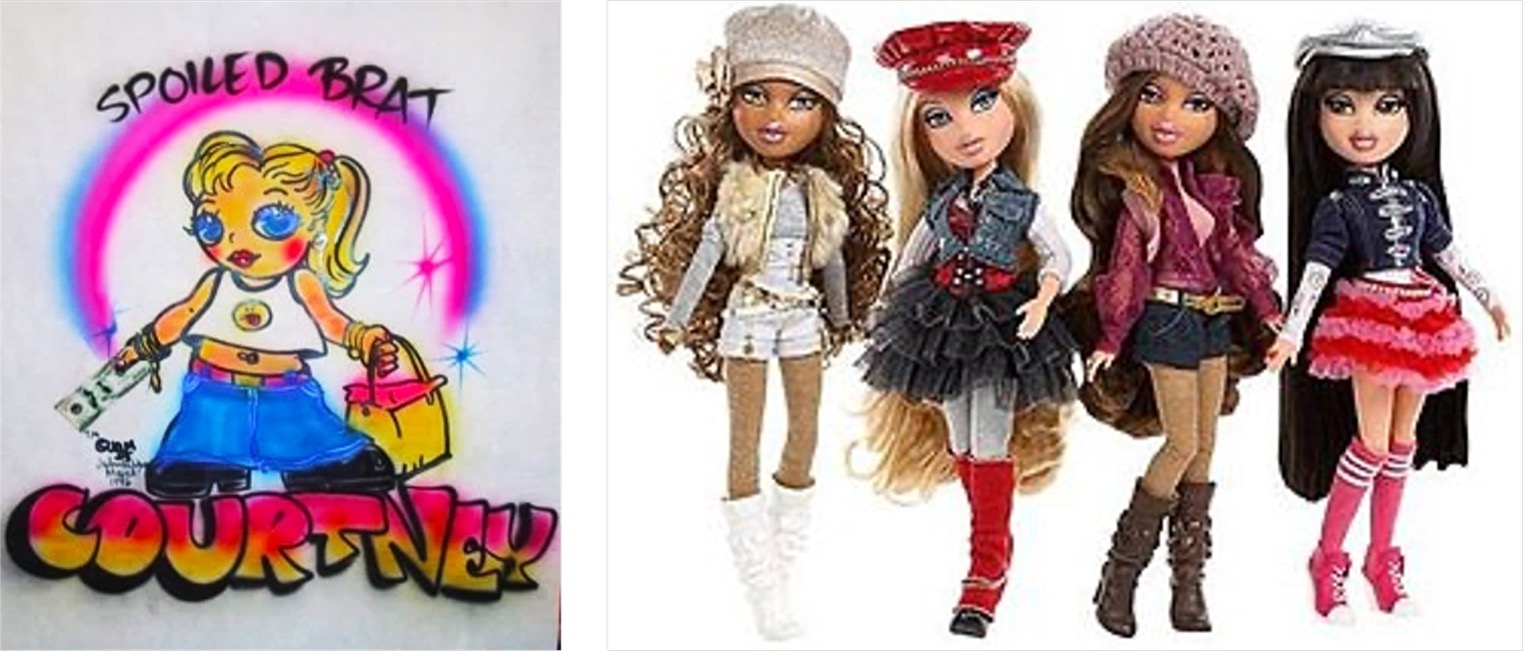
Image description: Left: A colorful cartoon of a blonde girl labeled “Spoiled Brat Courtney,” wearing sunglasses, a crop top, and blue jeans, holding cash in one hand and a pink shopping bag in the other, with a neon circle background. Right: Four Bratz dolls dressed in fashionable, edgy outfits with hats, skirts, boots, and high heels, each with distinct hairstyles and poses.
Notes and questions
(1) In Gaste v. Kaiserman 863 F.2d 1061 (2d 1988), the plaintiff, Gaste, alleged that the defendant, Kaiserman, copied his song “Pour Toi” to create the hit song “Feelings,” claiming that Kaiserman gained access to the song through a third-party music publisher, despite the defendant’s denial of ever hearing the song prior to the litigation. Although the court emphasized that a “reasonable opportunity” to access the work is required, rather than just a bare or speculative possibility, it held that the jury could reasonably conclude that the defendant, Kaiserman, had access to Gaste’s song “Pour Toi” through Lebendiger, who had a connection to both parties. Moreover, the court was not troubled by long span of time and geography separating the works. The court concluded that “although Gaste’s theory of access relies on a somewhat attenuated chain of events extending over a long period of time and distance, we cannot say as a matter of law that the jury could not reasonably conclude that Kaiserman had access to the song through Lebendiger.”
Why was the plaintiff’s argument in Gaste stronger than in Art Attacks? What does this tell you about the difference between a reasonable opportunity of access and bare or speculative possibility?
(2) Does posting to social media give the whole world a reasonable opportunity of access? The Ninth Circuit said no in Woodland v. Hill, 136 F.4th 1199 (9th Cir. 2025). A photographer alleged that the recording artist Montero Lamar Hill, who performs as Lil Nas X, had imitated twelve of his photographs. His theory of access was that both men posted to Instagram, that their work fell within the same narrow sub-genre, and that Instagram’s recommendation algorithm would therefore have put his photographs in front of Hill. The court accepted that digital platforms could in principle make access easier to establish, but only where a plaintiff can show a reasonable chance that the defendant would actually have encountered the work given the platform’s algorithm or content-sharing policy. That was a large qualification, and the plaintiff could not satisfy it. Instagram has more than a billion users and far more posts; the fact that the defendant used the platform and the photographs were on it established no more than a bare possibility. The algorithmic theory was speculation, because nothing in the material offered showed that similarity of profile content alone would cause Instagram to promote one user’s posts to another, and there was no allegation that Hill had followed, liked, or otherwise interacted with the plaintiff’s account or anything like it. The court expressly declined to say what a plaintiff would need to plead about a platform’s algorithm to get over the line.
The plaintiff also argued that the sheer number of allegedly imitated photographs — twelve, not one — itself suggested access. The court disagreed, and the answer is worth remembering: the existence of multiple similar works does not prove access. That is a similarity argument wearing an access costume, and it belongs, if anywhere, in the striking similarity analysis considered below.
Striking similarity
What if the plaintiff does not have evidence that the defendant had a reasonable opportunity to view the work but there was a very high degree of similarity between the works? In such cases of “striking similarity” some courts take the view that the similarity between the works becomes its own evidence of access. Courts accept in effect that the similarities between A and B are such that the only plausible explanation is copying in fact. These cases are unusual. As the Seventh Circuit observed in Selle v. Gibb, 741 F.2d 896 (7th Cir. 1984), an inference of access may arise from “proof of similarity which is so striking that the possibilities of independent creation, coincidence and prior common source are, as a practical matter, precluded.” But note that in that case the court was careful to point out that a prior common source for both plaintiff’s and defendant’s work could undermine an inference of copying. In a later Seventh Circuit case, Design Basics, LLC v. Lexington Homes, Inc., 858 F.3d 1093 (7th Cir. 2017), the court summarized:
So in the rare case involving an uncanny resemblance for which copying the plaintiff’s work is the only plausible explanation, further proof of access may not be required. But in general, to prove a circumstantial case of copyright infringement, the plaintiff must separately prove both access and similarity. (emphasis added).
Note that Design Basics indicates the threshold for striking similarity is high, it applies to “rare case involving an uncanny resemblance.”
Unicolors, Inc. v. Urban Outfitters, Inc., 853 F.3d 980 (9th Cir. 2017) illustrates striking similarity at work. In that case, Unicolors, a Los Angeles-based fabric design company, held a copyright in a fabric design called PE1130. Between 2008 and 2011, Unicolors sold about 14,000 yards of fabric with this design. In 2010, Urban Outfitters developed a dress using a fabric design that Unicolors alleged was similar to its PE1130 design. The district court determined that there was insufficient evidence to conclude on summary judgment that the Subject Design had been widely disseminated. But it concluded that such evidence was unnecessary because on its analysis, the works were strikingly similar. The court of appeals agreed:
We conclude that a district court may grant summary judgment for plaintiffs on the issue of copying when the works are so overwhelmingly similar that the possibility of independent creation is precluded. The works at issue in this case meet this standard. The objective similarities between the works are stark: the shapes, motifs, arrangements, spacing, and colors of the images in each design are nearly identical. Because of the decisive objective overlap between the works, no reasonable juror could conclude under the intrinsic test that the works are not substantially similar in total concept and feel. Therefore, the district court properly granted summary judgment.
Wrongful Copying (a.k.a Improper Appropriation)
The role of experts in wrongful copying
The ordinary observer test for substantial similarity is applied by conducting a side-by-side comparison of the two works, but that does not always make sense. Consider a novel written in English and an alleged copy written in French. These works don’t lend themselves to side-by-side comparison and statistically, a person who is fluent in both English and French is extraordinary, not ordinary. A simple side-by-side comparison also doesn’t make sense if there are important similarities that relate to unprotectable elements within the works. Thus, even when courts determine substantial similarity with respect to the ordinary observer, they usually supercharge that hypothetical observer with enormous powers of discernment.
The ordinary observer standard has led to undue rigidity on the use of experts in copyright litigation. Using experts to determine the reaction of the ordinary observer strikes many courts as a non sequitur. Most famously, in Arnstein v. Porter, 154 F.2d 464 (2d Cir. 1946), the Second Circuit said that analytical dissection of the two works in issue was relevant to establish copying in fact and thus “the testimony of experts may be received to aid the trier of the facts.” But, on the issue of wrongful copying—the court used the terms “illicit copying” and “unlawful appropriation”—the court said:
On that issue [wrongful copying] the test is the response of the ordinary lay hearer; accordingly, on that issue, ‘dissection’ and expert testimony are irrelevant.
This seems wrong. The simple fact is that there is nothing ordinary about the ordinary observer. The ordinary observer is not a person to be found and interviewed by the court; it is a legal construct, a lens to be applied when comparing A to B to determine substantial similarity. There are very few cases where the finder of fact would not be assisted by some expert instruction as to what to look for and what to listen for in the comparison of A to B. Moreover, in cases where the subject matter is complex, technical, or simply foreign to the average juror, expert dissection and analysis will be the only relevant criteria.
As the Northern District of Illinois explained in Francescatti v. Germanotta, No. 11 CV 5270, 2014 WL 2767231, at *8 (N.D. Ill. June 17, 2014):
Although dissection and expert testimony is not favored, the judicially created ordinary observer test should not deprive authors of this significant statutory grant merely because the technical requirements of a different medium dictate certain differences in expression. Without deciding the question, we note that in some cases it may be important to educate the trier of fact as to such considerations in order to preserve the author’s rights under the Copyright Act.
Why are courts so hostile to the use of experts in assisting with the analysis of wrongful copying? Partly this is a mistrust born of experience. On the plaintiff’s side, experts will note every conceivable similarity and explain why those similarities are what is really important about the works and why the objective dissimilarities are of no consequence.
In the Ninth Circuit, the extrinsic-intrinsic test allows for expert evidence on the issue of substantial similarity in the objective “extrinsic” part of the analysis. That seems preferable to the more doctrinaire position in the Second Circuit.
The Abstraction, Filtration, and Comparison Test
In Computer Associates Intern., Inc. v. Altai, Inc., 982 F.2d 693 (2d Cir. 1992), the Second Circuit recognized that the ordinary observer test generally applied to determine substantial similarity was unlikely to be of much use in the context of computer software. At 713, the court said:
… in deciding the limits to which expert opinion may be employed in ascertaining the substantial similarity of computer programs, we cannot disregard the highly complicated and technical subject matter at the heart of these claims. Rather, we recognize the reality that computer programs are likely to be somewhat impenetrable by lay observers — whether they be judges or juries — and, thus, seem to fall outside the category of works contemplated by those who engineered the Arnstein test.
In place of an ordinary observer test, the court announced an approach that has become known as the “abstraction, filtration, and comparison” test. The AFC test is widely used in computer software cases and occasionally in other contexts.
As its name suggests, the AFC test has three steps. As the court explained in Computer Associates:
… we think that district courts would be well-advised to undertake a three-step procedure, based on the abstractions test utilized by the district court, in order to determine whether the non-literal elements of two or more computer programs are substantially similar. This approach breaks no new ground; rather, it draws on such familiar copyright doctrines as merger, scènes à faire, and public domain. …
In ascertaining substantial similarity under this approach, a court would first break down the allegedly infringed program into its constituent structural parts. Then, by examining each of these parts for such things as incorporated ideas, expression that is necessarily incidental to those ideas, and elements that are taken from the public domain, a court would then be able to sift out all non-protectable material. Left with a kernel, or possible kernels, of creative expression after following this process of elimination, the court’s last step would be to compare this material with the structure of an allegedly infringing program. The result of this comparison will determine whether the protectable elements of the programs at issue are substantially similar so as to warrant a finding of infringement.
Using this AFC approach, the court was able to set aside similarities based on high-level abstractions, standard programming techniques, and any aspects of the software that would have been dictated by external factors. Without this kind of systematic dissection, courts would be far too quick to conclude that two programs performing the same function in the same environment were substantially similar.
Special Considerations Relating to Music
Dual protection for musical works and sound recordings
Copyright law draws a distinction between musical works—which we can broadly think of as composition—and sound recordings, the work that results from fixing a performance of a musical work into a material object such as magnetic tape or some kind of digital storage device. Musical works and sound recordings are both now protected by copyright law, although that has not always been the case. Musical works have been part of copyright since 1831, sound recordings did not become subject to copyright protection in the United States until 1972.
In lay terms you might think of an LP or a CD as a sound recording, but in copyright law the physical medium is a “phonorecord” and the abstract work encoded in that medium is the sound recording. In other words, the phonorecord is the vessel and the sound recording is the content. What makes this terminology even more confusing is that the phonorecord contains both a copy of the sound recording and of the underlying musical work or composition. The Copyright Act defines sound recordings and phonorecords, but not “musical works.”
17 U.S. Code § 101 - Definitions
“Sound recordings” are works that result from the fixation of a series of musical, spoken, or other sounds, but not including the sounds accompanying a motion picture or other audiovisual work, regardless of the nature of the material objects, such as disks, tapes, or other phonorecords, in which they are embodied.
“Phonorecords” are material objects in which sounds, other than those accompanying a motion picture or other audiovisual work, are fixed by any method now known or later developed, and from which the sounds can be perceived, reproduced, or otherwise communicated, either directly or with the aid of a machine or device. The term “phonorecords” includes the material object in which the sounds are first fixed.
Commentators often point to the dual protection of music as something of an oddity, after all, novels and motion pictures are each protected by only a single copyright. The oddity is partly historical, but it also reflects an important distinction between different kinds of creative contributions. A musical composition is literally an instruction on how to perform a piece of music. Those instructions can be quite detailed, or somewhat bare bones. Either way, the composition defines the essence of the song and provides more than enough detail to justify copyright protection, but it still leaves room for each performer to express the song their own particular way. Copyright in the musical work accrues to the author of the original song, having a separate copyright in the sound recording provides a narrow exclusive right with respect to a particular recorded performance of the music work.
For example, Jimi Hendrix’s recording of All Along the Watchtower is widely considered to be the definitive version of that song. All Along the Watchtower was originally written and recorded by Bob Dylan. Dylan and Hendrix have distinctive voices and musical styles, but the difference in the recordings goes deeper than this: the Hendrix recording is dominated by a powerful electric guitar sound and multilayered production that gives it a different, arguably more urgent, feel. So perhaps the dual nature of musical copyright is not so odd after all: by providing a separate copyright for sound recordings, copyright law recognizes those contributions and gives musical performers and producers who create a distinctive sound a separate copyright in that production.
Differences between the rights that accrue to musical works and to sound recordings
Sound recording copyright is quite different to musical work copyright. For reasons discussed in a later chapter, there is no general public performance right for sound recordings, only a more limited right for public performance by a “digital audio transmission” which is primarily relevant to the Internet radio and satellite radio. Compare Section 106(4) to section 106(6) of the Copyright Act.
As a result, when the Hendrix version of All Along the Watchtower is played on terrestrial AM/FM radio, only Bob Dylan gets paid. However, when the Hendrix version is played via Internet radio, such as Pandora or Spotify, the copyright owner of the sound recording also gets paid.
Unfortunately, it gets even more complicated. Although sound recordings have existed since the 19th century, they were only made the subject of federal copyright in the United States in 1972. The 1972 law was forward looking and did not grant retrospective protection to recordings prior to February 15, 1972. However, Congress extended copyright protection to pre-1972 sound recordings in the “Classics Protection and Access Act” which was passed as part of the Music Modernization Act of 2018. The method Congress chose to achieve this objective adds some additional complexity to the structure of the Copyright Act. The CPA Act adds a new chapter to the Copyright Act (Section 1401) that provides that the unauthorized use of a sound recording fixed before February 15, 1972 shall be subject to the same remedies as any other form of copyright infringement. Section 1401 of the Act puts pre- and post-1972 sound recordings on an equal footing, but it does not extend a general performance right to sound recordings.
In addition to having a separate and more limited public performance right, sound recordings are also different to musical works in terms of the reproduction right. Section 114(b) limits the scope of the reproduction right in sound recordings to the reproduction of “the actual sounds fixed in the sound recording.” Accordingly, even a “sound alike” recording that was intended to exactly mimic the original sound recording will not infringe the rights of the sound recording. Samples and literal copies in various media still count as copies of the sound recording, but even deliberate imitation in a new recording or performance is considered fair game.
The Seventh Circuit put that limitation to work in Richardson v. Kharbouch, Nos. 24-1119 & 24-2378 (7th Cir. Oct. 16, 2025). Eddie Richardson created a hip-hop beat, “Hood Pushin Weight,” at sixteen, and registered it as a sound recording. He later heard what he believed to be his beat in “Ain’t Worried About Nothin,” recorded by Karim Kharbouch, who performs as French Montana. The difficulty was that Richardson had registered a sound recording and not the underlying musical composition. Affirming summary judgment for the defendants, the court held that a sound recording plaintiff must produce evidence of actual duplication of the recorded sounds themselves; imitation of the composition, however close, will not do. As the court put it, § 114(b) leaves “the world at large … free to imitate or simulate the creative work fixed in the recording so long as an actual copy of the sound recording itself is not made.” Because Richardson had no evidence that anyone had sampled his recording, his claim failed. The case is a reminder that the choice of what to register is not a formality: it determines what the plaintiff must later prove.
What is more, section 115 of the Copyright Act contains a compulsory license which allows any performer to record a new version of a musical work, provided that the song has already been commercially recorded. The compulsory cover license provision has enabled a great deal of creativity over the years, but it also has a troubling racial history. It was common practice in the early 20th century for white producers and record labels to use white musicians to record more or less exact copies of performances by black artists. At the time, White Americans would eagerly consume White “Pop” music but not “Race records.” For more, see Robert Brauneis, Copyright, Music, and Race: The Case of Mirror Cover Recordings ( https://ssrn.com/abstract=3591113); Kevin J. Greene, Thieves in the Temple: The Scandal of Copyright Registration and African-American Artists, 49 Pepperdine Law Review 615 (2022).
Section 115 now has two limbs. The original compulsory cover license still works song by song: a would-be recording artist serves a notice, records the work, and pays a statutory rate. But most music is now streamed rather than sold, and serving separate notices for tens of millions of works was never going to be practical. The Music Modernization Act of 2018 therefore added a blanket license for digital music providers, covering all musical works available for mechanical licensing at once.
Administering it required a new institution. The Act directed the Register of Copyrights to designate a Mechanical Licensing Collective to run the blanket license: to build and maintain the database matching sound recordings to the musical works embodied in them, to collect royalties from the streaming services and distribute them to songwriters and publishers, and to hold unmatched royalties until their owners are identified. The rates themselves are not negotiated but set by the Copyright Royalty Board in periodic proceedings, which is why arguments about mechanical royalties tend to be arguments about regulatory definitions rather than about contracts.
Mechanical Licensing Collective v. Spotify USA Inc., 763 F. Supp. 3d 608 (S.D.N.Y. 2025), shows what that looks like in practice. Spotify Premium had offered unlimited music streaming; in November 2023 Spotify added fifteen hours of audiobook listening a month, without changing the price. In March 2024 it launched a separate audiobooks-only plan, and began reporting Premium as a “Bundled Subscription Offering” rather than a standalone “Subscription Offering” — a reclassification that carries a materially lower royalty, and which the Collective said would cost the music industry some $150 million in the first year alone.
The Collective argued that Spotify had manufactured a bundle for royalty purposes: that audiobook access was not really an “other product or service” within the regulatory definition, and that in any event it had no more than “token value”, since Spotify had originally added it without raising the price. Judge Torres rejected both arguments and dismissed the complaint. The regulation says “other products or services”, not other preexisting or separately sold products or services, and the court declined to read words into it that Congress and the Copyright Royalty Board had not used. Fifteen hours of audiobooks a month was more than token. On the Collective’s own pleaded facts, Premium was a bundle. The Collective moved for reconsideration and lost on that point: the court had not overlooked its allegation that Spotify had previously certified Premium as a standalone offering, but had rejected it as irrelevant. It did reopen the case, to let the Collective seek leave to replead two different claims — that Spotify underpaid on the audiobooks-only plan, and that it miscalculated Premium’s royalties by treating that plan’s price as the standalone value of the non-music component. Both assume the classification holding rather than challenge it.
The case is a useful corrective to the intuition that a compulsory license removes bargaining from the picture. It does remove price negotiation. What it puts in its place is a contest over how a service describes itself, decided by reference to regulatory definitions — and, on these facts, decided against the collective that Congress created to protect songwriters.
The scope of rights in musical works
The preceding discussion is premised on the notion that there is a clear distinction between musical composition and musical performance. This distinction has been challenged by some academic commentators.
Copyright law has generally assumed that musical works should be primarily defined in terms of melody, rhythm, and harmony, but with a central emphasis on melody. This history is extensively reviewed by Professor Joseph Fishman who summarizes: “Throughout much of its history, copyright law has seemingly adopted a fragmented version of pure sonicism. The musical work as legal object amounts not even to a combination of melody, rhythm, and harmony, but more narrowly to melody in particular.” See Joseph Fishman, Music as a Matter of Law, 131 Harvard Law Review 1861 (2018).
Copyright’s traditional focus on melody, and to a lesser extent rhythm and harmony, reflects traditional Western views about music, and it fits comfortably with the archetype of song creation beginning with a single instrument (usually a piano or a guitar). Several commentators have noted the racial and cultural implications of a conception of music that privileges some types of music over others, and some types of musicians over others.
The traditional view, reflected in all but a few cases, means that copyright in a musical work is limited to aspects of melody, rhythm, and tempo and the like that would ordinarily be found in sheet music. See e.g. D’Almaine v. Boosey, (1835) 160 Eng. Rep. 117 (Ex.) (holding that merely rearranging an opera score did not excuse copying because “it is the air or melody which is the invention of the author, and which may in such case be the subject of piracy”); Northern Music Corp. v. King Record Distributing Co., 105 F. Supp. 393, 400 (S.D.N.Y. 1952) (“It is in the melody of the composition — or the arrangement of notes or tones that originality must be found. It is the arrangement or succession of musical notes, which are the finger prints of the composition, and establish its identity.”)
But note that the musical work is not just the primary melody, in Fred Fisher, Inc. v. Dillingham 298 F. 145 (S.D.N.Y. 1924), Judge Hand explained that infringement could occur from copying “any substantial component part, either in melody or accompaniment” and held the defendant liable for copying an accompaniment motif known as an ostinato, rather than the main melodic line. An ostinato is a bit like a bassline, but not the same thing. An ostinato is a repeated musical pattern or phrase, which can occur in any part of the music, in any voice or instrument. A bassline is a sequence of notes played in the lower register (bass), usually outlining the harmonic structure of a piece of music. While a bassline can be repetitive, it doesn’t have to be, so not all basslines are ostinatos. Sheet music contains tempo, key, and key signature, as well, but focusing on these elements would usually be unduly limiting on the scope of the right.
Copyright in Musical Style?
The composition-focused view of the scope of musical works leaves out a great deal that one hears in a typical sound recording. On this view, instrumentation, production techniques, distinctive vocal qualities and timbres (timbre is the character or quality of a musical sound or voice as distinct from its pitch and intensity) are not part of the musical work copyright, although they are entitled to the copyright protection against mechanical reproduction as part of the sound recording right.
The importance of the distinction between musical composition and performance is highlighted by the “Blurred Lines” case. As mentioned in a previous chapter, Blurred Lines is a polarizing case study because many key stylistic features of Got To Give It Up were so blatantly copied by Robin Thicke and Pharrell Williams, and yet, no specific melody, harmony, rhythm or lyrics were actually copied at all. The two songs have similar basslines, a similarly sparse arrangement, a syncopated cowbell rhythm, very similar instrumentation, handclaps and similar vocal style. These similarities seem to have been intentional, but they should not have been enough to sustain a finding of infringement. The vocal qualities, instrumentation and syncopated cowbell and other similarities which make the songs sound so similar are aspects of performance and should not be thought of as part of the copyright in the underlying musical work.
The division between sound recording rights and the rights in the underlying musical composition is not an unfortunate accident. It provides an important source of protection for performers—if their performances are recorded, they cannot be mechanically reproduced without permission—but it also ensures that other performers are free to adopt the same styles, techniques and grooves in new musical works without fear of liability. Without this distinction, the idea-expression distinction would be seriously compromised in the realm of popular music.
Professor Sean O’Connor argues for a broader conception of the musical work that would secure exclusive rights in many stylistic aspects of performance, such as the sounds and impressions created by new devices and performing techniques. O’Connor argues that AI music generators are based on distinct musical styles and thus these styles are sufficiently valuable and specific to merit copyright protection. See, Sean M. O’Connor, AI Replication of Musical Styles Points the Way to an Exclusive Rights Regime, in Research Handbook on Intellectual Property and Artificial Intelligence 65 (Ryan Abbott ed., 2022).
O’Connor actually makes two distinct arguments about musical style. His more modest claim is that stylistic elements within a specific work, such as the vocal style and instrumentation in a particular song, could be annotated in a complete orchestral score and are thus legitimately within the scope of musical work copyright. He calls this “compositional performative style” and argues that by failing to protect “compositional performative style” modern copyright law is merely “privilege the creative contributions of only some kinds of composers—those working well within the Western classical music derived mode of composition abstracted from performative aspects and style—and not others.” O’Connor also argues protecting compositional performative style would bring the law into harmony with market realities and modern production techniques. He points out that pop music today is composed with the groove, sound, and beat first with lyrics and melody often added as an afterthought and that it is often the techniques used to produce a unique sound that are the true innovation. O’Connor’s even bolder claim is that the law should recognize a proprietary style that emerges not just from a single work, but across a collection of works, perhaps even a collection of works spanning a long timescale and different producers and collaborators.
In Music as a Matter of Law, Joe Fishman also notes that the traditional melody focused view of musical works in copyright law is out of step with modern production techniques and modern views about music. But Fishman argues that despite this, for pragmatic reasons, copyright in musical works should be limited to melody and should not include musical style and performance elements. Fishman both concedes and claims too much. A more reasonable position, the position that the caselaw seems to adopt by and large, is that we should understand the musical work as being comprised of those musical elements that would be reproduced in a standard form of composition. That certainly places melody front and center, but it does not suggest an exclusive focus on melody. Fishman concedes too much because the reasons to continue to understand the musical work as elements that would be reproduced in a standard form of composition go beyond simple pragmatism. It relates back to the most fundamental axiom of copyright, the distinction between ideas and expression. Protecting musical style would grant protection at an unhealthy level of generality. The law should not preempt other artists from using a given combination of stylistic elements to create an entirely new work of music.
The traditional distinction between musical composition and performance in copyright leaves the ineffable qualities of personality captured in performance to the right of publicity. In Midler v. Ford Motor Co., 849 F.2d 460, 463 (9th Cir.1988), the Ninth Circuit held that “when a distinctive voice of a professional singer is widely known and is deliberately imitated in order to sell a product, the sellers have appropriated what is not theirs and have committed a tort in California.” See also, Waits v. Frito-Lay, Inc., 978 F.2d 1093 (9th Cir. 1992). Copyright’s traditional distinction between musical composition and performance places innovations in style and technique in the public domain where they belong by virtue of the idea-expression distinction. O’Connor’s proposal for protecting compositional performative style separate from melody flies in the face of the idea-expression distinction. Popular musical styles and techniques should be copied, that is how new genres of music emerge.
The idea-expression distinction is also key to understanding why giving exclusive rights to a broader concept of musical style that emerges across a series of works is untenable. Personality and reputation are emergent properties that develop across an artist’s career, and these are protected by laws in relation to the right of publicity and defamation. However, copyright protects the author’s interests in relation to singular works. Any concept of musical style that can only be identified by considering several works collectively seems far too abstract to merit copyright protection.
Registration and the scope of copyright in musical works
Another reason why no infringement should have been found in Williams v. Gaye is that even if one could mount a theoretical argument that Marvin Gaye’s specific choices regarding instrumentation could have been brought within the scope of the musical work copyright by registering a more elaborate musical notation, this did not in fact transpire. The version of Got To Give It Up registered with the Copyright Office was not a fully realized orchestral score, or even a standard piece of sheet music, it was merely a lead sheet identifying the very basics of the composition. This is significant because when Marvin Gaye first recorded Got To Give It Up, copyright still required registration in advance of publication, registration in turn required deposit, and deposit had to be in the form of written notation, i.e., some form of sheet music. Registration with the Copyright Office was a prerequisite to obtaining federal copyright protection under the Copyright Act of 1909 and previous U.S. copyright acts. Voluntary publication of a work without noticeable registration would make you ineligible for copyright protection and thus permanently consign it to the public domain. The registration requirement had a special significance for musical works because, until 1978, the only form of the work that the Copyright Office would accept for registration was written notation, i.e., sheet music.
Once upon a time it was common practice for music publishers to submit only a stripped-down lead sheet for registration and deposit thus leaving out chord voicings, voice leading, bass line or other aspects of accompaniment. This practice combined with the registration requirement meant that any aspect of a song that was not recorded in the written notation was not part of the song’s copyright. This has proved to be particularly problematic for composers who did not read or write sheet music and thus relied on others to correctly record the full scope of their works. In 2020, the Ninth Circuit took up this issue (among others) in Skidmore v. Led Zeppelin. The extract that follows addresses the deposit issue and also the portion of the court’s reasoning relating to the originality instructions given to the jury.
Skidmore v. Led Zeppelin, 952 F.3d 1051 (9th Cir. 2020) (En Banc)
Sheet Music for Taurus by Randy Wolfe
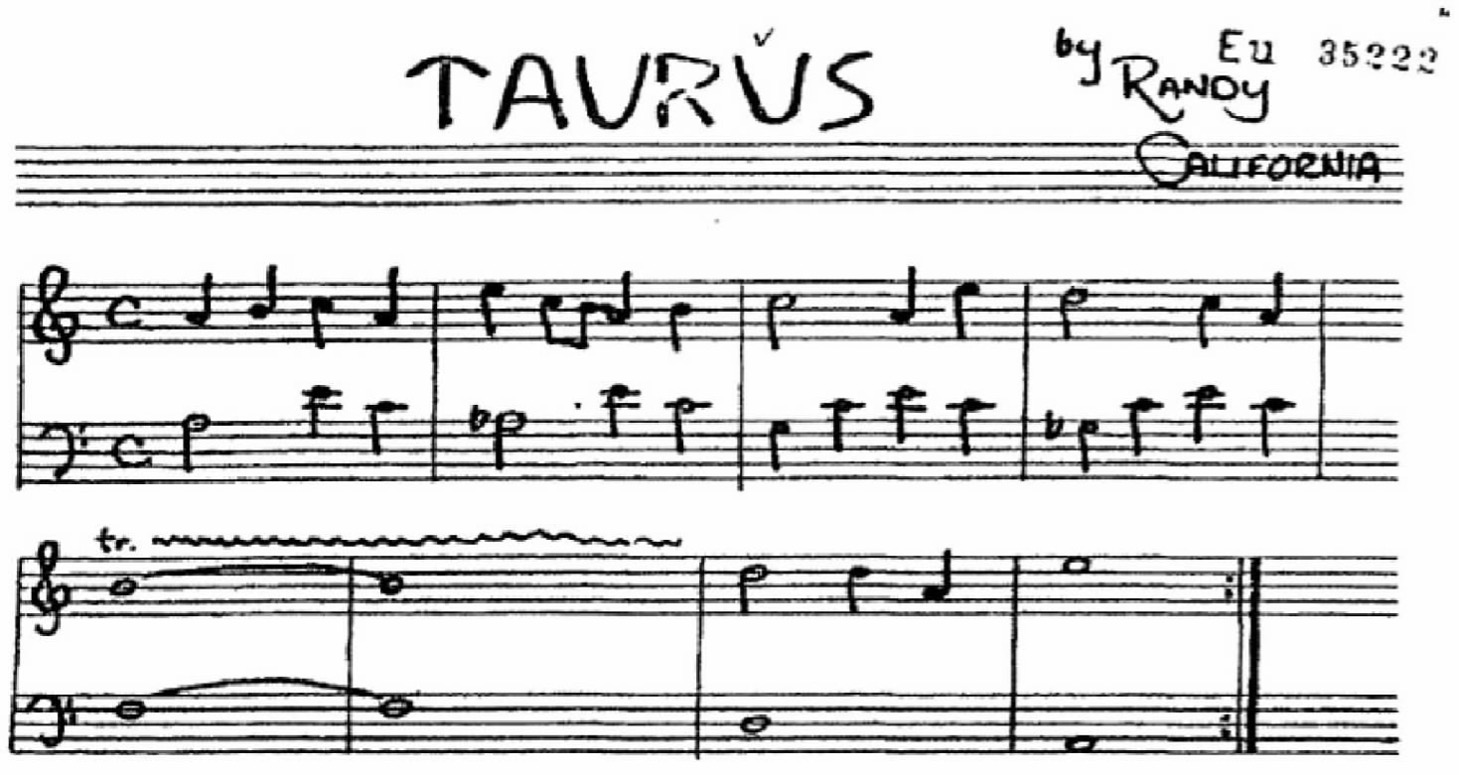
Image description: A handwritten sheet of music titled “Taurus” by Randy California. The score shows treble and bass clefs with musical notes and symbols, including a trill marking. The manuscript is in black ink on white paper, with the title written in large letters at the top center and the composer’s name in the upper right corner.
McKeown, Circuit Judge:
Stairway to Heaven has been called the greatest rock song of all time. Yet, hyperbole aside, nearly 40 years after the English rock band Led Zeppelin released its hit recording, the song is not impervious to copyright challenges. The estate of guitarist Randy Wolfe claims that Led Zeppelin and its guitarist Jimmy Page and vocalist Robert Plant copied portions of Taurus, a song written by Wolfe and performed by his band Spirit.
BACKGROUND
Randy Wolfe, professionally known as Randy California, wrote the instrumental song Taurus in 1966 or 1967. He was a guitarist in the band Spirit. Spirit signed a recording contract in August 1967 and released its first eponymous album—which included Taurus—a few months later. Wolfe also entered into an Exclusive Songwriter’s and Composer’s Agreement with Hollenbeck Music Co. (“Hollenbeck”). In December 1967, Hollenbeck registered the copyright in the unpublished musical composition of Taurus, listing Wolfe as the author. As required for registration of an unpublished work under the 1909 Copyright Act, which was in effect at the time, Hollenbeck transcribed Taurus and deposited one page of sheet music (the “Taurus deposit copy”), with the United States Copyright Office.
Around the same time, across the Atlantic, another rock band, Led Zeppelin, was formed by Jimmy Page, Robert Plant, John Paul Jones, and John Bonham. Led Zeppelin released its fourth album in late 1971. The untitled album, which became known as “Led Zeppelin IV,” contained the now iconic song Stairway to Heaven. Stairway to Heaven was written by Jimmy Page and Robert Plant.
It is undisputed that Spirit and Led Zeppelin crossed paths in the late 1960s and the early 1970s. The bands performed at the same venue at least three times between 1968 and 1970. Led Zeppelin also performed a cover of a Spirit song, Fresh Garbage. But there is no direct evidence that the two bands toured together, or that Led Zeppelin band members heard Spirit perform Taurus.
Wolfe passed away in 1997. After his death, Wolfe’s mother established the Randy Craig Wolfe Trust (the “Trust”) and served as the trustee until she passed away. Neither Wolfe nor his mother filed a suit regarding Stairway to Heaven. Michael Skidmore became a co-trustee of the Trust in 2006.
Fast forward forty-three years from the release of Stairway to Heaven to May 2014. Skidmore filed a suit alleging that Stairway to Heaven infringed the copyright in Taurus, naming as defendants Led Zeppelin, James Patrick Page, Robert Anthony Plant, John Paul Jones, Super Hype Publishing, and the Warner Music Group Corporation as parent of Warner/Chappell Music, Inc. (“Warner/Chappell”), Atlantic Recording Corporation, and Rhino Entertainment Co. (collectively “Led Zeppelin”). One may wonder how a suit so long in the making could survive a laches defense. The Supreme Court answered this question in Petrella v. Metro-Goldwyn-Mayer, Inc., which clarified that laches is not a defense where copyright infringement is ongoing. 572 U.S. 663, 668 (2014).
Skidmore alleged direct, contributory, and vicarious copyright infringement. He also sought equitable relief for a claim that he titled “Right of Attribution—Equitable Relief—Falsification of Rock n’ Roll History.” Skidmore’s claims are not based on the entire Taurus composition. Rather, Skidmore claims that the opening notes of Stairway to Heaven are substantially similar to the eight-measure passage at the beginning of the Taurus deposit copy:
The claimed portion includes five descending notes of a chromatic musical scale. These notes are represented on the piano as a set of adjacent black and white keys, from right to left. The beginning of Stairway to Heaven also incorporates a descending chromatic minor chord progression in A minor. However, the composition of Stairway to Heaven has a different ascending line that is played concurrently with the descending chromatic line, and a distinct sequence of pitches in the arpeggios, which are not present in Taurus.
Led Zeppelin disputed ownership, access, and substantial similarity. Led Zeppelin also alleged affirmative defenses, including independent creation, unclean hands, and laches.
At the close of discovery, Led Zeppelin moved for summary judgment. The district court granted the motion in part and denied it in part [and] ruled that under the 1909 Act, the scope of the copyright was circumscribed by the musical composition transcribed in the Taurus deposit copy. Thus, only the one-page Taurus deposit copy, and not a sound recording, could be used to prove substantial similarity between Taurus and Stairway to Heaven.
The district court granted Led Zeppelin’s motion in limine to exclude Taurus sound recordings and expert testimony based on those recordings. The district court again concluded that the Taurus deposit copy, rather than any recordings of Spirit’s performance of Taurus, formed the sole benchmark for determining substantial similarity. The district court found that there were triable issues of fact relating to ownership, access, substantial similarity, and damages.
Against the backdrop of these rulings, the trial lasted five days. Two key issues predominated: access to Taurus by Led Zeppelin band members and substantial similarity.
On the access question, the district court allowed Skidmore to play various sound recordings of Taurus for Page outside of the presence of the jury. Skidmore then examined Page on access in front of the jury. Page testified that he owned “a copy of the album that contains ‘Taurus,’ ... in [his] collection,” while denying “any knowledge of ‘Taurus.’”
The substantial similarity question pitted two expert musicologists against each other. Skidmore’s expert, Dr. Alexander Stewart, analyzed, one by one, five categories of similarities. Dr. Stewart acknowledged that a chromatic scale and arpeggios are common musical elements. But he found Taurus and Stairway to Heaven to be similar because the descending chromatic scales in the two compositions skip the note E and return to the tonic pitch, A, and the notes in the scale have the same durations. Then he pointed to three two-note sequences—AB, BC, and CF#—that appear in both compositions. In his view, the presence of successive eighth-note rhythms in both compositions also made them similar. Finally, he testified that the two compositions have the same “pitch collection,” explaining that certain notes appear in the same proportions in the beginning sequence of both works.
In sum, Dr. Stewart claimed that five musical elements in combination were copied because these elements make Taurus unique and memorable, and these elements also appear in Stairway to Heaven. Skidmore’s closing argument reinforced these points. Neither Dr. Stewart nor Skidmore’s counsel argued that the categories of similarities were selected and arranged to form protectable expression in the design, pattern, or synthesis of the copyrighted work. Nor did they make a case that a particular selection and arrangement of musical elements were copied in Stairway to Heaven.
Led Zeppelin’s expert, Dr. Lawrence Ferrara, testified that the two compositions are completely distinct. To highlight the marked differences in the compositions, he presented the following exhibit, which juxtaposed the claimed portion of Taurus against Stairway to Heaven:
Dr. Ferrara testified that the similarities claimed by Skidmore either involve unprotectable common musical elements or are random. For example, Dr. Ferrara explained that the similarity in the three two-note sequences is not musically significant because in each song the sequences were preceded and followed by different notes to form distinct melodies. He described the purported similarity based on these note sequences as akin to arguing that “crab” and “absent” are similar words because they both have the letter pair “ab.” He also testified that the similarity in the “pitch collection” is not musically meaningful because it is akin to arguing that the presence of the same letters in “senator” and “treason” renders the words similar in meaning.
At the close of trial, the district court discussed with counsel the intended jury instructions. The district court did not give the proposed instructions on the inverse ratio rule and the selection and arrangement of unprotectable elements. Skidmore objected to the district court’s decision to omit an inverse ratio instruction but did not do so as to the omitted selection and arrangement instruction.
The jury returned a verdict for Led Zeppelin. In special interrogatories, the jury found that Skidmore owned the copyright to Taurus and that Led Zeppelin had access to Taurus, but that the two songs were not substantially similar under the extrinsic test. Following the verdict, the district court entered a judgment and an amended judgment. Skidmore did not file any post-judgment motions challenging the verdict, but timely appealed from the amended judgment.
Significantly, Skidmore does not make a substantial evidence claim. Instead, he focuses on a handful of legal issues, challenging: (1) the ruling that substantial similarity must be proven using the copyright deposit copy; (2) the ruling that sound recordings could not be played to prove access; [and others].
A panel of our court vacated the amended judgment in part and remanded for a new trial. We granted rehearing en banc.
ANALYSIS
I. THE 1909 COPYRIGHT ACT
The world of copyright protection for music changed dramatically during the twentieth century and those changes dictate our analysis here. The baseline issue we address is the scope of Wolfe’s copyright in the unpublished composition Taurus, which was registered in 1967, between the passage of the Copyright Act of 1909 (“1909 Act”) and the sweeping copyright reform adopted in the Copyright Act of 1976 (“1976 Act”).
[The court went into some detail on the evolution of copyright’s treatment of music and noted that although musical compositions have been part of copyright since 1831, sound recordings did not become subject to copyright protection until 1972. The court also explained that due to the formalities requirements of the 1909 Copyright Act, the rights of the author of a musical composition were limited to the musical composition as it was transcribed in the deposit copy. This changed significantly under the 1976 Copyright Act—the new Act allowed composers to submit a recording rather than sheet music as the deposit copy for a musical composition—but those changes were not retrospective.]
… B. THE TAURUS DEPOSIT COPY
The 1967 deposit copy of Taurus is a single page of sheet music. Skidmore suggests that the copyright extends beyond the sheet music; that is, the deposit copy is somehow archival in nature and more of a reference point than a definitive filing. This approach ignores the text of the statute and the purpose of the deposit.
We have outlined copyright protection under the 1909 Act as follows: “[A]n unpublished work was protected by state common law copyright from the moment of its creation until it was either published or until it received protection under the federal copyright scheme.” ABKCO, 217 F.3d at 688. The referenced federal copyright protection for unpublished works is found in the text of the statute: “copyright may also be had of the works of an author of which copies are not reproduced for sale, by the deposit, with claim of copyright, of one complete copy of such work if it be a . . . musical composition. . . .” 1909 Act § 11.
The text is clear—for unpublished works, the author must deposit one complete copy of such work. The purpose of the deposit is to make a record of the claimed copyright, provide notice to third parties, and prevent confusion about the scope of the copyright. See Data Gen. Corp. v. Grumman Sys. Support Corp., 36 F.3d 1147, 1161-62 (1st Cir. 1994) (the deposit requirement provides the “Copyright Office with sufficient material to identify the work in which the registrant claims a copyright . . . [and] prevent[s] confusion about which work the author is attempting to register”); Report of the Register of Copyrights on the General Revision of the U.S. Copyright Law 71 (1961) (one of the purposes of the deposit is “to identify the work” being registered).
Even before the 1909 Act, the Supreme Court stated that one objective of the deposit was to permit inspection by other authors “to ascertain precisely what was the subject of copyright.” Merrell v. Tice, 104 U.S. 557, 561 (1881). At the time that Taurus was registered, the Copyright Office’s practice regarding applications to register unpublished musical compositions was to consider “writing to the applicant, pointing out that protection extends only to the material actually deposited, and suggesting that in his own interest he develop his manuscript to supply the missing element.” Compendium of Copyright Office Practices (“Copyright Office Compendium”) § 2.6.1.II.a (1st ed. 1967) (emphasis added). The inescapable conclusion is that the scope of the copyright is limited by the deposit copy.
The practical treatment of deposit copies underscores their importance. The 1909 Act prohibits destruction of copies of unpublished works without notice to the copyright owner. 1909 Act §§ 59-60. Buttressing this protection, the Register of Copyright’s policy is to retain access to the deposit copies of unpublished works for the full copyright term.
The cases Skidmore cites to suggest that the content of the deposit copy may be supplemented are not instructive. See, e.g., Washingtonian Publ’g Co. v. Pearson, 306 U.S. 30, 41-42 (1939) (addressing the failure to promptly submit a deposit copy for a published work); Three Boys Music Corp. v. Bolton, 212 F.3d 477, 486-87 (9th Cir. 2000) (addressing whether an incomplete deposit copy contained the “essential elements” of the musical composition such that subject matter jurisdiction was proper). Nor do the cases analyzing the 1976 Act illuminate the copyright scope question under the 1909 Act. See Bridgeport Music, Inc. v. UMG Recordings, Inc., 585 F.3d 267, 276 (6th Cir. 2009); Nat’l Conference of Bar Exam’rs v. Multistate Legal Studies, Inc., 692 F.2d 478, 482-83 (7th Cir. 1982).
Although Skidmore offers a host of reasons why adherence to the statute complicates proof in copyright cases, these arguments cannot overcome the statutory requirements. For example, Skidmore claims that it is impractical to compare a sound recording of the infringing work to a deposit copy of the infringed work, even though that is precisely what happened here, and experts for both sides were confident in their analysis. Indeed, during the trial, Skidmore’s master guitarist, Kevin Hanson, performed the Taurus deposit copy as he interpreted it.
Skidmore also complains that restricting protection to the deposit copy disadvantages musicians who do not read music because it can be time consuming and expensive to make an accurate deposit copy. Apparently, that was not a problem here, as Wolfe’s work was transcribed for the sheet music deposit. Digital transcription and other technological advances undercut this argument, not to mention that for decades now, sound recordings have been accepted as the deposit copy. Finally, Skidmore offers conjecture about what might happen if a deposit copy were lost or destroyed. We need not play this “what if” guessing game because the statute is clear and unambiguous.
The district court correctly concluded that under the 1909 Act, which controls the copyright registration in this case, the Taurus deposit copy circumscribes the scope of the copyright. Because the deposit copy defines the four corners of the Taurus copyright, it was not error for the district court to decline Skidmore’s request to play the sound recordings of the Taurus performance that contain further embellishments or to admit the recordings on the issue of substantial similarity. …
IV. THE JURY INSTRUCTION CHALLENGES … B. THE ORIGINALITY INSTRUCTIONS
Although copyright protects only original expression, it is not difficult to meet the famously low bar for originality. Feist, 499 U.S. at 345 (“The sine qua non of copyright is originality”; “[t]he vast majority of works make the grade quite easily ....”); see also 17 U.S.C. § 102(a) (“Copyright protection subsists... in original works of authorship ....”).
Even in the face of this low threshold, copyright does require at least a modicum of creativity and does not protect every aspect of a work; ideas, concepts, and common elements are excluded. See 17 U.S.C. § 102(b); Feist, 499 U.S. at 345-46. Nor does copyright extend to “common or trite” musical elements, Smith, 84 F.3d at 1216 n.3, or “commonplace elements that are firmly rooted in the genre’s tradition,” Williams, 895 F.3d at 1140-41 (Nguyen, J., dissenting). These building blocks belong in the public domain and cannot be exclusively appropriated by any particular author. See Satava v. Lowry, 323 F.3d 805, 810 (9th Cir. 2003) (“Expressions that are standard, stock, or common to a particular subject matter or medium are not protectable under copyright law”). Authors borrow from predecessors’ works to create new ones, so giving exclusive rights to the first author who incorporated an idea, concept, or common element would frustrate the purpose of the copyright law and curtail the creation of new works. See id. at 813 (“we must be careful in copyright cases not to cheat the public domain”); Berkic v. Crichton, 761 F.2d 1289, 1293 (9th Cir. 1985) (“General ideas ... remain forever the common property of artistic mankind.”); 1 Nimmer § 2.05[B] (“In the field of popular songs, many, if not most, compositions bear some similarity to prior songs.”). With these background principles in mind, we review the district court’s instructions on originality, Nos. 16 and 20.
Jury Instruction No. 16 explained “what a copyright is, what it protects, and what it does not protect.” Relevant to this appeal, the instruction provided that “copyright only protects the author’s original expression in a work.” This statement comes straight from the Supreme Court’s opinion in Feist. The instruction went on to state that copyright “does not protect ideas, themes or common musical elements, such as descending chromatic scales, arpeggios or short sequences of three notes.” Although this statement is derived from Smith v. Jackson, 84 F.3d 1213 (9th Cir. 1996), Skidmore objects to the list of unprotectable elements. In particular, he argues that characterizing the “descending chromatic scales, arpeggios or short sequence of three notes” as examples of “common musical elements” was prejudicial to him.
To put this instruction in context, it is useful to outline the essence of the “common musical elements” or building blocks. The chromatic scale is one of two principal scales in Western music. It consists of twelve pitches separated by a half-step. On a piano, this means playing the white and black keys in order from left to right. Three or more notes or pitches sounded simultaneously are called chords, and an arpeggio, sometimes called a broken chord, is “a chord whose pitches are sounded successively, ... rather than simultaneously.” Arpeggio, Chromatic, and Chord, Harvard Dictionary of Music (Don Michael Randel ed., 4th ed. 2003).
To conduct a copyright infringement analysis, the factfinders ask “whether ‘the protectible elements, standing alone, are substantially similar’” and “disregard the non-protectible elements.” Cavalier, 297 F.3d at 822 (quoting Williams v. Crichton, 84 F.3d 581, 588 (2d Cir. 1996)); see Apple Computer, Inc. v. Microsoft Corp., 35 F.3d 1435, 1446 (9th Cir. 1994) (same). Jury Instruction No. 16 correctly listed non-protectable musical building blocks that no individual may own, and did not, as Skidmore claims, exclude the particular use of musical elements in an original expression.
For example, despite Skidmore’s challenge to the characterization of descending chromatic scales as unprotectable, even his own expert musicologist, Dr. Stewart, agreed musical concepts like the minor chromatic line and the associated chords have been “used in music for quite a long time” as “building blocks.” This candid acknowledgement was echoed by Led Zeppelin’s expert. Dr. Ferrara described the “chromatic scale, descending or ascending,” as “a musical building block. This is something that no one can possibly own.” The commonality of descending scales and arpeggios has been reinforced by the Copyright Office, which lists “diatonic or chromatic scales” and “arpeggios” as common property musical material. Copyright Office Compendium § 802.5(A) (3d ed. 2017). Emphasizing the importance of original creation, the Copyright Office notes that “a musical work consisting entirely of common property material would not constitute original authorship.” Id. Just as we do not give an author “a monopoly over the note of B-flat,” descending chromatic scales and arpeggios cannot be copyrighted by any particular composer. Swirsky, 376 F.3d at 851.
We have never extended copyright protection to just a few notes. Instead we have held that “a four-note sequence common in the music field” is not the copyrightable expression in a song. Granite Music Corp. v. United Artists Corp., 532 F.2d 718, 721 (9th Cir. 1976). In the context of a sound recording copyright, we have also concluded that taking six seconds of the plaintiff’s four-and-a-half-minute sound recording—spanning three notes—is de minimis, inactionable copying. See Newton, 388 F.3d at 1195-96. One of our colleagues also expressed skepticism that three notes used in a song can be copyrightable by observing that of the “only 123 or 1,728 unique combinations of three notes,” not many would be useful in a musical composition. See Williams, 895 F.3d at 1144 n.6 (Nguyen, J., dissenting). The Copyright Office is in accord, classifying a “musical phrase consisting of three notes” as de minimis and thus not meeting the “quantum of creativity” required under Feist. Copyright Office Compendium, § 313.4(B) (3d ed. 2017). At the same time, we have not foreclosed the possibility that “seven notes” could constitute an original expression. Swirsky, 376 F.3d at 852. To the contrary, our sister circuit observed decades ago that “the seven notes available do not admit of so many agreeable permutations that we need be amazed at the re-appearance of old themes.” Arnstein v. Edward B. Marks Music Corp., 82 F.2d 275, 277 (2d Cir. 1936).
In view of our precedent and accepted copyright principles, the district court did not commit a reversible error by instructing the jury that a limited set of a useful three-note sequence and other common musical elements were not protectable.
The district court also instructed the jury on copyright originality in Jury Instruction No. 20, which states:
An original work may include or incorporate elements taken from prior works or works from the public domain. However, any elements from prior works or the public domain are not considered original parts and not protected by copyright. Instead, the original part of the plaintiff’s work is limited to the part created:
1. independently by the work’s author, that is, the author did not copy it from another work; and
2. by use of at least some minimal creativity.
Despite Skidmore’s claim that the following language has no support in the law and was prejudicial—“any element from prior works or the public domain are not considered original parts and not protected by copyright”—this is black-letter law. See 17 U.S.C. §§ 102(b), 103. Reading this sentence with the preceding one—an “original work may include or incorporate elements taken from prior works or works from the public domain”—we conclude that Jury Instruction No. 20 correctly instructed the jury that original expression can be the result of borrowing from previous works or the public domain.
Skidmore appears to want less than the law demands. In his closing and on appeal, he argued that a work is original as long as it was independently created. Not quite. Though not demanding, originality requires at least “minimal” or “slight” creativity—a “modicum” of “creative spark”—in addition to independent creation. Feist, 499 U.S. at 345-46, 362. Jury Instruction No. 20 correctly articulated both requirements for originality, that the work be created “independently by the work’s author,” and contain “at least some minimal creativity.” The court’s omission of the optional, bracketed language from the Ninth Circuit Model Jury Instruction 17.14 (2017)—which reads, “In copyright law, the ‘original’ part of a work need not be new or novel”—was not a reversible error. The reference to “minimal creativity” in Jury Instruction No. 20 embraces this concept. Reviewing the jury instructions as a whole, we conclude that the originality instructions were sound and were not prejudicial to Skidmore. …
CONCLUSION
This copyright case was carefully considered by the district court and the jury. Because the 1909 Copyright Act did not offer protection for sound recordings, Skidmore’s one-page deposit copy defined the scope of the copyright at issue. In line with this holding, the district court did not err in limiting the substantial similarity analysis to the deposit copy or the scope of the testimony on access to Taurus. We affirm the district court’s challenged jury instructions. Nor did the district court err in its formulation of the originality instructions, or in excluding a selection and arrangement instruction. Viewing the jury instructions as a whole, there was no error with respect to the instructions. Finally, we affirm the district court with respect to the remaining trial issues and its denial of attorneys’ fees and costs to Warner/Chappell.
The trial and appeal process has been a long climb up the Stairway to Heaven. The parties and their counsel have acquitted themselves well in presenting complicated questions of copyright law. We affirm the judgment that Led Zeppelin’s Stairway to Heaven did not infringe Spirit’s Taurus.
Notes and questions
(1) It is worth listening to the comparison for yourself. See e.g., https://www.youtube.com/watch?v=ye7hCIWwhGE&ab_channel=RainsonZeppelin.
(2) In Skidmore v. Led Zeppelin, the Ninth Circuit rejected the argument that “the deposit copy is somehow archival in nature and more of a reference point than a definitive filing” and thus that copyright in a musical work extends beyond the sheet music. This had important implications for how the trial was conducted: “Because the deposit copy defines the four corners of the Taurus copyright, it was not error for the district court to decline Skidmore’s request to play the sound recordings of the Taurus performance that contain further embellishments or to admit the recordings on the issue of substantial similarity.” Was this decision correct? Was it fair to the plaintiff?
(3) How did the deposit copy ruling impact the court’s originality analysis?
(4) The deposit copy rule is not a Ninth Circuit peculiarity. In Structured Asset Sales, LLC v. Sheeran, 120 F.4th 1066 (2d Cir. 2024), the Second Circuit took the same view. Structured Asset Sales owns a one-ninth interest in the royalties from “Let’s Get It On,” the 1973 Marvin Gaye song written with Ed Townsend, and alleged that Ed Sheeran’s “Thinking Out Loud” infringed it. Because “Let’s Get It On” was registered under the 1909 Act, the court held that the scope of the copyright is fixed by the sheet music deposited with the Copyright Office in 1973, and not by the commercial sound recording, which contains a good deal that the deposit copy does not. That mattered because the plaintiff’s theory depended on a selection-and-arrangement claim built from a common four-chord progression combined with a syncopated harmonic rhythm. Confined to the deposit copy and after filtering out what was unprotectable, the court held that the combination was too commonplace to support a finding of infringement as a matter of law. Read alongside Skidmore, the case shows how much can turn on a decision made at the registration stage decades before any litigation, and on the once-common practice of depositing a stripped-down lead sheet rather than a full transcription.
De Minimis Copying
Not all literal reproduction constitutes copyright infringement. De minimis non curat lex is a Latin phrase that means: the law does not concern itself with trifles. Under the doctrine of de minimis non curat lex, a court may reject an infringement claim based on literal copying that is insignificant as falling below the standard of a prima facie infringement. In other words, some technical copies are so minor that they do not trigger the reproduction right and thus the court does not need to address the closely related question of the defense of fair use.
For example, in Sandoval v. New Line Cinema Corp., 47 U.S.P.Q.2d (BNA) 1215 (2d Cir. 1998), the court of appeals held that the use of certain photographs in the movie “Seven” was de minimis because the photographs only appeared briefly in 11 shots and when they did appear they were either obstructed, out of focus, or seen from a distance and in poor lighting. However, in Ringgold v. Black Entertainment Television, Inc., 126 F.3d 70 (2d Cir. 1997), the same court held that the use of artwork as set decoration on a television show was not de minimis. Although the artwork appeared for only a few seconds in less than perfect focus, it was nonetheless clearly discernable and in some detail.
Consider the following illustrative case:
Solid Oak Sketches, LLC v. 2K Games, Inc., 449 F. Supp. 3d 333 (SDNY 2020)
Laura Taylor Swain, United States District Judge.
[Plaintiff Solid Oak was the exclusive licensee of certain tattoo artists. Solid Oak sued defendant video game companies for their lifelike depictions of various NBA players in their “NBA 2K” video games. Plaintiff did not object to the use of the players’ names and likenesses as such, but it argued that whenever the game depicted tattooed stars such as Eric Bledsoe, LeBron James, and Kenyon Martin, it infringed the copyright on those players’ tattoos. Defendants moved for summary judgment, arguing, in part, that their use of the tattoos was de minimis.]
… Tattoos
According to Defendants’ expert, Nina Jablonski, “tattoos have been a part of human expression for thousands of years.” In modern day, tattoos like the Tattoos at issue in this litigation “reflect the personal expression of the person bearing the tattoo and are created for that purpose.” The Tattoos reflect the Players’ personal expression.
Solid Oak holds an exclusive license to each of the Tattoos. However, Solid Oak is not licensed to apply the tattoos to a person’s skin, and Solid Oak does not hold any publicity or trademark rights to the Players’ likenesses. The Players “have given the NBA the right to license [their] likeness to third-parties,” and the NBA has granted such a license to Take-Two. The Players also granted Take-Two permission to use their likenesses. [The court reviewed each of the tattoos at issue in detail.]
Two of LeBron James’ Tattoos
Image description: Two close-up images of a person’s arm tattoos. Left: The tattoo covers the outer forearm and elbow area, featuring dark, dense patterns that are hard to distinguish. Right: A similar arm tattoo showing more defined shapes, including what appears to be a small figure and other abstract or organic patterns along the forearm.
NBA 2K Video Game
The NBA 2K game, which is much shorter in duration than an actual NBA game, has “many components, including graphics, characters, a fictitious plot, gameplay, [and] music.” These components, which include auditory elements such as “the sound of shoes against the court’s surface; the noise of the crowd, the horns and other audible warnings signaling elapsing shot clocks, ending timeouts, ... television announcers performing play-by-play,” and visual elements such as “the basketball; the hoop, ... the court, ... the players, including multiple individuals on the court and on the sidelines, each of whom wears jerseys with different accessories and other features (such as tattoos); coaches; referees; cheerleaders; spectators; the stadium; and the game clock and scoring system,” are designed to most accurately simulate the look and feel of an actual NBA game.
To further the goal of simulating an actual NBA game, Take-Two included the Tattoos in NBA 2K “to accurately depict the physical likenesses of the real-world basketball players as realistically as possible.” However, for a number of reasons, NBA 2K users do not see the Tattoos clearly, if at all, during gameplay. NBA 2K does not depict the Tattoos separately from the Players. Therefore, the Tattoos only appear when a user selects Mr. James, Mr. Martin, or Mr. Bledsoe from over 400 available players. The Tattoos comprise only a miniscule proportion of the video game data: only 0.000286% to 0.000431% of the NBA 2K game data is devoted to the Tattoos.
When a Tattooed player is selected, the Tattoos are depicted on a computer or television screen at about 4.4% to 10.96% of the size that they appear in real life “due to the great distance from the camera that the players usually are depicted” and the resulting relatively small size of the player figures. The Tattoos appear merely as “visual noise,” “no more noticeable than a simulated player’s nose shape or hairstyle.” The Tattoos “are subordinated to the display of the court and the players in competition.” The Tattoos also cannot be observed clearly because they are often “blocked from view by other players,” are “obstructed by other game elements,” “often appear out-of-focus,” and “players on whom the Tattoos appear move quickly in the game.”
Defendants provided video clips showing how each of the Players appears during NBA 2K gameplay. At no point during the video clips are the Tattoos discernible to the viewer. These videos demonstrate that the Players’ tattoos, including the Tattoos at issue, appear entirely out-of-focus. The Tattoos are further obscured by the Players’ quick and erratic movements up and down the basketball court.
The Tattoos did not play a significant role in marketing NBA 2K. The NBA 2K game covers do not depict the Players or their tattoos, and the advertising materials neither depicted nor discussed the Tattoos. According to Defendants’ expert, Dr. Jay, while “consumers buy NBA 2K video games for numerous reasons ... consumers do not buy NBA 2K video games for the tattoos on LeBron James, Eric Bledsoe or Kenyon Martin.”
Market for Licensing Tattoos
Solid Oak has not profited from licensing the Tattoos. Solid Oak has never created a video game that depicts the Tattoos, nor has Solid Oak licensed the Tattoos for use in a video game. Defendants’ expert, Dr. Bogost, stated that he is “not familiar with any video game developer licensing the rights to tattoos for inclusion in a video game.” Solid Oak has not identified an instance in which a tattoo image has been licensed for use in a video game. Defendants’ expert, James Malackowski, opined that a market for licensing basketball players’ tattoos for use in video games is “unlikely to develop.” As noted above, Defendants’ expert, Dr. Jay, relied on consumer survey data to conclude that “consumers do not buy NBA 2K video games for the tattoos on LeBron James, Eric Bledsoe or Kenyon Martin.” Thus, there is no demand for licensing the Tattoos for use in a video game.
Solid Oak has neither licensed the Tattoo designs nor sold merchandise depicting the Tattoos. Solid Oak’s owner, Matthew Siegler, testified that he would “need permission from the players ... to not infringe on their right of publicity,” in order to move forward with a business selling “dry wick apparel” bearing the Players’ tattoos. Solid Oak does not have a license to use the Players’ publicity or trademark rights. Solid Oak has not proffered any evidence indicating that it has a prospect of obtaining such rights.
Plaintiff’s Copyright Infringement Claim
Defendants move to dismiss Plaintiff’s complaint for copyright infringement, arguing that Plaintiff cannot prove its claim because Defendants’ use of the Tattoos is de minimis and Plaintiff is thus unable to prove the key substantial similarity element of its cause of action. Defendants further argue that the copyright claim must fail because their use of the images was pursuant to implied authorization granted prior to Plaintiff’s acquisition of any rights in the Tattoos.
De Minimis Use
“In order to establish a claim of copyright infringement, a plaintiff with a valid copyright must demonstrate that: (1) the defendant has actually copied the plaintiff’s work; and (2) the copying is illegal because a substantial similarity exists between the defendant’s work and the protectible elements of plaintiff’s.” Peter F. Gaito Architecture, LLC v. Simone Dev. Corp., 602 F.3d 57, 63 (2d Cir. 2010). To be substantially similar, the amount copied must be more than de minimis. Castle Rock Entm’t, Inc. v. Carol Publ’g Grp., Inc., 150 F.3d 132, 138 (2d Cir. 1998) (citing Ringgold v. Black Entertainment Television, Inc., 126 F.3d 70, 75 (2d Cir. 1997)). “To establish that the infringement of a copyright is de minimis, and therefore not actionable, the alleged infringer must demonstrate that the copying of the protected material is so trivial ‘as to fall below the quantitative threshold of substantial similarity, which is always a required element of actionable copying.’” Sandoval v. New Line Cinema Corp., 147 F.3d 215, 217 (2d Cir. 1998) (quoting Ringgold, 126 F.3d at 74).
The quantitative component of a de minimis analysis concerns (i) “the amount of the copyrighted work that is copied,” (ii) “the observability of the copied work — the length of time the copied work is observable in the allegedly infringing work,” and (iii) factors such as “focus, lighting, camera angles, and prominence.” Ringgold, 126 F.3d at 75. “Observability of the copyrighted work in the allegedly infringing work” is fundamental to a determination of whether the “quantitative threshold” of substantial similarity has been crossed. Sandoval, 147 F.3d at 217.
Substantial similarity must be determined through application of the “ordinary observer test,” which considers “whether an average lay observer would recognize the alleged copy as having been appropriated from the copyrighted work.” Rogers v. Koons, 960 F.2d 301, 307 (2d Cir. 1992). In other words, the Court considers “whether the ordinary observer, unless he set out to detect the disparities, would be disposed to overlook them, and regard their aesthetic appeal as the same.” Id. at 307-08. Summary judgment may be granted on a de minimis use claim when “no reasonable trier of fact could find the works substantially similar.” Estate of Smith v. Cash Money Records, Inc., 253 F. Supp. 3d 737, 746 (S.D.N.Y. 2017).
As noted above, Defendants assert that Plaintiff cannot establish substantial similarity because their use of the Tattoos is de minimis. Plaintiff protests that “Defendants have provided no material extrinsic evidence that answers the material questions surrounding de minimis use.”
In resisting Defendants’ earlier motion for judgment on the pleadings, Plaintiff had argued that, “if an NBA2K player selects Messrs. James, Martin and Bledsoe in a given game or series of games, or ‘employs the broad range of the video game’s features to focus, angle the camera on, or make the subject tattoos more prominent,’ ‘the overall observability of the subject tattoos can be fairly significant.’” The Court denied the motion, holding, inter alia, that, at the pleading stage,
there [was] no objective perspective as to how the Defendants’ video game is generally played, or to what extent certain game features can be or are actually utilized, that would allow this Court to make determinations about the choices and subsequent observations of the ‘average lay observer,’ or about the observability and prominence of the Tattoos. The Court [was] thus unable to conclude without the aid of extrinsic evidence that ‘no reasonable jury, properly instructed, could find that the two works are substantially similar.’
Here, Defendants are entitled as a matter of law to summary judgment dismissing Plaintiff’s copyright infringement claim because no reasonable trier of fact could find the Tattoos as they appear in NBA 2K to be substantially similar to the Tattoo designs licensed to Solid Oak. The Tattoos only appear on the players upon whom they are inked, which is just three out of over 400 available players. The undisputed factual record shows that average game play is unlikely to include the players with the Tattoos and that, even when such players are included, the display of the Tattoos is small and indistinct, appearing as rapidly moving visual features of rapidly moving figures in groups of player figures. Furthermore, the Tattoos are not featured on any of the game’s marketing materials.
When the Tattoos do appear during gameplay (because one of the Players has been selected), the Tattoos cannot be identified or observed. The Tattoos are significantly reduced in size: they are a mere 4.4% to 10.96% of the size that they appear in real life. The video clips proffered by Defendants show that the Tattoos “are not displayed [in NBA 2K] with sufficient detail for the average lay observer to identify even the subject matter of the [Tattoos], much less the style used in creating them.” Sandoval, 147 F.3d at 218. The videos demonstrate that the Tattoos appear out of focus and are observable only as undefined dark shading on the Players’ arms. Further, the Players’ quick and erratic movements up and down the basketball court make it difficult to discern even the undefined dark shading. The uncontroverted evidence proffered by Defendants demonstrates that the Tattoos often do not appear during the NBA 2K video game and, when they do, they are so small and distorted by the camera angles and other game elements that they are indiscernible to the average game users. While Plaintiff previously asserted that NBA 2K “employs the broad range of the video game’s features to focus, angle the camera on, or make the subject tattoos more prominent”, Plaintiff has not proffered any evidence to support that proposition. The undisputed evidence of record shows that Defendants’ use of the Tattoos in NBA 2K falls below the quantitative threshold of substantial similarity. No reasonable fact finder could conclude that Plaintiff has carried its burden of proving that Defendants’ use of the copyrighted material was substantially similar to Plaintiff’s copyrighted work. Thus, Defendants are entitled as a matter of law to judgment dismissing Plaintiff’s [complaint], which asserts only a copyright infringement claim, and a declaration that Defendants’ use of the Tattoos is de minimis.
[The court also concluded that the defendants held an implied license to feature the Tattoos as part of the Players’ likenesses, noting that “the tattooists necessarily granted the Players nonexclusive licenses to use the Tattoos as part of their likenesses” and that the players in turn had given the NBA the right to license their likeness to third-parties. In addition, the court found that Defendants’ use of the Tattoos in the challenged video game versions constituted fair use.]
Notes and questions
(1) In the case above, the court held that the copying was de minimis, but note that in Catherine Alexander v. Take Two Interactive, 489 F. Supp. 3d 812, 823 (S.D. Ill. 2020) the court held that the de minimis use doctrine did not apply to a video game that copied and displayed WWE wrestler Randy Orton and his tattoos. The court said de minimis was inapplicable because “[the] defense has been successfully invoked to allow copying of a small and usually insignificant portion of the copyrighted works, not the wholesale copying of works in their entirety as occurred here.” Is that correct?
(2) In Gottlieb Development LLC v. Paramount Pictures Corp., 590 F. Supp. 2d 625 (2008) the plaintiff alleged that Paramount Pictures’ use of its copyrighted “Silver Slugger” pinball machine in the background of a single scene in the movie What Women Want infringed its copyrights. The court disagreed. Applying the de minimis doctrine, it found that the Silver Slugger pinball machine appeared only briefly, always in the background, partially obscured, and without any focus or relevance to the plot. Its copyrighted elements, including distinctive designs, were neither clearly visible nor discernible to an average viewer. The use was deemed quantitatively and qualitatively trivial, satisfying the de minimis threshold.
(3) For a similar case, see Lmnopi v. XYZ Films, LLC, 449 F. Supp. 3d 86 (E.D. N.Y. 2020) in which plaintiffs alleged that a mural created by Lmnopi— an American artist dedicated to utilizing her artistic skills as a way to amplify messages emanating from within movements for social, economic, racial and climate justice—was prominently featured without permission for 3.5 seconds in the opening scene of the film Bushwick, released by XYZ Films and distributed by Netflix, Amazon, and Google. The use was de minimis because the mural appears for approximately 3.5 seconds in a 93-minute film, consistently in the background, partially obscured by a red pickup truck and an actress in the foreground, alongside other murals, with no focus, reference, or relevance to the film’s plot.
(4) For a recent case on the de minimis doctrine, see Kelley v. Morning Bee Inc., 2023 BL 337537, S.D.N.Y., No. 21-8420, 9/26/23. In 2021, Apple and Morning Bee released a documentary about Grammy-winning artist Billie Eilish. In a scene lasting forty-three seconds, Eilish arrives at Auckland Airport where the plaintiff’s photos, a series called “Airportraits,” were displayed. These photos were briefly visible for fifteen seconds, albeit unfocused and overshadowed, in the background while a Māori group performed for Eilish. The images represented only 0.18% of the film’s total duration. The court ruled for the defendants on a motion to dismiss on the basis of the de minimis doctrine and, in the alternative, fair use.
(5) Come back to this issue when you have read the material on fair use and query whether and how the doctrine of de minimis use plays a different role to the fair use doctrine. Do we need both? How are they different?
(6) Is music sampling ever a de minimis use? In Bridgeport Music, Inc. v. Dimension Films, 410 F.3d 792 (6th Cir. 2005) the court held that sampling any portion of a sound recording—even a short unrecognizable snippet—is infringing without any room for consideration of the quantity or quality of what was copied. The court said, “Get a license or do not sample.” The ruling has been widely criticized. In VMG Salsoul, LLC v. Ciccone, 824 F.3d 871 (9th Cir. 2016), the Ninth Circuit rejected Bridgeport, holding that very short, unrecognizable samples may qualify as de minimis and do not require a license. Madonna’s song “Vogue” used a 0.23-second horn sample from “Love Break” by the Salsoul Orchestra. The court found the sample was not recognizable to the average listener, and thus too trivial to support a claim.
Richardson v. Townsquare Media, Inc., 174 F.4th 299 (2d 2026)
Plaintiff Delray Richardson appeals a judgment dismissing his copyright infringement claims on the pleadings. Richardson sued Townsquare Media, Inc. (“Townsquare”) after it reproduced videos he created on a hip-hop news website it operates. First, Townsquare reproduced a video Richardson had recorded of basketball legend Michael Jordan breaking up a fight (the “Jordan Video”) in an article that speculated about the identity of an individual who may have been involved in the incident. Second, Townsquare, in two separate articles, embedded from YouTube an interview Richardson had conducted with the rapper Melle Mel in which Melle Mel criticized rapper Eminem (the “Melle Mel Video”). And in each of those three articles, Townsquare included a screenshot from the relevant video in the article’s headline.
The district court granted Townsquare judgment on the pleadings. We disagree in part and agree in part.
[The court of appeals concluded that the district court incorrectly determined, at the pleading stage, that Townsquare’s use of the Jordan Video was fair. It then turned to the question of whether the district court had erroneously applied the de minimis doctrine to Townsquare’s use of the screenshots from the Jordan and Melle Mel Videos.]
… Once again, we disagree with the district court’s conclusion. The de minimis doctrine has no application here, as Townsquare prominently displayed the screenshots as the backdrop to the headline in each article.
While the district court and the parties refer to the de minimis doctrine at various points as a defense, we have noted that the doctrine is not a special case of “fair use” or some other defense, but is more accurately treated as an example of a plaintiff’s failure to present a prima facie case of infringement. Ringgold v. Black Entertainment Television, Inc., 126 F.3d 70, 75-76 (2d Cir. 1997). “To establish infringement, the copyright owner must demonstrate that (1) the defendant has actually copied the plaintiff’s work; and (2) the copying is illegal because a substantial similarity exists between the defendant’s work and the protectible elements of plaintiff’s.” Yurman Design, Inc. v. PAJ, Inc., 262 F.3d 101, 110 (2d Cir. 2001) (internal quotation marks omitted and emphasis in original). Here, the first element is clearly alleged. By taking screenshots, Townsquare made literal copies of video “frames” and incorporated those copies into its articles.
As for the second element, substantial similarity has both a qualitative and a quantitative component. “The qualitative component concerns the copying of expression, rather than ideas,” while “[t]he quantitative component generally concerns the amount of the copyrighted work that is copied.” Ringgold, 126 F.3d at 75. While the term “de minimis” might ostensibly suggest a quantitative focus, and thus imply, as the district court appears to have believed, that copying a single frame capturing a split-second image from a longer video would inherently qualify for such a doctrine, the doctrine in reality is more complex. In evaluating whether use is de minimis, we have instructed courts to look at “the amount of the copyrighted work that was copied, as well as[] (in cases involving visual works)[] the observability of the copyrighted work in the allegedly infringing work.” Sandoval v. New Line Cinema Corp., 147 F.3d 215, 217 (2d Cir. 1998). “Observability, in turn, includes review of the ‘focus’ and ‘prominence’ of copyrighted material in the allegedly infringing work.” Eliahu v. Mediaite, LLC, No. 23-cv-11015, 2024 WL 4266323, at *3 (S.D.N.Y. Sept. 23, 2024), quoting Ringgold, 126 F.3d at 75.
Applying that standard, we have typically found de minimis use where the defendant’s inclusion of the copyrighted work was incidental or unidentifiable in the secondary work. In Sandoval, for example, we considered the use of the plaintiff’s photographs in David Fincher’s crime thriller Seven. The photographs appear in one scene as “transparencies affixed to [a] light box” in an apartment belonging to the murder suspect. 147 F.3d at 216. The photographs “never appear in focus,” and are primarily “seen in the distant background.” Id. In the two shots in which the photographs are in the foreground, the “figures in [them] are barely discernable.” Id. Based on those facts, we concluded that Fincher’s use was de minimis, because the photographs were “not displayed with sufficient detail for the average lay observer to identify even the subject matter of the photographs, much less the style used in creating them.” Id. at 218; see also, e.g., Gottlieb Development LLC v. Paramount Pictures Corp., 590 F. Supp. 2d 625, 632-33 (S.D.N.Y. 2008) (finding de minimis use of plaintiff’s pinball machine in film where it was “always in the background” and was “never mentioned and play[ed] no role in the plot”); Gayle v. Home Box Office, Inc., No. 17-cv-5867, 2018 WL 2059657, at *2-*3 (S.D.N.Y. May 1, 2018) (finding HBO’s use of plaintiff’s graffiti in background of scene was de minimis where it was barely visible, never in focus, had “no role in the plot,” and appeared “on screen for no more than two to three seconds” (internal quotation marks omitted)).
Consider, in contrast, our decision in Ringgold, which rejected a de minimis argument. There, BET and HBO included in a television show a poster featuring a painting by artist Faith Ringgold. 126 F.3d at 72. The poster was displayed “as a wall-hanging in [a] church hall” during a music recital, where it appeared in nine sequences totaling 26.75 seconds. Id. at 72-73. In one “four-to-five-second segment[,]… almost all of the poster [was] clearly visible.” Id. at 77. Although at no point did “the dialogue, action, or camera work” call particular attention to the poster, we concluded that the use of the poster was not de minimis, as “[t]he painting component of the poster [was] recognizable as a painting, and with sufficient observable detail for the ‘average lay observer’ to discern [the depiction of] African-Americans in Ringgold’s colorful, virtually two-dimensional style.” Id. at 73, 77, quoting Rogers v. Koons, 960 F.2d 301, 307 (2d Cir. 1992); see also, e.g., Hirsch v. CBS Broadcasting Inc., No. 17-cv-1860, 2017 WL 3393845, at *4-*5 (S.D.N.Y. Aug. 4, 2017) (use of plaintiff’s photograph of Ivanka Trump’s stalker in television program about stalkers was actionable even though it appeared on screen only for two seconds, as “[t]he observability factors … all disfavor[ed] a finding of de minimis infringement”).
Here, the district court concluded that Townsquare’s publication of the screenshots from the Jordan and Melle Mel Videos as background images for its articles’ headlines constituted de minimis use because a “[s]ingle-still frame … make[s] up a very small fraction of the original video.” App’x 130. That reasoning overlooks the de minimis doctrine’s emphasis on observability. As the cases above illustrate, the doctrine applies where the copyrighted work plays a negligible or incidental role in the secondary work. But here, the copyrighted work is the very subject of the secondary work. Townsquare included the screenshots to signal to readers the topics of its articles. Thus, not only would a reader be able to readily identify the “subject matter” of the screenshots, easy identification was indeed Townsquare’s intention in reproducing them. Sandoval, 147 F.3d at 218.
Moreover, as Richardson argues, the district court’s reasoning is hard to square with 17 U.S.C. § 106(5), which grants exclusive copyrights to “the individual images of a motion picture or other audiovisual work.” Thus, one could understand the copyrighted work here to be the individual screenshots and not just the videos they are part of. Viewed through that lens, Townsquare reproduced in each article not “a very small fraction” of a copyrighted work but the entire work. App’x 130. The reproduction of a single frame of a larger video may constitute in certain circumstances de minimis use, but it cannot be the sole basis for that finding.
Lastly, Townsquare argues that the observability analysis employed in cases like Ringgold and Sandoval has no place here, because those cases involved “visual works” and not “video works.” Appellee’s Br. 47-49. That argument is meritless. While Ringgold specifically addressed its observability analysis to the copying of a “visual work,” 126 F.3d at 74, there is no “principled reason why Ringgold can be disregarded” wholesale based on the medium of the copyrighted and secondary works, Eliahu, 2024 WL 4266323, at *4. A video such as the ones at issue in this case is, after all, an audiovisual work, and the analysis in Ringgold would seem fully applicable if the work seen in the background of the accused film were a TV screen showing, even for just a few seconds, a clearly recognizable clip from a famous film (say, the farewell scene in Casablanca), rather than a poster. Whether a secondary use of a copyrighted work is de minimis depends on whether the secondary use would be recognizable to an “average lay observer,” an inquiry that necessarily turns not just on how much of the copyrighted work a potential infringer uses but also on how the work is presented. Ringgold, 126 F.3d at 77. To be sure, the observability factors may vary across media. For example Ringgold’s references to “lighting” and “camera angles” are irrelevant in discussing Townsquare’s reproduction of still images on its website. But the fact that particular observability factors may be medium-specific does not alter the nature of the general inquiry.
Accordingly, the district court erred in finding Townsquare’s use of the screenshots to be, as a matter of law at the pleading stage, de minimis. Townsquare prominently displayed the screenshots, which are clearly recognizable as taken from the embedded videos (as Townsquare intended them to be), to communicate the subject matter of its articles. As a fallback, Townsquare argues that the qualitative component of substantial similarity is not satisfied, because its use of the screenshots “capture[d] none of the most important qualitative components of the Videos.” Appellee’s Br. 50. But that too is not determinable at this stage of the case; the screenshots arguably capture some important qualitative components from the videos, even if those components are of a factual nature. The screenshot from the Jordan Video documents the basketball star in action, towering over one of the fight’s participants. And the screenshots from the Melle Mel Videos, while they do not communicate Melle Mel’s statements regarding Eminem, arguably evince the confident, matter-of-fact demeanor with which he spoke.
Notes and questions
(1) Richardson treats the de minimis question as part of the plaintiff’s prima facie case on substantial similarity rather than as a defense. What does that reallocation do to the dynamics of a motion to dismiss? Who now bears the burden, and at what stage can the question realistically be resolved?
(2) The court weighs both the quantitative amount taken and the qualitative “observability” of what was taken — its focus, prominence and detail. If a publisher deliberately selects the single most iconic and recognizable frame of a two-hour film to use as a thumbnail, can that use ever be de minimis on the court’s reasoning, even though the frame is a vanishingly small fraction of the film?
(3) What is the proper denominator? Richardson suggests that § 106(5) may make each individual image of an audiovisual work a copyrighted work in its own right, in which case the screenshot is not a fraction of anything but a whole work reproduced entire. Is that a persuasive reading of § 106(5), and what would follow from it?
(4) In the older cases — Sandoval, Gottlieb, Gayle — the copyrighted work turns up incidentally in the background of someone else’s narrative. In digital journalism a single frame is pulled out and made the focal point of the article. Is the real distinction the medium, as Townsquare argued, or the editorial function: set dressing on the one hand, headline illustration on the other? After Richardson, what is left for online publishers who use screenshots from viral videos without a license, and which doctrines must they now rely on instead?
Statutory Limits on the Reproduction Right
As we have seen, the copyright owner’s exclusive reproduction right in Section 106(1) is defined with reference to the thresholds of substantial similarity and the de minimis doctrine. In addition, the scope of the reproduction right is also limited in specific situations by Section 113, Section 120(a) and Section 114 of the Copyright Act.
Useful articles
Section 113 adds some nuance to the concept of reproduction in the context of articles of manufacture. Section 113(c) provides some latitude for pictures or photographs of useful articles in the context of advertising, commentary, or news reporting. Note that the section only applies “where work has been lawfully reproduced in a useful article that is being offered for sale or distribution to the public ...”
Subsection (d) limits the author’s moral rights in relation to mutilation or destruction to allow for the removal of works of visual art from buildings if the work was installed prior to the effective date of the Visual Artists Rights Act of 1990, or the author expressly consented to such removal, etc.
17 U.S. Code § 113 - Scope of exclusive rights in pictorial, graphic, and sculptural works
(a) Subject to the provisions of subsections (b) and (c) of this section, the exclusive right to reproduce a copyrighted pictorial, graphic, or sculptural work in copies under section 106 includes the right to reproduce the work in or on any kind of article, whether useful or otherwise.
(b) This title does not afford, to the owner of copyright in a work that portrays a useful article as such, any greater or lesser rights with respect to the making, distribution, or display of the useful article so portrayed than those afforded to such works under the law, whether title 17 or the common law or statutes of a State, in effect on December 31, 1977, as held applicable and construed by a court in an action brought under this title.
(c) In the case of a work lawfully reproduced in useful articles that have been offered for sale or other distribution to the public, copyright does not include any right to prevent the making, distribution, or display of pictures or photographs of such articles in connection with advertisements or commentaries related to the distribution or display of such articles, or in connection with news reports.
(d)
(1) In a case in which—
(A) a work of visual art has been incorporated in or made part of a building in such a way that removing the work from the building will cause the destruction, distortion, mutilation, or other modification of the work as described in section 106A(a)(3), and
(B) the author consented to the installation of the work in the building either before the effective date set forth in section 610(a) of the Visual Artists Rights Act of 1990, or in a written instrument executed on or after such effective date that is signed by the owner of the building and the author and that specifies that installation of the work may subject the work to destruction, distortion, mutilation, or other modification, by reason of its removal,
then the rights conferred by paragraphs (2) and (3) of section 106A(a) shall not apply.
(2) If the owner of a building wishes to remove a work of visual art which is a part of such building and which can be removed from the building without the destruction, distortion, mutilation, or other modification of the work as described in section 106A(a)(3), the author’s rights under paragraphs (2) and (3) of section 106A(a) shall apply unless—
(A) the owner has made a diligent, good faith attempt without success to notify the author of the owner’s intended action affecting the work of visual art, or
(B) the owner did provide such notice in writing and the person so notified failed, within 90 days after receiving such notice, either to remove the work or to pay for its removal.
For purposes of subparagraph (A), an owner shall be presumed to have made a diligent, good faith attempt to send notice if the owner sent such notice by registered mail to the author at the most recent address of the author that was recorded with the Register of Copyrights pursuant to paragraph (3). If the work is removed at the expense of the author, title to that copy of the work shall be deemed to be in the author.
(3) The Register of Copyrights shall establish a system of records whereby any author of a work of visual art that has been incorporated in or made part of a building, may record his or her identity and address with the Copyright Office. The Register shall also establish procedures under which any such author may update the information so recorded, and procedures under which owners of buildings may record with the Copyright Office evidence of their efforts to comply with this subsection.
Architectural works
Section 120(a) limits the scope of copyright in architectural works to ensure that photographs and other representations of buildings ordinarily visible by the public do not infringe any copyright in the underlying architectural work. The same section also allows the owners of the building embodying an architectural work to make changes to the building without infringing the right to make a derivative work based on the copyrighted work in section 106(2).
17 U.S. Code § 120(a) - Scope of exclusive rights in architectural works
(a) Pictorial Representations Permitted. —
The copyright in an architectural work that has been constructed does not include the right to prevent the making, distributing, or public display of pictures, paintings, photographs, or other pictorial representations of the work, if the building in which the work is embodied is located in or ordinarily visible from a public place.
(b) Alterations to and Destruction of Buildings.—
Notwithstanding the provisions of section 106(2), the owners of a building embodying an architectural work may, without the consent of the author or copyright owner of the architectural work, make or authorize the making of alterations to such building, and destroy or authorize the destruction of such building.
Note that § 120(a) is narrower than it first appears. It permits pictorial representations of a constructed building; it does not permit every two-dimensional depiction of the design. In Designworks Homes, Inc. v. Columbia House of Brokers Realty, Inc., 126 F.4th 589 (8th Cir. 2025), real estate agents drew simplified floorplans of houses in order to market them for resale. The Eighth Circuit reversed a grant of summary judgment resting on § 120(a), holding that a floorplan is not a “pictorial representation” within the meaning of the section. The agents won all the same, but on fair use: the floorplans served an informational purpose the designs themselves lacked, and any substitution in the resale market was, as the court put it, “substitution blessed by copyright’s first sale doctrine.”
Limited Protection for Sound Recordings
Section 114(b) limits the scope of the reproduction right in sound recordings to the reproduction of “the actual sounds fixed in the sound recording.” Accordingly, even a sound-alike recording that was intended to exactly mimic the original sound recording will not infringe the rights of the sound recording, as such. This limitation does not apply to musical works, so the sound-alike recording may still infringe the reproduction right with respect to the underlying composition.
17 U.S. Code § 114 - Scope of exclusive rights in sound recordings
(b) The exclusive right of the owner of copyright in a sound recording under clause (1) of section 106 is limited to the right to duplicate the sound recording in the form of phonorecords or copies that directly or indirectly recapture the actual sounds fixed in the recording. The exclusive right of the owner of copyright in a sound recording under clause (2) of section 106 is limited to the right to prepare a derivative work in which the actual sounds fixed in the sound recording are rearranged, remixed, or otherwise altered in sequence or quality. The exclusive rights of the owner of copyright in a sound recording under clauses (1) and (2) of section 106 do not extend to the making or duplication of another sound recording that consists entirely of an independent fixation of other sounds, even though such sounds imitate or simulate those in the copyrighted sound recording. The exclusive rights of the owner of copyright in a sound recording under clauses (1), (2), and (3) of section 106 do not apply to sound recordings included in educational television and radio programs (as defined in section 397 of title 47) distributed or transmitted by or through public broadcasting entities (as defined by section 118(f)): Provided, That copies or phonorecords of said programs are not commercially distributed by or through public broadcasting entities to the general public.
Oliver Smith, February 2, 2015, The Telegraph, “How an incredible coincidence sparked a Facebook plagiarism row” http://www.telegraph.co.uk/travel/travelnews/11379383/How-an-incredible-coincidence-sparked-a-Facebook-plagiarism-row.html. Photo A was taken by Sarah Scurr, a British student living in Santiago, Chile. Photo B was taken by Marisol Ortiz Elfeldt, a Chilean reporter and amateur photographer.↩︎