Part 1 · Chapter 7
The Reproduction Right—Part I
Introduction
Section 106(1) of the Copyright Act of 1976 gives copyright owners the exclusive right “to reproduce the copyrighted work in copies or phonorecords,” but nothing in the Copyright Act actually tells us what standard to apply in determining whether one work amounts to a reproduction of another.
This lack of guidance is no problem in easy cases where the defendant has copied the plaintiff’s work in its entirety, or nearly so. These cases of “simple piracy” are common enough, but they do not lead to many interesting judgments and so they are underrepresented in published opinions and copyright law casebooks. But of course, as already discussed in a previous chapter, the rights of the copyright owner are not limited to literal word-for-word reproductions or close facsimiles of the original work. As Judge Learned Hand explained in Nichols v. Universal Pictures 45 F.2d 119 (2d Cir. 1930) (extracted in a previous chapter):
It is of course essential to any protection of literary property, whether at common-law or under the statute, that the right cannot be limited literally to the text, else a plagiarist would escape by immaterial variations. That has never been the law, but, as soon as literal appropriation ceases to be the test, the whole matter is necessarily at large, so that, as was recently well said by a distinguished judge, the decisions cannot help much in a new case.
If the exclusive right to reproduce the work in copies goes well beyond complete literal copies—i.e., well beyond simple piracy—how far should it go? What test should courts use to determine when that right has been infringed? Adding to the silence of the Copyright Act on this question, the Supreme Court has never indicated that it favors any particular approach. In Feist Publications, Inc. v. Rural Telephone Service Co., 499 U.S. 340, 361 (1991), the Court said: “To establish infringement, two elements must be proven: (1) ownership of a valid copyright, and (2) copying of constituent elements of the work that are original.” Although it was not an issue before the Court, Justice Gorsuch elaborated on the Feist formulation in his concurrence in Andy Warhol Foundation for the Visual Arts, Inc. v. Goldsmith, 598 U.S. 508 (2023):
As part of this process, a court must isolate and vindicate only the truly original elements of a copyrighted work. The plaintiff must usually show not only a similarity but a “substantial” similarity between the allegedly infringing work and the original elements of his own copyrighted work. And even when two works are substantially similar, if both the plaintiff’s and the defendant’s works copy from a third source (reworking, say, a traditional artistic or literary theme), a claim for infringement generally will not succeed.
That is much more than the Court had said previously.
The caselaw on how to determine the scope of the reproduction right, beyond exact copying, is a hot mess. In An Empirical Study of Copyright’s Substantial Similarity Test, 13 UC Irvine Law Review 35 (2022), Professor Clark Asay and his team of research assistants reviewed a random sample of about 1000 written opinions addressing substantial similarity in copyright between 1978 and 2020. What they found was confusion and a “law in action” that departed significantly from the “law on the books.”
Copyright law’s predominant means for determining copyright infringement is the so-called “substantial similarity” test. In the absence of clear direction from either the Supreme Court or Congress, lower courts have developed this test to assess whether an alleged infringer has taken so much of a copyright holder’s protectible material as to constitute copyright infringement. Every circuit uses some version of this test, and courts employ it to assess whether any of a copyright owner’s rights—not just the right of reproduction—have been violated. The test is frequently in the news at the heart of highly publicized copyright disputes. And for obvious reasons, scholars have devoted significant attention to analyzing and critiquing it.
Each circuit has its own way of applying the test, with different circuits employing a multitude of subtests within the larger substantial similarity inquiry. In fact, the substantial similarity inquiry is notorious for its lack of uniformity, both within circuits and across them, despite commentators’ attempts to provide sanitized versions of what different circuits do. … The substantial similarity test’s second prong, where courts determine whether the defendant has taken so much protectable material as to constitute copyright infringement, is characterized by significant heterogeneity. Our data suggest that no dominant approach to answering this question exists, even within many circuits. Instead, courts normally use multiple subtests and copyright limitations to shape their decisions. They also use expert evidence more frequently under prong two than prong one, regardless of medium, another result that defies conventional wisdom.
This chapter will try to bring some order to this chaos by segmenting the relevant caselaw into temporal-conceptual eras.
The Era of Judicial Analysis
In the early to mid-20th Century copyright cases were largely decided by judges in equity courts, not juries. As such, judges had flexibility to determine nonliteral infringement without formal structures or rigid tests. This explains why judges in cases from the 1930s onwards frequently stated that it was impossible to create a clear, universal test for copyright infringement due to the inherently subjective nature of the issue. Judge Hand’s opinion in Nichols v. Universal Pictures (1930) (extracted in a previous chapter) is a classic example of the flexible, case-by-case approach to substantial similarity. In that case, Judge Hand relies a great deal on his own analysis of the works in dispute and his familiarity with genres to determine the appropriate level of generality at which to compare the works, and to decide what elements to exclude from that comparison. Consider two additional examples.
Sheldon v. Metro-Goldwyn Pictures Corp. 81 F.2d 49 (2d Cir. 1936)
Plaintiffs claimed that the MGM motion picture Letty Lynton infringed their copyright in a play, Dishonored Lady. Plaintiffs argued that defendants had used their play to create the movie, pointing to similarities between the two works and prior negotiations for the sale of the rights to the play. The defendants denied using the play and claimed that the movie was based on a public domain story about a historical figure and an English novel inspired by the same story.
As Judge Hand explores over many pages of the Federal Reports, the plaintiffs’ play was based on the trial and story of Madeleine Smith, a young woman accused of poisoning her lover in 1857. Smith was acquitted, but the sensational trial was a well-known case. In the play, the character Madeleine Cary is a corrupt New York socialite who poisons her lover, an Argentinian dancer named Moreno, to escape from their affair and marry a respectable man. The plot centers on her conflict with Moreno and her eventual decision to poison him with strychnine.
Defendants’ movie also features a young woman, Letty Lynton, who has a troubled love affair with a man named Emile Renaul. When he threatens to expose their relationship, Letty poisons him with strychnine to protect her reputation and future marriage. The plot of the movie, although different in some details, shares key similarities with the plaintiffs’ play, particularly the themes of a young woman poisoning her lover to escape a damaging relationship.
For Judge Hand, the issues boiled down to two things. First, whether the movie had used the play as its source rather than the public domain story or the novel by the same name. Second, if there was copying, whether it was copying of expression versus copying of the “‘theme,’ or ‘ideas,’ or the like.” Somewhat confusingly from our modern perspective, Hand calls copying of non-expression “fair use.”
Judge Hand then spends several more pages reviewing the similarities in the main characters of each story and several parallels in the events that take place that were not traceable to the original public domain story. Hand notes that the dialogue from the play is not part of the movie, but once again, this was a silent film so that is not surprising. He then concludes
The play is the sequence of the confluents of all these means, bound together in an inseparable unity; it may often be most effectively pirated by leaving out the speech, for which a substitute can be found, which keeps the whole dramatic meaning. That as it appears to us is exactly what the defendants have done here; the dramatic significance of the scenes we have recited is the same, almost to the letter. True, much of the picture owes nothing to the play; some of it is plainly drawn from the novel; but that is entirely immaterial; it is enough that substantial parts were lifted; no plagiarist can excuse the wrong by showing how much of his work he did not pirate. We cannot avoid the conviction that, if the picture was not an infringement of the play, there can be none short of taking the dialogue.
Accordingly, the Second Circuit reversed the trial court’s finding of no infringement and entered an injunction.
Notes and questions
(1) Once again, notice how judges in this era were comfortable deciding what was protectable expression and what wasn’t and then determining whether the overlaps in protectable expression were significant. Why does the plaintiff in Nichols fail where the plaintiff in Sheldon succeeds?
(2) What does it mean to say that “the dramatic significance of the scenes we have recited is the same, almost to the letter”? Where does “dramatic significance” fit along a continuum between ideas and expression?
(3) When judges find substantial similarity in spite of some clear differences between the plaintiff’s work and the defendant’s they almost always quote Sheldon for the proposition that “no plagiarist can excuse the wrong by showing how much of his work he did not pirate.”
Peter Pan Fabrics, Inc. v. Martin Weiner Corp. 274 F.2d 487 (2d Cir. 1960)
HAND, Circuit Judge.
This is an appeal from a preliminary injunction, granted by Judge Herlands, forbidding the defendant to copy an ornamental design, printed upon cloth. The plaintiffs — which for the purposes of this appeal are to be regarded as one — and the defendant are both “converters” of textiles, used in the manufacture of women’s dresses. A “converter” buys uncolored cloth upon which he prints ornamental designs, and which he then sells to dressmakers. The plaintiffs bought from a Parisian designer a design, known as “Byzantium,” which it registered as a “reproduction of a work of art,” and for which the Copyright Office issued [a] certificate. …
The test for infringement of a copyright is of necessity vague. In the case of verbal “works” it is well settled that although the “proprietor’s” monopoly extends beyond an exact reproduction of the words, there can be no copyright in the “ideas” disclosed but only in their “expression.” Obviously, no principle can be stated as to when an imitator has gone beyond copying the “idea,” and has borrowed its “expression.” Decisions must therefore inevitably be ad hoc. In the case of designs, which are addressed to the aesthetic sensibilities of an observer, the test is, if possible, even more intangible. No one disputes that the copyright extends beyond a photographic reproduction of the design, but one cannot say how far an imitator must depart from an undeviating reproduction to escape infringement. In deciding that question one should consider the uses for which the design is intended, especially the scrutiny that observers will give to it as used. In the case at bar we must try to estimate how far its overall appearance will determine its aesthetic appeal when the cloth is made into a garment.
Both designs have the same general color, and the arches, scrolls, rows of symbols, etc. on one resemble those on the other though they are not identical. Moreover, the patterns in which these figures are distributed to make up the design as a whole are not identical. However, the ordinary observer, unless he set out to detect the disparities, would be disposed to overlook them, and regard their aesthetic appeal as the same. That is enough; and indeed, it is all that can be said, unless protection against infringement is to be denied because of variants irrelevant to the purpose for which the design is intended.
Notes and questions
(1) Who is the ordinary observer in this case, what are they observing?
(2) The test that is often quoted from Peter Pan Fabrics is whether “the ordinary observer, unless he set out to detect the disparities, would be disposed to overlook them, and regard their aesthetic appeal as the same.” Where does sameness in “aesthetic appeal” fit along a continuum from ideas to expression?
***
This flexible, case-by-case approach worked well enough when judges were familiar with the subject matter and could draw on experience from similar cases, but the resulting rulings were at least as intuitive as they were analytical. The flexibility of the equity era came under strain in the post-World War II period, as legal realism gave way to legal process theory, which emphasized structured reasoning over holistic judicial discretion. As Bruce Boyden summarizes in The Grapes of Roth, a 2024 article in the Washington Law Review:
The Legal Process School, which rose to prominence in the 1950s and whose methods still dominate legal education and practice today, argued that judicial opinions required “reasoned elaboration.” Judging was only a democratically legitimate exercise of power, the process theorists maintained, if a judge explained in detail the steps that led to the result from a neutral starting principles. After the 1950s, opinions became far more elaborate in identifying multi-step tests, each step of which was analyzed separately by applying facts to law.
Compounding this strain, the intuitive approach of the equity era also seemed less and less plausible as the scope of works copyright protected expanded in the aftermath of Mazer v. Stein 347 U.S. 201 (1954) which had the effect of expanding the copyrightability of works of applied art and industrial design. Judges who were well versed in music, film, and literature, were not as comfortable addressing lampshades and children’s toys.
The Recognition Test
In the 1960s American courts shifted to treating substantial similarity as a factual question to be resolved under a recognition test, but this shift was prefigured by one of the most important cases in the modern copyright law canon, Arnstein v. Porter.
In Arnstein v. Porter, Ira B. Arnstein, a composer, accused the renowned songwriter Cole Porter of stealing portions of his compositions to use in several of Porter’s famous songs. Arnstein claimed that Porter’s agents had obtained copies of his unpublished and published works, including possibly by breaking into his home! Arnstein pointed to melodic similarities between his and Porter’s compositions, which he believed were evidence of copying. Porter denied having ever seen or heard Arnstein’s compositions and argued that any similarities were coincidental, stemming from common musical expressions.
Arnstein v. Porter, 154 F.2d 464 (2d Cir. 1946)
Circuit Judge Frank
The principal question on this appeal is whether the lower court, under Rule 56, properly deprived plaintiff of a trial of his copyright infringement action. The answer depends on whether “there is the slightest doubt as to the facts.” In applying that standard here, it is important to avoid confusing two separate elements essential to a plaintiff’s case in such a suit: (a) that defendant copied from plaintiff’s copyrighted work and (b) that the copying (assuming it to be proved) went so far as to constitute improper appropriation.
As to the first — copying — the evidence may consist (a) of defendant’s admission that he copied or (b) of circumstantial evidence — usually evidence of access — from which the trier of the facts may reasonably infer copying. Of course, if there are no similarities, no amount of evidence of access will suffice to prove copying. If there is evidence of access and similarities exist, then the trier of the facts must determine whether the similarities are sufficient to prove copying. On this issue, analysis (“dissection”) is relevant, and the testimony of experts may be received to aid the trier of the facts. If evidence of access is absent, the similarities must be so striking as to preclude the possibility that plaintiff and defendant independently arrived at the same result.
If copying is established, then only does there arise the second issue, that of illicit copying (unlawful appropriation). On that issue (as noted more in detail below) the test is the response of the ordinary lay hearer; accordingly, on that issue, “dissection” and expert testimony are irrelevant.
In some cases, the similarities between the plaintiff’s and defendant’s work are so extensive and striking as, without more, both to justify an inference of copying and to prove improper appropriation. But such double-purpose evidence is not required; that is, if copying is otherwise shown, proof of improper appropriation need not consist of similarities which, standing alone, would support an inference of copying.
Each of these two issues — copying and improper appropriation — is an issue of fact. If there is a trial, the conclusions on those issues of the trier, of the facts — of the judge if he sat without a jury, or of the jury if there was a jury trial — bind this court on appeal, provided the evidence supports those findings, regardless of whether we would ourselves have reached the same conclusions. But a case could occur in which the similarities were so striking that we would reverse a finding of no access, despite weak evidence of access (or no evidence thereof other than the similarities); and similarly as to a finding of no illicit appropriation.
We turn first to the issue of copying. After listening to the compositions as played in the phonograph recordings submitted by defendant, we find similarities; but we hold that unquestionably, standing alone, they do not compel the conclusion, or permit the inference, that defendant copied. The similarities, however, are sufficient so that, if there is enough evidence of access to permit the case to go to the jury, the jury may properly infer that the similarities did not result from coincidence.
Summary judgment was, then, proper if indubitably defendant did not have access to plaintiff’s compositions. Plainly that presents an issue of fact. On that issue, the district judge, who heard no oral testimony, had before him the depositions of plaintiff and defendant. The judge characterized plaintiff’s story as “fantastic”; and, in the light of the references in his opinion to defendant’s deposition, the judge obviously accepted defendant’s denial of access and copying. Although part of plaintiff’s testimony on deposition (as to “stooges” and the like) does seem “fantastic,” yet plaintiff’s credibility, even as to those improbabilities, should be left to the jury. If evidence is “of a kind that greatly taxes the credulity of the judge, he can say so, or, if he totally disbelieves it, he may announce that fact, leaving the jury free to believe it or not.”
But even if we were to disregard the improbable aspects of plaintiff’s story, there remain parts by no means “fantastic.” On the record now before us, more than a million copies of one of his compositions were sold; copies of others were sold in smaller quantities or distributed to radio stations or band leaders or publishers, or the pieces were publicly performed. If, after hearing both parties testify, the jury disbelieves defendant’s denials, it can, from such facts, reasonably infer access. It follows that, as credibility is unavoidably involved, a genuine issue of material fact presents itself. With credibility a vital factor, plaintiff is entitled to a trial where the jury can observe the witnesses while testifying. Plaintiff must not be deprived of the invaluable privilege of cross-examining the defendant — the “crucial test of credibility” — in the presence of the jury. Plaintiff, or a lawyer on his behalf, on such examination may elicit damaging admissions from defendant; more important, plaintiff may persuade the jury, observing defendant’s manner when testifying, that defendant is unworthy of belief.
We cannot now say — as we think we must say to sustain a summary judgment — that at the close of a trial the judge could properly direct a verdict.
We agree that there are cases in which a trial would be farcical. But where, as here, credibility, including that of the defendant, is crucial, summary judgment becomes improper and a trial indispensable. We think that Rule 56 was not designed thus to foreclose plaintiff’s privilege of examining defendant at a trial, especially as to matters peculiarly within defendant’s knowledge.
Assuming that adequate proof is made of copying, that is not enough; for there can be “permissible copying,” copying which is not illicit. Whether (if he copied) defendant unlawfully appropriated presents, too, an issue of fact. The proper criterion on that issue is not an analytic or other comparison of the respective musical compositions as they appear on paper or in the judgment of trained musicians. The plaintiff’s legally protected interest is not, as such, his reputation as a musician but his interest in the potential financial returns from his compositions which derive from the lay public’s approbation of his efforts. The question, therefore, is whether defendant took from plaintiff’s works so much of what is pleasing to the ears of lay listeners, who comprise the audience for whom such popular music is composed, that defendant wrongfully appropriated something which belongs to the plaintiff.
Surely, then, we have an issue of fact which a jury is peculiarly fitted to determine.22
Footnote 22: It would, accordingly, be proper to exclude tone-deaf persons from the jury.
Indeed, even if there were to be a trial before a judge, it would be desirable (although not necessary) for him to summon an advisory jury on this question.
We should not be taken as saying that a plagiarism case can never arise in which absence of similarities is so patent that a summary judgment for defendant would be correct. Thus suppose that Ravel’s “Bolero” or Shostakovitch’s “Fifth Symphony” were alleged to infringe “When Irish Eyes Are Smiling.”23
Footnote 23: In such a case, the complete absence of similarity would negate both copying and improper appropriation.
But this is not such a case. For, after listening to the playing of the respective compositions, we are, at this time, unable to conclude that the likenesses are so trifling that, on the issue of misappropriation, a trial judge could legitimately direct a verdict for defendant.
At the trial, plaintiff may play, or cause to be played, the pieces in such manner that they may seem to a jury to be inexcusably alike, in terms of the way in which lay listeners of such music would be likely to react. The plaintiff may call witnesses whose testimony may aid the jury in reaching its conclusion as to the responses of such audiences. Expert testimony of musicians may also be received, but it will in no way be controlling on the issue of illicit copying, and should be utilized only to assist in determining the reactions of lay auditors. The impression made on the refined ears of musical experts or their views as to the musical excellence of plaintiff’s or defendant’s works are utterly immaterial on the issue of misappropriation; for the views of such persons are caviar to the general — and plaintiff’s and defendant’s compositions are not caviar.
Notes and questions
(1) Arnstein v. Porter is a copyright case, but arguably copyright issues took a backseat to the intellectual contest between Judge Jerome Frank, an opponent of summary judgment, and Judge Charles Clark, one of its most recognizable proponents. The district court judge in Arnstein v. Porter was understandably skeptical when the litigious Ira Arnstein accused the famous Cole Porter of infringing copyrights in a collection of songs, some of which had never been published. That skepticism doubtlessly increased when Arnstein explained this theory that Porter had hired “stooges” to follow him and ransack his home in order to obtain his compositions. The eventual success of Arnstein’s appeal owed a lot to the trial judge’s overly blunt and candid dismissal of Arnstein as, in effect, a vexatious and frivolous litigant. See Shyamkrishna Balganesh, The Questionable Origins of the Copyright Infringement Analysis, 68 Stanford Law Review 791 (2016).
(2) Arnstein treats both copying in fact and wrongful copying as pure questions of fact that must be determined by a jury except in the most extreme circumstances. But as we will see, the role of judges in determining infringement has waxed and waned repeatedly over the years since Arnstein. The standard for summary judgment set out in Arnstein was that the plaintiff was entitled to a trial of his copyright infringement action if there were “the slightest doubt as to the facts.” This exacting standard has long since been overruled and yet Arnstein continues to influence the allocation of responsibilities between judge and jury in copyright litigation.
(3) Arnstein set forth a logical two-part test for copyright infringement: the copyright owner must show: first, that defendant’s work was actually copied from hers, in the sense that there was a causal connection running from the work of the copyright owner to that of the defendant; and second, that the defendant’s work is too similar to the plaintiff’s to be permissible. In short, copying in fact and wrongful copying. This two-part, copying in fact plus wrongful copying approach is now central to establishing infringement under the reproduction right in modern U.S. copyright law.
(4) How is a plaintiff supposed to prove copying in fact? Judge Frank explained that actual copying could be established by “defendant’s admission that he copied” or by circumstantial evidence, by establishing some combination of access to the work and similarity. What makes copying wrongful (or “illicit” or “unlawful”)?, Judge Frank said “the test is the response of the ordinary lay hearer.” Notice here that Arnstein treats both copying in fact and wrongful copying as questions of fact. Copying in fact seems like a more objective determination, whereas the “wrongfulness” of the copying is subjective. Under the Arnstein framework, the kinds of similarity that might support a finding of actual copying are objective and thus analytical dissection of the works aided by the testimony of experts might be appropriate. On the other hand, because wrongful copying “is the response of the ordinary lay hearer” Judge Frank said that “accordingly, on that issue, “dissection” and expert testimony are irrelevant.” Whether this is really so is an issue taken up later in this chapter.
Bradbury v. Columbia Broad Sys., Inc., 287 F.2d 478 (9th Cir. 1961)
Ray Bradbury sued Columbia Broadcasting System (CBS), writer Robert Alan Aurthur, and producer Martin Manulis for copyright infringement, alleging that the 1957 television play A Sound of Different Drummers unlawfully copied protectible expression from his works The Fireman and Fahrenheit 451. The district court ruled for the defendants, finding no access, no copying, and no substantial similarity in expression.
The court of appeals found the claim that the show’s writer and producer’s work was developed independently of Fahrenheit hard to credit given their awareness of the book and prior dealings between Bradbury and CBS. The court of appeals concluded that: “Here we have not only direct evidence of access but we find similarities from which access and copying may be inferred.”
The court of appeals reviewed a long list of 21 similarities between Fahrenheit and A Sound Of Different Drummers involving key plot elements, character relationships, and thematic motifs such as book-burning by government employees, the influence of an unorthodox girl on the protagonist, secret book-reading, societal control through technology and media, and underground efforts to preserve literature, all leading to personal betrayals and confrontations with authority figures. For example, in Fahrenheit 451, the Fireman, “in ignorance of where he is going, is taken to burn his own house” and in Drummers “the Bookman, in ignorance of where he is going, is taken to kill his own friends.”
After reciting the list, the court continued:
No contention is made by defendants that the above recited similarities do not exist and it is apparent that an ordinary person or observer, after reading The Fireman, Fahrenheit 451, and seeing the picture A Sound of Different Drummers, would note similarities as we did which would bring about a belief that A Sound Of Different Drummers is a dramatization or adaptation of Fahrenheit 451. … The incidents and their sequence that make up the action and develop the story in each of the works are too similar to be coincidental.
Turning to whether this copying amounted to infringement the court said:
To constitute an invasion of copyright it is not necessary that the whole of a work should be copied, nor even a large portion of it in form or substance, but that, if so much is taken that the value of the original is sensibly diminished, or the labors of the original author are substantially, to an injurious extent, appropriated by another, that is sufficient to constitute an infringement. The test of infringement is whether the work is recognizable by an ordinary observer as having been taken from the copyrighted source. Slight differences and variations will not serve as a defense. The means of expressing an idea is subject to copyright protection and where one uses his own method or way of expressing his idea, as Bradbury has done, such adornment constitutes a protectible work.
The court concluded that defendants had copied not merely the general theme of a future anti-book society, but Bradbury’s particular expression of that theme, which is protected by copyright. The court affirmed the judgment in favor of producer Martin Manulis, finding no evidence that he had access to or participated in copying Bradbury’s works. As to CBS and Aurthur, however, the court held them jointly liable for willful infringement and remanded for determination of damages, injunctive relief, costs, and attorneys’ fees.
Notes and questions
(1) Notice that how the court identifies where to draw the line between infringement and noninfringement; it uses terms like “value of the original” and “the labors of the original author.” But then the court goes on to say: “the test of infringement is whether the work is recognizable by an ordinary observer as having been taken from the copyrighted source.” Does the court mean for the ordinary observer to focus on value and labor? In the wake of Feist v. Rural Telephone, that doesn’t sound right. But perhaps all the court meant was that “the means of expressing an idea” is where we see the author’s labor and thus that is the true value of the work?
(2) Another way of seeing the Bradbury case is that the court of appeals thought the similarities listed by the plaintiff were specific enough to fall on the expression side of the idea-expression distinction, whereas the district court for the most part did not. The decision in Bradbury made it hard for trial courts to discount such lists of similarities. However, in some cases, courts would focus on a list of differences and apply a recognition test in favor of the defendant. In Ideal Toy Corp. v. Fab-Lu Ltd. 360 F.2d 1021 (2d Cir. 1966), for example, the Second Circuit took a recognition approach similar to the Ninth Circuit in Bradbury, saying:
It is well established, however, that in order to sustain a claim of copyright infringement the claimant is required to demonstrate a substantial similarity between the copyrighted work and the alleged copy. This is a factual question and the appropriate test for determining whether substantial similarity is present is whether an average lay observer would recognize the alleged copy as having been appropriated from the copyrighted work.
In Ideal Toy, the plaintiff claimed that two of the defendant’s dolls were too similar to its “Tammy” and “Pepper” dolls. The trial court denied a preliminary copyright injunction, stating that while the dolls shared similarities in “size and shape, and indeed some features (such as hands and arms) are virtually identical,” the overall impression to an ordinary observer was “quite distinct.” In contrast to Bradbury v. CBS, the court of appeals did not think that the dolls had enough in common such that “an average lay observer would recognize the alleged copy as having been appropriated from the copyrighted work.” Note that the procedural posture in Ideal Toy may have been significant as the Second Circuit was reviewing the district court’s denial of a preliminary injunction.
(3) The problem with the test of recognition as framed in Bradbury v. CBS and Ideal Toy (and others), was that it did not seem to provide much opportunity for a trial judge to filter out unprotectable elements before handing the question over to a jury; nor did it provide a way to take account of fundamental differences between the works that transcended lists of similarities and dissimilarities. These problems with the recognition test were exemplified by the Roth Greeting Cards case.
Roth Greeting Cards v. United Card Co. 429 F.2d 1106 (9th Cir. 1970)
Plaintiff Roth sued United for copying its greeting card designs, alleging that United had copied its jokes and artwork. The evidence was fairly clear that United had modeled its cards on Roth’s, but the jokes Roth used were not original and United used different artwork in its cards. This sounds like it should have been an easy case for the court to find no infringement, and indeed the trial court found that the artwork in plaintiff’s greeting cards had not been infringed and there was no infringement in copying the text of Roth’s cards because it was merely “common and ordinary English words and phrases which are not original with Roth and were in the public domain prior to first use by plaintiff.” The Ninth Circuit found that all elements of each card considered as a whole made the cards in total both original and copyrightable.
Similar Greeting Cards in Roth
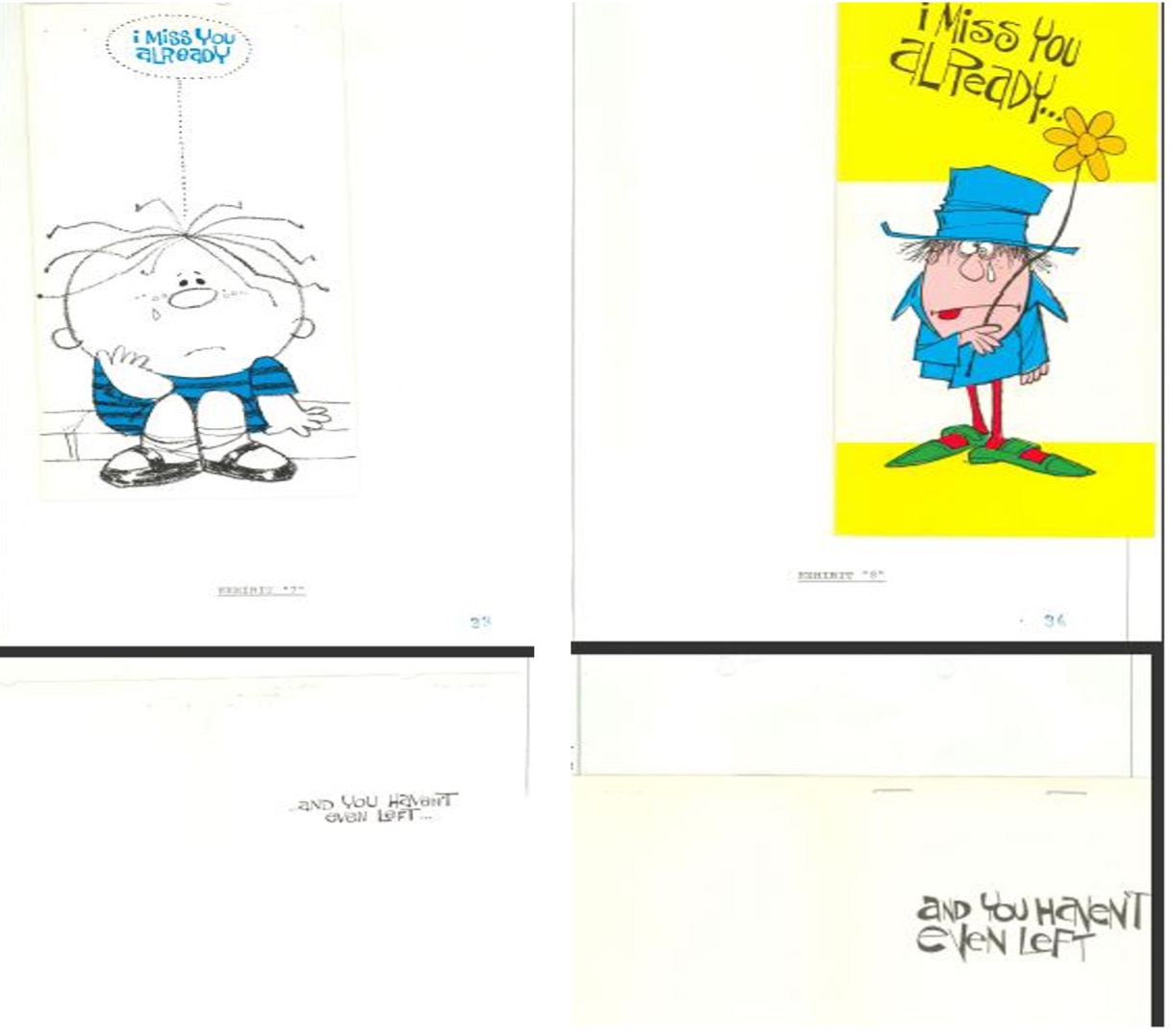
Image description: Two pairs of greeting card designs. Top left: A black-and-white sketch of a sad child with messy hair, seated with arms around knees, and the text “I miss you already.” Bottom left: The punchline “...and you haven’t even left” in small print. Top right: A colored cartoon of a person in a blue coat and hat holding a yellow flower, with the text “I miss you already” in playful font. Bottom right: The same punchline in stylized lettering.
The following extract contains the court’s infringement analysis.
To constitute an infringement under the Act there must be substantial similarity between the infringing work and the work copyrighted; and that similarity must have been caused by the defendant’s having copied the copyright holder’s creation.
It appears to us that in total concept and feel the cards of United are the same as the copyrighted cards of Roth. With the possible exception of one United card, the characters depicted in the artwork, the mood they portrayed, the combination of artwork conveying a particular mood with a particular message, and the arrangement of the words on the greeting card are substantially the same as in Roth’s cards. In several instances the lettering is also very similar.
It is true, as the trial court found, that each of United’s cards employed artwork somewhat different from that used in the corresponding Roth cards. However, the test of infringement is whether the work is recognizable by an ordinary observer as having been taken from the copyrighted source.
The remarkable similarity between the Roth and United cards in issue is apparent to even a casual observer. For example, one Roth card has, on its front, a colored drawing of a cute moppet suppressing a smile and, on the inside, the words “i wuv you.” With the exception of minor variations in color and style, defendant’s card is identical. Likewise, Roth’s card entitled “I miss you already,” depicts a forlorn boy sitting on a curb weeping, with an inside message reading “… and You Haven’t even Left”, is closely paralleled by United’s card with the same caption, showing a forlorn and weeping man, and with the identical inside message.
Notes and questions
(1) The court in Roth focused on the “remarkable similarity” in the “total concept and feel” of the cards produced by Roth and United. It looked to the combination of elements such as character, mood, and message in addition to the arrangement of the words on the card. The court did not seem bothered by the fact that the characters on United’s cards were drawn differently, that the words used were not original to Roth, or that the placement on the card, although not inevitable, was fairly conventional.
(2) Academics love to hate “total concept and feel.” As used in Roth, the “total concept and feel” test seems to misunderstand what copyright law is meant to protect. Concepts, whether broad or narrow, are explicitly excluded from protection under Section 102(b) of the Copyright Act. Additionally, the term “feel” is largely meaningless for most works, as it refers to an abstract sense rather than the actual expression. Using “total concept and feel” as the test for infringement seems to invite judges and juries to make infringement determinations based on subjective impressions and forgo rigorous legal analysis. And of course, equating protected elements of a work with vague notions of “concepts” or “feel,” blurs the crucial distinction between protectable expressions and unprotectable ideas.
Beyond Recognition, the Unfortunate case of Sid & Marty Krofft
In 1977 the Ninth Circuit developed its own distinctive approach to adjudicating copyright infringement cases in Sid & Marty Krofft Television v. McDonald’s Corp. Krofft is a landmark decision in many respects. To be fair, the court makes a commendable effort to add sophistication to the simple recognition test for infringement, but the test they formulated leaves a lot to be desired.
Sid & Marty Krofft Television v. McDonald’s Corp 562 F.2d 1157 (1977)
JAMES M. CARTER, Circuit Judge:
[Sid & Marty Krofft were puppeteers who had developed a children’s television program in the late 1960s. The H.R. Pufnstuf program included an assortment of puppet characters and a boy named Jimmy who lived on a fantasy island with walking trees and talking books. The show was a great success and generated spin-off products including toys, games, comic books, lunch boxes and Kellogg’s cereal commercials. In 1970, Needham, an advertising company working for the McDonald’s fast-food restaurant chain approached the puppeteers with the idea of adapting the H.R. Pufnstuf characters for an advertising campaign. Needham committed to working with Sid & Marty Krofft but cancelled the contract and hired former Krofft employees to make sets and costumes for the McDonaldland commercials. Needham even used the same voice actor as the H.R. Pufnstuf series. Most galling, after the McDonaldland campaign had been launched, the Kroffts were unable to license or renew several of the H.R. Pufnstuf spin-off products and the Ice Capades, which had used their characters, switched to the McDonaldland characters instead.]
… Proof of Infringement
It has often been said that in order to establish copyright infringement a plaintiff must prove ownership of the copyright and “copying” by the defendant. “Copying,” in turn, is said to be shown by circumstantial evidence of access to the copyrighted work and substantial similarity between the copyrighted work and defendant’s work. But an analysis of the cases suggests that these statements frequently serve merely as boilerplate to copyright opinions.
Under such statements, infringement would be established upon proof of ownership, access, and substantial similarity. Application of this rule, however, would produce some untenable results. For example, a copyright could be obtained over a cheaply manufactured plaster statue of a nude. Since ownership of a copyright is established, subsequent manufacturers of statues of nudes would face the grave risk of being found to be infringers if their statues were substantially similar and access were shown. The burden of proof on the plaintiff would be minimal, since most statues of nudes would in all probability be substantially similar to the cheaply manufactured plaster one.
Clearly the scope of copyright protection does not go this far. A limiting principle is needed. This is provided by the classic distinction between an “idea” and the “expression” of that idea. It is an axiom of copyright law that the protection granted to a copyrighted work extends only to the particular expression of the idea and never to the idea itself. Mazer v. Stein, 347 U.S. 201, 217-18 (1954); Baker v. Selden, 101 U.S. 99, 102-03 (1879). This principle attempts to reconcile two competing social interests: rewarding an individual’s creativity and effort while at the same time permitting the nation to enjoy the benefits and progress from use of the same subject matter.
The real task in a copyright infringement action, then, is to determine whether there has been copying of the expression of an idea rather than just the idea itself. Only this expression may be protected and only it may be infringed.
The difficulty comes in attempting to distill the unprotected idea from the protected expression. No court or commentator in making this search has been able to improve upon Judge Learned Hand’s famous “abstractions test” articulated in Nichols v. Universal Pictures Corporation.
… The test for infringement therefore has been given a new dimension. There must be ownership of the copyright and access to the copyrighted work. But there also must be substantial similarity not only of the general ideas but of the expressions of those ideas as well. Thus two steps in the analytic process are implied by the requirement of substantial similarity.
The determination of whether there is substantial similarity in ideas may often be a simple one. Returning to the example of the nude statue, the idea there embodied is a simple one — a plaster recreation of a nude human figure. A statue of a horse or a painting of a nude would not embody this idea and therefore could not infringe. The test for similarity of ideas is still a factual one, to be decided by the trier of fact.
We shall call this the “extrinsic test.” It is extrinsic because it depends not on the responses of the trier of fact, but on specific criteria which can be listed and analyzed. Such criteria include the type of artwork involved, the materials used, the subject matter, and the setting for the subject. Since it is an extrinsic test, analytic dissection and expert testimony are appropriate. Moreover, this question may often be decided as a matter of law.
The determination of when there is substantial similarity between the forms of expression is necessarily more subtle and complex. As Judge Hand candidly observed, “Obviously, no principle can be stated as to when an imitator has gone beyond copying the ‘idea,’ and has borrowed its ‘expression.’ Decisions must therefore inevitably be ad hoc.” Peter Pan Fabrics, Inc. v. Martin Weiner Corp., 274 F.2d 487, 489 (2d Cir. 1960). If there is substantial similarity in ideas, then the trier of fact must decide whether there is substantial similarity in the expressions of the ideas so as to constitute infringement.
The test to be applied in determining whether there is substantial similarity in expressions shall be labeled an intrinsic one — depending on the response of the ordinary reasonable person. It is intrinsic because it does not depend on the type of external criteria and analysis which marks the extrinsic test. As this court stated in Twentieth Century-Fox Film Corp. v. Stonesifer, 140 F.2d 579, 582 (9th Cir. 1944):
The two works involved in this appeal should be considered and tested, not hypercritically or with meticulous scrutiny, but by the observations and impressions of the average reasonable reader and spectator.
Because this is an intrinsic test, analytic dissection and expert testimony are not appropriate.
This same type of bifurcated test was announced in Arnstein v. Porter, 154 F.2d 464, 468-69 (2d Cir. 1946). The court there identified two separate elements essential to a plaintiff’s suit for infringement: copying and unlawful appropriation. Under the Arnstein doctrine, the distinction is significant because of the different tests involved.
[T]he trier of fact must determine whether the similarities are sufficient to prove copying. On this issue, analysis (‘dissection’) is relevant, and the testimony of experts may be received to aid the trier of facts. … If copying is established, then only does there arise the second issue, that of illicit copying (unlawful appropriation). On that issue . . . the test is the response of the ordinary lay hearer; accordingly, on that issue, ‘dissection’ and expert testimony are irrelevant.
We believe that the court in Arnstein was alluding to the idea-expression dichotomy which we make explicit today. When the court in Arnstein refers to “copying” which is not itself an infringement, it must be suggesting copying merely of the work’s idea, which is not protected by the copyright. To constitute an infringement, the copying must reach the point of “unlawful appropriation,” or the copying of the protected expression itself. We analyze this distinction in terms both of the elements involved — idea and expression — and of the tests to be used — extrinsic and intrinsic — in an effort to clarify the issues involved.
The Tests Applied
In the context of this case, the distinction between these tests is important. Defendants do not dispute the fact that they copied the idea of plaintiffs’ Pufnstuf television series — basically a fantasyland filled with diverse and fanciful characters in action. They argue, however, that the expressions of this idea are too dissimilar for there to be an infringement. They come to this conclusion by dissecting the constituent parts of the Pufnstuf series — characters, setting, and plot — and pointing out the dissimilarities between these parts and those of the McDonaldland commercials.
This approach ignores the idea-expression dichotomy alluded to in Arnstein and analyzed today. Defendants attempt to apply an extrinsic test by the listing of dissimilarities in determining whether the expression they used was substantially similar to the expression used by plaintiffs. That extrinsic test is inappropriate; an intrinsic test must here be used. As the court in Arnstein stated:
Whether (if he copied) defendant unlawfully appropriated presents, too, an issue of fact. The proper criterion on that issue is not an analytic or other comparison of the respective . . . compositions . . . . The plaintiff’s legally protected interest in the potential financial return from his compositions which derive from the lay public’s approbation of his efforts. The question, therefore, is whether defendant took from plaintiff’s works so much of what is pleasing to the [eyes and] ears of lay [persons], who comprise the audience for whom such popular [works are] composed, that defendant wrongfully appropriated something which belongs to the plaintiff. Surely, then, we have an issue of fact which a jury is peculiarly fitted to determine.
Analytic dissection, as defendants have done, is therefore improper.
Defendants contest the continued viability of Arnstein. It is true that Arnstein’s alternative holding that summary judgment may not be granted when there is the slightest doubt as to the facts has been disapproved. But the case’s tests for infringement have consistently been approved by this court. They have also been accepted by other courts. We believe Arnstein is still good law.
Since the intrinsic test for expression is uniquely suited for determination by the trier of fact, this court must be reluctant to reverse it. As a finding of fact, a conclusion as to the question of copying is subject to the “clearly erroneous” standard. But it follows that this court will be less likely to find clear error when the subjective test for copying of expression has been applied.
The present case demands an even more intrinsic determination because both plaintiffs’ and defendants’ works are directed to an audience of children. This raises the particular factual issue of the impact of the respective works upon the minds and imaginations of young people. As the court said in Ideal Toy Corp. v. Fab-Lu Ltd., 261 F.Supp. 238, 241-42 (S.D.N.Y.1966), aff’d, 360 F.2d 1021 (2 Cir. 1966):
In applying the test of the average lay observer, [children] are not to be excluded — indeed they are the ‘far-flung faithful . . . audience.’ The television advertising campaign of plaintiff was directed toward acquainting these youngsters with . . . its new teenage and pre-teen dolls. The impression of the faces and general appearance of the dolls was upon them. . . . The dolls create the same impression, both with respect to their appearances and the play — uses for which they are suited. It is the youngsters who, on the basis of this impression, go to the stores with their parents or at home make their wishes known for the dolls they desire after television has made its impact upon them. In their enthusiasm to acquire . . . [the dolls] they certainly are not bent upon ‘detecting disparities’ or even readily observing upon inspection such fine details as the point at which the necks are molded.
The H.R. Pufnstuf series became the most popular children’s show on Saturday morning television. This success led several manufacturers of children’s goods to use the Pufnstuf characters. It is not surprising, then, that McDonald’s hoped to duplicate this peculiar appeal to children in its commercials. It was in recognition of the subjective and unpredictable nature of children’s responses that defendants opted to recreate the H.R. Pufnstuf format rather than use an original and unproven approach.
Defendants would have this court ignore that intrinsic quality which they recognized to embark on an extrinsic analysis of the two works. For example, in discussing the principal characters — Pufnstuf and Mayor McCheese — defendants point out:
“‘Pufnstuf’ wears what can only be described as a yellow and green dragon suit with a blue cummerband from which hangs a medal which says ‘mayor’. ‘McCheese’ wears a version of pink formal dress — ‘tails’ — with knicker trousers. He has a typical diplomat’s sash on which is written ‘mayor’, the ‘M’ consisting of the McDonald’s trademark of an ‘M’ made of golden arches.”
So not only do defendants remove the characters from the setting, but dissect further to analyze the clothing, colors, features, and mannerisms of each character. We do not believe that the ordinary reasonable person, let alone a child, viewing these works will even notice that Pufnstuf is wearing a cummerbund while Mayor McCheese is wearing a diplomat’s sash.
Duplication or near identity is not necessary to establish infringement. As Judge Learned Hand put it, copyright “cannot be limited literally to the text, else a plagiarist would escape by immaterial variations.” Nichols v. Universal Pictures Corp., 45 F.2d 119, 121 (2d Cir. 1930).
We have viewed representative samples of both the H.R. Pufnstuf show and McDonaldland commercials. It is clear to us that defendants’ works are substantially similar to plaintiffs’.[9] They have captured the “total concept and feel” of the Pufnstuf show. Roth Greeting Cards v. United Card Co., 429 F.2d 1106, 1110 (9th Cir. 1970). We would so conclude even if we were sitting as the triers of fact. There is no doubt that the findings of the jury in this case are not clearly erroneous.
Footnote 9: Even a dissection of the two works reveals their similarities. The “Living Island” locale of Pufnstuf and “McDonaldland” are both imaginary worlds inhabited by anthromorphic plants and animals and other fanciful creatures. The dominant topographical features of the locales are the same: trees, caves, a pond, a road, and a castle. Both works feature a forest with talking trees that have human faces and characteristics.
The characters are also similar. Both lands are governed by mayors who have disproportionately large round heads dominated by long wide mouths. They are assisted by “Keystone cop” characters. Both lands feature strikingly similar crazy scientists and a multi-armed evil creature.
It seems clear that such similarities go beyond merely that of the idea into the area of expression. The use of the basic idea of the works does not inevitably result in such similarities. Certainly a jury applying an intrinsic test could find such similarities of expression substantial.
… Access
In addition to substantial similarity, a plaintiff must show access in order to prove infringement. Access is proven when the plaintiff shows that the defendant had an opportunity to view or to copy plaintiff’s work. In this case, there is no dispute as to defendants’ access to plaintiffs’ work. Indeed, defendants were engaged in negotiations with plaintiffs for licensing of the works even while preparing the McDonaldland commercials.
No amount of proof of access will suffice to show copying if there are no similarities. This is not to say, however, that where clear and convincing evidence of access is presented, the quantum of proof required to show substantial similarity may not be lower than when access is shown merely by a preponderance of the evidence. As Professor Nimmer has observed:
Clear and convincing evidence of access will not avoid the necessity of also proving substantial similarity since access without similarity cannot create an inference of copying. However, this so-called ‘Inverse Ratio Rule’ . . . would seem to have some limited validity. That is, since a very high degree of similarity is required in order to dispense with proof of access, it must logically follow that where proof of access is offered, the required degree of similarity may be somewhat less than would be necessary in the absence of such proof.
We agree.
In this case, representatives of Needham actually visited the Kroffts’ headquarters in Los Angeles to discuss the engineering and design work necessary to produce the McDonaldland commercials. They did this after they had been awarded the contract by McDonald’s and apparently with no intention to work with the Kroffts. We believe that this degree of access justifies a lower standard of proof to show substantial similarity. Since the subjective test applies, it is impossible to quantify this standard. But there is no question it is met here.
… Conclusion
The judgment of the district court finding infringement is affirmed. The McDonald commercials are based on the same ideas as the H.R. PufnStuf series. The expression of that idea is sufficiently similar so that a jury applying an intrinsic test could find infringement. This is especially true here since there was strong evidence of access.
Notes and questions
(1) The mess that Krofft made. There are some important differences in the extrinsic-intrinsic test as set forth in Krofft and how the test works today. Although cited with reverence in the Ninth Circuit, the reality is that Krofft was a terrible decision: it made a mess of copyright adjudication which it has taken the Ninth Circuit decades to dig itself out of.
(2) Similarity in ideas? According to Krofft, copyright infringement is proven by showing ownership, access and then substantial similarity under an extrinsic-intrinsic test. Confusingly, although the court said that under the extrinsic part of the test some dissection and analysis was appropriate, it also said that the point of that analysis was to determine if there was “substantial similarity in ideas.” Ideas? Not expression?
The court waived away the defendant’s lists of differences in expression as essentially irrelevant and held that such differences would mean nothing to “the ordinary reasonable person, let alone a child [the intended audience], viewing these works.” In other words, once similarity of ideas has been established “extrinsically” the only thing left to do is assess “intrinsic” similarities from the point of view of the ordinary observer. In addition to basing infringement on similarity of ideas, this approach does not leave much room for the defendant to point out more detailed similarities that should nonetheless be unprotectable for various reasons.
As should be obvious, Krofft’s extrinsic test made no sense because ideas are not protected by copyright. The Ninth Circuit has since “clarified” its position on this point. As the court explained in Shaw v. Lindheim, 919 F.2d 1353 (9th Cir. 1990):
… panels applying Krofft to literary works have included a lengthy list of concrete elements under the extrinsic test. Whereas Krofft listed “the type of artwork involved, the materials used, the subject matter, and the setting for the subject” as criteria for consideration under the extrinsic test, id., a series of opinions [courts in the Ninth circuit] have listed “plot, themes, dialogue, mood, setting, pace, and sequence” as extrinsic test criteria. [Later cases added] “characters” to the list and transforming “sequence” into “sequence of events”.
Now that it includes virtually every element that may be considered concrete in a literary work, the extrinsic test as applied to books, scripts, plays, and motion pictures can no longer be seen as a test for mere similarity of ideas. Because the criteria incorporated into the extrinsic test encompass all objective manifestations of creativity, the two tests are more sensibly described as objective and subjective analyses of expression, having strayed from Krofft’s division between expression and ideas. Indeed, a judicial determination under the intrinsic test is now virtually devoid of analysis, for the intrinsic test has become a mere subjective judgment as to whether two literary works are or are not similar.
Following cases like Shaw, the extrinsic test is no longer a “test for similarity of ideas” it is the objective and analytical half of the test for similarity of expression. Retrofitted in this way the extrinsic-intrinsic test actually makes a lot of sense because it gives courts a structure for combining analytical/objective aspects of the similarity inquiry with the more intuitive/holistic aspects.
(3) What ever happened to copying in fact? In Krofft, Ninth Circuit said that it was applying the bifurcated test for copyright infringement developed by the Second Circuit in Arnstein—(1) copying in fact and (2) wrongful copying or improper appropriation—but in reality, the extrinsic-intrinsic test only speaks to the second prong and presumes that proving access is enough to establish copying in fact.
Consider what the court said after announcing that it had given the test for infringement “a new dimension:”
There must be ownership of the copyright and access to the copyrighted work. But there also must be substantial similarity not only of the general ideas but of the expressions of those ideas as well. Thus two steps in the analytic process are implied by the requirement of substantial similarity.
The court then set out the extrinsic test: “whether there is substantial similarity in ideas;” and the “intrinsic” test: “whether there is substantial similarity in expressions … depending on the response of the ordinary reasonable person.”
Look back at the quote above, the Krofft test requires ownership, access, and substantial similarity, but nowhere does it explicitly require the plaintiff to establish copying in fact. A bit later on the court confirms this saying: “In addition to substantial similarity, a plaintiff must show access in order to prove infringement.”
Of course, this may not have been what the Ninth Circuit meant, but the syllogism that “copyright infringement = ownership + access + extrinsic similarity + intrinsic similarity” did a lot of harm in cases where those similarities were not probative of actual copying. It was not until Rentmeester v. Nike, Inc., 883 F.3d 1111 (9th Cir. 2018) (extracted below) that the Ninth Circuit began clearly requiring proof of copying in fact and not just proof of access.
(4) Total concept and feel. In the Krofft court’s intrinsic analysis it explained that it had viewed representative samples of the works at issue and that it was clear that defendants’ works were substantially similar to plaintiffs’ because they had “captured the ‘total concept and feel’ of the Pufnstuf show.” The court cited Roth on this point.
Bruce Boyden argues in The Grapes of Roth that the impact of this elevation of ‘total concept and feel’ had far more nuanced consequences than one might think. He argues that “the reference to ‘total concept and feel’ allowed the court to express a conclusion as to whether the defendants had taken too much copyrightable expression without specifically identifying what in the plaintiff’s work was expression, what in the defendant’s work was similar or dissimilar, and where the threshold level of similarity lay.”
Boyden’s argument is that “total concept and feel” gave judges an easy way to reject infringement claims where plaintiffs presented long list of similarities by simply pointing to their own assessment that the works in question had a different overall vibe or gestalt. Moreover, judges could do so without sounding quite as normative or subjective as they otherwise might. Boyden points to several cases where “rather than openly weed out uncopyrightable similarities, courts would instead describe the two works in detail, and then at the end simply express the conclusion that the ‘total concept and feel’ of the two works was different.” In the hands of expert judges ‘total concept and feel’ is sometimes simply “a reminder that, while the infringement analysis must begin by dissecting the copyrighted work into its component parts in order to clarify precisely what is not original, infringement analysis is not simply a matter of ascertaining similarity between components viewed in isolation.” See Tufenkian Import/Export Ventures, Inc. v. Einstein Moomjy, Inc., 338 F.3d 127 (2d Cir. 2003).
Reyher v. Children’s Television Workshop. 533 F.2d 87 (2d Cir. 1976)
In Reyher, the plaintiffs alleged infringement of their illustrated children’s book which told the story of a lost child searching for her mother. The child’s search is delayed because her description of her mother as “the most beautiful woman in the world” does not align with conventional beauty standards. The defendants published a two-page story in Sesame Street Magazine that followed the same basic plot but featured different dialogue, illustrations, and a different setting. After discussing the need to locate in copyright in the reproduction of expression and not ideas, the court of appeals said:
The question which remains is whether defendants in the instant case utilized the idea in Reyher’s book or instead descended so far into the concrete as to invade her expression. We must first note that both stories, intended for children, are necessarily less complex than some other works submitted to pattern analysis. Therefore, in addition to the essential sequence of events, we might properly consider the “total concept and feel” of the works in question. Roth Greeting Cards v. United Card Company, 429 F.2d 1106, 1110 (9 Cir. 1970).
Reyher’s thirty-five page book focuses on a Russian family living in the Ukraine; the setting of the story is an important component of the work. The main protagonists are the mother, father and six year old daughter. The first few pages describe the duties of each family member in harvesting the wheat crop. There is also narrative about the customary feast days during harvesting as Reyher describes, through the literary device of the little girl helping her mother, the preparation of distinctive Russian foods. The feast day itself is depicted with vivid details of costume and entertainment. We have now progressed through fifteen pages of appellant’s book. On the last day of field work prior to the feast, the little girl is separated from her parents. Meeting a group of villagers unfamiliar to her, she describes her mother as the most beautiful woman in the world. The village leader sends boys to bring back all the likely candidates; none, of course, is the mother. Finally, a homely woman, in fact the girl’s mother, approaches the crowd and is joyfully reunited with her child. The village leader presents the moral of the story: “We do not love people because they are beautiful, but they seem beautiful to us because we love them.” At the feast day, the little girl tells her mother that, although other children have teased her about her feelings, she thinks her mother is the most beautiful woman in the world. The mother expresses her happiness that her child sees with her heart as well as with her eyes.
The Sesame Street Magazine version of the story, two pages long, presumably is set in Africa. There is no textual detail about African life; any information comes from the five illustrations, which show African dress on the characters, a woman carrying a basket on her head, and thatched huts. The story opens with a little boy crying in the fields because he has become separated from his mother. He describes her as the most beautiful woman in the world. The village leader gathers all the beautiful women from surrounding villages to no avail. An old unattractive woman, the missing mother, is reunited with her son. The village leader states that although he doesn’t find her beautiful, the important thing is what the little boy thinks. The lesson to be learned is “what’s not so beautiful to some can be very, very beautiful to others.”
Based on the special relationship between parent and child, both works present the thematic concept that to a lost child, the familiar face of the mother is the most beautiful face, even though the mother is not, in fact, beautiful to most. The overlapping sequences of events concern the lost child finding his or her mother, albeit with some difficulty because of the description given. This similarity of events, however, may be considered scenes a faire, scenes which necessarily result from identical situations. Thus, where a lost child is the protagonist, there is likely to be a reunion with parents. Furthermore, the morals stated by the two stories differ in emphasis. Reyher’s book focuses on how love makes people appear beautiful, while the CTW story stresses that what is beautiful to some may not be beautiful to others. More importantly, however, the two works differ in “total feel.” Reyher’s book presents a picture of family life in the Russian Ukraine and develops the characters of the little girl and her mother. The CTW story is barren of meaningful setting or character development in its attempt to present its theme. The two stories are not similar in mood, details or characterization. Since both present only the same idea, no infringement as to protected expression occurred. The district court’s finding that the two illustrations of the reunion scene have such substantial differences as not to warrant a finding of infringement is one we will not disturb.
Notes and questions
(1) What work is “total concept and feel” doing in this opinion? How does the court decide what is unprotectable as scenes a faire, and what differences in “total concept and feel” matter as opposed to being “immaterial variations” as Judge Hand said in Sheldon?
(2) As Bruce Boyden argues, the impact of “total concept and feel” became intertwined with broader trends in civil procedure. In the 1980s summary judgment in copyright cases was quite common. As Reyher v. Children’s Television Workshop illustrates, in motions for summary judgment as well as in bench trials, courts tended to use ‘total concept and feel’ to reject claims of infringement. However, if the case ever got to a jury, as it did in Sid & Marty Krofft, “total concept and feel” tended to favor plaintiffs.
The Era of Jury Empowerment
In the late 1980s, in response to the Supreme Court’s Celotex trilogy, courts began to hesitate in granting summary judgment. The Celotex trilogy rulings made it easier for courts in other areas of law to grant summary judgment but in copyright it became harder for judges to speculate without objective evidence what a reasonable juror would and would not find dissimilar. The problem was twofold: first, the renewed attention to summary judgment standards made it hard for district courts to reject dubious claims of infringement in the face of conflicting expert evidence; second, when juries returned questionable verdicts based on their assessment that the plaintiff had passed the extrinsic test and that the total concept and feel of the works was the same, judges had very few options. Three Boys Music Corp. v. Bolton, 212 F.3d 477 (9th Cir. 2000) illustrates the latter problem and Swirsky v. Carey illustrates the former.
Three Boys Music Corp. v. Bolton 212 F.3d 477 (9th Cir. 2000)
In 1964, rhythm and blues pioneers, the Isley Brothers wrote and recorded “Love is a Wonderful Thing.” The song was released by United Artists but did not achieve major chart success. In 1991, the adult contemporary singer Michael Bolton released a song with the same title and in 1992, the Isley Brothers’ music publishing company sued for copyright infringement. The jury agreed and awarded $5.4 million in damages.
The conclusion that the Isley Brothers’ 1964 song and Michael Bolton’s 1991 song are substantially similar is hard to understand beyond the fact that both songs exuberantly celebrate the cliché that “love is a wonderful thing.” The melodies and harmonies are different, the lyrics and phrasing differ. Furthermore, the idea that Bolton had subconsciously copied the song seemed tenuous given that the Isley Brothers does not seem to have made much of an impression on the world, unlike the number one hit He’s So Fine, in the George Harrison, My Sweet Lord case (discussed in a previous chapter). The Isley Brothers argued that Bolton had access to their song “Love is a Wonderful Thing” through widespread dissemination and had engaged in subconscious copying. They presented evidence that Bolton grew up listening to rhythm and blues, was a fan of the Isley Brothers, and could have heard their song on radio and television where he lived. Additionally, Bolton himself questioned whether his song resembled a classic Marvin Gaye song during the recording process.
The weakness of the plaintiff’s access theory and the differences in melody, harmony, lyrics, and style probably should have led the court to rule that Bolton’s song did not infringe on the Isley Brothers’ track, but the court of appeals deferred to the jury, noting:
Given the difficulty of proving access and substantial similarity, appellate courts have been reluctant to reverse jury verdicts in music cases. … Our decision is predicated on judicial deference—finding that the law has been properly applied in this case, viewing the facts most favorably to the appellees, and not substituting our judgment for that of the jury.
Specifically in relation to access the court noted “despite the weaknesses of the Isley Brothers’ theory of reasonable access, the appellants had a full opportunity to present their case to the jury.” Turning to substantial similarity it proclaimed:
We will not second-guess the jury’s application of the intrinsic test. “Since the intrinsic test for expression is uniquely suited for determination by the trier of fact, this court must be reluctant to reverse it.” (citing Krofft) Furthermore, we will not reverse factual determinations regarding the extrinsic test absent a clearly erroneous application of the law. It is well settled that a jury may find a combination of unprotectible elements to be protectible under the extrinsic test because the over-all impact and effect indicate substantial appropriation.
Swirsky v. Carey, 376 F.3d 841 (9th Cir. 2004)
[Kevin Swirsky sued Mariah Carey and her collaborators for copyright infringement, claiming that Carey’s song “Thank God I Found You” was substantially similar to Swirsky’s earlier song “One of Those Love Songs.” In general, the two songs are quite dissimilar in terms of lyrics and the melodies of the verses, but Swirsky argued that they share a similar chorus and that Carey’s song thus infringed. The district court granted summary judgment to Carey on the basis of lack of substantial similarity and Swirsky appealed.]
Substantial Similarity
The expert testimony on which Swirsky relied was that of Dr. Robert Walser, chair of the Musicology Department at the University of California at Los Angeles. On the basis of his aural assessment of One and Thank God, Dr. Walser opined that the two songs had substantially similar choruses.
Dr. Walser admitted that the lyrics and verse melodies of the two songs differed “clearly and significantly,” but stated that the two songs’ choruses shared a “basic shape and pitch emphasis” in their melodies, which were played over “highly similar basslines and chord changes, at very nearly the same tempo and in the same generic style.” Dr. Walser also noted that it was a “suspicious coincidence” that the two songs’ choruses were both sung in B-flat. Dr. Walser further testified that the choruses in both One and Thank God shared a similar structure in that measures five through seven of each chorus were “almost exactly” the same as the first three measures of each chorus.
Dr. Walser also noted a number of differences between the two songs’ choruses. Dr. Walser found that the fourth measures of the choruses were “dramatically different” from each other and noted that while the “basic, emphasized pitches and rhythms” of the basslines were alike, the basslines to both choruses were “ornamented and played slightly differently from chorus to chorus.” Dr. Walser also found that certain “text-setting choices” created differences between the two songs’ choruses. For example, he noted that in Thank God, Carey sings “D, scale degree three, for a full beat on the first beat of the first measure” while Xscape in One sings the same pitch “divided into two eight-note pulses.” Dr. Walser ultimately concluded, however, that these differences were not enough to differentiate the songs because the overall emphasis on musical notes was the same, which “contributed to the impression of similarity one hears when comparing the two songs.”
Dr. Walser transcribed his aural impressions into a series of visual “transcriptions.” Dr. Walser created a transcription of each chorus’ pitch sequence, melody, and bassline. Dr. Walser labeled his transcription of the basslines a “reduction” because he transcribed only the “basic, emphasized pitches and rhythms.” Dr. Walser thus did not include any bassline notes or pitches he found to be “ornamented” in his transcriptions.
The district court found this evidence insufficient to survive a motion for summary judgment. First, the district court found that Dr. Walser’s expert methodology was flawed. Second, the district court, using its own analysis, found that no triable issue was raised as to the substantial similarity of measures two, three, six, seven, and eight of the two choruses. We disagree with much of the district court’s reasoning and conclude that Swirsky has satisfied the extrinsic test because he has provided indicia of a sufficient disagreement concerning the substantial similarity of the two works.
A. Dr. Walser’s Methodology
There is nothing inherently unsound about Dr. Walser’s musicological methodology in this case. The district court is correct that Dr. Walser’s methodology is “selective,” in as much as it discounts notes that he characterizes as “ornamental.” Dr. Walser, however, explained that the melody (pitch and rhythm) and bassline of a song cannot be divorced from the harmonic rhythm of a song. According to Dr. Walser, notes falling on the beat will be more prominent to the ear than notes falling off the beat. Thus, Dr. Walser opined that, even though measure three of both choruses were not identical in numerical pitch sequence or note selection, they both “emphasized the second scale degree, C, over an A in the bass, resolving to the third scale degree, D, over a D in the bass in the last half of the measure.” Dr. Walser provided a comparable analysis for measures one, three, and eight.
Similarly, Dr. Walser explained that some artists will ornament their notes in ways that others do not. Dr. Walser testified at deposition that both Carey and Xscape ornament their notes with “melismas” and “appoggiaturas,” both of which are technical terms for moving up to the next note and then back again. Dr. Walser testified that he did not notate these ornaments in his transcriptions, or take them into account in his opinion, because he “took that to be a matter of the singer customizing the song and regarded those notes as not structural; they are ornamental.” As we said in Newton v. Diamond, 349 F.3d 591 (2003), we can “consider only the defendant’s appropriation of the song’s compositional elements and must remove from consideration all the elements unique to Plaintiff’s performance.” Dr. Walser’s methodology sought to remove notes he perceived as performance-related.
To a certain extent, Dr. Walser’s methodology does concentrate on how the two choruses sound to his expert ears, which led the district court to conclude that his testimony related to intrinsic and not extrinsic similarity. We do not agree, however, that Dr. Walser’s testimony was an intrinsic rather than extrinsic analysis. He was not testifying, as the intrinsic test would require, as to whether subjectively the ordinary, reasonable person would find the total concept and feel of the two choruses to be substantially similar. Instead, he was stating that, although the two choruses are not exactly identical on paper, when examined in the structural context of harmony, rhythm, and meter, they are remarkably similar. We, therefore, cannot accept the district court’s conclusion that Dr. Walser did not “adequately explain, based on objective criteria, why [his] particular subset of notes is more important, or more appropriately analyzed, than the other notes present in the songs.” The district court erred in completely discounting Dr. Walser’s expert opinion.
B. The District Court’s Measure-by-Measure Analysis
The district court also erred by basing its comparison of the two choruses almost entirely on a measure-by-measure comparison of melodic note sequences from the full transcriptions of the choruses. Objective analysis of music under the extrinsic test cannot mean that a court may simply compare the numerical representations of pitch sequences and the visual representations of notes to determine that two choruses are not substantially similar, without regard to other elements of the compositions. Under that approach, expert testimony would not be required at all, for any person untrained in music could conclude that “2-2-2-2-2-2-1-2-1-3” did not match “2-2-4-3-2-3” or that a half-note is not identical to an eighth-note. Certainly, musicological experts can disagree as to whether an approach that highlights stressed notes, as Dr. Walser’s does, is the most appropriate way to break down music for substantial-similarity comparison, but no approach can completely divorce pitch sequence and rhythm from harmonic chord progression, tempo, and key, and thereby support a conclusion that compositions are dissimilar as a matter of law. It is these elements that determine what notes and pitches are heard in a song and at what point in the song they are found. To pull these elements out of a song individually, without also looking at them in combination, is to perform an incomplete and distorted musicological analysis.
Furthermore, to disregard chord progression, key, tempo, rhythm, and genre is to ignore the fact that a substantial similarity can be found in a combination of elements, even if those elements are individually unprotected. Thus, although chord progressions may not be individually protected, if in combination with rhythm and pitch sequence, they show the chorus of Thank God to be substantially similar to the chorus of One, infringement can be found.
We recognize the difficulties faced by the district court in this case. … In analyzing musical compositions under the extrinsic test, we have never announced a uniform set of factors to be used. We will not do so now. [The court explained that music consists of many elements and that prior cases had found similarity based on the combination of unprotectable elements. Courts generally consider elements like melody, harmony, rhythm, lyrics, and experts have suggested other elements like timbre, and tone may be relevant.]
There is no one magical combination of these factors that will automatically substantiate a musical infringement suit; each allegation of infringement will be unique. So long as the plaintiff can demonstrate, through expert testimony that addresses some or all of these elements and supports its employment of them, that the similarity was “substantial” and to “protected elements” of the copyrighted work, the extrinsic test is satisfied. Swirsky has met that standard here.
Notes and questions
(1) In his expert report, Dr. Walser disregarded bassline notes and pitches he classified as ornamental or performance-related; he also set aside certain “text-setting choices.” Instead, Dr. Walser focused on what he considered to be the “overall emphasis on musical notes.” These seem like subjective decisions about what matters in music, how does such a report assist with the objective analysis required by the extrinsic test? For further discussion, see Miah Rosenberg, Do You Hear What I Hear? Expert Testimony in Music Infringement Cases in the Ninth Circuit, 39 UC Davis Law Review 1669 (2006).
(2) Consider the plight of a trial judge faced with a claim of musical copyright infringement centering on supposedly overlapping choruses. If the plaintiff’s claim seems implausible based on the judge’s own comparison of the works, what can or should she do? If Swirsky v. Carey is any guide, a judge will be chided for conducting her own musical analysis and she is apparently obliged to accept an expert’s comparison that is transparently impressionistic and selective.
A Resurgence of Judicial Analysis
The era of heightened pleading standards ushered in by Bell Atlantic Corp. v. Twombly 550 U.S. 544 (2007) and Ashcroft v. Iqbal 556 U.S. 662 (2009) empowered courts to reject copyright claims due to implausibility on a motion to dismiss.
Peter F. Gaito Architecture, LLC v. Simone Development Corp. 602 F.3d 57 (2d Cir. 2010)
[Peter F. Gaito Architecture, LLC and Joseph Simone (President of Simone Development Corp.) agreed to jointly submit a proposal for a real estate development project in New Rochelle, NY. Gaito Architecture was responsible for the architectural design, while Simone was to secure financing. Gaito Architecture drafted plans, which were submitted in the name of Simone Development Corp. The City of New Rochelle awarded the project to the group. However, after a dispute over compensation, Simone terminated the relationship and found a new architectural firm to continue the project. Gaito Architecture sued for copyright infringement, alleging that defendants’ redesigns were substantially similar to their original designs. However, the district court granted defendants’ motion to dismiss holding that no substantial similarity existed and dismissed the copyright claim.]
… We must first consider whether it was proper for the district court to make a determination as to substantial similarity on a Rule 12(b)(6) motion to dismiss, a question that this Circuit has not directly addressed.
At the outset, we acknowledge that “the test for infringement of a copyright is of necessity vague.” For that reason, and because the question of substantial similarity typically presents an extremely close question of fact, questions of non-infringement have traditionally been reserved for the trier of fact.
The question of substantial similarity is by no means exclusively reserved for resolution by a jury, however, and we have repeatedly recognized that, in certain circumstances, it is entirely appropriate for a district court to resolve that question as a matter of law, “either because the similarity between two works concerns only noncopyrightable elements of the plaintiff’s work, or because no reasonable jury, properly instructed, could find that the two works are substantially similar.” Warner Bros. Inc. v. Am. Broad. Cos., 720 F.2d 231, 240 (2d Cir.1983). See Walker v. Time Life Films, Inc., 784 F.2d 44, 48 (2d Cir.1986) (“A district court may determine noninfringement as a matter of law on a motion for summary judgment either when the similarity concerns only noncopyrightable elements of [plaintiff’s] work, or when no reasonable trier of fact could find the works substantially similar.”); Durham Indus., Inc. v. Tomy Corp., 630 F.2d 905, 918 (2d Cir.1980) (“Although the issue of substantial similarity is clearly a factual one, it was entirely proper for [the district court] to hold that [defendant-counterclaimant] is not entitled to go to trial on the issue of infringement.”)
These same principles hold true when a defendant raises the question of substantial similarity at the pleadings stage on a motion to dismiss. It is well settled that in ruling on such a motion, a district court may consider the facts as asserted within the four corners of the complaint together with the documents attached to the complaint as exhibits, and any documents incorporated in the complaint by reference. In copyright infringement actions, “the works themselves supersede and control contrary descriptions of them,” Walker, 784 F.2d at 52, including any contrary allegations, conclusions or descriptions of the works contained in the pleadings. When a court is called upon to consider whether the works are substantially similar, no discovery or fact-finding is typically necessary, because what is required is only a visual comparison of the works.
Thus, where, as here, the works in question are attached to a plaintiff’s complaint, it is entirely appropriate for the district court to consider the similarity between those works in connection with a motion to dismiss, because the court has before it all that is necessary in order to make such an evaluation. If, in making that evaluation, the district court determines that the two works are not substantially similar as a matter of law, the district court can properly conclude that the plaintiff’s complaint, together with the works incorporated therein, do not “plausibly give rise to an entitlement to relief.” Ashcroft v. Iqbal, 129 S.Ct. at 1950 (2009).
We are mindful that a motion to dismiss does not involve consideration of whether a plaintiff will ultimately prevail on the merits, but instead solely whether the claimant is entitled to offer evidence in support of his claims. We also acknowledge that there can be certain instances of alleged copyright infringement where the question of substantial similarity cannot be addressed without the aid of discovery or expert testimony. See, e.g., Computer Assocs. Int’l, Inc. v. Altai, Inc., 982 F.2d 693, 713 (2d Cir.1992). Nothing in this opinion should be read to upset these settled principles, or to indicate that the question of non-infringement is always properly considered at the pleadings stage without the aid of discovery. But where, as here, the district court has before it all that is necessary to make a comparison of the works in question, we see no error in the district court’s decision to resolve the question of substantial similarity as a matter of law on a Rule 12(b)(6) motion to dismiss.
Having concluded that the district court did not err in considering the question of substantial similarity on defendants’ motion to dismiss, we now turn to whether the district court erred in resolving that question in defendants’ favor. We review that determination de novo, because credibility is not at stake and all that is required is a visual comparison of the works — a task we may perform as well as the district court.
The standard test for substantial similarity between two items is whether an ordinary observer, unless he set out to detect the disparities, would be disposed to overlook them, and regard the aesthetic appeal as the same. In applying the so-called “ordinary observer test,” we ask whether “an average lay observer would recognize the alleged copy as having been appropriated from the copyrighted work.” Knitwaves, Inc. v. Lollytogs Ltd. (Inc.), 71 F.3d 996, 1002 (2d Cir.1995). On occasion, though, we have noted that when faced with works “that have both protectible and unprotectible elements,” our analysis must be “more discerning,” Fisher-Price, Inc. v. Well-Made Toy Mfg. Corp., 25 F.3d 119, 123 (2d Cir.1994), and that we instead “must attempt to extract the unprotectible elements from our consideration and ask whether the protectible elements, standing alone, are substantially similar,” Knitwaves, Inc., 71 F.3d at 1002.
No matter which test we apply, however, we have disavowed any notion that “we are required to dissect the works into their separate components, and compare only those elements which are in themselves copyrightable.” Id. at 1003. Instead, we are principally guided “by comparing the contested design’s total concept and overall feel with that of the allegedly infringed work,” Tufenkian Import/Export Ventures, Inc. v. Einstein Moomjy, Inc., 338 F.3d 127, 133 (2d Cir. 2003); see Boisson, 273 F.3d at 272; Knitwaves Inc., 71 F.3d at 1003, as instructed by our “good eyes and common sense,” Hamil Am., 193 F.3d at 102. This is so because “the defendant may infringe on the plaintiff’s work not only through literal copying of a portion of it, but also by parroting properties that are apparent only when numerous aesthetic decisions embodied in the plaintiff’s work of art — the excerpting, modifying, and arranging of [unprotectible components]... — are considered in relation to one another.” Tufenkian Import/Export Ventures, Inc., 338 F.3d at 134. Thus, in the end, our inquiry necessarily focuses on whether the alleged infringer has misappropriated “the original way in which the author has selected, coordinated, and arranged the elements of his or her work.” Knitwaves Inc., 71 F.3d at 1004 (quoting Feist).
A de novo application of these principles to the works in question here unequivocally demonstrates the utter lack of similarity between the two designs.
Plaintiffs’ overall design for the Church Street Project, for instance, consists of not one, but three prominent structures: a 34-story residential tower, a structure containing “proposed retail with residential duplex units above,” and an “8-story mixed-use building,” all oriented along Church and Division Streets in downtown New Rochelle. Defendants’ re-design, by contrast, consists of a single structure comprised of a 42-story residential tower, two-story retail spaces facing Main Street, retail space adjacent to the tower to be occupied by two large retail tenants, and retail or commercial space adjacent to the southeastern end of the project site. While plaintiffs’ design includes a series of townhouses, the re-design contains none.
The buildings in both designs are connected by pedestrian plazas, but in different ways. Plaintiffs’ design contains a prominent plaza that connected Church and Division Streets, and that leads to the indoor parking facility and a proposed park. Defendants’ re-design instead contains a plaza that runs “along the east side of Division Street to the center of the Church/Division Lot with a through connection to Main Street.” The new park included in plaintiffs’ design sits at the corner of Leroy Place and Division Street, and features two prominent circular designs with a diagonal walkway. By contrast, the one in defendants’ redesign is a U-shaped park that wraps around the new parking garage and faces Church Street, Leroy Place, and Division Street.
Finally, and critically, it is patent that the overall visual impressions of the two designs are entirely different. Indeed, nothing in the various schematics and plans indicates any similarities between the specific aesthetic choices embodied in the respective designs.
To be sure, both designs set forth similar ideas and concepts relating to the design of a mixed-use development in downtown New Rochelle centered around a prominent residential tower. Upon examining the “total concept and feel” of the designs with “good eyes and common sense,” Hamil Am., 193 F.3d at 102, however, we confidently conclude that no “average lay observer would recognize the alleged copy as having been appropriated from the copyrighted work.” Knitwaves Inc., 71 F.3d at 1001.
In urging us to conclude that the works in question here are substantially similar, plaintiffs rely on the numerous alleged similarities between the two designs that are set forth in the Amended Complaint. As noted above, these similarities range from the inclusion and placement of certain features in the Church Street Project to the specific parameters and specifications for the project.
In a copyright action, however, the similarity between two works must concern the expression of ideas, not the ideas themselves. This principle, known as the “idea/expression dichotomy,” “assures authors the right to their original expression, but encourages others to build freely upon the ideas and information conveyed by a work.” Feist, 499 U.S. at 349-50. Where, as here, plaintiffs point to a variety of alleged similarities between two works, we are required to determine whether any alleged “similarities are due to protected aesthetic expressions original to the allegedly infringed work, or whether the similarity is to something in the original that is free for the taking.” Tufenkian Import/Export Ventures, Inc., 338 F.3d at 134-35.
Here, after carefully considering the various alleged similarities between plaintiffs’ design and defendants’ redesign, it is clear that no more was taken than ideas and concepts. As the district court correctly observed, the various components and features that defendants allegedly misappropriated are generalized concepts and ideas that are “common to countless other urban high-rise residential developments.” Indeed, were we to permit plaintiffs to seek recovery for the alleged infringement of, for instance, “architecture that was light, airy, transparent, made of glass with hints of traditional materials,” we would directly contravene the underlying goal of copyright to “encourage[] others to build freely upon the ideas and information conveyed by a work.” Feist, 499 U.S. at 350. With respect to the placement of those various elements and features, the allegedly copied matter solely consists of “generalized notions of where to place functional elements,” notions that we explicitly found to be unprotectible in Attia v. Society of the New York Hospital, 201 F.3d 50, 55 (2d Cir.1999) [another architecture case]. Finally, to the extent that plaintiffs seek to recover for the alleged infringement of certain design parameters set forth in their designs, such parameters, even when viewed in the aggregate, do not represent plaintiffs’ personal expression, but instead mere ideas that may be taken and utilized by a successor without violating the copyright of the original author or designer. Nor does the inclusion of these parameters in a Memorandum of Understanding somehow transform them into protectible expression under the copyright laws.
Notes and questions
(1) The Peter F. Gaito Architecture case illustrates the courts’ turn toward a more searching analytical approach to determining copyright liability and the influence of Twombly and Iqbal. Twombly and Iqbal not only led courts to be more critical of plaintiffs’ claims on a motion to dismiss it also became more common to see courts taking the two parts of the Arnstein test seriously and filtering out non-protectable elements on either a motion for summary judgment that would bypass a jury trial, or a motion for judgment as a matter of law that would overturn a jury verdict on largely the same grounds. This approach is exemplified by the Ninth Circuit in Rentmeester v. Nike.
(2) Combining the ordinary observer test for copyright infringement with the summary judgment standard leads to some interesting mental gymnastics. For a district court judge to grant the defendant’s motion for summary judgment on the basis that there was no wrongful copying, the court must conclude that no reasonable jury would conclude that the ordinary observer would think that the works were sufficiently alike to warrant a finding of infringement. Notice that this A speculating about what B would conclude about what C would think (where A is the judge, B is the hypothetical reasonable jury and C is the ordinary observer). This sounds a bit complicated, but it makes more sense when you keep in mind that the ordinary observer is a legal construct, not a real person.
Rentmeester v. Nike, Inc., 883 F.3d 1111 (9th Cir. 2018)
WATFORD, Circuit Judge:
This is a copyright infringement action brought by the renowned photographer Jacobus Rentmeester against Nike, Inc. The case involves a famous photograph Rentmeester took in 1984 of Michael Jordan, who at the time was a student at the University of North Carolina. The photo originally appeared in Life magazine as part of a photo essay featuring American athletes who would soon be competing in the 1984 Summer Olympic Games. We are asked to decide whether Nike infringed Rentmeester’s copyright when it commissioned its own photograph of Jordan and then used that photo to create one of its most iconic trademarks.
I
The allegations in Rentmeester’s complaint, which we accept as true at this stage of the proceedings, establish the following. Rentmeester’s photograph of Jordan, reproduced in the Appendix, is highly original.
Rentmeester’s 1984 photograph of Michael Jordan
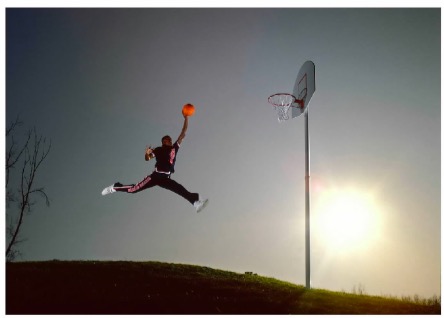
Image description: A basketball player is captured midair against a clear sky, legs spread wide in a split, holding an orange basketball high above his head as he approaches the hoop. The sun glows brightly to the right, casting dramatic light across the scene.
It depicts Jordan leaping toward a basketball hoop with a basketball raised above his head in his left hand, as though he is attempting to dunk the ball. The setting for the photo is not a basketball court, as one would expect in a shot of this sort. Instead, Rentmeester chose to take the photo on an isolated grassy knoll on the University of North Carolina campus. He brought in a basketball hoop and backboard mounted on a tall pole, which he planted in the ground to position the hoop exactly where he wanted. Whether due to the height of the pole or its placement within the image, the basketball hoop appears to tower above Jordan, beyond his reach.
Rentmeester instructed Jordan on the precise pose he wanted Jordan to assume. It was an unusual pose for a basketball player to adopt, one inspired by ballet’s grand jeté, in which a dancer leaps with legs extended, one foot forward and the other back. Rentmeester positioned the camera below Jordan and snapped the photo at the peak of his jump so that the viewer looks up at Jordan’s soaring figure silhouetted against a cloudless blue sky. Rentmeester used powerful strobe lights and a fast shutter speed to capture a sharp image of Jordan contrasted against the sky, even though the sun is shining directly into the camera lens from the lower right-hand corner of the shot.
Not long after Rentmeester’s photograph appeared in Life magazine, Nike contacted him and asked to borrow color transparencies of the photo. Rentmeester provided Nike with two color transparencies for $150 under a limited license authorizing Nike to use the transparencies “for slide presentation only.” It is unclear from the complaint what kind of slide presentation Nike may have been preparing, but the company was then beginning its lucrative partnership with Jordan by promoting the Air Jordan brand of athletic shoes.
In late 1984 or early 1985, Nike hired a photographer to produce its own photograph of Jordan, one obviously inspired by Rentmeester’s. In the Nike photo, Jordan is again shown leaping toward a basketball hoop with a basketball held in his left hand above his head, as though he is about to dunk the ball. See Appendix.
Michael Jordan Photo Commissioned By Nike
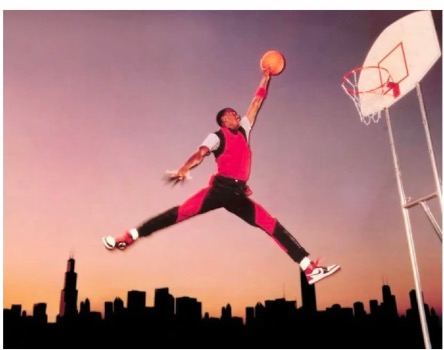
Image description: A basketball player in a red and black uniform leaps high in the air against a sunset sky, legs spread in a split, holding a basketball overhead toward the hoop. The city skyline, including the Sears Tower, is silhouetted in the background.
The photo was taken outdoors and from a similar angle as in Rentmeester’s photo, so that the viewer looks up at Jordan’s figure silhouetted against the sky. In the Nike photo, though, it is the city of Chicago’s skyline that appears in the background, a nod to the fact that by then Jordan was playing professionally for the Chicago Bulls. Jordan wears apparel reflecting the colors of his new team, and he is of course wearing a pair of Nike shoes. Nike used this photo on posters and billboards as part of its marketing campaign for the new Air Jordan brand.
When Rentmeester saw the Nike photo, he threatened to sue Nike for breach of the limited license governing use of his color transparencies. To head off litigation, Nike entered into a new agreement with Rentmeester in March 1985, under which the company agreed to pay $15,000 for the right to continue using the Nike photo on posters and billboards in North America for a period of two years. Rentmeester alleges that Nike continued to use the photo well beyond that period.
In 1987, Nike created its iconic “Jumpman” logo, a solid black silhouette that tracks the outline of Jordan’s figure as it appears in the Nike photo. See Appendix.
The Iconic Nike “Jumpman” logo
Image description: The black silhouette of a basketball player in mid-leap, legs spread wide and one arm extended upward holding a ball.
Over the past three decades, Nike has used the Jumpman logo in connection with the sale and marketing of billions of dollars of merchandise. It has become one of Nike’s most recognizable trademarks.
Rentmeester filed this action in January 2015. He alleges that both the Nike photo and the Jumpman logo infringe the copyright in his 1984 photo of Jordan. His complaint asserts claims for direct, vicarious, and contributory infringement, as well as a claim for violation of the Digital Millennium Copyright Act, 17 U.S.C. § 1202. Rentmeester seeks damages only for acts of infringement occurring within the Copyright Act’s three-year limitations period (January 2012 to the present). Doing so avoids the defense of laches that would otherwise arise from his 30-year delay in bringing suit. See Petrella v. Metro-Goldwyn-Mayer, Inc., 134 S.Ct. 1962, 1970 (2014).
The district court granted Nike’s motion to dismiss under Federal Rule of Civil Procedure 12(b)(6). The court dismissed Rentmeester’s claims with prejudice after concluding that neither the Nike photo nor the Jumpman logo infringe Rentmeester’s copyright as a matter of law. We review that legal determination de novo.
II
To state a claim for copyright infringement, Rentmeester must plausibly allege two things: (1) that he owns a valid copyright in his photograph of Jordan, and (2) that Nike copied protected aspects of the photo’s expression. See Feist Publications, Inc. v. Rural Telephone Service Co., 499 U.S. 340, 361 (1991); Shaw v. Lindheim, 919 F.2d 1353, 1356 (9th Cir. 1990).
Although our cases have not always made this point explicit, the second element has two distinct components: “copying” and “unlawful appropriation.” Sid & Marty Krofft Television Productions, Inc. v. McDonald’s Corp., 562 F.2d 1157, 1164-65 (9th Cir. 1977); Arnstein v. Porter, 154 F.2d 464, 468 (2d Cir. 1946). Proof of copying by the defendant is necessary because independent creation is a complete defense to copyright infringement. No matter how similar the plaintiff’s and the defendant’s works are, if the defendant created his independently, without knowledge of or exposure to the plaintiff’s work, the defendant is not liable for infringement. See Feist, 499 U.S. at 345-46. Proof of unlawful appropriation—that is, illicit copying—is necessary because copyright law does not forbid all copying. The Copyright Act provides that copyright protection does not “extend to any idea, procedure, process, system, method of operation, concept, principle, or discovery, regardless of the form in which it is described, explained, illustrated, or embodied in [the copyrighted] work.” 17 U.S.C. § 102(b). Thus, a defendant incurs no liability if he copies only the “ideas” or “concepts” used in the plaintiff’s work. To infringe, the defendant must also copy enough of the plaintiff’s expression of those ideas or concepts to render the two works “substantially similar.” Mattel, Inc. v. MGA Entertainment, Inc., 616 F.3d 904, 913-14 (9th Cir. 2010).
When the plaintiff lacks direct evidence of copying, he can attempt to prove it circumstantially by showing that the defendant had access to the plaintiff’s work and that the two works share similarities probative of copying. See Baxter v. MCA, Inc., 812 F.2d 421, 423 (9th Cir. 1987). Such proof creates a presumption of copying, which the defendant can then attempt to rebut by proving independent creation. Three Boys Music Corp. v. Bolton, 212 F.3d 477, 486 (9th Cir. 2000).
Unfortunately, we have used the same term—“substantial similarity”—to describe both the degree of similarity relevant to proof of copying and the degree of similarity necessary to establish unlawful appropriation. The term means different things in those two contexts. To prove copying, the similarities between the two works need not be extensive, and they need not involve protected elements of the plaintiff’s work. They just need to be similarities one would not expect to arise if the two works had been created independently. Laureyssens v. Idea Group, Inc., 964 F.2d 131, 140 (2d Cir. 1992). To prove unlawful appropriation, on the other hand, the similarities between the two works must be “substantial” and they must involve protected elements of the plaintiff’s work. Laureyssens, 964 F.2d at 140.1
Footnote 1: To avoid the confusion that arises from using the same term to describe two different concepts, some courts now use the term “probative similarity” to describe the similarities relevant to proof of copying.
In this case, Rentmeester has plausibly alleged the first element of his infringement claim—that he owns a valid copyright. The complaint asserts that he has been the sole owner of the copyright in his photo since its creation in 1984. And the photo obviously qualifies as an “original work of authorship,” given the creative choices Rentmeester made in composing it. See 17 U.S.C. § 102(a)(5); Burrow-Giles Lithographic Co. v. Sarony, 111 U.S. 53, 60 (1884). Rentmeester alleges that he registered his photo with the Copyright Office in 2014, which permits him to bring this suit. 17 U.S.C. § 411(a).
Rentmeester has also plausibly alleged the “copying” component of the second element. He alleges that he provided color transparencies of his photo to Nike’s creative director shortly before production of the Nike photo. That allegation establishes that Nike had access to Rentmeester’s photo, which in this context means a reasonable opportunity to view it. Nike’s access to Rentmeester’s photo, combined with the obvious conceptual similarities between the two photos, is sufficient to create a presumption that the Nike photo was the product of copying rather than independent creation.
The remaining question is whether Rentmeester has plausibly alleged that Nike copied enough of the protected expression from Rentmeester’s photo to establish unlawful appropriation. To prove this component of his claim, Rentmeester does not have to show that Nike produced an exact duplicate of his photo. But, as mentioned, he does have to show that Nike copied enough of the photo’s protected expression to render their works “substantially similar.” See Mattel, 616 F.3d at 913-14.
In our circuit, determining whether works are substantially similar involves a two-part analysis consisting of the “extrinsic test” and the “intrinsic test.” The extrinsic test assesses the objective similarities of the two works, focusing only on the protectable elements of the plaintiff’s expression. Cavalier v. Random House, Inc., 297 F.3d 815, 822 (9th Cir. 2002). Before that comparison can be made, the court must “filter out” the unprotectable elements of the plaintiff’s work—primarily ideas and concepts, material in the public domain, and scènes à faire (stock or standard features that are commonly associated with the treatment of a given subject). Id. at 822-23. The protectable elements that remain are then compared to corresponding elements of the defendant’s work to assess similarities in the objective details of the works. The intrinsic test requires a more holistic, subjective comparison of the works to determine whether they are substantially similar in “total concept and feel.” Id. at 822 (internal quotation marks omitted). To prevail, a plaintiff must prove substantial similarity under both tests. Funky Films, Inc. v. Time Warner Entertainment Co., 462 F.3d 1072, 1077 (9th Cir. 2006).
Only the extrinsic test’s application may be decided by the court as a matter of law, McCulloch v. Albert E. Price, Inc., 823 F.2d 316, 319 (9th Cir. 1987), so that is the only test relevant in reviewing the district court’s ruling on a motion to dismiss. Before applying the extrinsic test ourselves, a few words are in order about the filtering process that the test demands.
Certain types of works can be dissected into protected and unprotected elements more readily than others. With novels, plays, and motion pictures, for instance, even after filtering out unprotectable elements like ideas and scènes à faire, many protectable elements of expression remain that can be objectively compared. “Plot, themes, dialogue, mood, setting, pace, characters, and sequence of events” are elements we have previously identified. Funky Films, 462 F.3d at 1077.
Photographs cannot be dissected into protected and unprotected elements in the same way. To be sure, photos can be broken down into objective elements that reflect the various creative choices the photographer made in composing the image—choices related to subject matter, pose, lighting, camera angle, depth of field, and the like. See Ets-Hokin v. Skyy Spirits, Inc., 225 F.3d 1068, 1074-75 (9th Cir. 2000). But none of those elements is subject to copyright protection when viewed in isolation. For example, a photographer who produces a photo using a highly original lighting technique or a novel camera angle cannot prevent other photographers from using those same techniques to produce new images of their own, provided the new images are not substantially similar to the earlier, copyrighted photo. With respect to a photograph’s subject matter, no photographer can claim a monopoly on the right to photograph a particular subject just because he was the first to capture it on film. A subsequent photographer is free to take her own photo of the same subject, again so long as the resulting image is not substantially similar to the earlier photograph.
That remains true even if, as here, a photographer creates wholly original subject matter by having someone pose in an unusual or distinctive way. Without question, one of the highly original elements of Rentmeester’s photo is the fanciful (non-natural) pose he asked Jordan to assume. That pose was a product of Rentmeester’s own “intellectual invention,” Burrow-Giles, 111 U.S. at 60; it would not have been captured on film but for Rentmeester’s creativity in conceiving it. The pose Rentmeester conceived is thus quite unlike the pose at issue in Harney v. Sony Pictures Television, Inc., 704 F.3d 173 (1st Cir. 2013), which consisted of nothing more than a daughter riding piggyback on her father’s shoulders. The photographer there did not orchestrate the pose and, even if he had, the pose is so commonplace as to be part of the public domain. Id. at 187; see also Leibovitz v. Paramount Pictures Corp., 137 F.3d 109, 116 (2d Cir. 1998) (pose of a nude, pregnant woman in profile is part of the public domain).
Without gainsaying the originality of the pose Rentmeester created, he cannot copyright the pose itself and thereby prevent others from photographing a person in the same pose. He is entitled to protection only for the way the pose is expressed in his photograph, a product of not just the pose but also the camera angle, timing, and shutter speed Rentmeester chose. If a subsequent photographer persuaded Michael Jordan to assume the exact same pose but took her photo, say, from a bird’s eye view directly above him, the resulting image would bear little resemblance to Rentmeester’s photo and thus could not be deemed infringing.
What is protected by copyright is the photographer’s selection and arrangement of the photo’s otherwise unprotected elements. If sufficiently original, the combination of subject matter, pose, camera angle, etc., receives protection, not any of the individual elements standing alone. In that respect (although not in others), photographs can be likened to factual compilations. Justin Hughes, The Photographer’s Copyright—Photograph as Art, Photograph as Database, 25 Harv. J. L. & Tech. 339, 350-51 (2012). An author of a factual compilation cannot claim copyright protection for the underlying factual material—facts are always free for all to use. Feist, 499 U.S. at 347-48. If sufficiently original, though, an author’s selection and arrangement of the material are entitled to protection. Id. at 348-49. The individual elements that comprise a photograph can be viewed in the same way, as the equivalent of unprotectable “facts” that anyone may use to create new works. A second photographer is free to borrow any of the individual elements featured in a copyrighted photograph, “so long as the competing work does not feature the same selection and arrangement” of those elements. Id. at 349. In other words, a photographer’s copyright is limited to “the particular selection and arrangement” of the elements as expressed in the copyrighted image. Id. at 350-5.2
Footnote 2: We deal here with photographs of recognizable subject matter, rather than more abstract photographic works. We need not decide whether the same principles would apply with equal force to that latter category of works.
This is not to say, as Nike urges us to hold, that all photographs are entitled to only “thin” copyright protection, as is true of factual compilations. A copyrighted work is entitled to thin protection when the range of creative choices that can be made in producing the work is narrow. Mattel, 616 F.3d at 913-14. In Mattel, we noted by way of illustration that “there are only so many ways to paint a red bouncy ball on blank canvas.” Id. at 914. We contrasted that with the “gazillions of ways to make an aliens-attack movie,” a work that would be entitled to “broad” protection given the much wider range of creative choices available in producing it. Id. at 913-14. When only a narrow range of expression is possible, copyright protection is thin because the copyrighted work will contain few protectable features.
Some photographs are entitled to only thin protection because the range of creative choices available in selecting and arranging the photo’s elements is quite limited. That was the case in Ets-Hokin v. Skyy Spirits, Inc., 323 F.3d 763 (9th Cir. 2003), where we held that the plaintiff’s commercial product shots of a vodka bottle were entitled to only thin protection. Given the constraints imposed by the subject matter and conventions of commercial product shots, there were relatively few creative choices a photographer could make in producing acceptable images of the bottle. As a result, subtle differences in lighting, camera angle, and background were sufficient to render the defendant’s otherwise similar-looking photos of the same bottle non-infringing. Id. at 766.
With other photographs, however, the range of creative choices available to the photographer will be far broader, and very few of those choices will be dictated by subject matter or convention. On the spectrum we set out in Mattel—the relatively small number of ways “to paint a red bouncy ball on blank canvas” on one end, and the “gazillions of ways to make an aliens-attack movie” on the other—many photos will land more on the “aliens-attack movie” end of the range. 616 F.3d at 913-14. As with any other work, the greater the range of creative choices that may be made, the broader the level of protection that will be afforded to the resulting image. See id. at 916; McCulloch, 823 F.2d at 321.
Rentmeester’s photo is undoubtedly entitled to broad rather than thin protection. The range of creative choices open to Rentmeester in producing his photo was exceptionally broad; very few of those choices were dictated by convention or subject matter. In fact, Rentmeester’s photo is distinctive precisely because he chose not to be bound by the conventions commonly followed in photographing a basketball player attempting to dunk a basketball. Such photos would typically call for a basketball court as the setting, whether indoors or out. Rentmeester chose instead to place Jordan on an open, grassy knoll with a basketball hoop inserted as a prop, whimsically out of place and seeming to tower well above regulation height. Rentmeester also departed from convention by capturing Jordan in a fanciful, highly original pose, one inspired more by ballet’s grand jeté than by any pose a basketball player might naturally adopt when dunking a basketball. These creative choices—along with the other choices Rentmeester made with respect to lighting, camera angle, depth of field, and selection of foreground and background elements—resulted in a photo with many non-standard elements. Rentmeester’s selection and arrangement of those elements produced an image entitled to the broadest protection a photograph can receive.
With those preliminary observations out of the way, we can now turn to whether Rentmeester has plausibly alleged that his photo and the Nike photo are substantially similar under the extrinsic test. As discussed, that inquiry requires us to assess similarities in the selection and arrangement of the photos’ elements, as reflected in the objective details of the two works. We do not have a well-defined standard for assessing when similarity in selection and arrangement becomes “substantial,” and in truth no hard-and-fast rule could be devised to guide determinations that will necessarily turn on the unique facts of each case. See Peter Pan Fabrics, Inc. v. Martin Weiner Corp., 274 F.2d 487, 489 (2d Cir. 1960). The best we can do is borrow from the standard Judge Learned Hand employed in a case involving fabric designs: The two photos’ selection and arrangement of elements must be similar enough that “the ordinary observer, unless he set out to detect the disparities, would be disposed to overlook them.” Id.
We conclude that the works at issue here are as a matter of law not substantially similar. Just as Rentmeester made a series of creative choices in the selection and arrangement of the elements in his photograph, so too Nike’s photographer made his own distinct choices in that regard. Those choices produced an image that differs from Rentmeester’s photo in more than just minor details.
Let’s start with the subject matter of the photographs. The two photos are undeniably similar in the subject matter they depict: Both capture Michael Jordan in a leaping pose inspired by ballet’s grand jeté. But Rentmeester’s copyright does not confer a monopoly on that general “idea” or “concept”; he cannot prohibit other photographers from taking their own photos of Jordan in a leaping, grand jeté-inspired pose. Because the pose Rentmeester conceived is highly original, though, he is entitled to prevent others from copying the details of that pose as expressed in the photo he took. Had Nike’s photographer replicated those details in the Nike photo, a jury might well have been able to find unlawful appropriation even though other elements of the Nike photo, such as background and lighting, differ from the corresponding elements in Rentmeester’s photo.
But Nike’s photographer did not copy the details of the pose as expressed in Rentmeester’s photo; he borrowed only the general idea or concept embodied in the photo. Thus, in each photo Jordan is holding a basketball above his head in his left hand with his legs extended, in a pose at least loosely based on the grand jeté. The position of each of his limbs in the two photos is different, however, and those differences in detail are significant because, among other things, they affect the visual impact of the images. In Rentmeester’s photo, Jordan’s bent limbs combine with the background and foreground elements to convey mainly a sense of horizontal (forward) propulsion, while in the Nike photo Jordan’s completely straight limbs combine with the other elements to convey mainly a sense of vertical propulsion. While the photos embody a similar idea or concept, they express it in different ways.
As to the other highly original element of Rentmeester’s photo—the unusual out-door setting he chose—Nike’s photographer did not copy the details of that element either. The two photos again share undeniable similarities at the conceptual level: Both are taken outdoors without the usual trappings of a basketball court, other than the presence of a lone hoop and backboard. But when comparing the details of how that concept is expressed in the two photos, stark differences are readily apparent. Rentmeester set his shot on a grassy knoll with a whimsically out-of-place basketball hoop jutting up from a pole planted in the ground. The grassy knoll in the foreground of Rentmeester’s photo is wholly absent from the Nike photo. In fact, in the Nike photo there is no foreground element at all. The positioning of the basketball hoops is also materially different in the two photos. In Rentmeester’s photo, the hoop is positioned at a height that appears beyond the ability of anyone to dunk on (even someone as athletic as Jordan), which further contributes to the whimsical rather than realistic nature of the depiction. The hoop in the Nike photo, by contrast, appears to be easily within Jordan’s reach.
The other major conceptual similarity shared by the two photos is that both are taken from a similar angle so that the viewer looks up at Jordan’s soaring figure silhouetted against a clear sky. This is a far less original element of Rentmeester’s photo, as photographers have long used similar camera angles to capture subjects silhouetted against the sky. But even here, the two photos differ as to expressive details in material respects. In Rentmeester’s photo, the background is a cloudless blue sky; in the Nike photo, it is the Chicago skyline silhouetted against the orange and purple hues of late dusk or early dawn. In Rentmeester’s photo, the sun looms large in the lower right-hand corner of the image; in the Nike photo the sun does not appear at all. And in Rentmeester’s photo, parts of Jordan’s figure are cast in shadow, while in the Nike photo every inch of Jordan’s figure is brightly lit.
Finally, the arrangement of the elements within the photographs is materially different in two further respects. In Rentmeester’s photo, Jordan is positioned slightly left of center and appears as a relatively small figure within the frame. In the Nike photo, he is perfectly centered and dominates the frame. In Rentmeester’s photo, the basketball hoop stands atop a tall pole planted in the ground, and the hoop’s position within the frame balances Jordan’s left-of-center placement. In the Nike photo, the hoop takes up the entire right border of the frame, highlighting Jordan’s dominant, central position. The hoops are also lit and angled differently toward the viewer, further distinguishing their expressive roles in the photographs.
In our view, these differences in selection and arrangement of elements, as reflected in the photos’ objective details, preclude as a matter of law a finding of infringement. Nike’s photographer made choices regarding selection and arrangement that produced an image unmistakably different from Rentmeester’s photo in material details—disparities that no ordinary observer of the two works would be disposed to overlook. What Rentmeester’s photo and the Nike photo share are similarities in general ideas or concepts: Michael Jordan attempting to dunk in a pose inspired by ballet’s grand jeté; an outdoor setting stripped of most of the traditional trappings of basketball; a camera angle that captures the subject silhouetted against the sky. Rentmeester cannot claim an exclusive right to ideas or concepts at that level of generality, even in combination. Permitting him to claim such a right would withdraw those ideas or concepts from the “stock of materials” available to other artists, thereby thwarting copyright’s fundamental objective of fostering creativity. Warner Bros. Inc. v. American Broadcasting Cos., 720 F.2d 231, 240 (2d Cir. 1983). Copyright promotes the progress of science and the useful arts by “encourag[ing] others to build freely upon the ideas and information conveyed by a work.” Feist, 499 U.S. at 349-50. That is all Nike’s photographer did here.
If the Nike photo cannot as a matter of law be found substantially similar to Rentmeester’s photo, the same conclusion follows ineluctably with respect to the Jumpman logo. The logo is merely a solid black silhouette of Jordan’s figure as it appears in the Nike photo, which, as we have said, differs materially from the way Jordan’s figure appears in Rentmeester’s photo. Isolating that one element from the Nike photo and rendering it in a stylized fashion make the Jumpman logo even less similar to Rentmeester’s photo than the Nike photo itself.
III
Rentmeester makes three additional arguments in support of reversal, none of which we find persuasive.
A
First, Rentmeester contends that dismissal at the pleading stage is rarely appropriate in copyright infringement cases and that he should have been allowed to take discovery before the district court assessed substantial similarity. It is true that dismissal of copyright infringement claims occurs more commonly at the summary judgment stage, but dismissal at the pleading stage is by no means unprecedented. Dismissal is appropriate here because the two photos and the Jumpman logo are properly before us and thus capable of examination and comparison. Nothing disclosed during discovery could alter the fact that the allegedly infringing works are as a matter of law not substantially similar to Rentmeester’s photo.
This is not a case in which discovery could shed light on any issues that actually matter to the outcome. In some cases, the defendant claims independent creation as a defense and thus denies having had access to the plaintiff’s work. In that scenario, disputed factual issues will often require discovery to flesh out. Here, Nike does not contest that it had access to Rentmeester’s photo, so that issue is not in dispute.
In other cases, more may need to be known about the range of creative choices available to the plaintiff photographer in order to determine the breadth of protection available to his work. Here, we have accepted as true all of Rentmeester’s allegations concerning the creative choices he made in producing his photograph. But even granting his photo the broad protection it deserves, a comparison of the works at issue makes clear that Nike’s photographer made creative choices of his own, which resulted in an image and derivative logo not substantially similar to Rentmeester’s photo. Nothing disclosed during discovery could strengthen Rentmeester’s arguments on this score.
OWENS, Circuit Judge, concurring in part and dissenting in part:
I agree with most of the majority’s analysis, and with its holding that Rentmeester cannot prevail on his Jumpman logo copyright infringement claim. However, I respectfully disagree with the majority’s conclusion as to the Nike photo.
After correctly (1) setting out the law of copyright as applied to photographs, and (2) recognizing that Rentmeester’s photo is entitled to “broad” copyright protection, the majority then dissects why, in its view, the Rentmeester and Nike photos are, as a matter of law, not substantially similar. This section of the majority reads like a compelling motion for summary judgment or closing argument to a jury, and it may be correct at the end of the day. Yet such questions of substantial similarity are inherently factual, and should not have been made at this stage of the game.
Where no discovery has taken place, we should not say that, as a matter of law, the Nike photo could never be substantially similar to the Rentmeester photo. This is an inherently factual question which is often reserved for the jury, and rarely for a court to decide at the motion to dismiss stage.
“Although it may be easy to identify differences between” the two photos, the Nike photo also has “much in common” with the broadly protected Rentmeester photo. Leigh, 212 F.3d at 1216 (reversing summary judgment for defendant with respect to its alleged infringement of a photograph notwithstanding “undeniably[] significant differences between the pictures”). For example, in addition to the similarity of both photos capturing Michael Jordan doing a grand-jeté pose while holding a basketball, both photos are taken from a similar angle, have a silhouette aspect of Jordan against a contrasting solid background, and contain an outdoor setting with no indication of basketball apart from an isolated hoop and backboard.
I cannot say that no reasonable jury could find in favor of Rentmeester regarding the Nike photo, so I would hesitate in granting summary judgment. Here, the majority did not permit the case even to go that far. Rather, it substituted its own judgment—with no factual record development by the parties—as to why the photos are not substantially similar.
While I disagree with the majority’s ruling as to the Nike photo, I agree with its holding as to the Jumpman logo. The only element of the Rentmeester photo which Nike possibly could have copied to create the Jumpman logo is the outline of Jordan doing a grand-jeté pose while holding a basketball. As the cases that the majority cites make clear, the outline of a pose isolated from a photograph enjoys, at best, “thin” copyright protection. A grand-jeté dunking pose cannot receive the broad protection that Rentmeester claims, even if Rentmeester encouraged Jordan to strike it. The pose is ultimately no different from the Vulcan salute of Spock, the double thumbs up of Arthur Fonzarelli, or John Travolta’s iconic Saturday Night Fever dance pose.
All of these poses can exist independently of the photographer taking them. It does not matter that Rentmeester told Jordan to pose that way-standing alone, a photograph of a mannequin or marionette in that same pose would receive the same thin protection. Cf. Folkens v. Wyland Worldwide, LLC, 882 F.3d 768, 774-76 (9th Cir. 2018) (holding that two dolphins crossing each other was an unprotected element because that pose can be found in nature and it was irrelevant that the dolphins were posed by animal trainers). Indeed, Rentmeester cannot cite any cases to suggest that Jordan’s pose, in isolation, enjoys anything more than the thinnest of copyright protection. To hold otherwise would mean that a photographer would own a broad copyright over photos of human movements, including facial expressions. I cannot find any authority in our cases or the relevant copyright statutes that would permit such a radical change in our intellectual property laws. Cf. id. at 775 (reaffirming that “ideas, ‘first expressed in nature, are the common heritage of humankind, and no artist may use copyright law to prevent others from depicting them’”) (quoting Satava v. Lowry, 323 F.3d 805, 813 (9th Cir. 2003)).
At this stage of the litigation, we assume that (1) Nike traced the Jumpman logo directly from the Nike photo, and (2) that Nike based its photo on the Rentmeester photo. Even assuming all of this to be true, the Jumpman logo is not “virtually identical” to the image of Jordan in the Rentmeester photo. Mattel, Inc. v. MGA Entm’t, Inc., 616 F.3d 904, 914 (9th Cir. 2010). For example, there are differences in the angles of Jordan’s arms and legs, and the Jumpman logo is a black silhouette. And without being virtually identical, the Jumpman logo—the outline of a pose by Jordan in the Nike photo-cannot infringe upon any thin copyright protection enjoyed by the few elements of the Rentmeester photo allegedly copied. See id.
Accordingly, while I agree with the majority regarding the Jumpman logo, I think that whether the Nike photo is substantially similar is not an uncontested breakaway layup, and therefore dismissal of that copyright infringement claim is premature.
Notes and questions
(1) Why did Rentmeester wait so long to bring this case? In the cert petition following the Ninth Circuit’s decision, the photographer’s lawyers explained:
After Rentmeester’s difficult experience with Nike in first complaining about the infringing Nike photo, he concluded that he would not be able to alter Nike’s behavior further without litigation. But Rentmeester’s livelihood was commercial photography, and he did not want to put that at risk by filing a copyright lawsuit against one of the world’s most important advertisers. Rentmeester felt he had no choice but to wait until after retiring from commercial photography to file this case.
(2) The two-stage extrinsic/intrinsic test discussed in Rentmeester breaks the substantial similarity inquiry down into an objective analytical assessment of the works (so-called extrinsic) and a subjective one that focuses on the gestalt reaction of the ordinary observer (so-called intrinsic). Even once we get past the confusing terminology of extrinsic and intrinsic, how clear is the objective/subjective distinction, really?
In Rentmeester the court carefully filters out “unprotectable elements of the plaintiff’s work—primarily ideas and concepts, material in the public domain, and scènes à faire” but also acknowledges that what “is protected by copyright is the photographer’s selection and arrangement of the photo’s otherwise unprotected elements.” A few paragraphs later, the court admits that it does “not have a well-defined standard for assessing when similarity in selection and arrangement becomes ‘substantial,’ and in truth no hard-and-fast rule could be devised to guide determinations that will necessarily turn on the unique facts of each case.” Borrowing from Peter Pan Fabrics, the court posited that: “The two photos’ selection and arrangement of elements must be similar enough that ‘the ordinary observer, unless he set out to detect the disparities, would be disposed to overlook them.’” Thus, in what is supposed to be the hardnosed, dissection driven, objective “extrinsic” test, the court falls back on mushy gestalt impressions that would seem to belong in the so-called intrinsic part of the test.
Indeed, it is quite common for courts in the Ninth Circuit to offer counterbalancing dissection and anti-dissection rules on both sides of the extrinsic/intrinsic divide. Just as extrinsic analysis can’t be to dissective, the gestalt reaction of the ordinary observer in the intrinsic part of the test can’t be too gestalty. Even in the subjective intrinsic analysis, the finder of fact must distinguish between the protected and unprotected material in a plaintiff’s work.
(3) It is worth contrasting the Ninth Circuit’s decision in Rentmeester with the “Blurred Lines” case, Williams v. Gaye, 895 F.3d 1106 (9th Cir. 2018), decided not long before by a different panel of the same court.
When Robin Thicke and Pharrell Williams recorded their 2013 summer hit, “Blurred Lines,” the evidence suggests that they self-consciously emulated aspects of Marvin Gaye’s 1977 hit song “Got To Give It Up.”
The Blurred Lines case is polarizing because in spite of what should have been clear differences in the music, Blurred Lines certainly evokes Got To Give It Up, by employing similar percussion, production effects, instrumentation, use of silence, and standard musical techniques like melisma (singing a single word over several notes). But despite those similarities the songs are lyrically and melodically distinct. Much like the experts in Swirsky v Carey, the Gaye Family’s expert witnesses portrayed aspects of the works as melodically similar but relied on “non-corresponding portions of the melodies of the two works and distorted the duration and placement of notes in their presentation.” However, as noted in the Amicus Musicologists Brief in that case, if you align the supposedly similar sections of music as they are actually notated, their melodies and harmonies are demonstrably unrelated. The Amicus Musicologists conclude that “a straightforward comparison … of any protected expression in the two musical compositions should have demonstrated that they are thoroughly dissimilar.”
The litigation did not go well for Robin Thicke and Pharrell Williams. Marvin Gaye’s family prevailed in a 2015 jury trial and were awarded $7 million in damages as well as a significant stake in future licensing revenue. On appeal, a majority of the Ninth Circuit court of appeals upheld the jury verdict, partly out of deference to the jury (as in the Three Boys Music case) and the evidentiary foundation established by the experts (as in Swirsky v Carey), and partly due the failure of the lawyers for Robin Thicke and Pharrell Williams to move for judgment as a matter of law at the end of the trial. Doing so was necessary to preserve the arguments they had made on summary judgment. Judge Nguyen, dissenting, reviewed the evidence, explained why the selective approach taken by the Gaye’s experts was untenable, took care to filter out uncopyrightable elements and concluded that the jury’s verdict could not stand. Although it is relatively clear that Robin Thicke and Pharrell Williams should not have lost at trial, it is far less clear whether the Ninth Circuit would have been right to reverse the jury.
(4) Yonay is the Ninth Circuit’s most recent statement of how the extrinsic test operates on a literary work. What does it add to Rentmeester?
Yonay v. Paramount Pictures Corp., 163 F.4th 685 (9th Cir. 2026)
MILLER, Circuit Judge:
Shosh and Yuval Yonay own the copyright in “Top Guns,” a 1983 magazine article by Ehud Yonay about the United States Navy Fighter Weapons School, popularly known as “Top Gun.” They sued Paramount Pictures Corporation, alleging that its 2022 movie Top Gun: Maverick infringed that copyright. “Top Guns” and Maverick do share some similarities because they both depict the Navy’s real fighter-pilot training program. But copyright plaintiffs must show more than an allegedly infringing work’s general similarity to their own. They must show that what is similar is their original expression. Because Maverick does not share substantial amounts of the original expression of “Top Guns,” we affirm the district court’s grant of summary judgment for Paramount.
I
In 1983, California Magazine published “Top Guns,” an 11-page article by Ehud Yonay about the Fighter Weapons School, later renamed the Strike Fighter Tactics Instructor Program, a Navy program that teaches advanced air-combat tactics. (We refer to Ehud Yonay as “Yonay” and to Shosh and Yuval Yonay, Yonay’s heirs and the plaintiffs here, as “the Yonays.”) The article discusses the history, culture, and setting of the Top Gun program and vividly describes the experience of flying F-14 aircraft. It focuses on two lieutenants, callsigns “Yogi” and “Possum,” describing their decisions to become fighter pilots and their experiences in naval aviation and the Top Gun program. The article is written in a style that the Yonays refer to as “‘New Journalism,’ where writers use extensive imagery and subjective expression to present facts with the colorful voice of fiction.” A representative passage is one of the article’s first descriptions of Yogi and Possum flying:
From where they sit, however, it’s not their silver rocket that’s rocking but the entire vast blue dome of sea and sky. There are no ups or downs up here, no rights or lefts, just a barely perceptible line separating one blue from another, and that line is spinning and racing like mad in the distance. Yogi was still in junior high school when he realized that flying straight and level might be okay for some people, but if you like yanking and banking—the feeling of riding inside one of those storm-in-a-bottle souvenirs—then there’s just one place for you, and that’s the cockpit of a fighter plane.
Shortly after “Top Guns” was published, Yonay granted Paramount all rights to the article. In return, Paramount paid Yonay a fixed sum of money and agreed to credit him in any movies “produced by [Paramount] hereunder and substantially based upon or adapted from” the article.
In 1986, Paramount released the feature-length movie Top Gun, whose credits state that it was “suggested by” Yonay’s article. Top Gun enjoyed great commercial success and was the top-grossing movie of 1986. [The court summarized the plot of the 1986 film Top Gun.]
After Yonay died in 2012, his widow Shosh and his son Yuval became the owners of the copyright in “Top Guns.” In 2020, they terminated Yonay’s agreement with Paramount by invoking 17 U.S.C. § 203(a)(3), which allows an author’s heirs to terminate certain copyright grants made during his lifetime. [The court then summarized the plot of Top Gun: Maverick in detail.]
Like its predecessor, Maverick was a major commercial success. Paramount did not compensate the Yonays or credit Yonay in the film.
After Maverick’s release, the Yonays sued Paramount in the Central District of California, asserting claims for copyright infringement and breach of contract. The district court denied a motion to dismiss but later granted Paramount’s motion for summary judgment. The court concluded that “Top Guns” and Maverick are not “substantially similar,” as required to establish copyright infringement. While the works have “some similarities,” the court explained, those similarities are “based on unprotected elements” like facts about the Top Gun program, “general plot ideas, and familiar stock scenes and themes.”
The Yonays appeal. We review the district court’s grant of summary judgment de novo.
II
To establish copyright infringement, plaintiffs must show that (1) they own a valid copyright in a work and (2) the defendant copied original aspects of the work. Feist Publ’ns, Inc. v. Rural Tel. Serv. Co., 499 U.S. 340, 361 (1991). Only the second element is at issue in this case, and really only part of it: Paramount argues that the Yonays have not shown that anything copied from the article was original—in other words, that they have not shown “unlawful appropriation.” Skidmore as Tr. for Randy Craig Wolfe Tr. v. Led Zeppelin, 952 F.3d 1051, 1064 (9th Cir. 2020) (en banc).
Copyright protection does not “extend to any idea, procedure, process, system, method of operation, concept, principle, or discovery, regardless of the form in which it is described, explained, illustrated, or embodied in such work.” 17 U.S.C. § 102(b). “Thus, a defendant incurs no liability if he copies only the ‘ideas’ or ‘concepts’ used in the plaintiff’s work.” Rentmeester v. Nike, Inc., 883 F.3d 1111, 1117 (9th Cir. 2018), overruled in part on other grounds by Skidmore, 952 F.3d at 1068-69. And, of particular relevance here, copyright law also does not protect the facts set forth in a work, so a defendant is not liable for copying them. Feist, 499 U.S. at 346-48; accord Harper & Row Publishers, Inc. v. Nation Enters., 471 U.S. 539, 556 (1985) (“No author may copyright his ideas or the facts he narrates.”). “Copyright assures authors the right to their original expression, but encourages others to build freely upon the ideas and information conveyed by a work.” Feist, 499 U.S. at 349-50.
To show unlawful appropriation, plaintiffs must therefore demonstrate that the works in question share “substantial similarity in protectable expression,” not merely in facts, ideas, or concepts. Skidmore, 952 F.3d at 1064 (emphasis added). To do so, they must satisfy both an extrinsic test and an intrinsic test. Williams v. Gaye, 895 F.3d 1106, 1119 (9th Cir. 2018). The extrinsic test “assesses the objective similarities of the two works.” Rentmeester, 883 F.3d at 1118. The intrinsic test is subjective and tests “for similarity of expression from the standpoint of the ordinary reasonable observer, with no expert assistance.” Jada Toys, Inc. v. Mattel, Inc., 518 F.3d 628, 637 (9th Cir. 2008) (quoting Apple Comput., Inc. v. Microsoft Corp., 35 F.3d 1435, 1442 (9th Cir. 1994)). Because “the intrinsic test is reserved exclusively for the trier of fact,” only the extrinsic test is relevant at the summary-judgment stage. Williams, 895 F.3d at 1119.
“When applying the extrinsic test, a court must filter out and disregard the non-protectible elements.” Cavalier v. Random House, Inc., 297 F.3d 815, 822 (9th Cir. 2002). For literary works, “the test focuses on articulable similarities between the plot, themes, dialogue, mood, setting, pace, characters, and sequence of events in two works.” Id..
But even if none of the artistic elements in those categories reveals substantial similarity, works can be substantially similar if they share the “selection and arrangement” of those elements—or, in other words, “the particular way in which the artistic elements form a coherent pattern, synthesis, or design.” Skidmore, 952 F.3d at 1074; see Hanagami v. Epic Games, Inc., 85 F.4th 931, 943 (9th Cir. 2023). For a “selection-and-arrangement” claim to succeed, the elements themselves need not be protectable. Rather, “a copyright plaintiff may argue ‘infringement... based on original selection and arrangement of unprotected elements.’” Skidmore, 952 F.3d at 1074 (omission in original) (quoting Metcalf v. Bochco, 294 F.3d 1069, 1074 (9th Cir. 2002)); see also Metcalf, 294 F.3d at 1074 (“The particular sequence in which an author strings a significant number of unprotectable elements can itself be a protectable element.”).
We first evaluate the Yonays’ arguments about individual elements of the works and then consider their argument based on selection and arrangement.
A
The Yonays contend that there are similarities in each of the categories of elements described in our cases: plot, sequence of events, characters, dialogue, themes, mood, setting, and pace. We agree with the district court that the Yonays cannot show meaningful similarities in any of those categories.
Before considering the individual categories, however, we observe a problem that pervades the Yonays’ arguments: Although “Top Guns” contains much original, protected expression—most notably, its vivid phrasing and innovative structure—none of that expression appears in Maverick. The Yonays identify similarities between the article and the film only by describing both works at such a high level of abstraction that the similarities do not involve protected expression. Their claim of substantial similarity fails because what is protected is not similar, and what is similar is not protected.
Plot and Sequence of Events: We are not sure it is accurate to characterize “Top Guns” as having a “plot” in the conventional sense—it is a nonfiction work, and the portions of the article that describe specific events do so in a nonlinear way that is repeatedly interrupted by historical and descriptive digressions. The article describes the various planes used by Navy fighter pilots, recounts how pilots learn to fly, explains the origin of the Top Gun program, and includes detailed descriptions of a flight simulator and Yonay’s own experience in a fighter plane. To the extent there is a plot, it is Yogi and Possum’s journey: They complete flight school and meet while going through fighter-pilot training; they are deployed on an aircraft carrier; they are sent to Top Gun as students and proceed through the school’s curriculum; and they graduate and are deployed again.
[The court contrasted Maverick’s conventional three-act plot with the article’s nonlinear, digressive structure.]
The Yonays argue that those differences are irrelevant to the analysis of substantial similarity. We agree with the general proposition that “no plagiarist can excuse the wrong by showing how much of his work he did not pirate.” Sheldon v. Metro-Goldwyn Pictures Corp., 81 F.2d 49, 56 (2d Cir. 1936) (L. Hand, J.). But a plot is simply “the ‘sequence of events’ by which the author expresses his ‘theme’ or ‘idea.’” Shaw v. Lindheim, 919 F.2d 1353, 1363 (9th Cir. 1990) (quoting 3 Melville B. Nimmer, Nimmer on Copyright § 13.03[A] (1989)), overruled in part on other grounds by Skidmore, 952 F.3d at 1068-69. The more that events are added to or subtracted from that sequence, the less that the plots can reasonably be described as similar, even if there is some overlap. Cf. Woodland v. Hill, 136 F.4th 1199, 1211 n.4 (9th Cir. 2025) (noting that “courts may identify differences in the works to explain why there is no substantial similarity”).
At oral argument, the Yonays emphasized that Maverick “lifts certain things” from “Top Guns,” including the fact that the F-14 “swings back its wings so that it can ... do a short takeoff”—a feature that becomes relevant to the plot when Maverick and Rooster take off in a stolen F-14 to escape enemy territory. But the F-14 is a real plane with variable-sweep wings. See Jane’s All the World’s Aircraft 1983-84, at 392 (John W.R. Taylor ed., 1983) (noting that “the configuration of the F-14 includes variable geometry wings” with “20° of leading-edge sweep in the fully forward position and 68° when fully swept”). The evocative language that “Top Guns” uses to describe the aircraft’s design—that its “wings can sweep back for fast flying or open to the sides like an eagle’s for landing or just for cruising around”—does not appear in Maverick. And the basic facts of the design do not enjoy copyright protection. See Feist, 499 U.S. at 349 (“No matter how original the format, however, the facts themselves do not become original through association.”). [The court rejected further asserted plot similarities as unprotectable facts and ideas.]
Characters: No character described in “Top Guns” appears in Maverick. In both works, of course, many of the characters are Top Gun instructors and trainees. But in a work about Top Gun, using instructors and trainees as characters is hardly original. In any event, the characters in the article are real people, and “a character based on a historical figure is not protected for copyright purposes.” Corbello v. Valli, 974 F.3d 965, 976 (9th Cir. 2020).
The Yonays point to the article’s “expressive characterizations” of the real Top Gun trainees. They highlight, for example, its description of the trainees in a bar: “These supremely healthy young males are standing around in twos and threes and talking about” a training flight while ignoring the dancing women “waving right in front of their eyes.” Those descriptive phrases are entitled to copyright protection: Although ideas and facts themselves are not protectable, “the specific details of an author’s rendering of ideas” and facts are. Corbello, 974 F.3d at 975 (quoting Funky Films, Inc. v. Time Warner Ent. Co., 462 F.3d 1072, 1077 (9th Cir. 2006)). But none of the quoted phrases appears in Maverick. The Yonays instead argue that Maverick copied general traits from the article’s characters—for example, that the film depicts pilots as “men’s men” who are “jocular, confident, competitive..., good-humored and deeply committed.” Like the Yonays’ asserted plot similarities, those traits are too general to be protectable. See Biani v. Showtime Networks, Inc., 153 F.4th 957, 965 (9th Cir. 2025).
Dialogue: It is unclear that any of the dialogue in “Top Guns” is protectable, given that the article presents all of that dialogue as real statements of real Top Gun instructors and trainees. See Corbello, 974 F.3d at 978 (“Elements of a work presented as fact are treated as fact.”). Regardless, none of the dialogue in “Top Guns” appears in Maverick—with the exception of the two-word phrase “fight’s on,” something that real fighter pilots say before beginning training exercises.
Faced with the lack of similarity in dialogue, the Yonays again resort to abstraction, arguing that “the characters in both Works speak in a way that is at once droll, idiomatic, techy, and charmingly unguarded.” Assuming that description to be accurate, it is too general to be protectable. [The court found no protectable similarity in theme, mood, setting, or pace.]
B
Given the lack of similarity in protectable elements, the Yonays understandably focus on a selection-and-arrangement argument. “A selection and arrangement copyright protects ... the particular way in which the artistic elements form a coherent pattern, synthesis, or design.” Skidmore, 952 F.3d at 1074. We consider selection-and-arrangement arguments because of the possibility that the original expression a defendant has copied from a plaintiff cannot be categorized as one, or even a combination, of plot, themes, dialogue, mood, setting, pace, characters, or sequence of events. But although “the particular sequence in which an author strings a significant number of unprotectable elements can itself be a protectable element,” Metcalf, 294 F.3d at 1074, that particular sequence must be original, see Feist, 499 U.S. at 349. To assert a selection-and-arrangement argument, a copyright plaintiff must identify “a combination of ... elements... numerous enough” and with a “selection and arrangement original enough that their combination constitutes an original work of authorship.” Skidmore, 952 F.3d at 1074 (quoting Satava v. Lowry, 323 F.3d 805, 811 (9th Cir. 2003)). Then, the plaintiff must show that the defendant’s selection and arrangement is substantially similar to the plaintiff’s. Id. at 1075.
The Yonays assert that the district court erred by “comparing the Works’ selection and arrangement of only ‘unprotected elements,’” because “selection and arrangement analysis must consider all elements, protected and unprotected.” We agree that an original selection and arrangement could include both protectable and unprotectable elements, and in such cases, a court should compare the selection and arrangement of all the elements. But to the extent the Yonays are arguing that a plaintiff can prevail under a selection-and-arrangement theory simply by showing that the two works share many similar elements, whether unprotectable or protectable, their argument reveals a misunderstanding of the extrinsic test.
As we have explained, a court applying the extrinsic test must filter out the unprotected elements. “‘Filtering’ and ‘selection and arrangement’ are not truly distinct tests.” Hanagami, 85 F.4th at 942 n.11. Both ask whether the defendant has copied something other than unprotectable elements. Filtering means that in addition to identifying the “articulable similarities” in the specific objective elements of the works in question, Cavalier, 297 F.3d at 822 (quoting Kouf, 16 F.3d at 1045), a court must also “determine whether the similar elements are protectable or unprotectable,” Mattel, Inc. v. MGA Ent., Inc., 616 F.3d 904, 913 (9th Cir. 2010). Only then can it be assured that “the protectable elements, standing alone, are” what is “substantially similar.” Corbello, 974 F.3d at 975 (quoting Funky Films, 462 F.3d at 1077).
To be sure, protectable expression can be, and often is, composed of smaller, unprotectable elements. A plot, for instance, is simply a combination of events. See Shaw, 919 F.2d at 1363. Although no discrete event that makes up a plot is itself protectable, a court cannot simply ignore all the unprotectable events, or it would be unable to identify the plot. In other words, even after a court filters out unprotectable elements, it may still consider those elements to the extent that they are constituent parts of protectable categories of expression.
Selection-and-arrangement analysis works the same way. A selection and arrangement of elements can be original and protectable, whether or not the elements themselves are protectable. When comparing two works’ selection and arrangement of elements, a court cannot blind itself to the elements, but similarities in those elements alone—no matter their quantity or importance to the work— cannot demonstrate unlawful appropriation. Instead, to be substantially similar, the works must share a “pattern, synthesis, or design” that is both “particular” and “coherent.” Skidmore, 952 F.3d at 1074.
The Yonays identify no such shared pattern of expression here. As with their argument about individual elements, the Yonays identify multiple factual similarities between the works when discussing selection and arrangement: for example, that “only the best of the best get invited back to Top Gun as instructors,” that “pilots live in a communal world,” that the program involves “grueling training,” and that lieutenants “carouse at the bar, which has a big brass bell and where those who break ‘house rules’ must buy a round for everyone.” But those are unprotectable facts about the Top Gun program, and a copyright plaintiff “cannot establish substantial similarity by reconstituting the copyrighted work as a combination of unprotectable elements and then claiming that those same elements also appear in the defendant’s work, in a different aesthetic context.” Skidmore, 952 F.3d at 1075; see also Corbello, 974 F.3d at 974 n.2 (rejecting a selection-and-arrangement theory where the works depicted shared factual elements “from different perspectives, with different characterizations of the people involved, in different media, and communicating a different overall message”).
The Yonays attempt to articulate patterns that the works share, but the patterns they describe are not the original expression in Yonay’s copyrighted article. For example, they point out that “rather than offer an encyclopedic narration of the naval base’s operations, Yonay focused on the personal backgrounds and idiosyncrasies of ambitious fighter pilots to engage his audience and humanize” the characters in “Top Guns.” They assert that Yonay “patterned contradictory character elements to engage his audience and enhance his Story: e.g., pilots are fierce, but playful; regimented, but irreverent; macho, but sensitive.” And they say that, in both works, “passages of idyllic flying over the beach in Southern California are juxtaposed suddenly and violently with gut-wrenching climbs, dives, and dogfights,” causing “beauty and terror” to “spring from each other.”
Those abstract ideas are not the article’s original expression. Showing characters’ backgrounds and personalities, giving them contradictory traits, and displaying action in aesthetically pleasing places have all been done before. And even if they had not, the Yonays “cannot claim an exclusive right to ideas or concepts at that level of generality, even in combination. Permitting them to claim such a right would withdraw those ideas or concepts from the ‘stock of materials’ available to other artists, thereby thwarting copyright’s ‘fundamental objective’ of ‘fostering creativity.’” Rentmeester, 883 F.3d at 1123 (quoting Warner Bros. Inc. v. American Broad. Cos., 720 F.2d 231, 240 (2d Cir. 1983)); see also Nichols v. Universal Pictures Corp., 45 F.2d 119, 121 (2d Cir. 1930) (L. Hand, J.) (“Upon any work, and especially upon a play, a great number of patterns of increasing generality will fit equally well, as more and more of the incident is left out.... But there is a point in this series of abstractions where they are no longer protected, since otherwise the playwright could prevent the use of his ‘ideas,’ to which, apart from their expression, his property is never extended.”).
In the face of a lack of substantial similarity, the Yonays emphasize that “Top Guns” contains significant amounts of original expression. But the expressive nature of the article shows merely that the work receives full copyright protection and that the substantial-similarity standard applies—in contrast, for example, to “painting a red bouncy ball on blank canvas,” where “there’s only a narrow range of” possible expression, so “a work must be ‘virtually identical’ to infringe.” Mattel, 616 F.3d at 914 (quoting Apple Comput., Inc. v. Microsoft Corp., 35 F.3d 1435, 1446-47 (9th Cir. 1994)). The question under the extrinsic test is whether the expression in Maverick is substantially similar to the original expression in “Top Guns,” and it is not.
AFFIRMED.
Notes and questions
(1) What does Yonay tell us about how filtration works in the Ninth Circuit? What does it suggest about the limits of similarity arguments based on selection-and-arrangement?
(2) The Ninth Circuit Reconsiders the Intrinsic Test. Having only fairly recently sorted out the mess it created in Sid & Marty Krofft, the Ninth Circuit now appears uneasy with the implications of the intrinsic half of the extrinsic/intrinsic test. Jeffrey Sedlik is a photographer; his 1989 portrait of Miles Davis, with a finger raised to his lips, is among the best-known images of the musician. Katherine Von Drachenberg, the tattoo artist better known as Kat Von D, used the photograph as a reference for a tattoo she gave a friend without charge, and posted images of the work in progress and of the finished tattoo on social media. Sedlik sued. At trial the jury found that the tattoo was not substantially similar to the photograph, and that other images used as intermediate copies in the process of creating the tattoo were fair use. A panel of the Ninth Circuit affirmed. Two members of the panel wrote separately to argue that the circuit’s intrinsic test should be abandoned, describing it as standardless and as inviting juries to reach copyright verdicts unconstrained by copyright law.
On 9 June 2026 the court granted rehearing en banc and vacated the panel opinion. See Sedlik v. Von Drachenberg, No. 24-3367. Argument was set for the week of 28 September 2026. The question for the en banc court is whether the intrinsic prong, as a subjective, expert-free, essentially unreviewable inquiry, has any continuing place in copyright infringement analysis, or whether the objective work of filtration ought to be the whole of it.
Was the jury so wrong? The verdict has been described as jury nullification, but that might be unfair to the jurors and it is certainly unfair to the defense. Counsel for Von Drachenberg succeeded in getting the jury to understand how a tattoo differs from a conventional two-dimensional image: it is applied to a living, curved, moving surface, its execution is constrained by the medium in ways a print is not, and it exists as an object on a person rather than as a picture. Those same differences largely disappear when the comparison presented on appeal, or in a casebook, is between the original photograph and a photograph of the tattoo. Flattened onto the page, the two images look far more alike than the tattoo and the photograph did to the jury.
Perhaps the gap between what the jury saw and what a reviewing court sees is a good reason to be skeptical of the need for appellate courts to police a verdict for the defense based on the ordinary observer’s reaction?
The Inevitable Tension Between Dissection and Gestalt
The extrinsic/intrinsic test from Sid & Marty Krofft has come a long way. Thanks to Rentmeester and other cases, it should now be clear that proving copyright infringement in the Ninth Circuit requires establishing copying in fact and wrongful copying, not merely access + substantial similarity. It should also be clear now that the two-part extrinsic/intrinsic test is nested within wrongful copying, on the assumption that copying in fact has already been established. In other words, Rentmeester brings Ninth Circuit copyright back into alignment with the copying in fact versus wrongful copying framework of the Second Circuit.
In both circuits, copying in fact can be proven directly by admission or eyewitness accounts, or indirectly by evidence of access and similarities that are probative of copying (whether or not these similarities are the kind that would make such copying wrongful). We address potential trade-offs between access and probative similarity in the next chapter.
On the issue of wrongful copying, courts in both circuits still face the difficult question of how to avoid finding of infringement to be based on similarities in unprotectable elements while steering clear of the opposite trap of disaggregating works into nothingness. After all, even the greatest works of literature are simply new towers made by the combination of old bricks and in many fields of artistic endeavor copyrightability rests on how uncopyrightable elements are combined.
Courts almost always say that the test for infringement is based on the reaction of the ordinary observer, but that is only ever true in the sense that the ordinary observer is an extraordinary legal fiction (like the “reasonable man” in negligence and the “person having ordinary skill in the art” in patent law). In most contexts, courts will attempt to parse out ideas from their expression, identify literary tropes, conventions, scènes à faire, and the constraints of the relevant medium, chosen materials, genre and public expectation. Such unprotectable elements are not always shielded from the observation of the ordinary observer, but the jury asked to evaluate what an ordinary observer would say is inevitably instructed to restrict their assessment to copyrightable features or combinations.
In the Second Circuit, the standard test for substantial similarity to establish wrongful copying is whether an ordinary observer would find the works the same in terms of “aesthetic appeal” or “total concept and feel” or whether they would “recognize the alleged copy as having been appropriated from the copyrighted work.” Sometimes courts in the Second Circuit expressly require the ordinary observer to be “more discerning” and filter out the unprotectible elements. Sometimes they allow those unprotectible elements to be considered in combination. Always the fact finder is cautioned that similarity between two works must concern the expression of ideas, not the ideas themselves. There is, in short, a confusing mishmash of dissective and holistic approaches.
The Ninth Circuit is no longer that different to the Second, except that the extrinsic-intrinsic test gives more structure to the analysis. In the Ninth Circuit after copying in fact has been conceded or established, the court then shifts to determining whether works are substantially similar both extrinsically and intrinsically. The extrinsic test focuses on objective similarities between the protectable elements of the plaintiff’s expression and the defendant’s work. To enable this focus the court must “filter out” the unprotectable elements of the plaintiff’s work—primarily ideas and concepts, material in the public domain, and scènes à faire. The protectable elements that remain are then compared to corresponding elements of the defendant’s work to assess similarities in the objective details of the works. Sometimes after this filtering there is nothing left to compare, and summary judgment should be awarded to the defendant. If the plaintiff shows that there is some “extrinsic” similarity in protectable expression, it must also show that there is an “intrinsic” similarity. The intrinsic test requires a more holistic, subjective comparison of the works to determine whether they are substantially similar in “total concept and feel.”