Part 2 · Chapter 14
Fair Use in Particular Contexts—Part II
Orthogonal uses
In Unbundling Fair Uses, Pamela Samuelson introduces the concept of “orthogonal uses” to describe a category of uses that do not compete with or substitute for the original work and are therefore more likely to be found fair. These are uses that serve fundamentally different purposes from the original—hence, orthogonal, meaning at right angles or non-overlapping in function. Samuelson contrasts these with uses that are more commercially or functionally aligned with the original, which are more likely to raise concerns about market harm or substitution. Orthogonal uses tend to serve an entirely different audience or entirely different function and self-evidently pose minimal or no threat to the market for the original work. They also often further broader public policy goals.
Evidence
Bond v. Blum 317 F.3d 385 (4th Cir. 2003)
In the early 2000s, William Bond married the recently divorced Alyson Slavin. Alyson Slavin and her ex-husband, William Slavin, were locked in a custody battle in which the ex-husband argued, for reasons that will become apparent, that the Bond-Slavin household was not a suitable environment for the former couple’s three children. Bond had a colorful background: he had been a country club tennis instructor, a bicycle salesman, a bodyguard, and an unpublished author. He was also a self-confessed murderer. Bond’s Self-Portrait of a Patricide: How I Got Away with Murder recounts in horrific detail how, at the age of 17, he planned and carried out the murder of his father with a hammer. As prose, the work apparently had no great appeal, but as evidence that the Bond house might not be the best place for a child to grow up, the book was solid gold. When William Slavin’s legal team introduced the manuscript at a deposition, Bond responded by registering his work with the Copyright Office and bringing an action for copyright infringement against William Slavin and his attorneys. Alyson Slavin’s parents, the Blums, who had been extorted by Bond and feared for their daughter’s safety, were also defendants in the copyright case. The district court held that Blum’s reproduction of the book was fair use and Bond appealed.
NIEMEYER, Circuit Judge.
… The first § 107 factor directs the inquiry into the “purpose and character of the [defendants’] use, including whether such use is of a commercial nature or is for nonprofit educational purposes.” 17 U.S.C. § 107(1). Application of this factor weighs heavily against Bond’s infringement claim. The defendants’ use of Bond’s copyrighted manuscript is not for any commercial purpose; the defendants are not seeking to exploit the copyrighted material without paying the customary price. Indeed, the defendants’ use is indifferent to Bond’s mode of expression. Rather, the narrow purpose of defendants’ use of the manuscript is for the evidentiary value of its content insofar as it contains admissions that Bond may have made against his interest when he bragged about his conduct in murdering his father, in taking advantage of the juvenile justice system, and in benefiting from his father’s estate. These are all facts relevant to the custody decision, and their use does not draw on Bond’s mode of expression.
Neither in his brief nor at oral argument has Bond been able to identify any harm or potential harm to his work against which the law of copyrights protects. The only harm that we can discern from his arguments is a claim that he has lost the right to control the release of a “private” or “confidential” document. But at oral argument, he conceded that the document was not confidential. Indeed, it is apparent that Bond has circulated the document in an effort to have it published. But more importantly, the protection of privacy is not a function of the copyright law. To the contrary, the copyright law offers a limited monopoly to encourage ultimate public access to the creative work of the author. If privacy is the essence of Bond’s claim, then his action must lie in some common-law right to privacy, not in the Copyright Act.
We next consider the second factor, “the nature of the copyrighted work.” 17 U.S.C. § 107(2). That Bond’s manuscript is unpublished and contains a stylized mode of expressing his feelings about historical facts weigh against a finding of fair use. But, as Campbell instructs, we do not consider the § 107 factors “in isolation, one from another,” but we weigh them together “in light of the purposes of copyright.” 510 U.S. at 578. Where, as here, the use of the work is not related to its mode of expression but rather to its historical facts and there is no evidence that the use of Bond’s manuscript in the state legal proceedings would adversely affect the potential market for the manuscript, one cannot say the incentive for creativity has been diminished in any sense. And because the societal benefit of having all relevant information presented in a judicial proceeding is an important one, it should be furthered if doing so would not unduly undermine the author’s rights with regard to his creative work.
Under the third § 107 factor, we examine the “amount and substantiality of the portion used in relation to the copyrighted work as a whole.” 17 U.S.C. § 107(3). As a general matter, as the amount of the copyrighted material that is used increases, the likelihood that the use will constitute a “fair use” decreases. But this is an imperfect generalization: “The extent of permissible copying varies with the purpose and character of the use.” Campbell, 510 U.S. at 586-87, 114 S.Ct. 1164.
It is conceded that the defendants’ challenged use of the manuscript in the state-court proceeding involved all, or nearly all, of the copyrighted work. Its use, however, was not for its expressive content, but rather for its allegedly factual content. The sole purpose and intent of introducing Bond’s manuscript was to obtain admissions of fact against his interest in an effort to prove that his home would not be a suitable place for custody of children. The use of the copyrighted material in this context, even the entire manuscript, does not undermine the protections granted by the Act but only serves the important societal interest in having evidence before the factfinder. Because the manuscript was not used to undermine any right conferred by the Copyright Act, Bond can derive little benefit from this factor in the context of this case.
Finally, we consider the effect of the defendants’ use of Bond’s copyrighted manuscript “upon the potential market for or value of the copyrighted work.” 17 U.S.C. § 107(4). This factor … touches most closely upon the author’s ability to capture the fruits of his labor and hence his incentive to create. Under this core inquiry, we determine whether the defendants’ introduction of the manuscript in evidence would materially impair the marketability of the work and whether it would act as a market substitute for it. On this factor, there is no evidence that the admission into evidence of Bond’s manuscript would adversely affect its marketability. Indeed, the district court made the observation: “Ironically, if anything, [the defendants’ use] increases the value of the work in a perverse way, but it certainly doesn’t decrease it.”
In sum, we conclude that the district court did not err in concluding that the defendants’ use of the manuscript as evidence in the state-court proceeding fell within the scope of fair use authorized by § 107 of the Copyright Act. To the contrary, we agree with the district court when it stated:
Purpose and character of the defendants’ use has nothing whatsoever to do with any interest that the copyright law was designed to protect. The copyright law was never designed to protect content as distinguished from mode of expression. It was certainly never intended to utilize, to keep from the public the ability to state the facts in a document as compared to the mode of expression. Moreover, the effect of defendants’ use on the potential market for value of the copyrighted work is absolutely zero.
Notes and questions
(1) The most surprising thing about Bond v. Blum is that it is not the only reported case involving fair use and murder. In 2005, a District Court in Virginia held that photographer Robert Shell’s copyright interests did not prevent the local police from reproducing a photo Shell had taken of his former assistant. See, Shell v. City of Radford, 351 F. Supp. 2d 510 (W.D. Va. 2005). The police were using the photo to solicit information from the public as they investigated Shell for the murder of said assistant. Shell lost his copyright case and was later convicted of manslaughter.
(2) In Jartech, Inc. v. Clancy, 666 F.2d 403 (9th Cir.1982) the Ninth Circuit found that photos and audio recordings of adult movies taken by agents of the city council for use in a nuisance abatement proceeding were fair use. Jartech stands out from other evidentiary fair use cases because the Ninth Circuit upheld a jury verdict of fair use with almost no discussion of the fair use factors. It simply noted that the defendants had reproduced the work as evidence in the nuisance abatement proceedings and not at all for the work’s “intrinsic purpose” and that as such a finding of fair use was justified.
In this case, the use to which the alleged infringers put the copy is not an intrinsic use. The alleged infringers made abbreviated copies of the films, not for subsequent use and enjoyment, but for evidence to be used in the nuisance abatement proceedings.
It is more common to see courts dutifully, almost ploddingly, work their way through the fair use factors in evidentiary fair use cases. Nonetheless, the decisive factor in evidentiary fair use cases is the fundamental difference between using a work as evidence and using it for its intrinsic purpose, regardless of whether that intrinsic purpose was informational, expressive or entertaining. The district court in Shell explained the difference in purpose as the contrast between using Shell’s photographs “for their evidentiary and investigatory value” and their “expressive content.” In Bond, the court made the same point by noting the copyright defendants’ indifference to the book’s expressive qualities: “The defendants’ use of Bond’s copyrighted manuscript … is indifferent to Bond’s mode of expression.” In another passage the court framed the contrast between using the manuscript as evidence and exploiting “the book’s manner of expression for any purpose, commercial or otherwise.”
(3) Why did the Fourth Circuit allow use of Self-Portrait of a Patricide in Bond v. Blum despite the fact that the entire manuscript was copied?
(4) The plaintiffs in Bond, Shell, and Jartech certainly had interests that were adversely affected by the unauthorized copying, why didn’t those interests carry the day under the fourth fair use factor?
(5) What if a freelance photographer was hired to take crime scene photographs? Would the use of those photos in a related civil case be fair use?
Right of Reply
Hustler Magazine Inc. v. Moral Majority Inc., 796 F.2d 1148 (9th Cir. 1986)
In November 1983, Hustler magazine published a parody of a well-known advertising campaign for Campari. The mock advertisement suggested that Rev. Jerry Falwell’s first sexual experience was with his mother, in an outhouse. Falwell, a fundamentalist preacher and conservative political figure, responded with a lawsuit for defamation and intentional infliction of emotional distress, but that suit ran aground on the First Amendment. See, Hustler Magazine, Inc. v. Falwell, 485 U.S. 46 (1988). Falwell also responded by mailing copies of the offending parody to over 750,000 of his viewers and supporters with a plea for donations to help finance his suit against Hustler and its publisher, Larry Flynt. Falwell and his organizations raised almost one million dollars as a result—roughly a six to one return on the cost of postage at the time. Hustler magazine responded in turn with a lawsuit for copyright infringement.
Hustler Magazine Mock Campari Advertisement
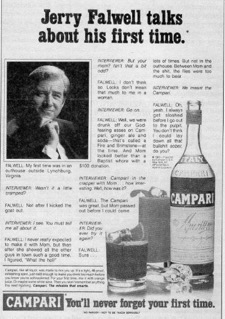
Image description: A black-and-white parody advertisement styled as an interview with Jerry Falwell for Campari liquor. The headline reads, “Jerry Falwell talks about his first time.” The text humorously plays on double meanings, making it sound risqué before revealing it refers to drinking Campari. On the right, there’s an image of a Campari bottle with a glass of the drink and ice.
Superficially, Falwell’s fair use defense did not look promising. Falwell had copied the totality of a highly creative work, without addition, and for commercial gain. Nonetheless, a majority of the Ninth Circuit court of appeals held that the Reverend’s use was fair. The majority saw Falwell’s actions as fair use because he republished the parody for a substantially different purpose. Whereas Hustler had created the work to mock Falwell and to entertain its readers, Falwell reprinted the work so that his readers could witness the outrage that he had endured. Hustler’s use was expressive and entertaining, Falwell’s was illustrative and evidentiary. As the court explained: “Falwell was not selling the parody, but was instead using the parody to make a statement about pornography and Larry Flynt, the publisher of Hustler.”
The court also recognized “the public interest in allowing an individual to defend himself against such derogatory personal attacks.” Falwell reprinted the parody to viscerally demonstrate the nature of the slight he had endured in circumstances where a mere summary would have been inadequate. Although both Hustler and Falwell had communicated the same mock-advertisement to their respective audiences to provoke a reaction, Falwell’s rebuttal purpose was entirely separate from Hustler’s initial expressive aims. Essentially, Falwell copied the magazine’s original expression, not to compete with Hustler’s communication or substitute for it, but to denounce it. As the court explained: “Although the Defendants used the parody for a commercial purpose in the sense that they profited from copying it, they did not actually sell the copies to willing buyers. Instead, the Defendants used the copies to generate moral outrage against their ‘enemies’ and thus stimulate monetary support for their political cause.”
For a similar case, with the same result, see Savage v. Council on American-Islamic Relations, Inc., 2008 WL 2951281 (N.D. Cal. July 25, 2008).
Illustrative and informational uses
There is often a fine line between commentary and criticism that reflects back on the original work or its author and merely illustrative use. The distinction is important because whereas reflective uses that embody commentary and criticism are inherently transformative, the transformativeness of illustrative uses is contingent. Even without some element of commentary or criticism, illustrative uses may qualify as transformative provided that there is a clear enough distinction between the original work’s intrinsic purpose and the illustrative use to which it has been put. Whether this difference in purpose exists depends a great deal on context and also on the purpose for which the plaintiff’s work was created in the first place.
The image search cases: Kelly and Perfect 10
In 2003 and 2007, two key court of appeals cases in the Ninth Circuit addressed whether the display of images in the context of a menu of Internet search results violated copyright. See Kelly v. Arriba Soft Corp., 336 F.3d 811 (9th Cir. 2003); Perfect 10, Inc. v. Amazon.com, Inc., 508 F.3d 1146 (9th Cir. 2007).
In both Kelly v. Arriba Soft and Perfect 10 v. Amazon, the copyright owners of various photographs sued visual search engines for the way their works were used by those services. At the time at least, Internet search engines that focused on images relied on matching search terms with text associated with images on the Internet. The search engines in Kelly and Perfect 10 worked as follows: if the text associated with an image file was responsive to a user’s search query, the search engine would display a small low-resolution “thumbnail” of the image in a menu of search results, giving the user something like a police lineup of images to choose from. Those thumbnail images were displayed from copies made by the search engine and stored on the search engine’s servers. However, once the user selected a particular thumbnail, the user’s Internet browser would be directed to the original location to retrieve the full-scale image. This distinction matters because under prevailing Ninth Circuit precedent at the time, the search engine could only be held directly liable for copyright infringement for images sourced from its own servers. Directing a user to someone else’s computer system could still qualify as copyright infringement, but only with specific knowledge of the underlying infringement. This distinction is referred to as the “server test”. See Perfect 10, Inc. v. Amazon.com, Inc., 508 F.3d 1146 (9th Cir. 2007). See later chapters of this book for the current status of the server test.
In both of the image search cases, Kelly and Perfect 10, the Ninth Circuit found that displaying low-resolution thumbnail images as part of a menu of search results was transformative. In Perfect 10, the court held that the search engine defendant’s use of thumbnails was “highly transformative.” It continued:
Although an image may have been created originally to serve an entertainment, aesthetic, or informative function, a search engine transforms the image into a pointer directing a user to a source of information. Just as a parody has an obvious claim to transformative value because it can provide social benefit, by shedding light on an earlier work, and, in the process, creating a new one, a search engine provides social benefit by incorporating an original work into a new work, namely, an electronic reference tool. Indeed, a search engine may be more transformative than a parody because a search engine provides an entirely new use for the original work, while a parody typically has the same entertainment purpose as the original work.
These thumbnails were complete copies after a fashion, but their size and quality suggested that they would not substitute for the original images. These same features also made it clear that the thumbnail images were being used as a pointing device toward the original images; an entirely different purpose to the original photos.
In both cases, the use of the thumbnails as pointing devices was deemed to be transformative because that use “served a different function” unrelated to “artistic expression.”
Bill Graham Archives v. Dorling Kindersley Ltd., 448 F.3d 605 (2d Cir 2006)
In 2003 Dorling Kindersley published an illustrated cultural history of the 1960s psychedelic jam band, the Grateful Dead. The 480-page coffee table book, Grateful Dead: The Illustrated Trip, was constructed around an annotated timeline combining over 2000 images with explanatory text. Among these 2000 images were seven concert posters owned by Bill Graham Archives.
The figure below is a representative illustration. On the left is a concert poster for Jefferson Airplane, the Grateful Dead and various others playing at the Hollywood Bowl. As seen on the right hand side of the image, a reduced version of the Hollywood Bowl poster is included in the timeline as one of several items competing for the reader’s attention in collage of images, text, and graphic art. The original Hollywood Bowl poster measured 14 by 21 inches and was reduced to about 1/20th in scale in the defendant’s book.
Plaintiff’s Hollywood Bowl Poster (left), The Illustrated Trip (right)
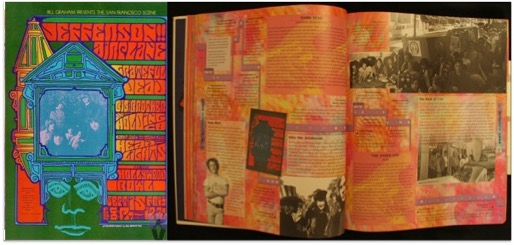
Image description: Left: A psychedelic concert poster with bright green, orange, purple, and blue colors promoting “Bill Graham Presents the San Francisco Scene” featuring Jefferson Airplane, Grateful Dead, and other bands. The design includes ornate shapes framing a central photo and stylized text. Right: An open magazine spread with a vibrant orange and yellow patterned background, blocks of text, and black-and-white photos of musicians and events from the same era.
Although the publisher had initially sought permission from the copyright owner to reproduce the images, the parties were unable to agree on terms and the publisher went ahead regardless. Copyright litigation followed shortly thereafter.
Taking a broad view of transformative use, the trial court in Bill Graham Archives v. Dorling Kindersley Ltd., held that the publisher’s use of the seven original concert posters in a biographical work was transformative, even though the copyrighted images themselves were not the subject of direct commentary or criticism. The district court held that it was sufficient that the works were displayed, not for their original purpose, but to commemorate historic events. On appeal, the Second Circuit agreed.
The Second Circuit held that even where the text of The Illustrated Trip did not comment directly on the concert posters, the works were presented as “historical artifacts graphically representing the fact of significant Grateful Dead concert events.” As such, the defendant’s illustrative use was transformatively different from the original expressive purpose for which the works had been created. As the court explained:
In the instant case, DK’s purpose in using the copyrighted images at issue in its biography of the Grateful Dead is plainly different from the original purpose for which they were created. Originally, each of BGA’s images fulfilled the dual purposes of artistic expression and promotion. The posters were apparently widely distributed to generate public interest in the Grateful Dead and to convey information to a large number people about the band’s forthcoming concerts. In contrast, DK used each of BGA’s images as historical artifacts to document and represent the actual occurrence of Grateful Dead concert events featured on Illustrated Trip’s timeline.
Using a copyrighted work to illustrate or document a historical event is not necessarily transformative. What made the defendant’s use transformative in the Bill Graham Archives case was that its illustrative use was “separate and distinct from the original artistic and promotional purpose for which the images were created.” In contrast, if the original work had been created to document the event, there would be no difference in purpose when the images were used “as historical artifacts to document and represent the actual occurrence of Grateful Dead concert events.” Likewise, the use would not have been transformative if the purpose of the defendant’s illustration was merely to deliver the expressive value of the plaintiff’s original artwork to a new audience. After all, the concert posters were not merely informational, they were also compelling works of graphic design.
The court of appeals was convinced that the defendant’s purpose in reproducing the copyrighted concert posters in The Illustrated Trip was to illustrate key historical events; it was not linked to the work’s original promotional purpose, nor was it simply an attempt to repackage the works for the sake of their intrinsic expressive appeal. This difference in purpose was reinforced by two aspects of the way in which the images were displayed in The Illustrated Trip. First, although the publisher reproduced a complete image of the seven concert posters, it did so on a significantly reduced scale. As the court explained, the reproductions were large enough to allow readers to recognize the historical significance of the posters but “inadequate to offer more than a glimpse of their expressive value.” Second, the posters were blended with a collage of other material in a way that minimized their individual significance. The combined effect of these two features ensured that even though the copyrighted images were copied in their entirety, the visual impact of their artistic expression was significantly limited.
Elvis Presley Enterprises, Inc. v. Passport Video, 349 F.3d 622 (9th Cir. 2003)
Passport Video is a useful counterpoint to Bill Graham Archives. In Passport Video a divided Ninth Circuit court of appeals upheld a lower court ruling that the producers of a 16-hour video documentary about the life of Elvis Presley, The Definitive Elvis, had gone beyond the limits of fair use. The Definitive Elvis included extensive video footage, photos, and music excerpts. The documentary used many copyrighted materials from the Plaintiffs, including clips of Elvis’ television appearances, which range from a few seconds to over a minute, with some clips comprising a large portion of Elvis’ total appearances on specific shows. It also incorporated copyrighted still photos and music as background visuals and audio. This extensive use was not transformative in the eyes of the majority because in large part, the documentary simply rebroadcast the plaintiff’s works for their intrinsic entertainment value. As the majority explained: “The purpose of showing these clips likely goes beyond merely making a reference for a biography, but instead serves the same intrinsic entertainment value that is protected by Plaintiffs’ copyrights.”
Notes and questions
(1) Is there really any difference between Bill Graham Archives and Passport Video that would justify the different fair use rulings?
Sofa Entertainment, Inc. v. Dodger Productions, Inc., 709 F.3d 1273 (9th Cir. 2013)
Jersey Boys was a popular Broadway musical about the 1960s group, the Jersey Boys. The first act of the play closes with a seven-second clip of Ed Sullivan introducing The Four Seasons before a performance on the Ed Sullivan Show—appearing on that influential 1960s television show was a significant turning point in many careers. Sofa Entertainment owned the copyright to historic clips of The Ed Sullivan Show and sued for copyright infringement.
The Ninth Circuit upheld summary judgment in favor of the defendant, principally on the grounds that the use was transformative. After citing Campbell for the proposition that “The central inquiry under the first factor is whether the new work is ‘transformative’”, the court explained:
Dodger references the Four Seasons’ performance on the January 2, 1966 episode of The Ed Sullivan Show to mark an important moment in the band’s career. At that point in rock & roll history, many American bands were pushed into obscurity by the weight of the “British Invasion,” which was kicked off by the Beatles’ performance on The Ed Sullivan Show. The Four Seasons, however, thrived. Being selected by Ed Sullivan to perform on his show was evidence of the band’s enduring prominence in American music. By using it as a biographical anchor, Dodger put the clip to its own transformative ends.
SOFA’s argument that the clip was used for its own entertainment value is not supported by the record. Moreover, because Dodger’s use of the clip is transformative, the fact that Jersey Boys is a commercial production is of little significance. Campbell, 510 U.S. at 579. Therefore, the first fair use factor heavily favors Dodger.
In light of that conclusion, the rest of the fair use analysis went on to favor the defendants as well. The court found that the original clip was factual and informational in nature, which weighed in favor of fair use; that only seven seconds of a much longer episode were used—just enough to serve the narrative purpose—and that the excerpt did not constitute the “heart” of the work; and that there was no meaningful market harm, as the use neither substituted for the original nor competed with it, and there was no realistic market for licensing such a brief, context-specific clip for dramatic reenactments.
Notes and questions
(1) Bill Graham Archives and the Jersey Boys case were decided prior to the Supreme Court’s decision in Andy Warhol Foundation v. Goldsmith. Would reproducing copyrighted concert posters in The Illustrated Trip to illustrate key historical events still be fair use today? Would using seven seconds of the Ed Sullivan Show “as a biographical anchor”?
Fair use in new markets
The Sony Betamax Case
The Sony Betamax was the first mass-market Video Cassette Recorder or VCR. The Betamax went on sale in 1975 and a year later Universal City Studios, Inc., and Walt Disney Productions, filed a law suit alleging that consumers used the device to infringe their copyrights; they also alleged that Sony Corporation, the manufacturer of the device, was responsible for any copyright infringement made possible by the new machine. The Supreme Court’s decision in Sony has two distinct components: the first examined whether consumer time-shifting of broadcast television for later viewing was fair use or copyright infringement; the second concerned the manufacturer’s liability for a technology which had both infringing and non-infringing uses. This following extract focuses on the fair use status of unauthorized time-shifting.
Sony Corp. of America v. Universal City Studios, Inc., 464 U.S. 417 (1984)
Justice Stevens delivered the opinion of the Court
… The question is thus whether the Betamax is capable of commercially significant noninfringing uses. In order to resolve that question, we need not explore all the different potential uses of the machine and determine whether or not they would constitute infringement. Rather, we need only consider whether on the basis of the facts as found by the District Court a significant number of them would be noninfringing. Moreover, in order to resolve this case we need not give precise content to the question of how much use is commercially significant. For one potential use of the Betamax plainly satisfies this standard, however it is understood: private, noncommercial time-shifting in the home. It does so both (A) because respondents have no right to prevent other copyright holders from authorizing it for their programs, and (B) because the District Court’s factual findings reveal that even the unauthorized home time-shifting of respondents’ programs is legitimate fair use. [Justice Steven’s discussion of authorized use is omitted.]
Unauthorized Time-Shifting
Even unauthorized uses of a copyrighted work are not necessarily infringing. An unlicensed use of the copyright is not an infringement unless it conflicts with one of the specific exclusive rights conferred by the copyright statute. Twentieth Century Music Corp. v. Aiken, 422 U.S., at 154-155. Moreover, the definition of exclusive rights in § 106 of the present Act is prefaced by the words “subject to sections 107 through 118.” Those sections describe a variety of uses of copyrighted material that “are not infringements of copyright” “notwithstanding the provisions of section 106.” The most pertinent in this case is § 107, the legislative endorsement of the doctrine of “fair use.”29
Footnote 29: The Copyright Act of 1909, 35 Stat. 1075, did not have a “fair use” provision. Although that Act’s compendium of exclusive rights “to print, reprint, publish, copy, and vend the copyrighted work” was broad enough to encompass virtually all potential interactions with a copyrighted work, the statute was never so construed. The courts simply refused to read the statute literally in every situation. When Congress amended the statute in 1976, it indicated that it “intended to restate the present judicial doctrine of fair use, not to change, narrow, or enlarge it in any way.” House Report p. 66 (1976).
That section identifies various factors that enable a court to apply an “equitable rule of reason” analysis to particular claims of infringement. Although not conclusive, the first factor requires that “the commercial or nonprofit character of an activity” be weighed in any fair use decision. If the Betamax were used to make copies for a commercial or profitmaking purpose, such use would presumptively be unfair. The contrary presumption is appropriate here, however, because the District Court’s findings plainly establish that time-shifting for private home use must be characterized as a noncommercial, nonprofit activity. Moreover, when one considers the nature of a televised copyrighted audiovisual work, § 107(2), and that time-shifting merely enables a viewer to see such a work which he had been invited to witness in its entirety free of charge, the fact that the entire work is reproduced, see § 107(3), does not have its ordinary effect of militating against a finding of fair use.
This is not, however, the end of the inquiry because Congress has also directed us to consider “the effect of the use upon the potential market for or value of the copyrighted work.” § 107(4). The purpose of copyright is to create incentives for creative effort. Even copying for noncommercial purposes may impair the copyright holder’s ability to obtain the rewards that Congress intended him to have. But a use that has no demonstrable effect upon the potential market for, or the value of, the copyrighted work need not be prohibited in order to protect the author’s incentive to create. The prohibition of such noncommercial uses would merely inhibit access to ideas without any countervailing benefit.
Thus, although every commercial use of copyrighted material is presumptively an unfair exploitation of the monopoly privilege that belongs to the owner of the copyright, noncommercial uses are a different matter. A challenge to a noncommercial use of a copyrighted work requires proof either that the particular use is harmful, or that if it should become widespread, it would adversely affect the potential market for the copyrighted work. Actual present harm need not be shown; such a requirement would leave the copyright holder with no defense against predictable damage. Nor is it necessary to show with certainty that future harm will result. What is necessary is a showing by a preponderance of the evidence that some meaningful likelihood of future harm exists. If the intended use is for commercial gain, that likelihood may be presumed. But if it is for a noncommercial purpose, the likelihood must be demonstrated.
In this case, respondents failed to carry their burden with regard to home time-shifting. The District Court described respondents’ evidence as follows:
“Plaintiffs’ experts admitted at several points in the trial that the time-shifting without librarying would result in ‘not a great deal of harm.’ Plaintiffs’ greatest concern about time-shifting is with ‘a point of important philosophy that transcends even commercial judgment.’ They fear that with any Betamax usage, ‘invisible boundaries’ are passed: ‘the copyright owner has lost control over his program.’” 480 F. Supp., at 467.
Later in its opinion, the District Court observed:
“Most of plaintiffs’ predictions of harm hinge on speculation about audience viewing patterns and ratings, a measurement system which Sidney Sheinberg, MCA’s president, calls a ‘black art’ because of the significant level of imprecision involved in the calculations.” Id., at 469.
There was no need for the District Court to say much about past harm. “Plaintiffs have admitted that no actual harm to their copyrights has occurred to date.”
On the question of potential future harm from time-shifting, the District Court offered a more detailed analysis of the evidence. It rejected respondents’ “fear that persons ‘watching’ the original telecast of a program will not be measured in the live audience and the ratings and revenues will decrease,” by observing that current measurement technology allows the Betamax audience to be reflected. Id., at 466. It rejected respondents’ prediction “that live television or movie audiences will decrease as more people watch Betamax tapes as an alternative,” with the observation that “[t]here is no factual basis for [the underlying] assumption.” It rejected respondents’ “fear that time-shifting will reduce audiences for telecast reruns,” and concluded instead that “given current market practices, this should aid plaintiffs rather than harm them.” Ibid. And it declared that respondents’ suggestion that “theater or film rental exhibition of a program will suffer because of time-shift recording of that program” “lacks merit.”
After completing that review, the District Court restated its overall conclusion several times, in several different ways. “Harm from time-shifting is speculative and, at best, minimal.” “The audience benefits from the time-shifting capability have already been discussed. It is not implausible that benefits could also accrue to plaintiffs, broadcasters, and advertisers, as the Betamax makes it possible for more persons to view their broadcasts.” “No likelihood of harm was shown at trial, and plaintiffs admitted that there had been no actual harm to date.” “Testimony at trial suggested that Betamax may require adjustments in marketing strategy, but it did not establish even a likelihood of harm.” “Television production by plaintiffs today is more profitable than it has ever been, and, in five weeks of trial, there was no concrete evidence to suggest that the Betamax will change the studios’ financial picture.”
The District Court’s conclusions are buttressed by the fact that to the extent time-shifting expands public access to freely broadcast television programs, it yields societal benefits. In Community Television of Southern California v. Gottfried, 459 U.S. 498 (1983), we acknowledged the public interest in making television broadcasting more available. Concededly, that interest is not unlimited. But it supports an interpretation of the concept of “fair use” that requires the copyright holder to demonstrate some likelihood of harm before he may condemn a private act of time-shifting as a violation of federal law.
When these factors are all weighed in the “equitable rule of reason” balance, we must conclude that this record amply supports the District Court’s conclusion that home time-shifting is fair use. In light of the findings of the District Court regarding the state of the empirical data, it is clear that the Court of Appeals erred in holding that the statute as presently written bars such conduct.
In summary, the record and findings of the District Court lead us to two conclusions. First, Sony demonstrated a significant likelihood that substantial numbers of copyright holders who license their works for broadcast on free television would not object to having their broadcasts time-shifted by private viewers. And second, respondents failed to demonstrate that time-shifting would cause any likelihood of nonminimal harm to the potential market for, or the value of, their copyrighted works. The Betamax is, therefore, capable of substantial noninfringing uses. Sony’s sale of such equipment to the general public does not constitute contributory infringement of respondents’ copyrights.
* * *
“The direction of Art. I is that Congress shall have the power to promote the progress of science and the useful arts. When, as here, the Constitution is permissive, the sign of how far Congress has chosen to go can come only from Congress.” Deepsouth Packing Co. v. Laitram Corp., 406 U.S. 518, 530 (1972).
One may search the Copyright Act in vain for any sign that the elected representatives of the millions of people who watch television every day have made it unlawful to copy a program for later viewing at home, or have enacted a flat prohibition against the sale of machines that make such copying possible.
It may well be that Congress will take a fresh look at this new technology, just as it so often has examined other innovations in the past. But it is not our job to apply laws that have not yet been written. Applying the copyright statute, as it now reads, to the facts as they have been developed in this case, the judgment of the Court of Appeals must be reversed.
It is so ordered.
Notes and questions
(1) Why did the Supreme Court majority hold that users of the Sony Betamax were engaging in fair use?
(2) How far should that reasoning extend to other technologies that facilitate consumer copying? In Recording Indus. Association of Am. v. Diamond Multimedia Sys., Inc., 180 F.3d 1072, 1079 (9th Cir.1999), the Ninth Circuit said that the Diamond Rio mp3 player (a large capacity portable MP3 player that predated the now more famous Apple iPod) “merely makes copies in order to render portable, or ‘space-shift,’ those [music] files that already reside on a user’s hard drive. . . . Such copying is a paradigmatic noncommercial personal use.”
(3) In Fox Broadcasting Co., Inc. v. Dish Network LLC, 747 F.3d 1060 (9th Cir. 2014), the Ninth Circuit affirmed the denial of a preliminary injunction, holding that Fox was not likely to overcome Dish Network’s fair use defense with respect to a digital video recorder that automatically skipped the advertisements in programs its users recorded. The court found that Fox had not demonstrated any harm from on-demand availability and that any harm resulting from the ease of skipping commercials did “not implicate any copyright interest.” The court of appeals explained:
Yet, as the district court held, commercial-skipping does not implicate Fox’s copyright interest because Fox owns the copyrights to the television programs, not to the ads aired in the commercial breaks. If recording an entire copyrighted program is a fair use, the fact that viewers do not watch the ads not copyrighted by Fox cannot transform the recording into a copyright violation.
Do you agree with this reasoning?
More typical new markets cases
Infinity Broadcast Corp. v. Kirkwood, 150 F.3d 104 (2d Cir. 1998)
FEINBERG, Circuit Judge:
I. Background
Dial-Up is a system designed by Wayne Kirkwood to enable his customers to listen to radio broadcasts originating in various cities throughout the United States. At the time of the trial the Dial-Up system allowed access to the 10 largest radio markets in the country, and Kirkwood plans to expand to more cities. In each city Kirkwood places a radio receiver connected to a phone line. The receiver, like a normal radio, receives broadcasts over the air. It then transmits them into the phone line so that a caller can listen to whatever station the receiver is tuned to. The receiver responds to commands entered via touch-tone phone so that a caller can tune the receiver to different stations. Dial-Up subscribers pay a fee in exchange for a list of the (unpublished) phone numbers connected to the receivers. Kirkwood exercises no control over the selection of stations by callers, though he has apparently developed (but not implemented) a version of the system that could block the retransmission of particular stations. Except for a potentially costly long-distance phone bill (from which Kirkwood derives no benefit), there is nothing to prevent a caller from listening to a particular station 24 hours a day, seven days a week. Dial-Up is marketed to radio stations, advertisers, talent scouts and others in the entertainment and advertising industry for purposes such as auditioning on-air talent, verifying the broadcast of commercials, and listening to a station’s programming format and feel. It is also, as Kirkwood emphasizes, marketed to performance rights organizations to assist them in enforcing the copyrights of their member artists.
Infinity Broadcasting Corp. (“Infinity”) owns a large network of radio stations, including stations in each of the markets in which Dial-Up has a receiver. Some of the programs that originate on Infinity-owned stations are syndicated, meaning that they are broadcast on stations in other markets in exchange for a fee or for advertising time. Some, but not all, of Infinity’s stations have “listen lines,” station-specific versions of Kirkwood’s service that the stations offer for free to certain clients.
In June 1997, the district judge held that Kirkwood’s actions were protected by the fair use defense set out in 17 U.S.C. § 107. Applying the four factors enumerated in that statute, he decided that on balance they favored Kirkwood and that Kirkwood’s use diminished neither the incentive of broadcasters to generate new creative programming, nor their “ability to gain a fair return on their endeavors.” 965 F.Supp. at 560-61. This appeal followed. …
1. Purpose and Character of the Use
The first statutory factor is the purpose and character of the alleged infringing use. The focus of this factor is
whether the new work merely supersedes the objects of the original creation[,] or instead adds something new, with a further purpose or different character, altering the first with new expression, meaning, or message; it asks, in other words, whether and to what extent the new work is “transformative.”
Campbell, 510 U.S. at 579. The district court found that this factor “cuts to some extent in Kirkwood’s direction,” primarily because Kirkwood “is using [Infinity’s] broadcasts for a quite different purpose,” namely for information rather than entertainment. Kirkwood, too, argues at length about the differences between Infinity’s purposes for its broadcasts and the reasons his customers use Dial-Up. We agree that the difference in purposes tends to support Kirkwood’s fair use claim. However, difference in purpose is not quite the same thing as transformation, and Campbell instructs that transformativeness is the critical inquiry under this factor.
Here, as the district judge observed, “Kirkwood’s retransmissions leave the character of the original broadcasts unchanged. There is neither new expression, new meaning nor new message.” In short, there is no transformation. As then-District Judge Leval noted in his frequently-cited article on fair use, Toward a Fair Use Standard, a use of copyrighted material that “merely repackages or republishes the original” is unlikely to be deemed a fair use.
Kirkwood argues that Dial-Up’s users transform the broadcasts by using them for their factual, not entertainment, content. However, it is Kirkwood’s own retransmission of the broadcasts, not the acts of his end-users, that is at issue here and all Kirkwood does is sell access to unaltered radio broadcasts. Also, it is not clear that all of Kirkwood’s target audience “transforms” the broadcasts as he suggests. Talent scouts, who admittedly would not be listening in order to be entertained themselves, would nevertheless be listening for the entertainment value of the broadcasts rather than the factual content.
Kirkwood also argues that his service is “of substantial benefit to society” because, among other things, it enables advertisers to confirm that their commercials were properly aired. According to Infinity, however, 75 to 80 percent of the advertising on its stations is from companies within the station’s broadcast range who may therefore monitor Infinity merely by turning on a radio. Similarly, the public benefit from other uses of Dial-Up can either be accomplished by other methods or is simply not enough to justify Kirkwood’s non-transformative retransmissions.
In sum, we think the different, and possibly beneficial, purposes of Kirkwood’s customers are outweighed by the total absence of transformativeness in Kirkwood’s acts of retransmission. We find that the first statutory factor leans in Infinity’s favor, rather than in Kirkwood’s.
2. Nature of the Copyrighted Work
The second factor is the nature of the copyrighted work, which recognizes that creative works are “closer to the core of intended copyright protection” than more factual works. Campbell, 510 U.S. at 586. The district court found that this factor favored Infinity. Kirkwood admits that some portions of the broadcasts are original and therefore deserving of copyright protection, but argues that Infinity also broadcasts material such as music and advertisements to which it does not own the copyright. The district court properly recognized, however, that “the compilation of these and other elements to make the allegedly infringed works is both unique and creative.” Id. The second factor favors Infinity.
3. Amount and Substantiality of the Portion Used
The third factor, amount and substantiality of the portion used, recognizes that the more of a copyrighted work that is taken, the less likely the use is to be fair, and that even a less substantial taking may be unfair if it captures the essence of the copyrighted work. See e.g., Harper & Row, 471 U.S. at 564-65 (although “words actually quoted were an insubstantial portion” of copyrighted book, they were “essentially the heart of the book”). Though not an absolute rule, generally, it may not constitute a fair use if the entire work is reproduced.
It is somewhat difficult to apply this factor to Dial-Up. Depending on the interest of Kirkwood’s customers, mere snippets of Infinity’s broadcasts may be retransmitted or a single station may be listened to for hours at a time. [However,] in this case the potential scope of retransmission is more relevant than evidence of actual retransmission by Dial-Up users thus far. Dial-Up permits essentially unlimited access to radio broadcasts in the cities in which it has receivers and there is thus the potential for retransmission of entire copyrighted programs. As the district court observed,
the more successful Kirkwood becomes in selling his service to interested parties, the more likely it is that any given broadcast will be retransmitted ... [and] that a subscriber, or the collective action of a plurality of subscribers, will cause Kirkwood to retransmit most or all of a given program.
Again, Kirkwood argues that because his users’ motives are beneficial to the purpose of copyright it makes no difference if entire broadcasts are heard. As discussed, however, societal benefit does not guarantee a finding of fair use. Nor does it, by itself, answer the question most relevant to this factor: whether “no more was taken than necessary.” Campbell, 510 U.S. at 589. Even if Kirkwood is correct that society benefits from his provision of access to Infinity’s broadcasts, he still must justify potentially providing his subscribers with access to every radio station in the cities Kirkwood serves, 24 hours a day, seven days a week. We agree with the district court that the third factor favors Infinity.
4. Effect of the Use upon the Potential Market
The fourth factor, effect of the use on the potential market for the copyrighted work,
requires courts to consider not only the extent of market harm caused by the particular actions of the alleged infringer, but also “whether unrestricted and wide-spread conduct of the sort engaged in by the defendant ... would result in a substantially adverse impact on the potential market” for the original.
Campbell, 510 U.S. at 590. Not all harms are cognizable under this factor. Specifically, fair use does not condemn the suppression or even destruction of the market by, for example, a “scathing theater review” or a parody. See Campbell, 510 U.S. at 591-92. Rather, it is concerned with secondary uses that, by offering a substitute for the original, usurp a market that properly belongs to the copyright-holder.
The district court, in applying this factor, started from the assumption that the value of Infinity’s copyrighted programs “lies in the ability to attract listeners” by providing the programs to the general public either on its own stations or, by syndication, on stations owned by others. The court then concluded that Kirkwood’s service, which is “directed to a narrow and specialized audience,” was likely to have no material effect on the value of the copyrighted material. The district court regarded as particularly relevant that Infinity is neither in the business of operating commercial listen lines nor has it “attempted to license the retransmission of its copyrighted programming for purposes such as Kirkwood’s,” and that the potential revenues to be obtained from such licensing, based on Kirkwood’s experience, are “extremely modest.”
We are not as impressed by these facts as was the district court. Although Infinity does not operate commercial listen lines such as Kirkwood’s, certain of its stations have their own listen lines and Infinity described these lines as being included in a “package” offered to certain advertisers. It is true that Infinity does not charge separately for these lines, and that Kirkwood has had limited success in doing so himself. But this does not necessarily mean that Infinity derives no economic benefit from its listen lines or that Kirkwood’s use has only a negligible effect on Infinity’s potential to exploit this market. Infinity, in the exercise of its business judgment, has decided that its best current use of listen lines is to offer them at no additional cost to certain “valued customers.” Dial-Up disrupts this practice by removing Infinity’s control over who should have access to such lines. Kirkwood is selling Infinity’s copyrighted material in a market that Infinity, as the copyright owner, is exclusively entitled to exploit. Kirkwood does not suppress demand for Infinity’s broadcasts in the manner of a reviewer, but instead replaces Infinity as the supplier of those broadcasts to meet the demand of his customers. This is precisely the kind of harm the fourth factor aims to prevent. As Infinity points out in its brief on appeal, “the revenues that Kirkwood generates for himself come not from a market that is only likely to be developed, but from a market that Infinity currently occupies,” albeit in different form. Infinity’s presence in Kirkwood’s market weighs in Infinity’s favor on this factor.
Kirkwood also implies that Infinity lacks an incentive to exploit the listen line market because enabling advertisers to check up on Infinity’s advertising billing practices is against its interest. This is not obvious, as evidenced by the fact that Infinity does offer listen lines to some advertisers. If we assume that advertisers will prefer to use broadcasters that can be relied upon to be honest, and consider the provision of monitoring services like listen lines to be an indicator of such reliability, then broadcasters who do not offer listen lines may be at a competitive disadvantage.
On balance, we think the fourth factor is a very close question. Infinity admits that it has no present interest in operating separate for-profit listen lines, but has demonstrated at least the potential for interference with its inclusion of listen lines as part of its advertising package. We disagree with the district court that this factor “strongly favors” Kirkwood, and indeed, considering that Kirkwood bears the burden of showing an absence of “usurpation” harm to Infinity, believe that it tips toward Infinity.
5. Aggregate Assessment
By our calculation, all four statutory factors point toward infringement and the lack of fair use. The statutory factors are not exclusive, but the facts of this case do not suggest any significant factors we have not already considered, and our assessment of the case in more abstract terms only strengthens our conclusion that Kirkwood’s is not a fair use. Kirkwood creates nothing and advances no body of knowledge or criticism. He simply takes Infinity’s unaltered broadcasts and markets them to a specific clientele.
Kirkwood has not met his burden of showing that his use of Infinity’s broadcasts does not infringe Infinity’s copyrights. Given the potential for large-scale retransmission of Infinity’s broadcasts by Kirkwood’s service, we conclude that Dial-Up’s retransmission of Infinity’s copyrighted broadcasts is not a fair use.
Notes and questions
(1) If the court could see that the Dial-Up retransmission service had a different purpose to the original broadcasts, and that it was possibly beneficial, why was it not transformative?
A & M Records, Inc. v. Napster, Inc., 239 F.3d 1004 (9th Cir. 2001)
Circuit Judge Beezer
Plaintiffs are engaged in the commercial recording, distribution and sale of copyrighted musical compositions and sound recordings. The complaint alleges that Napster, Inc. (“Napster”) is a contributory and vicarious copyright infringer. The district court preliminarily enjoined Napster “from engaging in, or facilitating others in copying, downloading, uploading, transmitting, or distributing plaintiffs’ copyrighted musical compositions and sound recordings, protected by either federal or state law, without express permission of the rights owner.” We entered a temporary stay of the preliminary injunction pending resolution of this appeal.
Napster facilitates the transmission of MP3 files between and among its users. Through a process commonly called “peer-to-peer” file sharing, Napster allows its users to: (1) make MP3 music files stored on individual computer hard drives available for copying by other Napster users; (2) search for MP3 music files stored on other users’ computers; and (3) transfer exact copies of the contents of other users’ MP3 files from one computer to another via the Internet. These functions are made possible by Napster’s MusicShare software, available free of charge from Napster’s Internet site, and Napster’s network servers and server-side software. Napster provides technical support for the indexing and searching of MP3 files, as well as for its other functions, including a “chat room,” where users can meet to discuss music, and a directory where participating artists can provide information about their music.
Plaintiffs claim Napster users are engaged in the wholesale reproduction and distribution of copyrighted works, all constituting direct infringement. The district court agreed. The district court determined that plaintiffs’ exclusive rights under § 106 were violated: “here the evidence establishes that a majority of Napster users use the service to download and upload copyrighted music. And by doing that, it constitutes—the uses constitute direct infringement of plaintiffs’ musical compositions, recordings.” The district court also noted that “it is pretty much acknowledged by Napster that this is infringement.” We agree that plaintiffs have shown that Napster users infringe at least two of the copyright holders’ exclusive rights: the rights of reproduction, § 106(1); and distribution, § 106(3). Napster users who upload file names to the search index for others to copy violate plaintiffs’ distribution rights. Napster users who download files containing copyrighted music violate plaintiffs’ reproduction rights.
Napster asserts an affirmative defense to the charge that its users directly infringe plaintiffs’ copyrighted musical compositions and sound recordings.
Fair Use
Napster contends that its users do not directly infringe plaintiffs’ copyrights because the users are engaged in fair use of the material. Napster identifies three specific alleged fair uses: sampling, where users make temporary copies of a work before purchasing; space-shifting, where users access a sound recording through the Napster system that they already own in audio CD format; and permissive distribution of recordings by both new and established artists.
The district court considered factors listed in 17 U.S.C. § 107, which guide a court’s fair use determination. … The district court concluded that Napster users are not fair users. We agree. We first address the court’s overall fair use analysis.
1. Purpose and Character of the Use
This factor focuses on whether the new work merely replaces the object of the original creation or instead adds a further purpose or different character. In other words, this factor asks “whether and to what extent the new work is ‘transformative.’” See Campbell v. Acuff-Rose Music, Inc., 510 U.S. 569, 579 (1994).
The district court first concluded that downloading MP3 files does not transform the copyrighted work. This conclusion is supportable. Courts have been reluctant to find fair use when an original work is merely retransmitted in a different medium. See, e.g., Infinity Broadcast Corp. v. Kirkwood, 150 F.3d 104, 108 (2d Cir.1998) (concluding that retransmission of radio broadcast over telephone lines is not transformative); UMG Recordings, Inc. v. MP3.com, Inc., 92 F.Supp.2d 349, 351 (S.D.N.Y.) (finding that reproduction of audio CD into MP3 format does not “transform” the work).
This “purpose and character” element also requires the district court to determine whether the allegedly infringing use is commercial or noncommercial. See Campbell, 510 U.S. at 584-85. A commercial use weighs against a finding of fair use but is not conclusive on the issue. Id. The district court determined that Napster users engage in commercial use of the copyrighted materials largely because (1) “a host user sending a file cannot be said to engage in a personal use when distributing that file to an anonymous requester” and (2) “Napster users get for free something they would ordinarily have to buy.” The district court’s findings are not clearly erroneous.
Direct economic benefit is not required to demonstrate a commercial use. Rather, repeated and exploitative copying of copyrighted works, even if the copies are not offered for sale, may constitute a commercial use. See Worldwide Church of God v. Philadelphia Church of God, 227 F.3d 1110, 1118 (9th Cir.2000) (stating that church that copied religious text for its members “unquestionably profited” from the unauthorized “distribution and use of [the text] without having to account to the copyright holder”); American Geophysical Union v. Texaco, Inc., 60 F.3d 913, 922 (2d Cir.1994) (finding that researchers at for-profit laboratory gained indirect economic advantage by photocopying copyrighted scholarly articles). In the record before us, commercial use is demonstrated by a showing that repeated and exploitative unauthorized copies of copyrighted works were made to save the expense of purchasing authorized copies. See Worldwide Church, 227 F.3d at 1117-18; Sega Enters. Ltd. v. MAPHIA, 857 F.Supp. 679, 687 (N.D.Cal.1994) (finding commercial use when individuals downloaded copies of video games “to avoid having to buy video game cartridges”); see also American Geophysical, 60 F.3d at 922. Plaintiffs made such a showing before the district court.
We also note that the definition of a financially motivated transaction for the purposes of criminal copyright actions includes trading infringing copies of a work for other items, “including the receipt of other copyrighted works.” See No Electronic Theft Act (“NET Act”), Pub.L. No. 105-147, 18 U.S.C. § 101 (defining “Financial Gain”).
2. The Nature of the Use
Works that are creative in nature are “closer to the core of intended copyright protection” than are more fact-based works. See Campbell, 510 U.S. at 586. The district court determined that plaintiffs’ “copyrighted musical compositions and sound recordings are creative in nature which cuts against a finding of fair use under the second factor.” We find no error in the district court’s conclusion.
3. The Portion Used
“While ‘wholesale copying does not preclude fair use per se,’ copying an entire work ‘militates against a finding of fair use.’” Worldwide Church, 227 F.3d at 1118 (quoting Hustler Magazine, Inc. v. Moral Majority, Inc., 796 F.2d 1148, 1155 (9th Cir.1986)). The district court determined that Napster users engage in “wholesale copying” of copyrighted work because file transfer necessarily “involves copying the entirety of the copyrighted work.” We agree. We note, however, that under certain circumstances, a court will conclude that a use is fair even when the protected work is copied in its entirety. See, e.g., Sony Corp. v. Universal City Studios, Inc., 464 U.S. 417, 449-50 (1984) (acknowledging that fair use of time-shifting necessarily involved making a full copy of a protected work).
4. Effect of Use on Market
“Fair use, when properly applied, is limited to copying by others which does not materially impair the marketability of the work which is copied.” Harper & Row Publishers, Inc. v. Nation Enters., 471 U.S. 539, 566-67 (1985). “[T]he importance of this [fourth] factor will vary, not only with the amount of harm, but also with the relative strength of the showing on the other factors.” Campbell, 510 U.S. at 591 n. 21. The proof required to demonstrate present or future market harm varies with the purpose and character of the use:
A challenge to a noncommercial use of a copyrighted work requires proof either that the particular use is harmful, or that if it should become widespread, it would adversely affect the potential market for the copyrighted work. . . . If the intended use is for commercial gain, that likelihood [of market harm] may be presumed. But if it is for a noncommercial purpose, the likelihood must be demonstrated.
Sony, 464 U.S. at 451 (emphases added).
Addressing this factor, the district court concluded that Napster harms the market in “at least” two ways: it reduces audio CD sales among college students and it “raises barriers to plaintiffs’ entry into the market for the digital downloading of music.” [The court summarized the district court’s treatment of the expert evidence.] The district court cited both the Jay and Fine Reports in support of its finding that Napster use harms the market for plaintiffs’ copyrighted musical compositions and sound recordings by reducing CD sales among college students. The district court cited the Teece Report to show the harm Napster use caused in raising barriers to plaintiffs’ entry into the market for digital downloading of music. The district court’s careful consideration of defendant’s objections to these reports and decision to rely on the reports for specific issues demonstrates a proper exercise of discretion in addition to a correct application of the fair use doctrine. Defendant has failed to show any basis for disturbing the district court’s findings.
We, therefore, conclude that the district court made sound findings related to Napster’s deleterious effect on the present and future digital download market. Moreover, lack of harm to an established market cannot deprive the copyright holder of the right to develop alternative markets for the works. See L.A. Times v. Free Republic, 54 U.S.P.Q.2d 1453, 1469-71 (C.D.Cal.2000) (stating that online market for plaintiff newspapers’ articles was harmed because plaintiffs demonstrated that “[defendants] are attempting to exploit the market for viewing their articles online”); see also UMG Recordings, 92 F.Supp.2d at 352 (“Any allegedly positive impact of defendant’s activities on plaintiffs’ prior market in no way frees defendant to usurp a further market that directly derives from reproduction of the plaintiffs’ copyrighted works.”). Here, similar to L.A. Times and UMG Recordings, the record supports the district court’s finding that the “record company plaintiffs have already expended considerable funds and effort to commence Internet sales and licensing for digital downloads.” 114 F.Supp.2d at 915. Having digital downloads available for free on the Napster system necessarily harms the copyright holders’ attempts to charge for the same downloads.
Judge Patel did not abuse her discretion in reaching the above fair use conclusions, nor were the findings of fact with respect to fair use considerations clearly erroneous. We next address Napster’s identified uses of sampling and space-shifting.
5. Identified Uses
Napster maintains that its identified uses of sampling and space-shifting were wrongly excluded as fair uses by the district court.
a. Sampling
Napster contends that its users download MP3 files to “sample” the music in order to decide whether to purchase the recording. Napster argues that the district court: (1) erred in concluding that sampling is a commercial use because it conflated a noncommercial use with a personal use; (2) erred in determining that sampling adversely affects the market for plaintiffs’ copyrighted music, a requirement if the use is noncommercial; and (3) erroneously concluded that sampling is not a fair use because it determined that samplers may also engage in other infringing activity.
The district court determined that sampling remains a commercial use even if some users eventually purchase the music. We find no error in the district court’s determination. Plaintiffs have established that they are likely to succeed in proving that even authorized temporary downloading of individual songs for sampling purposes is commercial in nature. The record supports a finding that free promotional downloads are highly regulated by the record company plaintiffs and that the companies collect royalties for song samples available on retail Internet sites. Id. Evidence relied on by the district court demonstrates that the free downloads provided by the record companies consist of thirty-to-sixty second samples or are full songs programmed to “time out,” that is, exist only for a short time on the downloader’s computer. In comparison, Napster users download a full, free and permanent copy of the recording. The determination by the district court as to the commercial purpose and character of sampling is not clearly erroneous.
The district court further found that both the market for audio CDs and market for online distribution are adversely affected by Napster’s service. As stated in our discussion of the district court’s general fair use analysis: the court did not abuse its discretion when it found that, overall, Napster has an adverse impact on the audio CD and digital download markets. Contrary to Napster’s assertion that the district court failed to specifically address the market impact of sampling, the district court determined that “even if the type of sampling supposedly done on Napster were a non-commercial use, plaintiffs have demonstrated a substantial likelihood that it would adversely affect the potential market for their copyrighted works if it became widespread.” The record supports the district court’s preliminary determinations that: (1) the more music that sampling users download, the less likely they are to eventually purchase the recordings on audio CD; and (2) even if the audio CD market is not harmed, Napster has adverse effects on the developing digital download market.
Napster further argues that the district court erred in rejecting its evidence that the users’ downloading of “samples” increases or tends to increase audio CD sales. The district court, however, correctly noted that “any potential enhancement of plaintiffs’ sales . . . would not tip the fair use analysis conclusively in favor of defendant.” We agree that increased sales of copyrighted material attributable to unauthorized use should not deprive the copyright holder of the right to license the material. See Campbell, 510 U.S. at 591 n. 21 (“Even favorable evidence, without more, is no guarantee of fairness. Judge Leval gives the example of the film producer’s appropriation of a composer’s previously unknown song that turns the song into a commercial success; the boon to the song does not make the film’s simple copying fair.”); see also L.A. Times, 54 U.S.P.Q.2d at 1471-72. Nor does positive impact in one market, here the audio CD market, deprive the copyright holder of the right to develop identified alternative markets, here the digital download market. See id. at 1469-71.
We find no error in the district court’s factual findings or abuse of discretion in the court’s conclusion that plaintiffs will likely prevail in establishing that sampling does not constitute a fair use.
b. Space-Shifting
Napster also maintains that space-shifting is a fair use. Space-shifting occurs when a Napster user downloads MP3 music files in order to listen to music he already owns on audio CD. Napster asserts that we have already held that space-shifting of musical compositions and sound recordings is a fair use. See Recording Indus. Ass’n of Am. v. Diamond Multimedia Sys., Inc., 180 F.3d 1072, 1079 (9th Cir.1999) (“Rio [a portable MP3 player] merely makes copies in order to render portable, or ‘space-shift,’ those files that already reside on a user’s hard drive. . . . Such copying is a paradigmatic noncommercial personal use.”). See also generally Sony, 464 U.S. at 423 (holding that “time-shifting,” where a video tape recorder owner records a television show for later viewing, is a fair use).
We conclude that the district court did not err when it refused to apply the “shifting” analyses of Sony and Diamond. Both Diamond and Sony are inapposite because the methods of shifting in these cases did not also simultaneously involve distribution of the copyrighted material to the general public; the time or space-shifting of copyrighted material exposed the material only to the original user. In Diamond, for example, the copyrighted music was transferred from the user’s computer hard drive to the user’s portable MP3 player. So too Sony, where “the majority of VCR purchasers . . . did not distribute taped television broadcasts, but merely enjoyed them at home.” Conversely, it is obvious that once a user lists a copy of music he already owns on the Napster system in order to access the music from another location, the song becomes “available to millions of other individuals,” not just the original CD owner.
c. Other Uses
Permissive reproduction by either independent or established artists is the final fair use claim made by Napster. The district court noted that plaintiffs did not seek to enjoin this and any other noninfringing use of the Napster system, including: chat rooms, message boards and Napster’s New Artist Program. Plaintiffs do not challenge these uses on appeal.
We find no error in the district court’s determination that plaintiffs will likely succeed in establishing that Napster users do not have a fair use defense.
Notes and questions
(1) Why is the result in Sony different to that in Napster and Kirkwood?
(2) Notice that in Sony, the plaintiffs apparently failed to offer convincing evidence of market harm but that Napster held that file-sharing harmed both the present market for CDs and the potential market for digital downloads that the plaintiffs had not really taken advantage of. The courts in these cases are not just making an empirical assessment of real-world markets, they are deciding what uses of copyrighted works should be the subject of market transactions. In some cases, these markets might not even exist yet or in their infancy, in others they may be well developed. Does the fact that the rights holder is deliberately leaving the market unfulfilled mean that what would otherwise be infringement should be fair use?
(3) Did file sharing really harm the market for recorded music? In addition to some fairly obvious intuition about substitution, the weight of empirical analysis strongly suggests it did. Justin Hughes and Michael D. Smith reviewed this evidence and how it has been received in the law review literature in a 2024 law review article. They found that the law literature disproportionately cites studies that show no harm from piracy, despite the majority of peer-reviewed research to the contrary. Of the 34 studies on the topic reviewed by Hughes and Smith, legal scholars tended to favor a single “no harm” study by Oberholzer-Gee and Strumpf, often ignoring the broader body of evidence. They attribute this disconnect to confirmation bias, citation cascades, insensitivity to peer review, and a tendency to present “balanced” views even when the evidence heavily favors one side. See, Justin Hughes & Michael D. Smith, Do Copyright Law Professors Pay Attention to Economists? – How Empirical Evidence on the Effects of Copyright Piracy Does (Not) Appear in Law Literature, 47 Columbia Journal of Law & the Arts 165 (2024).
(4) Part of the reason Napster was so popular in 1999 and 2000 before it was shut down was that there was no significant legal platform for MP3 downloads at the time. That market was essentially left void until the launch of the Apple iTunes Store on April 28, 2003. The recording industry’s reluctance to enter the digital distribution market seems like a classic case of the “Innovator’s Dilemma.” As Professor Clayton Christensen explains in his famous book by that name, companies that are heavily invested in the status quo are often disinclined to pursue new technologies that will disrupt an existing market. This is not because they fail to recognize the potential of the new technology, but rather because they appreciate that the new technology will cannibalize the market share of existing offerings.
American Geophysical Union v. Texaco, Inc., 60 F.3d 913 (2d Cir. 1994)
In the 1990s, American Geophysical Union and other scientific publishers who held copyrights to various scientific and technical journals sued Texaco Inc., a major oil company that maintained a private, for-profit corporate library and research facility, where its scientists and engineers routinely made photocopies of individual articles from scientific journals for their research purposes. The company subscribed to many scientific journals, but scientists would photocopy articles to keep in their personal files for future reference and research.
The case centered on Texaco’s systematic and institutionalized practice of photocopying copyrighted journal articles. Texaco employees would photocopy complete articles from journals the company legitimately subscribed to. The employees kept these copies in personal files for ongoing research projects and used the copies for their scientific and commercial research work. Although the copying was carried out by individual scientists, the court treated it as a corporate practice undertaken in furtherance of Texaco’s commercial research operations.
The Second Circuit held that Texaco’s systematic photocopying of journal articles did not constitute fair use and therefore infringed the plaintiffs’ copyrights. Both the district court, in an opinion by then-Judge Pierre Leval, and the Second Circuit majority emphasized that Texaco’s use was commercial and nontransformative. Notably, the court held that the use was commercial and not transformative because Texaco was using the articles for their original purpose (scientific research). The fact that photocopying made the articles more convenient to use in laboratories, offices, or at home did not alter their purpose or character and therefore did not render the use transformative.
When it turned to the fourth fair use factor (effect on the market for or value of the copyrighted work), the court acknowledged that there was no traditional market for individual journal articles—publishers typically only sold complete journal subscriptions and authors weren’t directly paid for articles. The court also acknowledged earlier precedent holding that similar photocopying by a government research library constituted fair use, most notably Williams & Wilkins Co. v. United States, a decision affirmed by an equally divided Supreme Court. In response to that decision, Congress encouraged the academic publishing industry to develop collective licensing mechanisms for photocopying.
However, the court determined that the publishers had since established a viable licensing market through the Copyright Clearance Center (CCC) that allowed institutional users to obtain photocopying licenses. The Texaco litigation was widely understood as a test case intended to encourage compliance with that emerging licensing regime. The court concluded that Texaco’s systematic photocopying caused substantial harm to the publishers’ copyrights because Texaco could have obtained authorized copies through document delivery services, direct licensing agreements, or CCC licenses, all of which would have generated significant additional revenue for the publishers. Although the Second Circuit did not believe Texaco’s copying would materially reduce journal subscriptions, it found that the loss of photocopying license revenue constituted cognizable market harm under the fourth factor.
The court did not think this framing of market effect was circular:
It is indisputable that, as a general matter, a copyright holder is entitled to demand a royalty for licensing others to use its copyrighted work, see 17 U.S.C. § 106 (copyright owner has exclusive right “to authorize” certain uses), and that the impact on potential licensing revenues is a proper subject for consideration in assessing the fourth factor.
However, not every effect on potential licensing revenues enters the analysis under the fourth factor. Specifically, courts have recognized limits on the concept of “potential licensing revenues” by considering only traditional, reasonable, or likely to be developed markets when examining and assessing a secondary use’s “effect upon the potential market for or value of the copyrighted work.” See Campbell (“The market for potential derivative uses includes only those that creators of original works would in general develop or license others to develop.”); Harper & Row (fourth factor concerned with “use that supplants any part of the normal market for a copyrighted work”). Applying this framework, the Second Circuit held that institutional photocopying licenses constituted such a traditional, reasonable, or likely-to-be-developed market.
Thus, Texaco stands for the proposition that established or emerging permissions markets for photocopying may be taken into account in evaluating fair use, even where the market consists of licenses created in response to widespread copying practices rather than long-standing modes of exploitation.
How do we know when a market will be “considered traditional, reasonable, or likely to be developed”?
Non-transformative uses in the public interest
Providing Access to the Print-Disabled
Providing access to the print-disabled is a non-transformative use, but it is nonetheless a preferred use under current fair use law.
In 2004, the Internet search engine company Google began scanning and digitizing the collections of a number of academic libraries with the aim of making their contents searchable in the same way Internet websites are searchable. One of the incentives for libraries to participate in this program was that they received their own digital versions of any item in their collection that Google had scanned.
The Google Books project led to a complicated class action lawsuit filed by the Authors Guild in 2005. In 2011, the Authors Guild filed a second lawsuit taking aim against the academic libraries that had partnered with Google. Those libraries had centralized their digital collections under the umbrella of a new organization called the HathiTrust. One of the features of the HathiTrust that the Authors Guild objected to was that the HathiTrust digital library allowed member libraries to provide students with print disabilities access to the full text of copyrighted works.
Authors Guild v. HathiTrust, 755 F.3d 87 (2d Cir.2014)
Circuit Judge Barrington D. Parker
The HDL allows member libraries to provide patrons with certified print disabilities access to the full text of copyrighted works. A “print disability” is any disability that prevents a person from effectively reading printed material. Blindness is one example, but print disabilities also include those that prevent a person from physically holding a book or turning pages. To use this service, a patron must obtain certification of his disability from a qualified expert. Through the HDL, a print-disabled user can obtain access to the contents of works in the digital library using adaptive technologies such as software that converts the text into spoken words, or that magnifies the text. Currently, the University of Michigan’s library is the only HDL member that permits such access, although other member libraries intend to provide it in the future.
Access to the Print-Disabled
The HDL also provides print-disabled patrons with versions of all of the works contained in its digital archive in formats accessible to them. In order to obtain access to the works, a patron must submit documentation from a qualified expert verifying that the disability prevents him or her from reading printed materials, and the patron must be affiliated with an HDL member that has opted-into the program. Currently, the University of Michigan is the only HDL member institution that has opted-in. We conclude that this use is also protected by the doctrine of fair use.
[The court’s general discussion of fair use is omitted] In applying the Factor One analysis, the district court concluded that “the use of digital copies to facilitate access for print-disabled persons is a transformative” use. This is a misapprehension; providing expanded access to the print disabled is not “transformative.”
As discussed above, a transformative use adds something new to the copyrighted work and does not merely supersede the purposes of the original creation. See Campbell, 510 U.S. at 579. The Authors state that they “write books to be read (or listened to).” By making copyrighted works available in formats accessible to the disabled, the HDL enables a larger audience to read those works, but the underlying purpose of the HDL’s use is the same as the author’s original purpose.
Indeed, when the HDL recasts copyrighted works into new formats to be read by the disabled, it appears, at first glance, to be creating derivative works over which the author ordinarily maintains control. See 17 U.S.C. § 106(2). As previously noted, paradigmatic examples of derivative works include translations of the original into a different language, or adaptations of the original into different forms or media. See id. § 101 (defining “derivative work”). The Authors contend that by converting their works into a different, accessible format, the HDL is simply creating a derivative work.
It is true that, oftentimes, the print-disabled audience has no means of obtaining access to the copyrighted works included in the HDL. But, similarly, the non-English-speaking audience cannot gain access to untranslated books written in English and an unauthorized translation is not transformative simply because it enables a new audience to read a work.
This observation does not end the analysis. “While a transformative use generally is more likely to qualify as fair use, ‘transformative use is not absolutely necessary for a finding of fair use.’” Swatch Group v. Bloomberg L.P., 756 F.3d 73, 84, (2d Cir.2014) (quoting Campbell, 510 U.S. at 579). We conclude that providing access to the print-disabled is still a valid purpose under Factor One even though it is not transformative. We reach that conclusion for several reasons.
First, the Supreme Court has already said so. As Justice Stevens wrote for the Court: “Making a copy of a copyrighted work for the convenience of a blind person is expressly identified by the House Committee Report as an example of fair use, with no suggestion that anything more than a purpose to entertain or to inform need motivate the copying.” Sony Corp. of Am., 464 U.S. at 455 n. 40.
Our conclusion is reinforced by the legislative history on which he relied. The House Committee Report that accompanied codification of the fair use doctrine in the Copyright Act of 1976 expressly stated that making copies accessible “for the use of blind persons” posed a “special instance illustrating the application of the fair use doctrine....” House Report at 73 (1976). The Committee noted that “special [blind-accessible formats] ... are not usually made by the publishers for commercial distribution.” Id. In light of its understanding of the market (or lack thereof) for books accessible to the blind, the Committee explained that “the making of a single copy or phonorecord by an individual as a free service for a blind persons [sic] would properly be considered a fair use under section 107.” Id. We believe this guidance supports a finding of fair use in the unique circumstances presented by print-disabled readers.
Since the passage of the 1976 Copyright Act, Congress has reaffirmed its commitment to ameliorating the hardships faced by the blind and the print disabled. In the Americans with Disabilities Act, Congress declared that our “Nation’s proper goals regarding individuals with disabilities are to assure equality of opportunity, full participation, independent living, and economic self-sufficiency for such individuals.” 42 U.S.C. § 12101(7). Similarly, the Chafee Amendment illustrates Congress’s intent that copyright law make appropriate accommodations for the blind and print disabled. See 17 U.S.C. § 121.
Through the HDL, the disabled can obtain access to copyrighted works of all kinds, and there is no dispute that those works are of the sort that merit protection under the Copyright Act. As a result, Factor Two weighs against fair use. This does not preclude a finding of fair use, however, given our analysis of the other factors. Cf. Davis v. Gap, Inc., 246 F.3d 152, 175 (2d Cir.2001) (“The second statutory factor, the nature of the copyrighted work, is rarely found to be determinative.”).
Regarding Factor Three, as previously noted, the HDL retains copies as digital image files and as text-only files, which are then stored in four separate locations. The Authors contend that this amount of copying is excessive because the Libraries have not demonstrated their need to retain the digital image files in addition to the text files.
We are unconvinced. The text files are required for text searching and to create text-to-speech capabilities for the blind and disabled. But the image files will provide an additional and often more useful method by which many disabled patrons, especially students and scholars, can obtain access to these works. These image files contain information, such as pictures, charts, diagrams, and the layout of the text on the printed page that cannot be converted to text or speech. None of this is captured by the HDL’s text-only copies. Many legally blind patrons are capable of viewing these images if they are sufficiently magnified or if the color contrasts are increased. And other disabled patrons, whose physical impairments prevent them from turning pages or from holding books, may also be able to use assistive devices to view all of the content contained in the image files for a book. For those individuals, gaining access to the HDL’s image files — in addition to the text-only files — is necessary to perceive the books fully. Consequently, it is reasonable for the Libraries to retain both the text and image copies.
The fourth factor also weighs in favor of a finding of fair use. It is undisputed that the present-day market for books accessible to the handicapped is so insignificant that “it is common practice in the publishing industry for authors to forgo royalties that are generated through the sale of books manufactured in specialized formats for the blind.” “The number of accessible books currently available to the blind for borrowing is a mere few hundred thousand titles, a minute percentage of the world’s books. In contrast, the HDL contains more than ten million accessible volumes.” When considering the 1976 Act, Congress was well aware of this problem. The House Committee Report observed that publishers did not usually make their books available in specialized formats for the blind. House Report at 73, 1976. That observation remains true today.
Weighing the factors together, we conclude that the doctrine of fair use allows the Libraries to provide full digital access to copyrighted works to their print-disabled patrons.
Notes and questions
(1) If providing print-disabled patrons with full digital access to books was not transformative, why does the court think it is still fair use?
(2) The Chafee Amendment. The Second Circuit in Authors Guild v. HathiTrust noted that in light of its holding on fair use it did not need to consider whether the disability-access use is protected under the Chafee Amendment, 17 U.S.C. § 121. Under the Chafee Amendment, “authorized entities” are permitted to reproduce or distribute copies of a previously published, nondramatic literary work in specialized formats exclusively for use by the blind or other persons with disabilities. Under § 121(d)(1), an “‘authorized entity’ means a nonprofit organization or a governmental agency that has a primary mission to provide specialized services relating to training, education, or adaptive reading or information access needs of blind or other persons with disabilities.”
In the district court, Judge Baer had held that the ADA reproduction and distribution of their collections to print-disabled individuals was part of the “primary mission” of the libraries of educational institutions. Thus, each library was a potential “authorized entity” under the Chafee Amendment. HathiTrust, 902 F.Supp.2d at 465. As a result, the district court concluded (at 465) that:
The provision of access to previously published non-dramatic literary works within the HDL fits squarely within the Chafee Amendment, although Defendants may certainly rely on fair use ... to justify copies made outside of these categories or in the event that they are not authorized entities.
Educational Fair Uses
Since the Statute of Anne, one of the essential purposes of copyright has been the “encouragement of learning” and the dissemination of knowledge. There is a strong tradition in American fair use jurisprudence of favoring educational uses. The text of section 107 itself highlights the importance Congress placed on educational use: among the six statutory examples are “teaching (including multiple copies for classroom use), scholarship, or research” and this preference is reinforced by the consideration in the first factor of whether a use is for “nonprofit educational purposes.”
17 U.S. Code § 107 - Limitations on exclusive rights: Fair use
Notwithstanding the provisions of sections 106 and 106A, the fair use of a copyrighted work, including such use by reproduction in copies or phonorecords or by any other means specified by that section, for purposes such as criticism, comment, news reporting, teaching (including multiple copies for classroom use), scholarship, or research, is not an infringement of copyright. In determining whether the use made of a work in any particular case is a fair use the factors to be considered shall include—
(1) the purpose and character of the use, including whether such use is of a commercial nature or is for nonprofit educational purposes; … (emphasis added)
The extent to which fair use justifies copying extracts of published works as part of student course materials has been contested for some time. Such practices were widespread at the time the 1976 Act was passed and are clearly supported by the legislative history but changes in technology (especially electronic course reserves) and market structure (the availability of new licensing options) have destabilized any consensus that existed in the background of the 1976 Act.
Although it is not an education case, American Geophysical Union v. Texaco, Inc., 60 F.3d 913 (2d Cir. 1994) is a pivotal case to add to our context here. Texaco is discussed earlier in this book.
In Basic Books, Inc. v. Kinko’s Graphics Corp., 758 F. Supp. 1522 (S.D.N.Y. 1991) the district court rejected a commercial copyshop’s argument that the copying of various extracts from copyrighted works for college student course materials was justified under the fair use doctrine. The court found the fact that certain excerpts represented 5 to 14 percent of the whole work to weigh against the defendant, and the fact that other excerpts represented 16 to 28 percent of the whole work weighed heavily against the defendant.
Similarly, in Princeton University Press v. Michigan Document Services, Inc., 99 F.3d 1381 (6th Cir. 1996) (en banc) the Sixth Circuit held that a commercial copyshop was not entitled to a fair use defense when it reproduced substantial portions of copyrighted academic works and sold the copies in bound, paper coursepacks to students for use in courses at the University of Michigan. In Princeton University Press, the court found that extracts ranging from 5 to 30 percent of the works in question weighed against fair use. The Sixth Circuit also found that although the students’ use of the copies was noncommercial, the copy shop used the copies for sale in the course of their for-profit business.
In the long-running Georgia State University (GSU) copyright case, Cambridge University Press v. Patton, three publishing houses sued GSU and various university officials for adopting a policy that allowed GSU professors to place book excerpts on electronic course reserve for the use by students as part of their course materials. The three publishers initially sued with respect to a larger set of books, but after encountering difficulty establishing that they in fact owned the rights in question, the case was narrowed to 74 individual works. Of those 74, the district court found only five had been excerpted beyond the bounds of fair use.
In Cambridge Univ. Press v. Patton, 769 F.3d 1232 (11th Cir. 2014), the Eleventh Circuit provided significant guidance as to how the fair use factors should be applied in photocopying cases and in the new context of electronic reserves, but it eschewed the notion that there can be generally applicable quantitative guidelines that determine whether a use is fair. On remand the district court continued to take a formulaic approach to fair use, although with certain adjustments to appease the Eleventh Circuit. In Cambridge University Press v. Albert, 906 F.3d 1290 (11th Cir. 2018) the Eleventh Circuit again faulted the district court for taking an overly mathematical approach to fair use and also for giving insufficient weight “to the severe threat of market substitution” in a case of non-transformative copying. The district court erred in utilizing a quantitative rubric (25% for factor one; 5% for factor two; 30% for factor three and 40% for factor four). Instead, the court was directed to make a qualitative assessment of the four factors combined without a mathematical formula at any step of its analysis.
Judge Evans delivered her third and final ruling in the GSU Copyright Case on March 2, 2020. In the end, the plaintiffs prevailed in only 10 of the 48 infringement claims still at issue. See Cambridge University Press v. Becker, 446 F. Supp. 3d 1145 (N.D. Ga. 2020). On September 29, 2020, Judge Evans declared GSU to be the prevailing party in the litigation (after all, they had prevailed in 89/99 claims brought to trial). However, the judge did not order the plaintiffs to pay GSU’s attorney fees as she had done earlier in the litigation. The court declined to order the sweeping and intrusive injunction proposed by the publishers, and simply ordered GSU administrators to “maintain copyright policies which are not inconsistent with the rulings of United States Court of Appeals for the 11th Circuit in this case,” and to inform all GSU professors in writing of the rulings.
The scope of fair use for educational copies remains quite uncertain.
Access Alone Is Not Enough
Hachette Book Group, Inc. v. Internet Archive, 115 F.4th 163 (2d Cir. 2024)
Robinson, Circuit Judge:
[The Internet Archive (IA), a nonprofit organization committed to providing universal access to knowledge, launched its “Free Digital Library” in 2011 to offer digital copies of print books scanned from its own and partner libraries’ physical collections, subject to a one-to-one owned-to-loaned ratio. In 2018, IA introduced the “Open Libraries Project,” allowing libraries to contribute their noncirculating print books to IA’s lending pool. By submitting catalogs for overlap analysis, libraries enabled IA to increase the number of concurrent checkouts for books IA already held in digital form, while maintaining the one-to-one ratio by counting these partner-held books as part of its owned inventory. During the COVID-19 pandemic, IA temporarily lifted this restriction through the launch of the “National Emergency Library” (NEL), permitting up to 10,000 simultaneous checkouts of digital books without regard to physical ownership. This deviation from Controlled Digital Lending (CDL) prompted a lawsuit in 2020 by four major publishers—Hachette, HarperCollins, Penguin Random House, and Wiley—who alleged copyright infringement of 127 works also available as licensed eBooks. IA claimed fair use under Section 107, but the district court rejected this defense, finding IA’s activities non-transformative, commercial, and harmful to the publishers’ eBook market.
I. The purpose and character of the use
A. Transformativeness
The first fair use factor focuses primarily on the extent to which the secondary use is transformative; that is, whether the new work merely supplants the original, “or instead adds something new, with a further purpose or different character, altering the [original] with new expression, meaning, or message.” Campbell v. Acuff-Rose Music, Inc., 510 U.S. 569, 579 (1994). The use of a work to achieve “a purpose that is the same as, or highly similar to, that of the original” is more likely to substitute or supplant the original work, and less likely to be considered transformative. Warhol II, 598 U.S. at 528.
IA argues that its Free Digital Library is transformative because it uses technology “to make lending more convenient and efficient” and “deliver[s] the work only to one already entitled to view it—the one person borrowing the book at a time.” Additionally, IA asserts that its Free Digital Library “enables uses not possible with print books and physical borrowing,” such as allowing “authors writing online articles [to] link directly to” a digital book in IA’s library. Thus, IA concludes, quoting Authors Guild, Inc. v. HathiTrust, 755 F.3d 87, 96 (2d Cir. 2014), each digital book “serves a new and different function from the original work and is not a substitute for it.”
Publishers, meanwhile, argue that IA’s Free Digital library does nothing ‘more than repackage or republish the Works. They assert that IA does not copy the Works to provide criticism, commentary, or information, but to serve the same purpose as the originals. In Publishers’ view, to hold IA’s use transformative would “destroy the value of [their] exclusive right to prepare derivative works,” including the right to publish their authors’ works as eBooks. Nor does IA’s adherence to CDL render its use transformative: “Without a different purpose from the original,” Publishers argue, “IA’s ebooks are not transformative.”
We conclude that IA’s use of the Works is not transformative. IA creates digital copies of the Works and distributes those copies to its users in full, for free. Its digital copies do not provide criticism, commentary, or information about the originals. Nor do they “add[ ] something new, with a further purpose or different character, altering the [originals] with new expression, meaning or message.” Campbell, 510 U.S. at 579. Instead, IA’s digital books serve the same exact purpose as the originals: making authors’ works available to read. IA’s Free Digital Library is meant to — and does — substitute for the original Works. Warhol II, 598 U.S. at 528 (“The use of an original work to achieve a purpose that is the same as, or highly similar to, that of the original work is more likely to substitute for, or supplant, the work.”). As we have said, “[w]hen all or a substantial portion of text that contains protectable expression is included in another work, solely to convey the original text to the reader without adding any comment or criticism, the second work may be said to have supplanted the original because a reader of the second work has little reason to buy a copy of the original.” Ringgold v. Black Entm’t TV, Inc., 126 F.3d 70, 79 (2d Cir. 1997). Though “[n]ot every instance will be clear cut,” this one is. Warhol II, 598 U.S. at 528.
True, there is some “change” involved in the conversion of print books to digital copies. See Infinity Broadcast Corp. v. Kirkwood, 150 F.3d 104, 108 n.2 (2d Cir. 1998) (“[A] change in format . . . is not technically a transformation.”). But the degree of change does not “go beyond that required to qualify as derivative.” Warhol II, 598 U.S. at 529. Unlike transformative works, derivative works “ordinarily are those that re-present the protected aspects of the original work, i.e., its expressive content, converted into an altered form.” Google Books, 804 F.3d at 225. To be transformative, a use must do “something more than repackage or republish the original copyrighted work.” Authors Guild, Inc. v. HathiTrust, 755 F.3d 87, 96 (2d Cir. 2014); see also TVEyes, 883 F.3d at 177 (“[A] use of copyrighted material that merely repackages or republishes the original is unlikely to be deemed a fair use.” (internal quotation marks omitted)). Changing the medium of a work is a derivative use rather than a transformative one. Warhol II, 598 U.S. at 529. In fact, we have characterized this exact use — “the recasting of a novel as an e-book” — as a “paradigmatic” example of a derivative work. Google Books, 804 F.3d at 215. Digitizing physical copies of written work is not transformative, because the act “merely transforms the material object embodying the intangible article that is the copyrighted original work.” American Geophysical Union v. Texaco Inc., 60 F.3d 913, 923 (2d Cir. 1994).
To construe IA’s use of the Works as transformative would significantly narrow — if not entirely eviscerate — copyright owners’ exclusive right to prepare (or not prepare) derivative works. See Warhol II, 598 U.S. at 528-29; 17 U.S.C. § 106(2). The Supreme Court has cautioned against such an “overbroad concept of transformative use.” Warhol II, 598 U.S. at 529. In Google Books, we identified a fair use in Google’s “snippet view” search function, which allowed users to search the text and view snippets of it online, 804 F.3d at 217-218, but we noted that had the Plaintiffs’ claim been “based on Google’s converting their books into a digitized form and making that digitized version accessible to the public, their claim would [have been] strong,” id. at 225. As the district court noted here, that is “precisely what the Publishers allege in this case.”
IA’s arguments to the contrary are unpersuasive. IA argues that the format change alone is not what makes its use transformative. Rather, its use of the Works is transformative because of “the sort of lending the scanning enables,” namely, (1) making lending more efficient, and (2) enabling other uses not possible with print books and physical borrowing. Neither of these justifications render IA’s use of the Works transformative because the underlying purpose of making the Works available in a derivative format is still the same.
IA argues that its use of the Works is transformative because it “make[s] lending more convenient and efficient” and “uses technology to deliver the work only to one already entitled to view it — the one person borrowing the book at a time.” Id. at 31-32. IA derives this argument from three cases: Sony, TVEyes, and ReDigi. In Sony, the defendant manufactured and sold home video tape recorders that allowed users to record TV programs broadcast at set times over the airwaves so they could watch them later. 464 U.S. at 422-23. The Supreme Court, in a decision that predated our use of the word “transformative” as a term of art, concluded that “time-shifting for private home use. . . [is] a noncommercial, nonprofit activity” that “merely enables a viewer to see such a work which [they] had [already] been invited to witness in its entirety free of charge.” Id. at 449. For those reasons, the Court concluded that the first fair use factor favored the defendant. Id.
We contextualized Sony within the modern fair use framework in TVEyes. There, the defendant recorded vast quantities of live TV programs, compiled those recordings into a text-searchable database in which they would be held for thirty-two days before being deleted, and allowed its paying subscribers to search for and watch up to ten-minute video clips of recordings that featured their terms of interest. 883 F.3d at 173-74. In assessing whether the use was transformative, we reframed the Supreme Court’s discussion from Sony:
While Sony was decided before “transformative” became a term of art, the apparent reasoning was that a secondary use may be a fair use if it utilizes technology to achieve the transformative purpose of improving the efficiency of delivering content without unreasonably encroaching on the commercial entitlements of the rights holder.
Id. at 177. Expanding on that reasoning, although we ultimately rejected TVEyes’ fair use claim, we concluded that the use at issue was at least “somewhat transformative” because it “enhanc[ed] efficiency” by enabling users to view programming that discussed topics of interest to them “without having to monitor thirty-two days of programming in order to catch each relevant discussion.” Id. at 177.
Later that same year, we addressed the fair use defense of a defendant-website that hosted an online platform for reselling digital music files. ReDigi, 910 F.3d at 652-54. We repeated our characterization of Sony from TVEyes, adding:
In Sony, the “apparent reasoning was that a secondary use may be a fair use if it utilizes technology to achieve the transformative purpose of improving the efficiency of delivering content without unreasonably encroaching on the commercial entitlements of the rights holder” because the improved delivery was to one entitled to receive the content. Id. at 661 (quoting TVEyes, 883 F.3d at 177). Still, we determined that the use in ReDigi was not transformative. Id. The website provided “neither criticism, commentary, nor information about” the original music files, nor did it “deliver the content in more convenient and usable form to one who has acquired an entitlement to receive the content.” Id. Instead, it effectively “provide[d] a market for the resale of digital music files, which . . . compete[d] with sales of the same recorded music by the rights holder.” Id. For that reason, the first fair use factor favored the plaintiffs. Id.
The “efficiencies” identified in Sony and TVEyes are distinct from the purported efficiencies offered by IA’s Free Digital Library. Sony was decided long before modern technology made it possible for one to view virtually any content at any time. Put in context, the “time-shifting” permitted by the defendant’s tape recorders in Sony was a unique efficiency not widely available at the time, and certainly not offered by the plaintiff-television producer. 464 U.S. at 449. The defendant in TVEyes likewise offered a uniquely efficient service: allowing users to watch short clips of television programs featuring their selected search terms. 883 F.3d at 173-74.
Here, by contrast, IA’s Free Digital Library offers few efficiencies beyond those already offered by Publishers’ own eBooks. IA argues that its use is more efficient because it “replace[s] the burdens of physical transportation with the benefits of digital technology,” but this ignores the fact that IA’s digital books compete directly with Publishers’ eBooks — works derivative of the original print books. Understood this way, IA’s Free Digital Library does not “improv[e] the efficiency of delivering content” without unreasonably encroaching on the rights of the copyright holder; it offers the same efficiencies as Publishers’ derivative works while greatly impinging on their exclusive right to prepare those works. TVEyes, 883 F.3d at 177; ReDigi, 910 F.3d at 661. In Sony, “timeshifting merely enable[d] a viewer to see such a work which [the viewer] had been invited to witness in its entirety free of charge” by the broadcasters, Sony, 464 U.S. at 449, and therefore did not “unreasonably encroach[ ] on the commercial entitlements of the rights holder,” TVEyes, 883 F.3d at 177 (characterizing Sony). The Publishers in this case never “invited” readers to read their books for free from an unlicensed digital library. Sony, 464 U.S. at 449.
Nor does IA’s asserted adherence to CDL render its use transformative. IA maintains that it delivers each Work “only to one already entitled to view [it]” — i.e., the one person who would be entitled to check out the physical copy of each Work. But this characterization confuses IA’s practices with traditional library lending of print books. IA does not perform the traditional functions of a library; it prepares derivatives of Publishers’ Works and delivers those derivatives to its users in full. That Section 108 allows libraries to make a small number of copies for preservation and replacement purposes does not mean that IA can prepare and distribute derivative works en masse and assert that it is simply performing the traditional functions of a library. 17 U.S.C. § 108; see also, e.g., ReDigi, 910 F.3d at 658 (“We are not free to disregard the terms of the statute merely because the entity performing an unauthorized reproduction makes efforts to nullify its consequences by the counterbalancing destruction of the preexisting phonorecords.”). Whether it delivers the copies on a one-to-one owned-to-loaned basis or not, IA’s recasting of the Works as digital books is not transformative. Google Books, 804 F.3d at 215.
IA also argues that its use is transformative “because it enables uses not possible with print books and physical borrowing,” such as allowing “authors writing online articles [to] link directly to [IA’s digital books].” We rejected a similar argument in TVEyes. There, the defendant argued that its provision of reproduced content identified through targeted search tools was transformative “because it allow[ed] clients to conduct research and analysis of television content by enabling them to view [video] clips responsive to their research needs[,] [and] [r]esearch . . . [was] a purpose not shared by users of the original content.” TVEyes, 883 F.3d at 178 n.4. Although we concluded that TVEyes’ use was at least “somewhat transformative,” id. at 178, we rejected the research-based argument, explaining that simply because “a secondary use can facilitate research does not itself support a finding that the secondary use is transformative,” id. at 178 n.4. To deem a use transformative on that basis would extend the concept of transformativeness “beyond recognition.” Id. So too here. That authors of online articles may embed links to IA’s Free Digital Library does not render the Library a significantly transformative secondary use of the Works.
In sum, because IA’s Free Digital Library primarily supplants the original Works without adding meaningfully new or different features that avoid unduly impinging on Publishers’ rights to prepare derivative works, its use of the Works is not transformative. TVEyes, 883 F.3d at 177 (“Although transformative use is not absolutely necessary for a finding of fair use, transformative works lie at the heart of the fair use doctrine, and a use of copyrighted material that merely repackages or republishes the original is unlikely to be deemed a fair use.”).
B. Commerciality
[The court considered whether IA’s use of copyrighted works was commercial under the first fair use factor. While commercial uses typically weigh against fair use, especially if only modestly transformative, courts have cautioned against a rigid view, noting that even profit-driven uses may qualify as fair. The district court found IA’s use commercial because IA solicits donations and receives a share of sales from Better World Books (BWB) via links on its site, despite IA offering its digital books for free. However, the appellate court disagreed, finding these revenue sources too attenuated to render the use commercial. IA does not charge for access, nor does it profit directly from the works. Its donations are general and not tied to specific uses, and any reputational benefit is typical of nonprofit activity. While IA’s nonprofit status does not determine the outcome, the court held that its use is non-commercial. Nonetheless, because the use was not transformative, the first fair use factor ultimately favors the Publishers.]
IV. The effect of the use on the potential market for or value of the works
A. IA does not disprove market harm
[IA argued that its Free Digital Library does not harm that market, asserting that its service is distinct from publishers’ offerings and provides public benefit. However, the court found IA’s use non-transformative and a likely substitute for the originals, especially as IA explicitly markets its service as a free alternative to buying or licensing books. While IA submitted expert reports claiming no market harm, the court found these unpersuasive due to flawed methodology, limited relevance, and failure to account for broader causal factors. Importantly, the burden to disprove market harm rests with IA, and the court held that it failed to meet it. Moreover, the potential harm if IA’s practices became widespread—allowing free access to works that would otherwise require payment—would severely damage publishers’ markets.]
We agree with Publishers’ assessment of market harm. “It is indisputable that, as a general matter, a copyright holder is entitled to demand a royalty for licensing others to use its copyrighted work, and that the impact on potential licensing revenues is a proper subject for consideration in assessing the fourth factor.” Bill Graham Archives v. Dorling Kindersley Ltd., 448 F.3d 605, 614 (2d Cir. 2006). While “only an impact on potential licensing revenues for traditional, reasonable, or likely to be developed markets should be legally cognizable” when evaluating market harm, here, Publishers’ library eBook licensing market is both reasonable and developed. TVEyes, 883 F.3d at 180 (cleaned up). And it is undisputed that IA appropriated the Works “without payment of [the] customary licensing fee.” Ringgold, 126 F.3d at 81. IA has thus “usurped a market that properly belongs to the copyright holder.” TVEyes, 883 F.3d at 180.
We are likewise convinced that “unrestricted and widespread conduct of the sort engaged in by [IA] would result in a substantially adverse impact on the potential market for [the Works in Suit].” Campbell, 510 U.S. at 590. IA’s Free Digital Library serves as a satisfactory substitute for the original Works. Were we to approve IA’s use of the Works, there would be little reason for consumers or libraries to pay Publishers for content they could access for free on IA’s website. See Warhol I, 11 F.4th at 50. Though Publishers have not provided empirical data to support this observation, we routinely rely on such logical inferences where appropriate in assessing the fourth fair use factor. See, e.g., Google Books, 804 F.3d at 223-25 (relying on logical inferences rather than empirical data to conclude that the secondary use did not serve as a competing substitute for the originals); ReDigi, 910 F.3d at 662-63 (relying on logical inferences rather than empirical data to conclude that the secondary use served as a competing substitute for the originals); Warhol I, 11 F.4th at 50 (relying on “self-evident” harm that would result if the defendant’s use were to become widespread). Thus, we conclude it is “self-evident” that if IA’s use were to become widespread, it would adversely affect Publishers’ markets for the Works in Suit. Warhol I, 11 F.4th at 50.
B. Any public benefits of IA’s Free Digital Library do not outweigh the harm to Publishers’ markets
Although IA cannot disprove market harm, we still “balance the benefit the public will derive if the use is permitted [against] the personal gain the copyright owner will receive if the use is denied.” Warhol I, 11 F.4th at 48. IA argues that its Free Digital Library provides “significant public benefits,” including expanding access to free literary materials. It asserts that prohibiting its CDL practices would cause harm “to those who have difficulty accessing physical libraries and to researchers and authors who use controlled digital lending in creating new works.”
We conclude that both Publishers and the public will benefit if IA’s use is denied.
To be sure, expanding access to knowledge would, in a general sense, benefit the public. But “[a]ny copyright infringer may claim to benefit the public by increasing public access to the copyrighted work.” Harper & Row, 471 U.S. at 569. That does not alone render the infringement lawful. Indeed, the Copyright Act and its empowering constitutional authority reflect a considered judgment that “the Progress of Science and useful Arts” is best promoted by laws that protect authors’ original works and permit authors to set the terms of engagement, at least for a limited time. See Sony, 464 U.S. at 429. Doing so benefits the public “by providing rewards for authorship.” Google Books, 804 F.3d at 212. This monopolistic power is a feature, not a bug, of the Copyright Act.
Within the framework of the Copyright Act, IA’s argument regarding the public interest is shortsighted. True, libraries and consumers may reap some short-term benefits from access to free digital books, but what are the long-term consequences? If authors and creators knew that their original works could be copied and disseminated for free, there would be little motivation to produce new works. And a dearth of creative activity would undoubtedly negatively impact the public. It is this reality that the Copyright Act seeks to avoid.
While IA claims that prohibiting its practices would harm consumers and researchers, allowing its practices would — and does — harm authors. With each digital book IA disseminates, it deprives Publishers and authors of the revenues due to them as compensation for their unique creations. Sandra Cisneros, an author who submitted a declaration in support of Publishers’ summary judgment motion, captured the effect of IA’s infringement:
I worked hard to earn the financial security that I now have and which enables me to earn a living from my pen without fear of poverty. And, as my agent reminds me, the royalty revenues I receive from the sales of books I have written are precious and must be closely guarded because this is ultimately going to generate the money that supports me in old age. . . .
When I went on the Internet Archive’s website and saw that scans of my books were being distributed to anybody who wanted them for free — without my permission or any payment — I was appalled. I found the experience so viscerally upsetting that I could not stay on the website for long. It was like I had gone to a pawn shop and seen my stolen possessions on sale.
Though IA and its amici may lament the consolidation of editorial power and criticize Publishers for being motivated by profits, behind Publishers stand authors who are entitled to compensation for the reproduction of their works and whose “private motivation . . . ultimately serve[s] the cause of promoting broad public availability of literature, music, and the other arts.” Warhol II, 598 U.S. at 526 (quoting Twentieth Century Music Corp., 422 U.S. at 156). IA’s Free Digital Library undermines that motivation.
In sum, IA has not met its “burden of proving that the secondary use does not compete in the relevant market[s].” Warhol I, 11 F.4th at 49. Its empirical evidence does not disprove market harm, and Publishers convincingly claim both present and future market harm. Any short-term public benefits of IA’s Free Digital Library are outweighed not only by harm to Publishers and authors but also by the long-term detriments society may suffer if IA’s infringing use were allowed to continue. For these reasons, the fourth fair use factor favors Publishers.
CONCLUSION
The parties in this case represent potentially serious interests. On the one hand, eBook licensing fees may impose a burden on libraries and reduce access to creative work. On the other hand, authors have a right to be compensated in connection with the copying and distribution of their original creations. Congress balanced these “competing claims upon the public interest” in the Copyright Act. Twentieth Century Music Corp., 422 U.S. at 156. We must uphold that balance here.
IA asks this Court to bless the large scale copying and distribution of copyrighted books without permission from or payment to the Publishers or authors. Such a holding would allow for widescale copying that deprives creators of compensation and diminishes the incentive to produce new works. This may be what IA and its amici prefer, but it is not an approach that the Copyright Act permits.
For these reasons, we AFFIRM.
Notes and questions
(1) Can a nonprofit actor ever prevail on fair use grounds if its use is non-transformative but clearly aimed at broader public benefit? What does this case tell us about the significance of “public benefits” in fair use cases? Is this consistent with cases like Google v Oracle?