Part 2 · Chapter 13
Fair Use in Particular Contexts—Part I
Fair use is often characterized as unpredictable. Although there are certainly cases where courts have applied the fair use doctrine in surprising ways, and cases where the application of fair use depended on close calls on disputed facts, by and large, the supposed unpredictability of fair use is more myth than reality. There are two keys to understanding the modern law of fair use. The first is that courts are primarily concerned with expressive substitution—uses that pose a real threat of substituting for the copyright owner’s original expression are unlikely to be fair; but uses that are unlikely to present a risk of expressive substitution have a good chance of being seen as fair, particularly if they are combined with some kind of additional justification.
The second key to understanding fair use is recognizing that the cases tend to cluster together in groups. In an influential 2009 law review article, Pamela Samuelson argued that most fair use cases follow consistent patterns, which can make outcomes more predictable when cases are analyzed within “policy-relevant clusters.” This clustering approach aids in understanding fair use beyond the statutory four-factor analysis, allowing cases to be better classified and more accurately predicted. As Samuelson writes, “if one analyzes putative fair uses in light of cases previously decided in the same policy cluster, it is generally possible to predict whether a use is likely to be fair or unfair.” See, Pamela Samuelson, Unbundling Fair Uses, 77 Fordham Law Review 2537 (2009). This chapter builds on Samuelson’s approach, but adopts a slightly different schema of classification.
Parody
Classic parody cases
Leibovitz v. Paramount Pictures Corp., 137 F.3d 109 (2d Cir. 1998)
The August 1991 cover of Vanity Fair (a magazine) featured a compelling nude portrait photo of actress Demi Moore by Annie Leibovitz. The iconic image, evoking Botticelli’s Birth of Venus, featured the very pregnant Moore in profile with a serious expression, covering her breasts with her hand and supporting her stomach. In 1993, preparing to promote Naked Gun 33 1/3: The Final Insult, Paramount approved an ad that mimicked the Leibovitz photo. It commissioned a new photograph of a similarly posed, nude, pregnant model, meticulously styled to resemble Moore’s posture, ring placement, and skin tone, with Leslie Nielsen’s smirking face digitally added. Released in early 1994, the ad featured the tagline “DUE THIS MARCH.”
Contrasting Images of Demi Moore and Leslie Nielsen
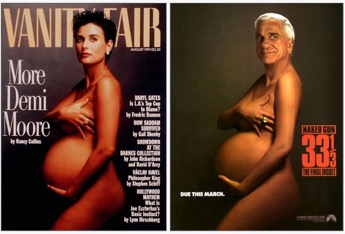
Image description: Side-by-side images. Left: The famous Vanity Fair cover featuring Demi Moore nude and pregnant, posed in profile with one arm across her chest and the other hand cradling her belly. Right: A parody image mimicking the pose, featuring an older man with white hair in the same nude, pregnant stance, promoting the film The Naked Gun 33⅓: The Final Insult.
JON O. NEWMAN, Circuit Judge:
… I. Fair Use and Parody
The fair use doctrine permits other people to use copyrighted material without the owner’s consent in a reasonable manner for certain purposes. Recognized at common law, the doctrine is now codified in section 107 of the 1976 Copyright Act. … Although the statute does not specifically list “parodies” among the categories of potentially “fair” uses, we have long afforded such works some measure of protection under this doctrine, see, e.g., MCA, Inc. v. Wilson, 677 F.2d 180 (2d Cir.1981); Elsmere Music, Inc. v. National Broadcasting Co., 623 F.2d 252 (2d Cir.1980); Berlin v. E.C. Publications, Inc., 329 F.2d 541 (2d Cir. 1964), and the Supreme Court authoritatively confirmed the applicability of the fair use doctrine to parodies in Campbell, 510 U.S. at 579. [The court then elaborated on “Campbell’s Clarification of the Fair Use Defense” before proceeding to apply the fair use factors.]
A. First factor.
Applying Campbell to the first-factor analysis, we inquire whether Paramount’s advertisement “may reasonably be perceived,” as a new work that “at least in part, comments on” Leibovitz’s photograph. Plainly, the ad adds something new and qualifies as a “transformative” work. Whether it “comments” on the original is a somewhat closer question. Because the smirking face of Nielsen contrasts so strikingly with the serious expression on the face of Moore, the ad may reasonably be perceived as commenting on the seriousness, even the pretentiousness, of the original. The contrast achieves the effect of ridicule that the Court recognized in Campbell would serve as a sufficient “comment” to tip the first factor in a parodist’s favor. See id. at 583, (“It is this joinder of reference and ridicule that marks off the author’s choice of parody from the other types of comment and criticism that traditionally have had a claim to fair use protection as transformative works.”).
In saying this, however, we have some concern about the ease with which every purported parodist could win on the first factor simply by pointing out some feature that contrasts with the original. Being different from an original does not inevitably “comment” on the original. Nevertheless, the ad is not merely different; it differs in a way that may reasonably be perceived as commenting, through ridicule, on what a viewer might reasonably think is the undue self-importance conveyed by the subject of the Leibovitz photograph. A photographer posing a well known actress in a manner that calls to mind a well known painting must expect, or at least tolerate, a parodist’s deflating ridicule.3
Footnote 3: Some have suggested that copyright law should accord fair use protection to parodies only when they offer commentary that is disparaging of the original. … While we agree that the fair use defense can play a valuable role in allowing commentary with criticizing messages to see the light of day, the fair use doctrine is broad enough to protect even those commentaries that are not so damaging that the original author would refuse to license them for a fee. A parodist need not demonstrate that the copyright owner would prohibit the use in order to qualify the copy as fair use under Campbell.
Apart from ridiculing pretentiousness, the ad might also be reasonably perceived as interpreting the Leibovitz photograph to extol the beauty of the pregnant female body, and, rather unchivalrously, to express disagreement with this message. The District Court thought such a comment was reasonably to be perceived from the contrast between “a serious portrayal of a beautiful woman taking great pride in the majesty of her pregnant body ... [and] a ridiculous image of a smirking, foolish-looking pregnant man.”
The fact that the ad makes a parodic comment on the original does not end the first-factor analysis, however, because the ad was created and displayed to promote a commercial product, the film. This advertising use lessens the “indulgence” to which the parodic ad is entitled. See Campbell, 510 U.S. at 585. Paramount seeks to mitigate the negative force of the advertising purpose by arguing that the advertisement should be viewed as an extension of the film, rather than merely an advertisement for it. Paramount emphasizes the general jocular nature of the film, as well as the film’s specific humorous treatment of pregnancy and parenthood.
Though the advertising purpose of a parodic copying should not be entirely discounted simply because the ad promotes a humorous work, there is some slight force to Paramount’s argument. For those who see the movie, the parodic comment of the ad might reasonably be perceived as reenforced by the kidding comments of the movie concerning pregnancy and parenthood.
On balance, the strong parodic nature of the ad tips the first factor significantly toward fair use, even after making some discount for the fact that it promotes a commercial product. Less indulgence, does not mean no indulgence at all. This is not a case like Steinberg v. Columbia Pictures Industries, Inc., 663 F.Supp. 706 (S.D.N.Y.1987), where a copyrighted drawing was appropriated solely to advertise a movie, without any pretense of making a comment upon the original.
B. Second Factor.
Though Paramount concedes the obvious point that Leibovitz’s photograph exhibited significant creative expression, Campbell instructs that the creative nature of an original will normally not provide much help in determining whether a parody of the original is fair use. Campbell, 510 U.S. at 586. The second factor therefore favors Leibovitz, but the weight attributed to it in this case is slight.
C. Third Factor.
In assessing the amount and substantiality of the portion used, we must focus only on the protected elements of the original. Leibovitz is entitled to no protection for the appearance in her photograph of the body of a nude, pregnant female. Only the photographer’s particular expression of such a body is entitled to protection. Thus, to whatever extent Leibovitz is contending that the ad takes the “heart” of the original, see Harper & Row, 471 U.S. at 564-66, she must limit her contention to the particular way the body of Moore is portrayed, rather than the fact that the ad copies the appearance of a nude, pregnant body. Moreover, in the context of parodies, “the heart is also what most readily conjures up the [original] for parody, and it is the heart at which parody takes aim,” Campbell, 510 U.S. at 588. Thus, the third-factor inquiry in the parody context concerns “what else the parodist did besides go to the heart of the original.” Id. at 589.
Paramount went to great lengths to have its ad copy protectable aspects of the Leibovitz photograph. Even though the basic pose of a nude, pregnant body and the position of the hands, if ever protectable, were placed into the public domain by painters and sculptors long before Botticelli, Leibovitz is entitled to protection for such artistic elements as the particular lighting, the resulting skin tone of the subject, and the camera angle that she selected.
The copying of these elements, carried out to an extreme degree by the technique of digital computer enhancement, took more of the Leibovitz photograph than was minimally necessary to conjure it up, but Campbell instructs that a parodist’s copying of more of an original than is necessary to conjure it up will not necessarily tip the third factor against fair use. On the contrary, “[o]nce enough has been taken to assure identification,” as plainly occurred here, the reasonableness of taking additional aspects of the original depends on the extent to which the “overriding purpose and character” of the copy “is to parody the original,” and “the likelihood that the parody may serve as a market substitute for the original”. That approach leaves the third factor with little, if any, weight against fair use so long as the first and fourth factors favor the parodist. Since those factors favor fair use in this case, the third factor does not help Leibovitz, even though the degree of copying of protectable elements was extensive.
D. Fourth Factor.
Leibovitz all but concedes that the Paramount photograph did not interfere with any potential market for her photograph or for derivative works based upon it. She appears to have conceded as much in her deposition testimony, as well. Her only argument for actual market harm is that the defendant has deprived her of a licensing fee by using the work as an advertisement. But she is not entitled to a licensing fee for a work that otherwise qualifies for the fair use defense as a parody. See Campbell, 510 U.S. at 592. The fourth factor favors the defendant.
Notes and questions
(1) How much would you need to change the facts of this case (and which facts would you change) to get to a result of no finding of fair use in this case?
Suntrust Bank v. Houghton Mifflin Co., 268 F.3d 1257 (11th Cir. 2001)
Margaret Mitchell’s 1936 novel, Gone With the Wind, is a cultural icon with an enduring hold on our collective imagination of the American South during the Civil War and Reconstruction. Its lasting appeal notwithstanding, Gone With the Wind is a controversial book, in part because Mitchell’s white characters are unapologetically racist and her non-white characters are one-dimensional reflections of that racism. In Mitchell’s novel, the antebellum South is idealized and the end of slavery is lamented. As Scarlett O’Hara, the book’s focal character, says: “The more I see of emancipation the more criminal I think it is. It’s just ruined the darkies.”
Alice Randall’s 2001 novel, The Wind Done Gone, retells this classic story from the perspective of Scarlett’s African-American half-sister, Cynara, and in doing so attempts to rebut the perspective, judgments, and mythology of the original work. In the course of this retelling, The Wind Done Gone takes the characters, plot, and major scenes from the original and recasts them. Although the narrative style and language of Randall’s book is quite different to the original, at a more abstract level of character, plot, and location, it borrows heavily from Gone With the Wind, especially in the latter book’s first half.
Mitchell’s literary estate viewed The Wind Done Gone as an act of piracy and sought to prevent its publication. On appeal from a lower court injunction, the court of appeals for the Eleventh Circuit agreed that Randall had borrowed liberally from Gone With the Wind, but in the court’s assessment, as a specific criticism of and rejoinder to the original, The Wind Done Gone was a transformative parody. The court had no trouble in seeing the dividing line between a legitimate parody and an infringing derivative work. Randall had not simply used Gone With the Wind to extend the story for its own sake, or as a platform for a general commentary on the Civil-War-era American South. Rather, like other effective parodies, she had conscripted the elements of the original to make war against itself. As the court summarized (at 1270):
… Randall’s work flips Gone With the Wind’s traditional race roles, portrays powerful whites as stupid or feckless, and generally sets out to demystify Gone With the Wind and strip the romanticism from Mitchell’s specific account of this period of our history.
The Wind Done Gone had taken quite liberally from Gone With the Wind, but it had done so in a thoroughly transformative manner “shedding light on an earlier work, and, in the process, creating a new one.”
The plaintiffs in Suntrust argued that Randall had taken too much of the original work because she could have made the same critical points in a way that required much less borrowing from the original. Randall chose to convey her criticisms of Gone With The Wind by creating a mirror world in which “every black character is given some redeeming quality — whether depth, wit, cunning, beauty, strength, or courage — that their Gone With the Wind analogues lacked.” The fact that there were more parsimonious choices available was irrelevant to the fair use analysis. What mattered was that where Mitchell’s original expression was appropriated, it was invested with a new meaning or message.
A parody must be consistently transformative, but there is no requirement that parodists take the bare minimum amount of copyright material necessary to achieve their ends. Nor is there any requirement that the original work should be the sole subject of the parody. In Campbell, the Court said that all that was required was that the defendant’s work “loosely target an original” as long as the parody “reasonably could be perceived as commenting on the original or criticizing it, to some degree.”
Although Randall had taken quite substantially from the original, in the eyes of the court, there was nothing extraneous to her parodic purpose. As Judge Marcus summarized in his concurrence (at 1280):
Even a cursory comparison of the two texts reveals that The Wind Done Gone profoundly alters what it borrows—indeed, at times beyond recognition. To catch some of Randall’s allusions, even a reader familiar with Mitchell’s work may need to refer to the original text. To create a successful parody, an author must keep certain elements constant while inverting or exaggerating other variables; generally there is an incongruity between the borrowed and the new elements. In Randall’s book, the ratio of the former to the latter is very low, and the incongruity between them wide.
Mattel Inc. v. Walking Mountain Products, 353 F.3d 792 (9th Cir. 2003)
Thomas Forsythe’s Malted Barbie & Oyster Dive
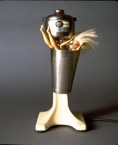
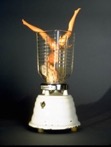
Image description: Left, a Barbie doll is positioned upside down inside a metal blender cup, with only her legs and part of her head with messy blonde hair visible. Right, a nude doll is placed upside down in a clear blender jar, with its legs sticking out above the rim.
In 1997, an artist named Thomas Forsythe developed a series of photographs entitled Food Chain Barbie, depicting Mattel’s famous Barbie doll in various absurd and often sexualized positions. As the Malted Barbie and Oyster Dive photos reproduced below illustrate, Forsythe’s works typically involved naked Barbie dolls imperiled by vintage household appliances.
For decades Mattel has promoted Barbie as an icon of beauty, wealth, and glamour and the ideal American woman. Others see Barbie as the quintessential representative of a consumer culture obsessed by idealized and unobtainable notions of beauty and perfection. According to the Copyright Act, however, the Barbie doll is a sculptural work entitled to copyright protection. Mattel zealously promotes its concept of Barbie and is quick to use copyright and trademark law to try to suppress alternative less charitable views.
In Mattel Inc. v. Walking Mountain Products, Mattel argued that Forsythe’s Food Chain Barbie series violated its copyright in the Barbie sculptures. The Ninth Circuit court of appeals disagreed. Although each of the photos in the Food Chain Barbie series arguably reproduced three-dimensional Barbie, albeit in two-dimensional form, the reproduction was not infringement, but fair use.
The court held that the defendant’s use of the iconic Barbie image was transformative in the sense that it added “something new, with a further purpose or different character, altering the first with new expression, meaning, or message.” The various Food Chain Barbie images conveyed the image of Barbie, but they also changed the meaning of that image by exposing Barbie to absurd and dangerous domestic situations. As the court summarized:
Forsythe turns this image on its head, so to speak, … His lighting, background, props, and camera angles all serve to create a context for Mattel’s copyrighted work that transform Barbie’s meaning. Forsythe presents the viewer with a different set of associations and a different context for this plastic figure. In some of Forsythe’s photos, Barbie is about to be destroyed or harmed by domestic life in the form of kitchen appliances, yet continues displaying her well known smile, disturbingly oblivious to her predicament. As portrayed in some of Forsythe’s photographs, the appliances are substantial and overwhelming, while Barbie looks defenseless. In other photographs, Forsythe conveys a sexualized perspective of Barbie by showing the nude doll in sexually suggestive contexts. It is not difficult to see the commentary that Forsythe intended or the harm that he perceived in Barbie’s influence on gender roles and the position of women in society.
In other words, Forsythe did more than simply drop Barbie in a blender; his choice of setting, lighting, and camera angle in each photo created a new work that quite clearly comments on the objectification of women and the conventional beauty myth associated with Barbie.
Mattel argued that Forsythe should not be entitled to fair use because he had copied the entirety of the Barbie figure in some photos. The toy company suggested that whatever critical purpose Forsythe intended could have been realized by limiting his photos to less than a complete image of Barbie—severed heads, for example? But as the court explained, visual works are often less amenable to segmentation than textual works. Forsythe’s use of the whole doll was entirely reasonable in the circumstances because, rather than dismembering the doll, Forsythe added to it “by creating a context around it and capturing that context in a photograph.” The court also noted that the two-dimensional photo of a three dimensional object scarcely constitutes a verbatim copy in any event. However, there is no indication that the court would have decided the case any differently had the artist’s medium of choice been sculpture rather than photography.
The Food Chain Barbie case demonstrates that the reasonableness of the amount of the copyright owner’s original expression used by the defendant in a new work will be assessed in light of the defendant’s transformative purpose, the nature of the work itself, and also with a view to how the defendant has changed the work. Courts should not make arbitrary distinctions based on whether those changes are in the form of subtraction or addition. The case also shows how certain works require greater appropriations to convey their essence. Moreover, certain genres of criticism justifiably require more extensive takings than others. If the defendant’s purpose is transformative in the sense of commenting upon or criticizing the original, there is no requirement that she pursue that goal in a given genre or that she take the absolute minimum amount of the copyrighted work possible within any given genre. As the Ninth Circuit explained,
Undoubtedly, one could make similar statements through other means about society, gender roles, sexuality, and perhaps even social class. But Barbie, and all the associations she has acquired through Mattel’s impressive marketing success, conveys these messages in a particular way that is ripe for social comment.
Notes and questions
(1) What do Suntrust Bank and Mattel Inc. v. Walking Mountain tell us about the relationship between the first and third fair use factors?
(2) What does Mattel Inc. v. Walking Mountain tell us about the relationship between the second and third fair use factors?
Parody versus Satire
Dr. Seuss Enterprises, LP v. Penguin Books, USA, Inc., 109 F.3d 1394 (9th Cir. 1997)
The use of a copyrighted work for a reflective purpose, such as commentary or criticism is transformative and is a significant step along the way to establishing fair use. However, the question of whether the defendant’s work should be seen as a commentary or criticism of the original may present a close question of fact.
In Dr. Seuss Enterprises, LP v. Penguin Books, USA, Inc., 109 F.3d 1394 (9th Cir. 1997) the Ninth Circuit court of appeals found that a book about the O.J. Simpson trial did not qualify for fair use because it amounted to satire, not parody.
Dr. Seuss’ Cat In the Hat and Cat NOT in the Hat (left), Cat NOT in the Hat Book Cover (right)
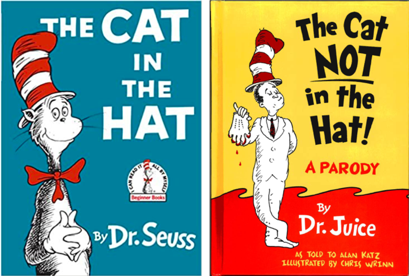
Image description: Side-by-side book covers. Left: The Cat in the Hat by Dr. Seuss, featuring the famous illustrated cat wearing a tall red-and-white striped hat and a red bow tie, on a teal background. Right: The Cat NOT in the Hat! A Parody by Dr. Juice, imitating the original style but with a mischievous-looking cat holding the severed head of the original Cat in the Hat, blood dripping, set against a yellow and red background.
The original Cat in the Hat was an anthropomorphic cat who wore a red and white striped hat and a red bow tie and was introduced to the world in a Dr. Seuss book by the same name in 1957. In 1995, Alan Katz and Chris Wrinn wrote and illustrated a satire of the famous O.J. Simpson double murder trial entitled The Cat NOT in the Hat. Katz and Wrinn retold the story of the O.J. Simpson trial in Dr. Seuss’s characteristic style with a narrator drawn to invoke the famous Cat in the Hat. As illustrated below, there are enough similarities between the original Cat in the Hat and the defendants’ narrator for the audience to make the connection, but arguably not a great deal beyond that.
The problem for the defendants in the Dr. Seuss case was not that they had appropriated too much of the original work for their purpose, but rather that the court could not see any valid purpose for their appropriation at all. The Cat NOT in the Hat did not appear to comment on the original Cat, its author, or anything it represented. In the court’s view, the defendant had invoked an association to the original Cat merely as a device to “get attention” and possibly even “to avoid the drudgery in working up something fresh.”
The Dr. Seuss case reinforced the distinction between parody and satire articulated by the Supreme Court in Campbell v. Acuff-Rose Music. Parody co-opts elements of a work into a critique of the work itself, the work’s creator, or something the work represents. Satire uses the original work as a vehicle to poke fun at another unrelated target. Part of the reason for recognizing the transformative nature of parodic and critical uses is that without fair use certain messages would be very difficult to convey. To make fun of a given work, one must invoke that work; whereas there are limitless ways to make fun of something entirely unrelated. Thus, as the Supreme Court said in Campbell (at 580–81):
Parody needs to mimic an original to make its point, and so has some claim to use the creation of its victim’s (or collective victims’) imagination, whereas satire can stand on its own two feet and so requires justification for the very act of borrowing.
What the Court did not say, however, was that satire could never find such a justification. It would be wrong to conclude that satire can never be transformative, but it is much easier to see why parody and other forms of direct criticism and commentary are transformative.
Arguably, Justice Kennedy’s concurrence in Campbell takes an unreasonably narrow view of the scope of parody. Kennedy proclaimed that to amount to fair use, a “parody must target the original, and not just its general style, the genre of art to which it belongs, or society as a whole (although if it targets the original, it may target those features as well).”
The better view is that the legitimate scope of parody is not confined to substance and style of the original work. Works do not exist in a vacuum and it seems perfectly legitimate to co-opt elements of an author’s original expression to critique the author herself or to say something about the genre of art that the work represents. For example, in 1962, Andy Warhol created a series of 20 x 16” paintings of Campbell’s Soup Cans that now hangs in the New York Museum of Modern Art. Each painting resembles one of Campbell’s mass-produced printed advertisements, but they are in fact hand-painted and the fleur de lys pattern ringing each can’s bottom edge is hand-stamped.
Andy Warhol’s Campbell’s Soup Cans, 1962 (Clam Chowder and Beef)
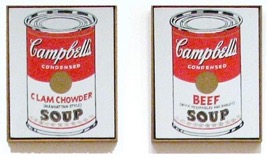
Image description: Two framed artworks depict Campbell’s condensed soup cans in Andy Warhol’s pop art style. The left can is labeled “Clam Chowder (Manhattan Style),” and the right can is labeled “Beef (with Vegetables and Barley).” Both cans are white with a red upper section and black lettering, each centered against a plain white background.
The Campbell’s Soup Cans series is generally understood to be a comment on consumer culture—this commentary is achieved through the juxtaposition of the traditional artistic form with the mundane mass-produced household object. (See for example, the Andy Warhol Foundation case, above) On this interpretation, Warhol’s depiction of Campbell’s soup cans is not simply a comment about society unrelated to the Campbell Soup Company; it is saying something about the relationship of the Campbell Soup Company to society. Perceived as such, Warhol’s work is a comment on the original work, not just broader social commentary.
The Ninth Circuit returned to both Dr. Seuss in Dr. Seuss Enterprises, LP v. ComicMix LLC, 983 F.3d 443 (9th Cir. 2020) extracted below.
Commentary
Kienitz v. Sconnie Nation LLC, 766 F.3d 756 (7th Cir. 2014)
T-Shirt Design and Original Photo in Kienitz v. Sconnie Nation
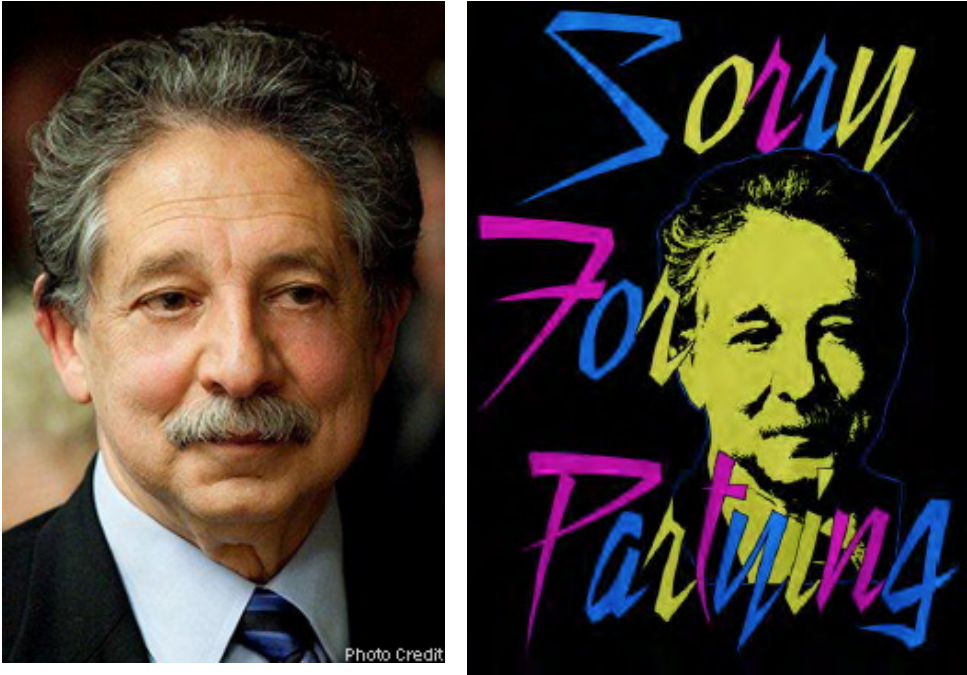
Image description: The image shows two side-by-side pictures of the same man. On the left, a neon-colored poster with the words “Sorry For Partying” features his face in bright yellow, outlined against a black background. On the right, there is a realistic color photo of the man with gray hair and a mustache, wearing a dark suit and light blue shirt, looking slightly to the side.
Defendant, Sconnie Nation had used a posterized version of a photograph of the Mayor of Madison, Wisconsin, Paul Soglin on their shirts with the text “Sorry for Partying.” The text was a rejoinder to Soglin who had apparently attended the first Mifflin Street Block Party while a student at the University of Wisconsin in 1969. However, as mayor, Soglin wanted to shut down the annual Block Party.
In Kienitz v. Sconnie Nation LLC the Seventh Circuit criticized Cariou’s transformative use analysis, suggesting that it overshadowed the rights of copyright owners to derivative works and the text of Section 107. For all that, the court agreed that the use was fair. Moreover, the court’s analysis reads a lot like a classic transformative use discussion informed by factor three:
Defendants removed so much of the original that, as with the Cheshire Cat, only the smile remains. Defendants started with a low-resolution version posted on the City’s website, so much of the original’s detail never had a chance to reach the copy; the original’s background is gone; its colors and shading are gone; the expression in Soglin’s eyes can no longer be read; after the posterization (and reproduction by silk-screening), the effect of the lighting in the original is almost extinguished. What is left, besides a hint of Soglin’s smile, is the outline of his face, which can’t be copyrighted. Defendants could have achieved the same effect by starting with a snapshot taken on the street. … by the time defendants were done, almost none of the copyrighted work remained.
Estate of Smith v. Graham, 799 F. App’x 36 (2d Cir. 2020)
In 1982, James Oscar Smith recorded the album “Off the Top.” One of the tracks on the album, “Jimmy Smith Rap,” is a spoken-word recording. Drake’s 2013 album “Nothing Was the Same” included a song titled “Pound Cake/Paris Morton Music 2” (“Pound Cake”). The opening to the song samples about 35 seconds of “Jimmy Smith Rap.”
The lyrics to “Jimmy Smith Rap” are set forth below, with the parts copied by Drake in bold:
Good God Almighty, like back in the old days
You know, years ago they had the A&R men to tell you what to play, how to play it and you know whether it’s disco rock, but we just told Bruce that we want a straight edge jazz so we got the fellas together Grady Tate, Ron Carter, George Benson, Stanley Turrentine.
Stanley was coming off a cool jazz festival, Ron was coming off a cool jazz festival. And we just went in the studio and we did it.
We had the champagne in the studio, of course, you know, compliments of the company and we just laid back and did it.
Also, Grady Tate’s wife brought us down some home cooked chicken and we just laid back and we was chomping on chicken and having a ball.
Jazz is the only real music that’s gonna last. All that other bullshit is here today and gone tomorrow. But jazz was, is and always will be.
We may not do this sort of recording again, I may not get with the fellas again. George, Ron, Grady Tate, Stanley Turrentine.
So we hope you enjoy listening to this album half as much as we enjoyed playing it for you.
Because we had a ball.
The sampled version in Pound Cake consists of:
Good God Almighty, like back in the old days.
You know, years ago they had the A&R men to tell you what to play, how to play it and you know whether it’s disco rock, but we just went in the studio and we did it.
We had champagne in the studio, of course, you know, compliments of the company, and we just laid back and did it.
So we hope you enjoy listening to this album half as much as we enjoyed playing it for you. Because we had a ball.
Only real music is gonna last, all that other bullshit is here today and gone tomorrow.
Some words from “Jimmy Smith Rap” were rearranged or deleted. No words were added. In producing the album, Drake’s production company, Cash Money had arranged for a music licensing company to ensure that parties obtained all necessary licenses. However, while it obtained a license for the “Jimmy Smith Rap” recording, it did not obtain a license for the “Jimmy Smith Rap” composition.
This case was decided as a ruling by. The facts are drawn from the district court opinion and the original audio tracks.
The court concluded, summary order without precedential effect, that the use of the “Jimmy Smith Rap” in Drake’s song “Pound Cake” constituted fair use, based on its analysis of the four statutory fair use factors. In terms of the purpose and character of the use, the court emphasized that the use was transformative because, while the original “Jimmy Smith Rap” celebrates the enduring value of jazz music, “Pound Cake” recontextualized and repurposed that message to assert that authenticity, not genre, is what defines real music. By altering the message and embedding it in a new, critical context, the court found the use sufficiently transformative.
On the issue of market effect, the court determined there was no evidence that “Pound Cake” harmed the market for “Jimmy Smith Rap” or served as a market substitute. The two works target different audiences—hip-hop and jazz—and there was no indication of a functioning market for licensing the original, which is important for fair use analysis.
Notes and questions
(1) How clear was it that Drake was responding to Smith as opposed to just making Smith’s comments more generally applicable so he could adopt them as his own? Would that interpretation undermine the case for fair use?
(2) Would this case be decided differently now in light of Andy Warhol Foundation?
Boesen v. United Sports Publications, Ltd., 2020 WL 6393010 (E.D.N.Y. Nov. 2, 2020)
In Boesen v. United Sports Publications, the court found that embedding an Instagram post containing a cropped, low-resolution version of the plaintiff’s copyrighted photograph was a transformative use protected by fair use.
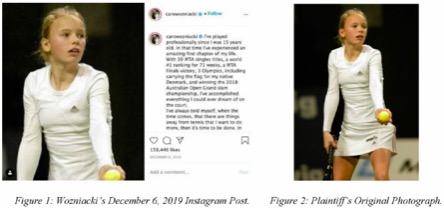
Image description: The image shows two side-by-side pictures of a female tennis player in a white outfit holding a tennis ball. On the left, the photograph is included within a screenshot of a December 6, 2019 Instagram post by Caroline Wozniacki, which includes text about her retirement. On the right, the same original photograph is shown alone, capturing her mid-match with focused expression, racket in hand, and ball in her other hand.
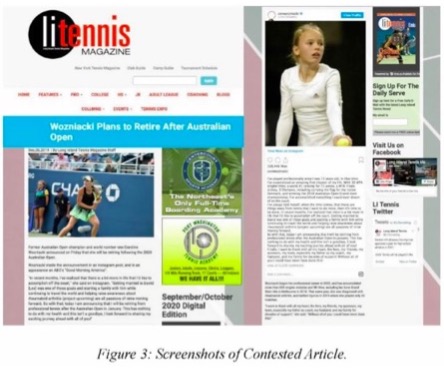
Image description: A screenshot of a tennis magazine article. The left side features the LI Tennis Magazine website with a headline reading “Wozniacki Plans to Retire After Australian Open,” accompanied by a photo of Caroline Wozniacki playing tennis. The right side shows her December 6, 2019 Instagram post, including a photograph of her on court in a white outfit holding a tennis ball, alongside her retirement announcement text.
Finding for the defendant, the court emphasized that the defendant news outlet did not use the image to depict Caroline Wozniacki for its own sake, but to report on her Instagram retirement announcement—the social media post itself was the subject of the article. By embedding the post, rather than displaying the image in isolation, the defendant added new context and purpose, transforming the photograph from a generic sports portrait into part of a commentary on Wozniacki’s use of social media to mark her career’s end. The court held that such use differed in character and function from the original and did not exploit the photo commercially beyond incidental advertising. This distinction, alongside the post’s cropped and diluted form, lack of market harm, and the article’s journalistic purpose, led the court to conclude that all four fair use factors favored the defendant, warranting dismissal of the infringement claim.
Notes and questions
(1) Do you agree that this was fair use?
Reporting the news
Los Angeles News Service v. KCAL-TV Channel 9, 108 F.3d 1119 (9th Cir. 1997)
Los Angeles News Service (“LANS”) was a freelance news service formed that specialized in coverage of live breaking news in Los Angeles shot from a helicopter. When the police officers that beat Rodney King were acquitted on April 29, 1992, the city of Los Angeles erupted into riots. One of the key events of the LA Riots was the gruesome beating of a white truck driver, Reginald Denny, by a group of black men and his eventual rescue by two black civilians. That dramatic incident was captured on film by the LANS news helicopter and broadcast live. The footage was initially broadcast on a television station licensed by LANS, but it was also rebroadcast without permission by several other stations. The district court held that the use of the footage by a local television station, KCAL, was fair use and LANS appealed.
RYMER, Circuit Judge:
… Purpose and character of use.
Even though the fact that KCAL was reporting news weighs heavily in its favor (§ 107 itself gives news reporting as an example), the fact that LANS and KCAL are both in the business of gathering and selling news cuts the other way. LANS does work that its licensees choose not to do for themselves, for example, operating its own helicopter with news crew aboard, and gets paid for licensing its coverage of news to the media. By the same token, KCAL is a for-profit company that is engaged in a commercial enterprise that also gathers, and then (indirectly) “sells” news. It, therefore, “stands to profit from exploitation of the copyrighted material without paying the customary price.” Harper & Row, 471 U.S. at 562. Thus, KCAL competes with other stations for advertising dollars, which are in turn dependent upon KCAL’s viewership. The fact that KCAL used LANS’s copyrighted footage free of charge, rather than paying LANS or someone else for the footage, or investing in its own helicopter and crew to obtain the footage itself, at least raises an inference that its articulated purpose of reporting the news was mixed with the actual purpose of doing so by using the best version — whether or not it meant riding LANS’s (or some other station’s) copyrighted coattails. While this did not serve to supplant the copyright holder’s commercially valuable right of first publication as The Nation did in Harper & Row by scooping the hardcover and Time abstracts of President Ford’s memoirs, we cannot say that KCAL’s use of the Denny tape had neither the effect nor purpose of depriving LANS of its also valuable right of licensing its original videotape which creatively captured the Denny beating in a way that no one else did.
On the other hand, there is a forceful argument that the LANS tape of the Denny beating itself became a news item shortly after it was published because its view was so extraordinary. To the extent that KCAL ran the tape as a news story, this would weigh in its favor. However, this factor does not weigh nearly so heavily as it might otherwise since there is no evidence that KCAL used the tape in this way. It did not attribute the tape to LANS, and so far as the record discloses, aired it as if it were KCAL’s own rather than, for example, indicating that the best tape of the beating had been made by a LANS helicopter crew. Instead, the tape was simply used as part of KCAL’s coverage of the riots. Although KCAL apparently ran its own voice-over, it does not appear to have added anything new or transformative to what made the LANS work valuable — a clear, visual recording of the beating itself.
While the fact that KCAL had requested a license but had been refused one is not dispositive, the propriety of the defendant’s conduct is relevant to the character of the use at least to the extent that it may knowingly have exploited a purloined work for free that could have been obtained for a fee. Harper & Row, 471 U.S. at 562, 105 S.Ct. at 2231. Unlike the circumstances in Campbell, nothing in this record suggests that KCAL requested a license in a good faith effort to avoid this litigation. KCAL obtained a copy of the tape from another station, directly copied the original, superimposed its logo on the LANS footage, and used it for the same purpose for which it would have been used had it been paid for.
[The court held the nature of the work being factual weighed substantially in KCAL’s favor.]
Amount and substantiality of what was used.
While a small amount of the entire Videotape was used, it was all that mattered. As we said of the defendant Audio Video Reporting Services in Los Angeles News Service v. Tullo, which provided a video “news clipping” service by monitoring television news programs, recording them on videotape and selling copies to interested individuals and businesses, “although AVRS copied only a small part of the raw footage shot by LANS, it was the most valuable part of that footage. In preparing a newscast, a television station selects the most effective and illustrative shots from the raw footage available. Thus the news programs AVRS copied included what LANS’s customers thought was the best of the LANS footage — its ‘heart.’” Here, as there, this factor weighs against KCAL, for “the fact that a substantial portion of the infringing work was copied verbatim is evidence of the qualitative value of the copied material, both to the originator and to the plagiarist who seeks to profit from marketing someone else’s copyrighted expression.” Harper & Row, 471 U.S. at 565.
Effect on the market.
This case doesn’t fit neatly into a traditional niche, because “news” isn’t normally thought of as having a secondary market. Also, LANS’s tape had been licensed — and published — before KCAL’s use, and was licensed after its use. To that extent, this factor weighs in favor of KCAL. At the same time, KCAL’s stated purpose was to use the tape as “news” and it was a potential (and in the past was an actual) licensee or consumer of LANS’s product; there is evidence that, given what LANS and KCAL do, KCAL’s use of LANS’s works for free, without a license, would destroy LANS’s original, and primary market. Just as we recognized in Los Angeles News Service v. Tullo that customers might choose to buy raw footage from LANS if they couldn’t buy it from AVRS, KCAL was ready to buy from LANS if it could, but went elsewhere when it couldn’t. Were this to happen more broadly, it no doubt would adversely affect LANS’s creative incentives. See Campbell, 510 U.S. at 587-89, 114 S.Ct. at 1176 (courts must consider “whether unrestricted and widespread conduct of the sort engaged in by the defendant ... would result in a substantially adverse impact on the potential market’ for the original.”) All told, this weighs against a finding of fair use.
In sum, KCAL’s use of LANS’s copyrighted tape was arguably in the public interest because it was a percipient recording of a newsworthy event. However, KCAL’s use was commercial and came in the wake of LANS’s refusal of a license. Although KCAL explains that it used the tape because it recorded news of considerable significance from the best perspective of any witness, there is no evidence that alternatives were not available (albeit from a less desirable vantage point). Also, while the tape had been licensed and published before KCAL’s use, it is not obvious that there was no impact on the market for first publication rights as KCAL itself requested a license. There is no dispute that KCAL used the heart of the tape. Under these circumstances, we cannot say that fair use is the only reasonable conclusion a trier of fact could reach in this case. We therefore reverse and remand for further proceedings.
Notes and questions
(1) The Ninth Circuit agreed that the Denny video captured a unique and newsworthy event of significant public interest. It also agreed that the defendant broadcaster, KCAL, had been engaged in news reporting, and that this fact weighed heavily in its favor. So why did the defendant’s fair use defense fail?
Núñez v. Caribbean International News Corporation, 235 F.3d 18 (1st Cir. 2000)
TORRUELLA, Chief Judge.
Appellant Núñez, a professional photographer, took several photographs of Joyce Giraud (Miss Puerto Rico Universe 1997) for use in Giraud’s modeling portfolio. Núñez then distributed the photographs to various members of the Puerto Rico modeling community in accordance with normal practice. After the photographs had been taken, some controversy arose over whether they were appropriate for a Miss Puerto Rico Universe, based on the fact that Giraud was naked or nearly naked in at least one of the photos. A local television program displayed the photographs on screen and asked random citizens whether they believed the photographs were “pornographic.” Giraud was interviewed by two local television stations as to her fitness to retain the Miss Universe Puerto Rico crown. El Vocero then obtained several of the photographs through various means. Over the next week, without Núñez’s permission, three of his photographs appeared in El Vocero, along with several articles about the controversy.
Núñez claimed that the reprint of his photographs in El Vocero without his permission violated the Copyright Act of 1976. [The district court held in favor of the defendant on the grounds of fair use.] …
El Vocero De Puerto Rico Front Pages, October 24 & 25, 1997
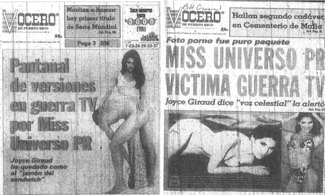
Image description: Two black-and-white newspaper covers from El Vocero de Puerto Rico featuring Miss Universe Puerto Rico, Joyce Giraud. Left: Giraud poses nude with her legs crossed and arms positioned to cover her chest; headline discusses TV disputes over Miss Universe PR. Right: A reclining nude image of Giraud accompanies a headline alleging she was a victim of a TV war, with text about a “photo porno” and her statement about a “celestial voice” warning her.
The Purpose and Character of the Use
The first factor in the fair use inquiry is “the purpose and character of the use, including whether such use is of a commercial nature or is for nonprofit educational purposes.” 17 U.S.C. § 107(1). The focus of this analysis asks “whether the new work merely ‘supersedes the objects’ of the original creation or instead adds something new.” Campbell, 510 U.S. at 579. The more “transformative” the new work, the less the significance of factors that weigh against fair use, such as use of a commercial nature. Id. … We agree with the district court that the commercial use here, however, constitutes more than mere reproduction for a profitable use. The photographs were used in part to create an enticing lead page that would prompt readers to purchase the newspaper. Thus El Vocero used the photograph not only as an ordinary part of a profit-making venture, but with emphasis in an attempt to increase its revenue. For this reason, the commercial nature of the reproduction counsels against a finding of fair use.
However, the district court also found that the pictures were shown not just to titillate, but also to inform. Puerto Ricans were generally concerned about the qualifications of Giraud for Miss Puerto Rico Universe, as is demonstrated by the several television shows discussing the photographs. This informative function is confirmed by the newspaper’s presentation of various news articles and interviews in conjunction with the reproduction. Appellee reprinted the pictures not just to entice the buying public, but to place its news articles in context; as the district court pointed out, “the pictures were the story.” It would have been much more difficult to explain the controversy without reproducing the photographs. And although such an explanatory need does not always result in a fair use finding, it weighs in the favor of appellee.
This is not to say that appellee’s use of the photographs was necessarily fair merely because the photographs were used for news purposes, nor does it establish a general “newsworthiness” exception. First, the Supreme Court has specifically frowned upon such an exception. See Harper & Row, 471 U.S. at 561 (“The fact that an article arguably is ‘news’ and therefore a productive use is simply one factor in a fair use analysis.”). Second, the problem with such an approach (as the Supreme Court pointed out) is that it provides an incentive for the infringer to create “news,” so that its infringement falls within the exception. See id. at 562. Were a “newsworthy” use per se fair, journalists and news photographers would be left with little assurance of being rewarded for their work. See id. at 558. It suffices to say here that El Vocero did not manufacture newsworthiness, as it sought not to “scoop” appellant by publishing his photograph, but merely to provide news reporting to a hungry public. And the fact that the story is admittedly on the tawdry side of the news ledger does not make it any less of a fair use.
Rather, what is important here is that plaintiffs’ photographs were originally intended to appear in modeling portfolios, not in the newspaper; the former use, not the latter, motivated the creation of the work. Thus, by using the photographs in conjunction with editorial commentary, El Vocero did not merely “supersede[] the objects of the original creation[s],” but instead used the works for “a further purpose,” giving them a new “meaning, or message.” Campbell, 510 U.S. at 579. It is this transformation of the works into news — and not the mere newsworthiness of the works themselves — that weighs in favor of fair use under the first factor of § 107. See id. (“central inquiry is whether defendant’s use is transformative”); see also Sony Corp. of America v. Universal City Studios, Inc., 464 U.S. 417, 478 (1984) (Blackmun, J., dissenting) (key question is whether defendant’s use “results in some added benefit to the public beyond that produced by the first author’s work”).
[The court noted that El Vocero attributed the photographs to Núñez and obtained each of the photographs lawfully. Furthermore,] as the district court explicitly found, El Vocero did not aim to use the photographs to compete with Núñez, nor to supplement his right of first production, as the photographs had already been distributed to the modeling community. Finally, appellee asserts that it believed in good faith that the photographs were available for general, unrestricted circulation and redistribution, and appellant offers little evidence to rebut this assertion.
In sum, the highlighting of the photograph on the front cover of El Vocero exposes the commercial aspect of the infringing use, and counts against the appellee. However, the informative nature of the use, appellee’s good faith, and the fact that it would have been difficult to report the news without reprinting the photograph suggest that on the whole, this factor is either neutral or favors a finding of fair use.
Nature of the Copyrighted Work
[The court found the second fair use factor, “nature of the copyrighted work,” favored fair use because although Núñez’s photographs had elements of creativity, they were primarily factual publicity images intended for public display, diminishing any claim to exclusive publication rights. It noted that “Although these photographs had not before been published in a book or public portfolio, they were hardly confidential or secret, as was the manuscript in Harper & Row prior to its serial publication.”]
Amount and Substantiality of the Use
The third factor is the “amount and substantiality of the portion used in relation to the copyrighted work as a whole.” 17 U.S.C. § 107(3). In this case, El Vocero admittedly copied the entire picture; however, to copy any less than that would have made the picture useless to the story. As a result, like the district court, we count this factor as of little consequence to our analysis.
Effect on the Market
The fourth statutory factor requires us to consider “the effect of the use upon the potential market for or value of the copyrighted work.” 17 U.S.C. § 107(4). Our inquiry is restrained to: (i) the extent of market harm caused by the particular actions of the alleged infringer; and (ii) whether unrestricted and widespread conduct of the sort engaged in by the defendant would result in a substantially adverse impact on the potential market. In other words, we examine the effect of this publication on the market, and we also determine whether wide-scale reproduction of professional photographs in newspapers (for similar purposes) would in general affect the market for such photography. As to the first, we find little impact on the market for these specific pictures. The district court noted that the purpose of dissemination of the pictures in question is not to make money, but to publicize; they are distributed for free to the professional modeling community rather than sold for a profit. The fact that a relatively poor reproduction was displayed on the cover of a newspaper should not change the demand for the portfolio. If anything, it might increase it. Even if there was widespread conduct of this sort, it would have little effect on the demand for disseminated pictures because a newspaper front page is simply an inadequate substitute for an 8” × 10” glossy.
However, the potential market for the photographs might also include the sale to newspapers for just this purpose: illustrating controversy. It is true that El Vocero’s use of the photograph without permission essentially destroys this market. There is no evidence, however, that such a market ever existed in this case. Núñez does not suggest that he ever tried to sell portfolio photographs to newspapers, or even that he had the right to do so under the contract with Giraud. Although it is more likely that other photographers do engage in such sales, and thus that widespread conduct of the type committed by El Vocero could destroy the newspaper sale market as a whole, we note again the context of this case. Surely the market for professional photographs of models publishable only due to the controversy of the photograph itself is small or nonexistent.
… Because the only discernible effect of the publication in El Vocero was to increase demand for the photograph, and because any potential market for resale directly to the newspaper was unlikely to be developed, this factor favors a finding of fair use.
CONCLUSION
In sum, the first, second, and fourth factors generally favor a finding of fair use. The third factor does not seem particularly relevant in this context. Again, we note that the finding of fair use always entails a case-by-case analysis, and the present case is no exception. Unauthorized reproduction of professional photographs by newspapers will generally violate the Copyright Act of 1976; in this context, however, where the photograph itself is particularly newsworthy, the newspaper acquired it in good faith, and the photograph had already been disseminated, a fair use exists under 17 U.S.C. § 107. As a result, we affirm the decision of the district court.
Notes and questions
(1) The Supreme Court’s decision in Harper & Row and the Ninth Circuit decision in Los Angeles News Service suggest that newsworthiness is no guarantee of fair use. Why is the outcome in Núñez v. Caribbean International different? What was transformative about the defendant newspaper’s use of the photos that was lacking in Harper & Row and Los Angeles News Service?
Monge v. Maya Magazines, Inc., 688 F.3d 1164 (9th Cir. 2012)
Monge v. Maya Magazines, Inc. centered on publication of private photographs of the secret wedding of two Puerto Rican celebrities, Noelia Lorenzo Monge and Jorge Reynoso.
TVNotas February 2009
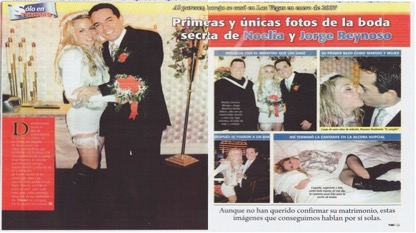
Image description: A Spanish-language magazine spread showing wedding photos of Noelia and Jorge Reynoso. Left page: The couple embraces and smiles at the camera, with Noelia in a short white lace dress and veil holding a bouquet, and Jorge in a dark suit with a red boutonniere. Right page: Smaller images show them with the officiant, kissing, at a bar, and lying together on a bed. Headlines describe these as the first and only photos of their secret wedding.
The dissent in Monge, Judge Smith regarded the case as similar to Núñez v. Caribbean International. Smith would have found in favor of fair use on the basis that the photos in suit were published as evidence that, contrary to their repeated denials, Monge and Reynoso were in fact married. For Smith, the photos were essential to rebut the couple’s denial and thus the exposé “constituted a transformative use because it shed light upon the Couple’s covert nuptials.” Smith also relied on the magazine’s commentary upon, and editing and arrangement of the photos as evidence of transformative use.
Writing for the majority, Judge McKeown disagreed. In the majority’s view, although the celebrity couple’s marital status was a matter of public interest, the wedding was the story, not the photos of the wedding. The magazine’s argument that its evidentiary use of the photos was transformative was substantially undercut by the fact that it had published all six photos of the wedding and subsequent festivities rather than relying on a single photo, or indeed upon a copy of the marriage certificate. From the majority’s perspective, the magazine’s publication of the photos was not transformative. The images themselves were largely unaltered and the associated text amounted to a mere sprinkling of commentary that was essentially pretextual.
Can we reconcile Núñez and Monge? Arguably we can. In Núñez, the defendant magazine was sharing the photos with its readers because the photos were the story, and it had a legitimate interest in commenting on the story and giving its readers information about the story. And that is the kind of difference in purpose that is transformative. Whereas the implication of Monge seems to be that the mere desire to expose expression (as opposed to information) that the plaintiff preferred to keep private is not the kind of difference in purpose that constitutes transformative use.
However, the difference between the dissent and the majority in Monge is essentially one of characterization. In Monge, the photos were taken to memorialize the couple’s wedding day. Beyond the mere fact that the wedding took place, the photos capture something of the mood and the atmosphere of the private ceremony and subsequent celebrations. Both objectively and subjectively, that is their purpose. If, like Judge Smith, we credit the view that the magazine published these photos as evidence that the wedding took place, Monge begins to look like a classic evidentiary use case. Under this interpretation, the defendant sought to communicate the fact of the photos’ existence and the fact of the wedding. This purpose would be rightly considered to be transformative because it is indifferent to the expressive qualities of the photos. If, like Judge McKeown, we take the view that the defendant magazine’s primary motive in publishing the photos was to satisfy its readers’ appetite for candid celebrity images, the defendant’s use appears entirely untransformative. The photos were taken to capture and preserve an otherwise effervescent moment in time and the defendant published them precisely because they achieved that effect. The mere fact that the plaintiffs intended the smallest possible audience for their works, whereas the defendant sought to make them public, does not demonstrate a difference in purpose.
As the majority notes, if one person’s desire to expose that which the author sought to conceal invariably amounted to a transformative difference in purpose, the right of first publication would be meaningless and invasion of privacy would be enshrined as a justification for what would otherwise be copyright infringement. There is no doubt a compelling public interest justification may require a finding of fair use, but it is hard to see the public interest in intrusion on privacy for its own sake.
Swatch Group v. Bloomberg, 756 F.3d 73 (2d Cir. 2014)
In 2011, the Swatch Group, a Swiss company with a significant investor base in the United States, held a conference call to discuss its latest earnings report with a select group of financial analysts. If Swatch had been a publicly traded United States company, it would have been obliged to disclose material information to all investors at the same time. However, the relevant law did not apply to overseas listed firms traded on American markets. Accordingly, Swatch Group chose to exclude the media and the public at large from its invitation-only investor conference call. Swatch Group arranged for the conference call to be recorded, and it was made clear that the recording was not to be published or broadcast. Comments and answers by Swatch Group executives accounted for 106 minutes of the entire 132 minute recording. When Bloomberg, a financial news service, somehow obtained a recording of the conference call and made it available to Bloomberg’s paying subscribers, the Swatch Group sued for copyright infringement.
KATZMANN, Chief Judge:
… A. Purpose and Character of Use
We turn first to “the purpose and character of the use.” 17 U.S.C. § 107(1). Whether one describes Bloomberg’s activities as “news reporting,” “data delivery,” or any other turn of phrase, there can be no doubt that Bloomberg’s purpose in obtaining and disseminating the recording at issue was to make important financial information about Swatch Group available to investors and analysts. That kind of information is of critical importance to securities markets. … where a financial research service obtains and disseminates important financial information about a foreign company in order to make that information available to investors and analysts, that purpose lends support to a finding of fair use.
It is undisputed here that Bloomberg is a commercial enterprise and that Bloomberg Professional is a subscription service available to paying users. [In prior cases] we have recognized that almost all newspapers, books and magazines are published by commercial enterprises that seek a profit, and have discounted this consideration where the link between the defendant’s commercial gain and its copying is attenuated such that it would be misleading to characterize the use as commercial exploitation. [The court noted the commercial nature of Bloomberg’s use, but assigned it relatively little weight.]
Swatch also contends that Bloomberg acted in bad faith and that this should count against it. Regardless of what role good or bad faith plays in fair use analysis, we need not tarry over it here. Even assuming that Bloomberg was fully aware that its use was contrary to Swatch Group’s instructions, Bloomberg’s overriding purpose here was not to “scoop” Swatch or “supplant the copyright holder’s commercially valuable right of first publication,” Harper & Row, 471 U.S. at 562, but rather simply to deliver newsworthy financial information to investors and analysts. That kind of activity, whose protection lies at the core of the First Amendment, would be crippled if the news media and similar organizations were limited to sources of information that authorize disclosure. See generally New York Times Co. v. United States, 403 U.S. 713 (1971).
The Supreme Court has also instructed courts analyzing the first fair use factor to consider the transformativeness of the use — that is, whether “the new work merely supersedes the objects of the original creation, or instead adds something new, with a further purpose or different character, altering the first with new expression, meaning, or message.” Campbell, 510 U.S. at 579. While a transformative use generally is more likely to qualify as fair use, “transformative use is not absolutely necessary for a finding of fair use.” Id.
In the context of news reporting and analogous activities, moreover, the need to convey information to the public accurately may in some instances make it desirable and consonant with copyright law for a defendant to faithfully reproduce an original work without alteration. Courts often find such uses transformative by emphasizing the altered purpose or context of the work, as evidenced by surrounding commentary or criticism. See, e.g., Bill Graham Archives v. Dorling Kindersley Ltd., 448 F.3d 605, 609-610 (2d Cir.2006); Nunez v. Caribbean Int’l News Corp., 235 F.3d 18, 22-23 (1st Cir.2000). Here, Bloomberg provided no additional commentary or analysis of Swatch Group’s earnings call. But by disseminating not just a written transcript or article but an actual sound recording, Bloomberg was able to convey with precision not only the raw data of the Swatch Group executives’ words, but also more subtle indications of meaning inferable from their hesitation, emphasis, tone of voice, and other such aspects of their delivery. This latter type of information may be just as valuable to investors and analysts as the former, since a speaker’s demeanor, tone, and cadence can often elucidate his or her true beliefs far beyond what a stale transcript or summary can show. As courts have long recognized in the context of witness testimony, a cold transcript contains only the dead body of the evidence, without its spirit, and cannot reveal the speaker’s hesitation, his doubts, his variations of language, his confidence or precipitancy, his calmness or consideration.
Furthermore, a secondary work can be transformative in function or purpose without altering or actually adding to the original work. Here, notwithstanding that the data disseminated by Bloomberg was identical to what Swatch Group had disseminated, the two works had different messages and purposes. To begin with, while Swatch Group purported to convey true answers to the analysts’ questions and to justify the propriety and reliability of its published earnings statement, Bloomberg made no representation one way or another as to whether the answers given by Swatch Group executives were true or reliable. Nor did Bloomberg purport to support the propriety or reliability of Swatch Group’s earnings statement. Bloomberg was simply revealing the newsworthy information of what Swatch Group executives had said. Bloomberg’s message — “This is what they said” — is a very different message from Swatch Group’s — “This is what you should believe.”
Moreover, Swatch Group intended to exclude members of the press and to restrict the information supplied by its executives to a relatively small group of analysts who had identified themselves to the company in advance. Bloomberg’s objective in rebroadcasting the call, by contrast, was to make this information public, defeating Swatch Group’s effort to restrict access. Bloomberg’s purpose, in other words, was to publish this factual information to an audience from which Swatch Group’s purpose was to withhold it. These differences give Bloomberg’s use at least an arguably transformative character.
In any event, regardless of how transformative the use is, we conclude that the first fair use factor, focusing on the purpose and character of the secondary use, favors fair use. We of course recognize that a news reporting purpose by no means guarantees a finding of fair use. See Harper & Row, 471 U.S. at 557. After all, “the promise of copyright would be an empty one if it could be avoided merely by dubbing the infringement a fair use ‘news report.’“ Id. A news organization thus may not freely copy creative expression solely because the expression itself is newsworthy. Nevertheless, we agree with the district court’s conclusion that, under the unusual circumstances of this case, the purpose and character of Bloomberg’s unaltered dissemination of Swatch Group’s expression weighs in favor of fair use, for two reasons.
First, as noted above, by disseminating a full, unadulterated recording of the earnings call, Bloomberg was able to convey valuable factual information that would have been impaired if Bloomberg had undertaken to alter the speech of the Swatch Group executives by interjecting its own interpretations. As we explained in a fair use case involving verbatim copying of a written work, “where an evaluation or description is being made, copying the exact words may be the only valid way precisely to report the evaluation.” Consumers Union, 724 F.2d at 1049-50; see also Harper & Row, 471 U.S. at 563, 105 S.Ct. 2218 (noting that direct copying may in some instances be “necessary adequately to convey the facts”). So too here, copying the exact spoken performance of Swatch Group’s executives was reasonably necessary to convey their full meaning. Bloomberg’s faithful reproduction thus served “the interest of accuracy, not piracy.” Consumers Union, 724 F.2d at 1049.
Second, Bloomberg’s use did no harm to the legitimate copyright interests of the original author. Importantly, Swatch has admitted that it did not seek to profit from the publication of the Earnings Call in audio or written format. The copyright-protected aspects of the earnings call — that is, the manner by which the facts were expressed — thus were of no value to Swatch or Swatch Group except insofar as they served to convey important information to the analysts in attendance. But Bloomberg’s copying of the Swatch Group executives’ words, as needed to communicate factual information about the company’s earnings report, in no way diminished Swatch Group’s ability to communicate with analysts, and thus caused no harm to Swatch’s copyright interests. In this way, the case at bar stands in stark contrast to a case like Harper & Row, where a magazine disseminated an unpublished excerpt of President Ford’s memoirs. This kind of gun-jumping, which scooped the publication of the copyrighted work and, in doing so, did considerable harm to the value of the original author’s copyright, is not present here.
Our prior decisions in Nihon Keizai Shimbun, Inc. v. Comline Business Data, Inc., 166 F.3d 65 (2d Cir.1999), Wainwright Securities, Inc. v. Wall Street Transcript Corp., 558 F.2d 91 (2d Cir. 1977), and Financial Information, Inc. v. Moody’s Investors Service, Inc. (“FII”), 751 F.2d 501 (2d Cir.1984), on which Swatch relies, are not to the contrary. In those cases, we rejected fair use arguments pressed by defendants who purported to be serving the public by providing access to important financial information. In Nihon and Wainwright, we stressed that the defendants had not supplemented or otherwise transformed the plaintiffs’ works. Instead, they had simply translated Japanese business articles into English, Nihon, or recounted the critical conclusions from research reports about major industrial and financial corporations, Wainwright. In FII, we rejected a fair use defense by a ratings agency that had copied information about municipal bond redemptions compiled by a competing financial publisher. Criticizing the district court’s conclusion that the defendant’s use served a “public function,” we stated that to so hold “would, it seems to us, state a rule that whenever there is a market for information, the paid delivery of goods to that market rises to a public function.” We rejected such a rule, finding that it would “distort” proper fair use analysis. Id.
In all three of those cases, however, the defendants attempted to use the banner of newsworthiness to supersede the core objects of original works whose production critically depended upon copyright protection. Finding fair use in those cases would have severely impeded the ability of news and research organizations to obtain payment for their expression, imperiling the economic foundation of vital industries. But unlike the arguments we rejected in Nihon, Wainwright, and FII, our decision today does not rest upon the newsworthiness of the original expression alone. To the contrary, we also place great weight on the absence of harm to the original author’s legitimate copyright interests. Swatch’s reliance on our prior cases is thus misplaced.
This first factor accordingly favors fair use.
[Remaining Factors]
[The court held that although the work was technically unpublished, “in light of the thinness of Swatch’s copyright, as well as Swatch Group’s prior dissemination of its executives’ expression,” the “nature of the work” factor favored fair use. The Second Circuit agreed with the district court “that Bloomberg’s use of the entire recording was reasonable in light of its purpose of disseminating important financial information to investors and analysts.” It thus held the “amount and substantiality of the use” weighed in neither party’s favor. The court also found that the “effect of the use upon the potential market for or value of the copyrighted work” favored Bloomberg. The district court noted that “the relevant market effect is that which stems from Bloomberg’s use of the original expression of Swatch Group’s senior officers.” Furthermore, it found nothing in the record to suggest any possible market effect stemming from Bloomberg’s use. The Second Circuit agreed, “especially in view of the obvious and furthermore conceded fact that Swatch had no interest in the exploitation of the copyright-protected aspects of the call.”]
Notes and questions
(1) The defendant’s fair use defense prevailed in Swatch Group v. Bloomberg, despite the weakness of its transformative use argument. Why?
Richardson v. Townsquare Media, Inc., 174 F.4th 299 (2d 2026)
In 2015, Richardson, a professional videographer, published a forty-two-second clip showing Michael Jordan breaking up a fight (the “Jordan Video”). The clip went largely unnoticed until July 2023, when the blog DailyLoud reposted it on X with the claim that the altercation involved rapper Wack 100 and Charleston White. Townsquare Media’s hip-hop outlet XXL wrote about the exchange, embedding DailyLoud’s X post with the full video and using a still from the video as its headline background. Richardson also sued over Townsquare’s treatment of a separate Melle Mel interview video and over screenshots taken from both videos. Townsquare moved for judgment on the pleadings, asserting fair use as to the Jordan Video, a YouTube Terms of Service license as to the embedded Melle Mel Video, and de minimis use as to the screenshots. The district court accepted all three defenses; Richardson appealed.
Writing for the Second Circuit, Judge Lynch held that the district court had misapplied the first, third and fourth fair use factors as to the Jordan Video. On transformativeness, the court found the question far closer than the district court had allowed. The headline sold the video itself rather than any commentary (“…Watch”), most of the article simply described what a viewer could see, and the only added content was a few sentences repeating DailyLoud’s unexplained speculation about White, with nothing in the video corroborating it. The video was reproduced unmodified and barely integrated into the reporting, suggesting that it retained its original purpose in new packaging. The court also faulted the district court for ignoring commerciality altogether: Townsquare is a for-profit entity running advertisements alongside the embed, and although the Swatch line of cases discounts commerciality where the link to the copying is attenuated, that cannot be resolved on the pleadings. The court held that factor one was therefore neutral at best.
On the third factor, Townsquare conceded that it had republished the entire video, and its necessity arguments failed. It could have paired the post’s text with a portion of the video, used a screenshot, or merely hyperlinked; it could have conveyed virality by reporting view counts or quoting comments. The claim that the full video let viewers assess White’s involvement struck the court as especially weak given that the second participant never appears on camera.
On market effect, the court held that the district court had drawn an impermissible inference for the defendant. Because the full video appeared on Townsquare’s site, viewers plausibly had no reason to seek out Richardson’s version, and it was not clear that they would gain anything from a copy unencumbered by the article’s text, its advertisements and the framing of the X post. Lost advertising, rental and purchase revenue would follow, and those inferences had to be drawn in Richardson’s favor. Distinguishing cases such as Brown v. Netflix, Inc., 855 F. App’x 61, 63–64 (2d Cir. 2021) (summary order) (eight seconds of a three-minute song), and Lombardo v. Dr. Seuss Enterprises, L.P., 729 F. App’x 131, 132–33 (2d Cir. 2018) (summary order) (a Grinch parody), where non-substitution was obvious, the court held that Townsquare had not carried its pre-discovery burden. Whatever transformative value the article had was outweighed by the wholesale republication, which made the use a plausible market substitute. Fair use could not be resolved on the pleadings, and the dismissal of the Jordan Video claim was reversed.
We encountered this case earlier, in connection with the de minimis doctrine.
Lynk Media, LLC v. Independent Digital News & Media, LLC, 2025 WL 2771625 (S.D.N.Y. Sept. 29, 2025)
Videographer Oliya Fedun shot five newsworthy videos, covering a Pennsylvania candidate’s rally remarks, an anti-vaccine-mandate protest at a Staten Island food court, a puppy adopted by Ukrainian soldiers, a disrupted town hall held by Representative Alexandria Ocasio-Cortez, and flags displayed at a pro-Palestine protest. Each was created with the intention of licensing it to news outlets, and each was posted to Twitter. The Independent’s publisher embedded the tweets in its articles and, for two of the videos, also posted screenshots. On cross-motions for summary judgment, the court held the infringement undisputed and rejected the fair use defense.
On fair use, the court held that the first factor decidedly favored the plaintiff: the videos and the embeds shared the identical purpose of documenting newsworthy events, and news reporting is not transformative where the original was itself news reporting. Invoking Romanova, the court held that separately declaring the existence of a social media controversy is not the same as communicating that message through the copying, and it rejected the argument that surrounding “cultural, political, and historical context” transforms the work, noting that such recontextualizing would swallow the doctrine. The videos’ contents, not the videos themselves, were the subject of the articles, so the commentary justification was unavailable, and the defendant’s commercial status and advertisement-laden pages pointed the same way. The second factor was neutral by concession. The third weighed against fair use given the wholesale copying, and the court rejected the claim that embedding left no editorial choice, noting Twitter’s option to hide media and the screenshots the defendant had itself used elsewhere. On the fourth factor the court found that unimpeded playback within the embed, combined with a demonstrated licensing market and the defendant’s own failed licensing inquiry over the Puppy Video, established that widespread embedding would overtake the market. The court declined to accept that posting to social media forfeits the licensing market, calling that a Hobson’s choice for creators, and found no public benefit sufficient to outweigh the harm.
Appropriation Art & Mashups
Rogers v. Koons 960 F.2d 301 (2d Cir. 1992)
In Rogers v. Koons, the artist Art Rogers sued sculptor Jeff Koons for copying a photograph that Rogers had taken and using it as a basis for one of Koons’ sculptures. The photograph depicted a couple holding eight puppies in a row, and Koons recreated the scene in his sculpture titled “String of Puppies.”
Koons String of Puppies and Rogers’ Puppies
Image description: Two side-by-side images show a couple seated with a row of puppies in their arms. On the left, a colorful sculpture depicts them with stylized, bright clothing and vivid blue puppies. On the right, a black-and-white photograph shows the same couple in real life, smiling while holding a similar group of puppies on their laps against a wooden fence backdrop.
Koons’s fair-use defense rested largely on his claim that he intended his sculpture to serve as a commentary on modern society. The court agreed that it might but denied the claim to fair use because “even given that ‘String of Puppies’ is a satirical critique of our materialistic society, it is difficult to discern any parody of the photograph ‘Puppies’ itself.” Thus the sculpture was satire, rather than parody. The court also noted that “the essence of Rogers’ photograph was copied nearly in toto, much more than would have been necessary even if the sculpture had been a parody of plaintiff’s work.” And furthermore, it found that Koons’ copying of the photograph was done in bad faith because he had removed the copyright notice before sending the photo to the Italian artisans who actually created the sculpture.
Blanch v. Koons, 467 F.3d 244 (2d Cir. 2006)
Jeff Koons had better luck in his second trip to the Second Circuit court of appeals. In Blanch v. Koons, the court held that a Jeff Koons painting that incorporated a copyrighted photograph drawn from a fashion magazine was fair use. The work in question was “Niagara,” which was part of a larger series of “Easyfun-Ethereal” paintings that were exhibited at the Deutsche Guggenheim Berlin from October 2000 to January 2001. To make the works in this series, Koons culled images from advertisements and other sources, scanned them, and digitally superimposed the scanned images against backgrounds of pastoral landscapes. He then printed color images of the resulting collages for his assistants to use as templates for applying paint to billboard-sized, 10’ × 14’ canvasses.
Jeff Koons’ Niagara and Blanch’s Magazine Photo
Image description: Two side-by-side images focus on women’s feet. On the left, a colorful artwork shows several pairs of feet, some in high-heeled sandals and some bare, suspended above desserts and a rocky landscape. On the right, a fashion photograph features crossed legs wearing shiny black high-heeled sandals with jeweled straps, positioned in a car interior.
The court was persuaded that Koons’ use of the Blanch photo was transformative.
Koons does not argue that his use was transformative solely because Blanch’s work is a photograph and his a painting, or because Blanch’s photograph is in a fashion magazine and his painting is displayed in museums. He would have been ill advised to do otherwise. We have declined to find a transformative use when the defendant has done no more than find a new way to exploit the creative virtues of the original work. … But Koons asserts — and Blanch does not deny — that his purposes in using Blanch’s image are sharply different from Blanch’s goals in creating it.
… Koons is, by his own undisputed description, using Blanch’s image as fodder for his commentary on the social and aesthetic consequences of mass media. His stated objective is thus not to repackage Blanch’s “Silk Sandals,” but to employ it “‘in the creation of new information, new aesthetics, new insights and understandings.’”
The test for whether “Niagara’s” use of “Silk Sandals” is “transformative,” then, is whether it “merely supersedes the objects of the original creation, or instead adds something new, with a further purpose or different character, altering the first with new expression, meaning, or message.” Campbell, 510 U.S. at 579. The test almost perfectly describes Koons’s adaptation of “Silk Sandals”: the use of a fashion photograph created for publication in a glossy American “lifestyles” magazine — with changes of its colors, the background against which it is portrayed, the medium, the size of the objects pictured, the objects’ details and, crucially, their entirely different purpose and meaning — as part of a massive painting commissioned for exhibition in a German art-gallery space. We therefore conclude that the use in question was transformative.
Notes and questions
(1) Why did Koons lose the first case but win the second one?
Cariou v. Prince, 714 F.3d 694 (2d Cir. 2013)
The defendant in Cariou, well known appropriation artist Richard Prince had taken a series of photos published in Patrick Cariou’s book, Yes Rasta, and enlarged, modified, and combined the works in new and surprising ways (see the illustrations below). The district court granted Cariou’s motion for summary judgment and Prince appealed to the Second Circuit. On appeal, the majority of the Second Circuit found that twenty-five of Prince’s artworks were “transformative as a matter of law” and remanded the remaining five works to the district court for further consideration. The Second Circuit’s ruling in Cariou was based on a side-by-side comparison of the works at issue, some of which had been barely altered and others that were altered almost beyond recognition. In addition to alterations of substance, the source material was sometimes tinted and always radically enlarged.
It is not immediately obvious why the majority remanded Charlie Company back to the District Court but concluded that Back to the Garden was fair use as a matter of law.
Remanded: Charlie Company (left) and Yes Rasta (right)
Image description: Two sets of black-and-white images show a man with long hair and a beard riding a donkey in a natural, wooded setting. On the left, the photo has been altered into an artwork with repeated panels and superimposed images of nude female figures. On the right, the original unaltered photograph shows the man seated bare-chested on the donkey, looking directly at the camera.
Not Remanded: Back to the Garden (left) and Yes Rasta (right)
Image description: Two side-by-side black-and-white images. On the left, a collage-style artwork overlays fragments of nude female figures with the repeated image of a man on a donkey, his and the women’s faces obscured by white blotches. On the right, the original photograph shows the man bare-chested with long hair and beard, sitting on a donkey in a natural outdoor setting, facing the camera.
Likewise, the Cariou court did not really explain its different treatment of Canal Zone compared to Ocean Club. There are clearly some differences between the works, but how and why those differences constitute the dividing line between “definitely fair use” and “might be fair use” is left to the reader’s imagination.
Remanded: Canal Zone 2008 (left) various pages of Yes Rasta (right)
Image description: Two sets of black-and-white images depict dense vegetation with a man among tall plants. On the left, a collage overlays repeated fragments of the man standing shirtless with long hair, partially obscured by white blotches. On the right, four separate photographs show the man in different positions within a lush, overgrown landscape, framed by rectangular outlines that highlight parts of the images.
Not Remanded: The Ocean Club (left) various pages of Yes Rasta (right)
Image description: Two sets of black-and-white images. On the left, a collage overlays repeated figures of a nude woman bending forward with face obscured, alongside images of a man standing in vegetation. On the right, individual photographs show the same long-haired, shirtless man among dense plants, some framed with rectangles highlighting details of the foliage and his figure.
Also, the court’s failure to conclude that Graduation was “definitely not fair use” as a matter of law was also perplexing given the majority’s confidence that so many works were fair use as a matter of law. Graduation is simply an enlarged version of Cariou’s original photo with three blue circles and blue guitar added.
Remanded: Graduation (left) and Original Photograph from Yes Rasta (right)
Image description: Two black-and-white images show a shirtless man with long dreadlocks standing in a forested area. On the left, the photograph has been altered, with his face obscured by blue shapes and a blue electric guitar digitally added across his body. On the right, the original unaltered photo shows him standing with arms relaxed at his sides, looking downward.
The majority suggested that all the defendant needed to do to qualify for transformative use was to change the aesthetic or genre of the work. To elaborate, the court’s conclusion in Cariou that so many of Prince’s works were transformative was based largely on its observation that:
Prince’s artworks manifest an entirely different aesthetic from Cariou’s photographs. Where Cariou’s serene and deliberately composed portraits and landscape photographs depict the natural beauty of Rastafarians and their surrounding environs, Prince’s crude and jarring works, on the other hand, are hectic and provocative. … Prince’s composition, presentation, scale, color palette, and media are fundamentally different and new compared to the photographs, as is the expressive nature of Prince’s work. (emphasis added).
This seems like a very low bar, depending on exactly what the court meant by “an entirely different aesthetic.” This seemingly permissive standard fueled concerns that the fair use doctrine would undercut the copyright owner’s rights with respect to derivative works.
Finally, the majority’s analysis of the fourth fair use factor, market effect, seemed to indicate that the defendant’s popularity amongst the rich and famous—the court name checks Jay-Z, Beyonce Knowles, Damien Hirst, Jeff Koons, Tom Brady, Gisele Bundchen, Graydon Carter, Anna Wintour, Jonathan Franzen, Candace Bushnell, Robert DeNiro, Angelina Jolie, and Brad Pitt—meant that there was no possibility that his works would compete with those of a little-known photographer. The court’s fawning discussion of celebrity culture was quite unfortunate because it implied that consideration of market effect in the fourth fair use factor would always allow the rich and famous to steal from the poor with impunity. The Second Circuit retreated from this view in Andy Warhol Foundation for the Visual Arts, Inc. v. Goldsmith, disavowing “a celebrity-plagiarist privilege.”
Notes and questions
(1) Would this case be decided the same way now, after the Supreme Court’s decision in Andy Warhol Foundation?
Mashups
Dr. Seuss Enterprises, LP v. ComicMix LLC, 983 F.3d 443 (9th Cir. 2020)
McKeown, Circuit Judge.
[In 2016, Dr. Seuss Enterprises L.P. sued ComicMix LLC alleging copyright infringement (among other things) in relation to Oh, The Places You’ll Boldly Go!, a comic book that combined elements of Dr. Seuss’ works with elements from the science fiction franchise Star Trek. The similarities between Boldly Go and the plaintiff’s works, including Oh, the Places You’ll Go!, were obvious (see the illustrations below) and far more extensive than in the Cat NOT in the Hat case (discussed above).
Seuss Cover (left) and ComicMix cover (right)
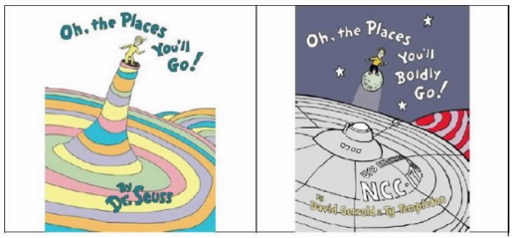
Image description: Two book covers side by side. On the left, Dr. Seuss’s Oh, the Places You’ll Go! shows a whimsical figure standing atop a tall, striped hill of pastel colors. On the right, a parody titled Oh, the Places You’ll Boldly Go! mimics the design, with the figure now standing on a small planet above a spaceship resembling the Star Trek Enterprise, surrounded by stars and space imagery.
ComicMix purposely crafted its book so that the title, the story, and the illustrations would evoke Oh, The Places You’ll Boldly Go! Indeed, ComicMix tried to copy portions of Go! as accurately as possible. The ComicMix production team was instructed to keep to the sentiment of Oh, The Places You’ll Go! that “life is an adventure but it WILL be tough and there WILL be setbacks, and you should not despair of them.” The text of Boldly was created using a side-by-side chart comparing it to Go! in order to match the structure of the original work. Several of the illustrations in Boldly closely mimic their counterparts in Go!, and may fairly be described as nearly identical to their Seussian counterparts.
Side-by-Side Comparisons from DSE’s complaint Docket No. 3:16-cv-02779 (S.D. Cal. Nov 10, 2016)
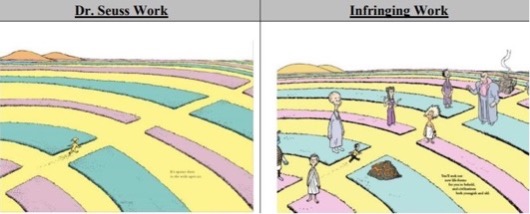
Image description: Two illustrated book pages shown side by side. On the left, Dr. Seuss’s original artwork depicts a small figure walking alone through colorful, winding pastel paths of yellow, pink, and blue with hills in the distance. On the right, the parody version keeps the same background but adds multiple adult characters, including ones in robes and suits, along with objects like a smoking pipe and a pile of brown matter on the path, altering the scene’s tone.
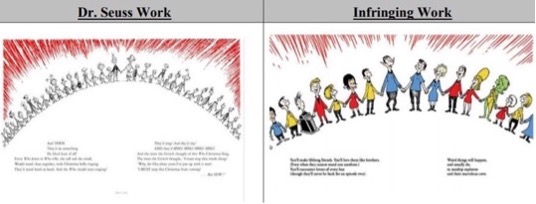
Image description: Two illustrated book pages are compared. On the left, Dr. Seuss’s original artwork shows a long line of identical Whos from How the Grinch Stole Christmas, holding hands in a circle against a background of red strokes. On the right, the Whos have been replaced with Star Trek characters, including Captain Kirk, Spock, and others in colorful uniforms, holding hands in a similar arc formation under the same red-streaked background. The characters are larger on the right.
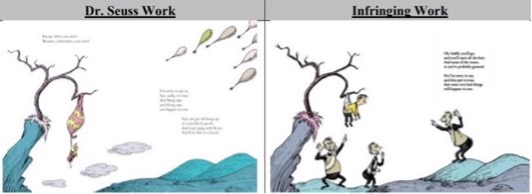
Image description: Two illustrated book pages compared. On the left, a whimsical scene shows a small figure dangling upside down from a tree branch, with balloon-like shapes drifting across the sky above a blue hill. On the right, the same background is used but the characters are different: several figures in uniform are shown, one hanging from the branch while two others stand on the hill below, gesturing upward.
Side-by-Side Comparisons from DSE’s complaint
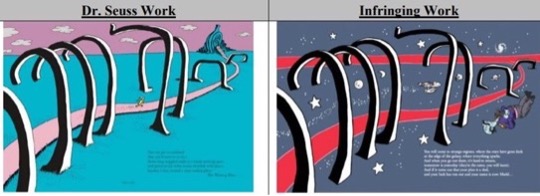
Image description: Two illustrated book pages compared. On the left, a small figure walks along a pink path that winds through tall, curved black arches against a bright blue background, with a whimsical creature seated in the distance. On the right, the same arches and winding path appear, but the setting is outer space, with stars, planets, and red trails across a dark sky. A figure in uniform floats near one of the arches.
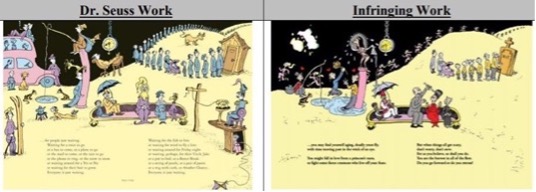
Image description: Two illustrated book pages compared. On the left, a Dr. Seuss-style scene shows whimsical characters waiting in various lines and settings: by a pink car, at a telephone booth, near clocks, and under an umbrella. On the right, the same layout and colors are used, but the characters differ: a mix of people and creatures wait in line, sit under umbrellas, and gather near a telephone booth, while a central figure hangs from a rope beneath a large lightbulb.
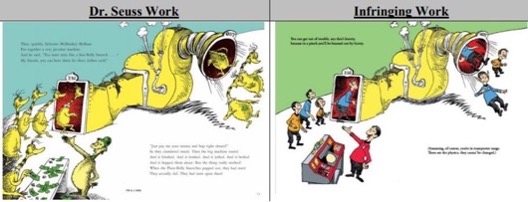
Image description: Two illustrated book pages compared. On the left, a Dr. Seuss-style scene shows yellow, furry creatures being funneled through a large whimsical machine, some entering and others exiting as part of a chaotic process. On the right, the same machine structure is depicted, but the figures are different: human characters in colorful outfits are shown interacting with the machine, one pointing to a control panel and others being processed through its openings.
Side-by-Side Comparisons from DSE’s complaint
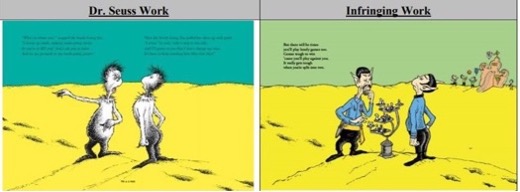
Image description: Two illustrated book pages compared. On the left, Dr. Seuss’s original scene shows two whimsical, scruffy characters standing face-to-face on a yellow, barren landscape, each pointing at the other. On the right, the same desert-like setting is used, but the characters are different: two uniformed figures with pointed ears and distinctive hairstyles stand across from each other with a tall object between them, while additional small figures appear in the background.
The district court held that Go! was not a parody but still qualified as fair use as a transformative work.] …
A. The Purpose and Character of Boldly Weigh Against Fair Use
The first statutory factor examines “the purpose and character of the use, including whether such use is of a commercial nature or is for nonprofit educational purposes.” 17 U.S.C. § 107(1). This factor has taken on a heightened significance because it influences the lens through which we consider two other fair use factors. The third factor—the amount and substantiality of use—“will harken back” to the first factor. See Campbell, 510 U.S. at 586. And the fourth factor, relating to market harm, is influenced by whether the commercial use was transformative. See Monge v. Maya Mags., Inc., 688 F.3d 1164, 1181 (9th Cir. 2012).
Although a commercial use is no longer considered presumptively unfair, the nature of the work remains “one element of the first factor enquiry.” Campbell, 510 U.S. at 584-85. As explained below, Boldly is not transformative, and its indisputably commercial use of Go! counsels against fair use. See Penguin Books, 109 F.3d at 1401 (commerciality “further cuts against the fair use defense” when there is “no effort to create a transformative work”).
The term “transformative” does not appear in § 107, yet it permeates copyright analysis because in Campbell, the Court interpreted the “central purpose” of the first-factor inquiry as determining “whether and to what extent the new work is ‘transformative.’” Campbell, 510 U.S. at 579. Transformative use of the original work can tip the first factor in favor of fair use.
A transformative work “adds something new, with a further purpose or different character, altering the first with new expression, meaning, or message.” Id. On the other hand, a work that “merely supersedes the objects of the original creation” is not transformative. Id. While the analysis of the first fair use factor “may be guided by the examples given in the preamble to § 107,” i.e., criticism, comment, news reporting, teaching, scholarship, and research, id. at 578-79, not even these works compel “a per se finding of fair use,” Monge, 688 F.3d at 1173. Thus, we do not ask whether mash-ups can be fair use—they can be—but whether Boldly is a transformative work.
The purpose and character of a parody fits squarely into preamble examples —particularly “criticism” and “comment” —and has “an obvious claim” to transformative use. Campbell, 510 U.S. at 579. By definition, a parody must “use some elements of a prior author’s composition to create a new one that, at least in part, comments on that author’s works.” Id. at 580. The need “to mimic an original to make its point” is the essence of parody. Id. at 580-81; see Penguin Books, 109 F.3d at 1400 (a parody must “conjure up” at least a part of “the object of the parody”). In short, a parody is a spoof, send-up, caricature, or comment on another work. A great example of a parody is the book The Wind Done Gone, which parrots portions of Gone with the Wind to offer a critical take on the book. See Suntrust Bank v. Houghton Mifflin Co., 268 F.3d 1257, 1270-71 (11th Cir. 2001) (“It is hard to imagine” how a parody that attempts to “strip the romanticism” of slavery in Gone with the Wind can be made “without depending heavily upon copyrighted elements of that book.”). On the other hand, if
the commentary has no critical bearing on the substance or style of the original composition, which the alleged infringer merely uses to get attention or to avoid the drudgery in working up something fresh, the claim to fairness in borrowing from another’s work diminishes accordingly (if it does not vanish), and other factors, like the extent of its commerciality, loom larger.
Campbell, 510 U.S. at 580.
Boldly is not a parody. ComicMix does not seriously contend that Boldly critiques or comments on Go!. Rather, it claims Boldly is a parody because it situated the “violent, sexual, sophisticated adult entertainment” of Star Trek “in the context of [Dr. Seuss]” to create a “funny” book. We considered and rejected this very claim in an appeal involving another well-known book by Dr. Seuss—The Cat in the Hat (Cat). The retelling of the O.J. Simpson double murder trial in the world of Cat—in a book titled The Cat NOT in the Hat! A Parody by Dr. Juice (Not)—was not a parody of Cat. Penguin Books, 109 F.3d at 1396, 1401. We explained that “broadly mimicking Dr. Seuss’s characteristic style” is not the same as “holding his style up to ridicule,” and that without a critique of Cat, all Not did was “simply retell the Simpson tale” using the expressive elements of Cat “to get attention or maybe even to avoid the drudgery in working up something fresh.” Id. at 1401.
Boldly’s claim to a parody fares no better. Although elements of Go! are featured prominently in Boldly, the juxtapositions of Go! and Star Trek elements do not hold Seussian style up to ridicule. From the project’s inception, ComicMix wanted Boldly to be a Star Trek primer that “evokes” rather than “ridicules” Go!. Similarly, Boldly’s use of the other Seuss works does not conjure up a critique of Go!. Boldly’s replacement of Grinch’s “‘Whos from Who-ville’ with the diverse crew and Kirk’s ‘lovers of every hue,’” the redrawing of “a Sneetches machine to signify the Enterprise transporter,” and the rendering of “the ‘lonely games’ played in Go!” as a “contemplative chess match between two Spocks” were all used to tell the story of the Enterprise crew’s adventures, not to make a point about Go!. Lacking “critical bearing on the substance or style of” Go!, Boldly cannot be characterized as a parody. Campbell, 510 U.S. at 580.
We also reject as “completely unconvincing” ComicMix’s post-hoc characterization of the work as criticizing the theme of banal narcissism in Go!. The effort to treat Boldly as lampooning Go! or mocking the purported self-importance of its characters falls flat.
Nor is Boldly otherwise transformative. ComicMix argues that even if Boldly is not a parody, Boldly is transformative because it replaced Seuss characters and other elements with Star Trek material. Again, the Cat case repudiates ComicMix’s position. There, efforts to leverage Dr. Seuss’s characters without having a new purpose or giving Dr. Seuss’s works new meaning similarly fell short of being transformative. The copyists “merely used” what Dr. Seuss had already created—e.g., “the Cat’s stove-pipe hat, the narrator (“Dr. Juice”), and the title (The Cat NOT in the Hat!)”—and overlaid a plot about the O.J. Simpson murder trial without altering Cat “with ‘new expression, meaning or message.’” Penguin Books, 109 F.3d at 1401 (quoting Campbell, 510 U.S. at 578). For the same reasons, ComicMix’s efforts to add Star Trek material on top of what it meticulously copied from Go! fail to be transformative.
Notably, Boldly lacks the benchmarks of transformative use. These telltale signs of transformative use are derived from the considerations laid out in Campbell, our north star, and Seltzer v. Green Day, Inc. from our circuit: (1) “further purpose or different character” in the defendant’s work, i.e., “the creation of new information, new aesthetic, new insights and understanding”; (2) “new expression, meaning, or message” in the original work, i.e., the addition of “value to the original”; and (3) the use of quoted matter as “raw material,” instead of repackaging it and “merely superseding the objects of the original creation.” See Campbell, 510 U.S. at 579. Boldly possesses none of these qualities; it merely repackaged Go!.
Boldly’s claim to transformative use rests on the fact that it has “extensive new content.” But the addition of new expression to an existing work is not a get-out-of-jail-free card that renders the use of the original transformative. The new expression must be accompanied by the benchmarks of transformative use. See, e.g., Seltzer, 725 F.3d at 1177-78; Cariou v. Prince, 714 F.3d 694, 706 (2d Cir. 2013); Blanch v. Koons, 467 F.3d 244, 251-52 (2d Cir. 2006).
Instead of possessing a further purpose or different character, Boldly paralleled Go!’s purpose. In propounding the same message as Go, Boldly used expression from Go! to “keep to [Go!’s] sentiment.” Absent new purpose or character, merely recontextualizing the original expression by “plucking the most visually arresting excerpts” of the copyrighted work is not transformative. L.A. News Serv. v. CBS Broad., Inc., 305 F.3d 924, 938-39 (9th Cir. 2002). By contrast, reconstituting copyrighted expression was for a new, transformative purpose when a “seven-second clip of Ed Sullivan’s introduction of the [band] Four Seasons on The Ed Sullivan Show” was used in the musical Jersey Boys, not to introduce the band’s performance, but to serve “as a biographical anchor” about the band. SOFA Ent., Inc. v. Dodger Prods., Inc., 709 F.3d 1273, 1276, 1278 (9th Cir. 2013).
Boldly also does not alter Go! with new expression, meaning, or message. A transformative work is one that alters the original work. While Boldly may have altered Star Trek by sending Captain Kirk and his crew to a strange new world, that world, the world of Go!, remains intact. Go! was merely repackaged into a new format, carrying the story of the Enterprise crew’s journey through a strange star in a story shell already intricately illustrated by Dr. Seuss. Unsurprisingly, Boldly does not change Go!; as ComicMix readily admits, it could have used another primer, or even created an entirely original work. Go! was selected “to get attention or to avoid the drudgery in working up something fresh,” and not for a transformative purpose. Campbell, 510 U.S. at 580.
Most telling is ComicMix’s repackaging of Go!’s illustrations. The Star Trek characters step into the shoes of Seussian characters in a Seussian world that is otherwise unchanged. ComicMix captured the placements and poses of the characters, as well as every red hatch mark arching over the handholding characters in Grinch’s iconic finale scene, then plugged in the Star Trek characters. (The Seuss images always appear to the left of the Boldly! images juxtaposed in this opinion.)
ComicMix copied the exact composition of the famous “waiting place” in Go!, down to the placements of the couch and the fishing spot. To this, ComicMix added Star Trek characters who line up, sit on the couch, and fish exactly like the waiting place visitors they replaced. Go! continues to carry the same expression, meaning, or message: as the Boldly text makes clear, the image conveys the sense of being stuck, with “time moving fast in the wink of an eye.”
ComicMix also copied a scene in Sneetches, down to the exact shape of the sandy hills in the background and the placement of footprints that collide in the middle of the page. Seussian characters were replaced with Spocks playing chess, making sure they “had similar poses” as the original, but all ComicMix really added was “the background of a weird basketball court.”
ComicMix likewise repackaged Go!’s text. Instead of using the Go! story as a starting point for a different artistic or aesthetic expression, Hauman created a side-by-side comparison of the Go! and Boldly texts in order “to try to match the structure of Go!.” This copying did not result in the Go! story taking on a new expression, meaning, or message. Because Boldly “left the inherent character of the [book] unchanged,” it was not a transformative use of Go!. Monge, 688 F.3d at 1176.
Although ComicMix’s work need not boldly go where no one has gone before, its repackaging, copying, and lack of critique of Seuss, coupled with its commercial use of Go!, do not result in a transformative use. The first factor weighs definitively against fair use.
[The court also held that the remaining fair use factors weighed against the defendant and that Boldly had not made a fair use of the plaintiff’s works. In relation to the third fair use factor, the amount and substantiality of the original work used, the court was careful to note the relationship between the first and third factors. The panel noted that “the extent of permissible copying varies with the purpose and character of the use,” citing Campbell, 510 U.S. at 586-87. However, given that the panel had already decided that the defendant’s book was neither parody nor transformative in any other way, this only gave the defendant a larger hill to climb. According to the court, about 60% of the defendant’s book (14 of 24 pages) were copied from Go! and other Seuss works. The court concluded:]
Given the absence of a parody or a transformative work, ComicMix offers no justification for the commercial exploitation and the extensive and meticulous copying of Go!. In fact, after the case was initiated, Gerrold offered to “replace the stuff that’s too dead on,” demonstrating that the mash-up “based on Dr. Seuss’s artwork” could have been created without wholesale copying of the work. The third factor weighs decisively against fair use.
[On the final factor, “the effect of the use upon the potential market for or value of the copyrighted work” the court concluded “that ComicMix’s non-transformative and commercial use of Dr. Seuss’s works likely leads to “cognizable market harm to the original.” Campbell, 510 U.S. at 591.” Beyond these factors, the court took particular note of the fact that Go! is an extremely popular gift around high school and college graduations and that ComicMix had intentionally targeted and aimed to capitalize on the same graduation market. Moreover, the court noted that the Seuss/Star Trek mashup was not unlike several authorized derivative works the copyright owner had already licensed, including: Oh, The Things You Can Do That Are Good For You!; Oh, the Places I’ll Go! By ME, Myself; Oh, Baby, the Places You’ll Go!; and Oh, the Places I’ve Been! A Journal. The court continued:]
Works like Boldly would curtail Go!’s potential market for derivative works. This is not a case where the copyist’s work fills a market that the copyright owner will likely avoid, as is true for “a lethal parody” or “a scathing theater review.” Campbell, 510 U.S. at 591-92. In fact, ComicMix hoped to get to one of the potential markets for Seuss’s derivative works before Seuss, believing that Seuss would “want to publish it themselves and give [ComicMix] a nice payday.”
Crucially, ComicMix does not overcome the fact that Seuss often collaborates with other creators, including in projects that mix different stories and characters. Seuss routinely receives requests for collaborations and licenses, and has entered into various collaborations that apply Seuss’s works to new creative contexts, such as the television and book series entitled The Wubbulous World of Dr. Seuss, a collaboration with The Jim Henson Company, famous for its puppetry and the creation of other characters like the Muppets. Other collaborations include a digital game called Grinch Panda Pop, that combines Jam City’s Panda character with a Grinch character; figurines that combine Funko Inc.’s toy designs with Seuss characters; and a clothing line that combines Comme des Garçons’ heart design with Grinch artwork.
Finally, ComicMix does not address a central aspect of market harm set out in Campbell—“whether unrestricted and widespread conduct of the sort engaged in” by ComicMix would undermine Seuss’s potential market. 510 U.S. at 590. This aspect is particularly significant here because of Seuss’s strong brand. ComicMix’s effort to use Seuss’s success against it falls flat. As noted by one of the amici curiae, the unrestricted and widespread conduct of the sort ComicMix is engaged in could result in anyone being able to produce, without Seuss’s permission, Oh the Places Yoda’ll Go!, Oh the Places You’ll Pokémon Go!, Oh the Places You’ll Yada Yada Yada!, and countless other mash-ups. Thus, the unrestricted and widespread conduct of the sort engaged in by ComicMix could “create incentives to pirate intellectual property” and disincentivize the creation of illustrated books. Monge, 688 F.3d at 1182. This is contrary to the goal of copyright “to promote the Progress of Science.” U.S. Const. art. I, § 8, cl. 8.
Notes and questions
(1) The court emphasizes that Boldly “repackaged” Go! rather than altered it. How does the concept of “repackaging” versus “recontextualizing” factor into the transformative use analysis?
(2) Do you agree with the court’s conclusion that Boldly was non-transformative despite incorporating new characters, settings, and content? Why or why not?
(3) Why did the court reject ComicMix’s argument that Boldly was a parody? Why does this matter to the case?