Part 1 · Chapter 4
Idea-Expression, Functionality and Other Exclusions—Part I
Introduction
Copyright law draws a distinction between original expression, which is protectable, and everything else, which is unprotectable. There are subtle differences of opinion as to what exactly belongs in the “everything else” bucket, but there is near universal consensus that copyright does not protect ideas, facts, functions, or processes. The distinction between copyrightable expression and uncopyrightable ideas, facts, functions, or processes is often shorthanded to the “idea-expression dichotomy” or the “idea-expression distinction.” At its simplest, the idea-expression distinction ensures that a copyright owner cannot prevent the ordinary reader from extracting and reproducing the facts or ideas embodied in the work. The uncopyrightability of ideas, facts, functions, and processes and the parallel exclusion of those elements from the scope of copyright protection in expressive works are core principles of copyright law.
The Idea-Expression Distinction and Levels of Generality
One important aspect of the idea-expression distinction to be aware of is the level of generality at which allegations of unauthorized copying should be assessed.
Copyright protection does not extend to general themes, basic plot devices, conventions of the genre etc. So, for example, the copyright in the James Bond novels and movies does not preempt the entire genre of a spy thriller. Other movie studios are perfectly entitled to recount the exploits of a thrill-seeking, womanizing spy with expensive tastes who rarely follows orders. However, you don’t need to copy every line of the James Bond screenplay to infringe the copyright in that work. A lot of copyright litigation boils down to the question of exactly where on the continuum between ideas and expression the line should be drawn. The classic statement on the idea expression distinction and the difficulty of focusing on the correct level of generality appears in Nichols v. Universal Pictures, a decision by the influential American jurist, Judge Learned Hand in 1930.
Nichols v. Universal Pictures, 45 F.2d 119 (2d Cir. 1930)
Circuit Judge Learned Hand.
The plaintiff is the author of a play, “Abie’s Irish Rose,” which it may be assumed was properly copyrighted under section five, subdivision (d), of the Copyright Act. The defendant produced publicly a motion picture play, “The Cohens and The Kellys,” which the plaintiff alleges was taken from it. As we think the defendant’s play too unlike the plaintiff’s to be an infringement, we may assume, arguendo, that in some details the defendant used the plaintiff’s play, as will subsequently appear, though we do not so decide. It therefore becomes necessary to give an outline of the two plays.
“Abie’s Irish Rose” presents a Jewish family living in prosperous circumstances in New York. The father, a widower, is in business as a merchant, in which his son and only child helps him. The boy has philandered with young women, who to his father’s great disgust have always been Gentiles, for he is obsessed with a passion that his daughter-in-law shall be an orthodox Jewess. When the play opens the son, who has been courting a young Irish Catholic girl, has already married her secretly before a Protestant minister, and is concerned to soften the blow for his father, by securing a favorable impression of his bride, while concealing her faith and race. To accomplish this he introduces her to his father at his home as a Jewess, and lets it appear that he is interested in her, though he conceals the marriage. The girl somewhat reluctantly falls in with the plan; the father takes the bait, becomes infatuated with the girl, concludes that they must marry, and assumes that of course they will, if he so decides. He calls in a rabbi, and prepares for the wedding according to the Jewish rite.
Meanwhile the girl’s father, also a widower, who lives in California, and is as intense in his own religious antagonism as the Jew, has been called to New York, supposing that his daughter is to marry an Irishman and a Catholic. Accompanied by a priest, he arrives at the house at the moment when the marriage is being celebrated, but too late to prevent it, and the two fathers, each infuriated by the proposed union of his child to a heretic, fall into unseemly and grotesque antics. The priest and the rabbi become friendly, exchange trite sentiments about religion, and agree that the match is good. Apparently out of abundant caution, the priest celebrates the marriage for a third time, while the girl’s father is inveigled away. The second act closes with each father, still outraged, seeking to find some way by which the union, thus trebly insured, may be dissolved.
The last act takes place about a year later, the young couple having meanwhile been abjured by each father, and left to their own resources. They have had twins, a boy and a girl, but their fathers know no more than that a child has been born. At Christmas each, led by his craving to see his grandchild, goes separately to the young folks’ home, where they encounter each other, each laden with gifts, one for a boy, the other for a girl. After some slapstick comedy, depending upon the insistence of each that he is right about the sex of the grandchild, they become reconciled when they learn the truth, and that each child is to bear the given name of a grandparent. The curtain falls as the fathers are exchanging amenities, and the Jew giving evidence of an abatement in the strictness of his orthodoxy.
“The Cohens and The Kellys” presents two families, Jewish and Irish, living side by side in the poorer quarters of New York in a state of perpetual enmity. The wives in both cases are still living, and share in the mutual animosity, as do two small sons, and even the respective dogs. The Jews have a daughter, the Irish a son; the Jewish father is in the clothing business; the Irishman is a policeman. The children are in love with each other, and secretly marry, apparently after the play opens. The Jew, being in great financial straits, learns from a lawyer that he has fallen heir to a large fortune from a great-aunt, and moves into a great house, fitted luxuriously. Here he and his family live in vulgar ostentation, and here the Irish boy seeks out his Jewish bride, and is chased away by the angry father. The Jew then abuses the Irishman over the telephone, and both become hysterically excited. The extremity of his feelings makes the Jew sick, so that he must go to Florida for a rest, just before which the daughter discloses her marriage to her mother.
On his return the Jew finds that his daughter has borne a child; at first he suspects the lawyer, but eventually learns the truth and is overcome with anger at such a low alliance. Meanwhile, the Irish family who have been forbidden to see the grandchild, go to the Jew’s house, and after a violent scene between the two fathers in which the Jew disowns his daughter, who decides to go back with her husband, the Irishman takes her back with her baby to his own poor lodgings. The lawyer, who had hoped to marry the Jew’s daughter, seeing his plan foiled, tells the Jew that his fortune really belongs to the Irishman, who was also related to the dead woman, but offers to conceal his knowledge, if the Jew will share the loot. This the Jew repudiates, and, leaving the astonished lawyer, walks through the rain to his enemy’s house to surrender the property. He arrives in great dejection, tells the truth, and abjectly turns to leave. A reconciliation ensues, the Irishman agreeing to share with him equally. The Jew shows some interest in his grandchild, though this is at most a minor motive in the reconciliation, and the curtain falls while the two are in their cups, the Jew insisting that in the firm name for the business, which they are to carry on jointly, his name shall stand first.
It is of course essential to any protection of literary property, whether at common-law or under the statute, that the right cannot be limited literally to the text, else a plagiarist would escape by immaterial variations. That has never been the law, but, as soon as literal appropriation ceases to be the test, the whole matter is necessarily at large, so that, as was recently well said by a distinguished judge, the decisions cannot help much in a new case. When plays are concerned, the plagiarist may excise a separate scene; or he may appropriate part of the dialogue. Then the question is whether the part so taken is “substantial,” and therefore not a “fair use” of the copyrighted work; it is the same question as arises in the case of any other copyrighted work. But when the plagiarist does not take out a block in situ, but an abstract of the whole, decision is more troublesome. Upon any work, and especially upon a play, a great number of patterns of increasing generality will fit equally well, as more and more of the incident is left out. The last may perhaps be no more than the most general statement of what the play is about, and at times might consist only of its title; but there is a point in this series of abstractions where they are no longer protected, since otherwise the playwright could prevent the use of his “ideas,” to which, apart from their expression, his property is never extended. Nobody has ever been able to fix that boundary, and nobody ever can. In some cases the question has been treated as though it were analogous to lifting a portion out of the copyrighted work; but the analogy is not a good one, because, though the skeleton is a part of the body, it pervades and supports the whole. In such cases we are rather concerned with the line between expression and what is expressed. As respects plays, the controversy chiefly centers upon the characters and sequence of incident, these being the substance.
We did not in Dymow v. Bolton, 11 F. (2d) 690, hold that a plagiarist was never liable for stealing a plot; that would have been flatly against our rulings in Dam v. Kirk La Shelle Co., 175 F. 902, and Stodart v. Mutual Film Co., 249 F. 513, affirming my decision in (D.C.) 249 F. 507; neither of which we meant to overrule. We found the plot of the second play was too different to infringe, because the most detailed pattern, common to both, eliminated so much from each that its content went into the public domain; and for this reason we said, “this mere subsection of a plot was not susceptible of copyright.” But we do not doubt that two plays may correspond in plot closely enough for infringement. How far that correspondence must go is another matter. Nor need we hold that the same may not be true as to the characters, quite independently of the “plot” proper, though, as far as we know, such a case has never arisen. If Twelfth Night were copyrighted, it is quite possible that a second comer might so closely imitate Sir Toby Belch or Malvolio as to infringe, but it would not be enough that for one of his characters he cast a riotous knight who kept wassail to the discomfort of the household, or a vain and foppish steward who became amorous of his mistress. These would be no more than Shakespeare’s “ideas” in the play, as little capable of monopoly as Einstein’s Doctrine of Relativity, or Darwin’s theory of the Origin of Species. It follows that the less developed the characters, the less they can be copyrighted; that is the penalty an author must bear for marking them too indistinctly.
In the two plays at bar we think both as to incident and character, the defendant took no more — assuming that it took anything at all — than the law allowed. The stories are quite different. One is of a religious zealot who insists upon his child’s marrying no one outside his faith; opposed by another who is in this respect just like him, and is his foil. Their difference in race is merely an obbligato to the main theme, religion. They sink their differences through grandparental pride and affection. In the other, zealotry is wholly absent; religion does not even appear. It is true that the parents are hostile to each other in part because they differ in race; but the marriage of their son to a Jew does not apparently offend the Irish family at all, and it exacerbates the existing animosity of the Jew, principally because he has become rich, when he learns it. They are reconciled through the honesty of the Jew and the generosity of the Irishman; the grandchild has nothing whatever to do with it. The only matter common to the two is a quarrel between a Jewish and an Irish father, the marriage of their children, the birth of grandchildren and a reconciliation.
If the defendant took so much from the plaintiff, it may well have been because her amazing success seemed to prove that this was a subject of enduring popularity. Even so, granting that the plaintiff’s play was wholly original, and assuming that novelty is not essential to a copyright, there is no monopoly in such a background. Though the plaintiff discovered the vein, she could not keep it to herself; so defined, the theme was too generalized an abstraction from what she wrote. It was only a part of her “ideas.”
Nor does she fare better as to her characters. It is indeed scarcely credible that she should not have been aware of those stock figures, the low comedy Jew and Irishman. The defendant has not taken from her more than their prototypes have contained for many decades. If so, obviously so to generalize her copyright, would allow her to cover what was not original with her. But we need not hold this as matter of fact, much as we might be justified. Even though we take it that she devised her figures out of her brain de novo, still the defendant was within its rights.
There are but four characters common to both plays, the lovers and the fathers. The lovers are so faintly indicated as to be no more than stage properties. They are loving and fertile; that is really all that can be said of them, and anyone else is quite within his rights if he puts loving and fertile lovers in a play of his own, wherever he gets the cue. The plaintiff’s Jew is quite unlike the defendant’s. His obsession is his religion, on which depends such racial animosity as he has. He is affectionate, warm and patriarchal. None of these fit the defendant’s Jew, who shows affection for his daughter only once, and who has none but the most superficial interest in his grandchild. He is tricky, ostentatious and vulgar, only by misfortune redeemed into honesty. Both are grotesque, extravagant and quarrelsome; both are fond of display; but these common qualities make up only a small part of their simple pictures, no more than any one might lift if he chose. The Irish fathers are even more unlike; the plaintiff’s a mere symbol for religious fanaticism and patriarchal pride, scarcely a character at all. Neither quality appears in the defendant’s, for while he goes to get his grandchild, it is rather out of a truculent determination not to be forbidden, than from pride in his progeny. For the rest he is only a grotesque hobbledehoy, used for low comedy of the most conventional sort, which any one might borrow, if he chanced not to know the exemplar.
The defendant argues that the case is controlled by my decision in Fisher v. Dillingham (D.C.) 298 F. 145. Neither my brothers nor I wish to throw doubt upon the doctrine of that case, but it is not applicable here. We assume that the plaintiff’s play is altogether original, even to an extent that in fact it is hard to believe. We assume further that, so far as it has been anticipated by earlier plays of which she knew nothing, that fact is immaterial. Still, as we have already said, her copyright did not cover everything that might be drawn from her play; its content went to some extent into the public domain. We have to decide how much, and while we are as aware as any one that the line, whereever it is drawn, will seem arbitrary, that is no excuse for not drawing it; it is a question such as courts must answer in nearly all cases. Whatever may be the difficulties a priori, we have no question on which side of the line this case falls. A comedy based upon conflicts between Irish and Jews, into which the marriage of their children enters, is no more susceptible of copyright than the outline of Romeo and Juliet.
The plaintiff has prepared an elaborate analysis of the two plays, showing a “quadrangle” of the common characters, in which each is represented by the emotions which he discovers. She presents the resulting parallelism as proof of infringement, but the adjectives employed are so general as to be quite useless. Take for example the attribute of “love” ascribed to both Jews. The plaintiff has depicted her father as deeply attached to his son, who is his hope and joy; not so, the defendant, whose father’s conduct is throughout not actuated by any affection for his daughter, and who is merely once overcome for the moment by her distress when he has violently dismissed her lover. “Anger” covers emotions aroused by quite different occasions in each case; so do “anxiety,” “despondency” and “disgust.” It is unnecessary to go through the catalogue for emotions are too much colored by their causes to be a test when used so broadly. This is not the proper approach to a solution; it must be more ingenuous, more like that of a spectator, who would rely upon the complex of his impressions of each character.
We cannot approve the length of the record, which was due chiefly to the use of expert witnesses. Argument is argument whether in the box or at the bar, and its proper place is the last. The testimony of an expert upon such issues, especially his cross-examination, greatly extends the trial and contributes nothing which cannot be better heard after the evidence is all submitted. It ought not to be allowed at all; and while its admission is not a ground for reversal, it cumbers the case and tends to confusion, for the more the court is led into the intricacies of dramatic craftsmanship, the less likely it is to stand upon the firmer, if more naïve, ground of its considered impressions upon its own perusal. We hope that in this class of cases such evidence may in the future be entirely excluded, and the case confined to the actual issues; that is, whether the copyrighted work was original, and whether the defendant copied it, so far as the supposed infringement is identical.
Decree affirmed.
Notes and questions
(1) In a perceptive article about copyright cases from the silent film era, Silent Similarity (2014), Jessica Litman recounts some of the background to the Nichols case. Anne Nichols was the author of a hit Broadway play, Abie’s Irish Rose. In 1925, Universal Pictures offered to buy the film rights to Abie’s Irish Rose, but Nichols refused. Two years later she sold the film rights to the company that would become Paramount Pictures in a deal that could have been worth as much as $1 million (in 1927 dollars!). The resulting film was a commercial success. Not to be dissuaded, Universal acquired the rights to another play and purported to use it as the basis for “The Cohens and Kellys.” Perhaps tellingly, Universal advertised The Cohens and Kellys as an “Abie’s Irish Rose for the screen.”
Litman points out that it is easy to miss the fact that The Cohens and Kellys was a silent movie. The judgment does not mention it, presumably because all films were silent in the 1920s, but the fact is important because silent films are mostly comprised of pictures and stage plays are entirely comprised of words. Thus, the only way a silent film could ever infringe the copyrighted script for a stage play is by virtue of similarities at a certain level of abstraction. Litman explains why this made the plaintiff’s case so difficult: “By casting Nichols’s case as one proved by similarities in the distilled essence of the two works, rather than in particular expressive details, Nichols’s lawyers invited the conclusion that the works were similar only at too high a level of abstraction.” For more, see Jessica Litman, Silent Similarity, 14 Chicago Kent Journal of Intellectual Property 11 (2014); Mark Rose, Criticism in the Courtroom: Nichols v Universal (1930) and the Determination of Infringement, 5 W.I.P.O Journal 65 (2013).
(2) In Nichols v. Universal Pictures, Judge Hand explains why copyright protection must extend beyond literal copying. According to Hand, what fundamental problem would arise if copyright were limited only to “literal appropriation”? What challenge does this create for courts in determining infringement, and why does Hand suggest that precedent provides limited guidance for future cases?
(3) Judge Hand’s opinion in Nichols contains what many consider the classic articulation of the “abstraction problem” in copyright law. Can you explain Hand’s concept of “patterns of increasing generality” and how they relate to the idea-expression distinction?
(4) Is Hand really suggesting that drawing a line between ideas and their expression is a pointless endeavor when he says: “Nobody has ever been able to fix that boundary [between idea and expression], and nobody ever can”?
Illustrations of the Idea-Expression Distinction at Work
The Copyright Office routinely denies registration for very simple works consisting of common or standard design elements. Such building blocks are too far along the idea end of the continuum between idea and expression to be protectable. The juxtaposition or arrangement of a few common or standard design elements may contain sufficient creativity to support a copyright, but not always. Although Feist (extracted in the previous chapter) indicates that the threshold of copyrightability is low, it also states the Copyright Act “implies that some ‘ways’ [of selecting, coordinating, or arranging uncopyrightable material] will trigger copyright, but that others will not.” (emphasis added).
Courts are far from consistent in their approach to originality, but in general they have taken heed of the Supreme Court’s directive in Feist. For example, in Coach, Inc. v. Peters, 386 F. Supp. 2d 495 (S.D.N.Y. 2005), the district court upheld the Copyright Office’s refusal to register simple designs consisting of two linked letter “C” shapes “facing each other in a mirrored relationship” and two unlinked letter “C” shapes “in a mirrored relationship and positioned perpendicular to the linked elements.” Similarly, in Satava v. Lowry, 323 F.3d 805 (9th Cir. 2003), the Ninth Circuit held that a glass sculpture of a jellyfish consisting of clear glass, an oblong shroud, bright colors, vertical orientation, and the stereotypical jellyfish form did not merit copyright protection. The court said:
It is true, of course, that a combination of unprotectable elements may qualify for copyright protection. But it is not true that any combination of unprotectable elements automatically qualifies for copyright protection. Our case law suggests, and we hold today, that a combination of unprotectable elements is eligible for copyright protection only if those elements are numerous enough and their selection and arrangement original enough that their combination constitutes an original work of authorship. (emphasis added)
Plaintiff’s and Defendant’s Jellyfish
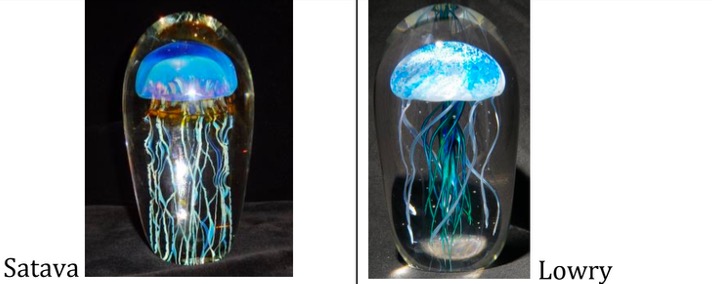
Image description: Two glass sculptures of jellyfish. Left, labeled “Satava,” features a domed blue-and-purple jellyfish with long, thin, wavy tentacles suspended in clear glass. Right, labeled “Lowry,” shows a blue-and-white jellyfish with more numerous, flowing tentacles in clear glass. Both pieces appear illuminated against a dark background.
Prompts as unprotectible ideas
The idea-expression distinction is now doing work in one of the most contested areas of contemporary copyright practice. In Copyright and Artificial Intelligence, Part 2: Copyrightability (January 2025), the Copyright Office concluded that a user who supplies a prompt to a generative AI system is not, on that basis alone, the author of the output. What is notable for present purposes is the reasoning. The Office did not rest solely on the human authorship requirement; it reached for the idea-expression line:
The Office concludes that, given current generally available technology, prompts alone do not provide sufficient human control to make users of an AI system the authors of the output. Prompts essentially function as instructions that convey unprotectible ideas. While highly detailed prompts could contain the user’s desired expressive elements, at present they do not control how the AI system processes them in generating the output.
The move is a familiar one. A prompt describes what the user wants; it does not fix the expression in which that want is realized, and the gap between the two is the gap between idea and expression. Note the temporal hedging, though. The Office ties its conclusion to “current generally available technology” and to what prompts do “at present,” which leaves open the possibility that a system offering finer control over output would change the analysis. Whether the idea-expression distinction can bear that weight, and whether a sufficiently precise prompt ever stops being an instruction and starts being expression, is a question the reader should carry into Chapter 3, where the report and the human authorship requirement are considered at length.
Bear in mind that this is an agency report and a statement of registration practice, not a judicial holding. It binds the Office; it does not bind a court.
The legend of John Cage’s silence
4’33” by John Cage is a 1952 modernist composition. The score instructs performers not to play during its three movements, which total four minutes and 33 seconds. According to a widely reported story, in 2002, British composer Mike Batt paid an undisclosed six-figure sum to the estate of American composer John Cage after being sued for plagiarism. The lawsuit was over Batt’s inclusion of a one-minute silence track, titled “A One Minute Silence”, on his album Classical Graffiti. The track was credited to “Batt/Cage”, with the “Cage” being a reference to Batt’s own pseudonym, Clint Cage. How can we reconcile this copyright suit with the idea-expression distinction? Obviously, we can’t. The entire story was a hoax and a publicity stunt by Batt who pretended a 1000 GBP donation to the John Cage Foundation he delivered on the steps of the High Court was a “six figure settlement.”
The Exclusion of Facts, Ideas, Functions, and Processes
Baker v. Selden, 101 U.S. 99 (1879)
Mr. Justice Bradley delivered the opinion of the court.
Charles Selden, the testator of the complainant in this case, in the year 1859 took the requisite steps for obtaining the copyright of a book, entitled “Selden’s Condensed Ledger, or Book-keeping Simplified,” the object of which was to exhibit and explain a peculiar system of book-keeping. In 1860 and 1861, he took the copyright of several other books, containing additions to and improvements upon the said system. The bill of complaint was filed against the defendant, Baker, for an alleged infringement of these copyrights. The latter, in his answer, denied that Selden was the author or designer of the books, and denied the infringement charged, and contends on the argument that the matter alleged to be infringed is not a lawful subject of copyright.
The parties went into proofs, and the various books of the complainant, as well as those sold and used by the defendant, were exhibited before the examiner, and witnesses were examined on both sides. A decree was rendered for the complainant, and the defendant appealed.
The book or series of books of which the complainant claims the copyright consists of an introductory essay explaining the system of book-keeping referred to, to which are annexed certain forms or blanks, consisting of ruled lines, and headings, illustrating the system and showing how it is to be used and carried out in practice. This system effects the same results as book-keeping by double entry; but, by a peculiar arrangement of columns and headings, presents the entire operation, of a day, a week, or a month, on a single page, or on two pages facing each other, in an account-book.
Baker’s Form
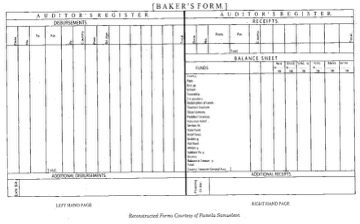
Image description: A black-and-white scanned ledger template titled “Baker’s Form,” divided into two main sections: “Auditor’s Register – Disbursements” on the left and “Auditor’s Register – Receipts” on the right. Each section has columns for dates, descriptions, amounts, and totals. The receipts side includes a “Balance Sheet” listing various funds such as County, School, Road, and Building.
Selden’s Form
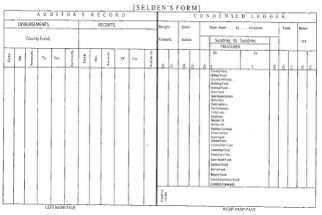
Image description: A black-and-white scanned ledger template titled “Selden’s Form.” The left page, labeled “Auditor’s Record,” tracks disbursements and receipts for the County Fund, with columns for date, number, amount, recipient, and authority. The right page, labeled “Condensed Ledger,” includes columns for debits, credits, totals, and balances, as well as a list of specific funds such as County Fund, Building Fund, School Fund, and Road Fund.
The defendant uses a similar plan so far as results are concerned; but makes a different arrangement of the columns, and uses different headings. If the complainant’s testator had the exclusive right to the use of the system explained in his book, it would be difficult to contend that the defendant does not infringe it, notwithstanding the difference in his form of arrangement; but if it be assumed that the system is open to public use, it seems to be equally difficult to contend that the books made and sold by the defendant are a violation of the copyright of the complainant’s book considered merely as a book explanatory of the system. Where the truths of a science or the methods of an art are the common property of the whole world, any author has the right to express the one, or explain and use the other, in his own way. As an author, Selden explained the system in a particular way. It may be conceded that Baker makes and uses account-books arranged on substantially the same system; but the proof fails to show that he has violated the copyright of Selden’s book, regarding the latter merely as an explanatory work; or that he has infringed Selden’s right in any way, unless the latter became entitled to an exclusive right in the system.
The evidence of the complainant is principally directed to the object of showing that Baker uses the same system as that which is explained and illustrated in Selden’s books. It becomes important, therefore, to determine whether, in obtaining the copyright of his books, he secured the exclusive right to the use of the system or method of book-keeping which the said books are intended to illustrate and explain. It is contended that he has secured such exclusive right, because no one can use the system without using substantially the same ruled lines and headings which he has appended to his books in illustration of it. In other words, it is contended that the ruled lines and headings, given to illustrate the system, are a part of the book, and, as such, are secured by the copyright; and that no one can make or use similar ruled lines and headings, or ruled lines and headings made and arranged on substantially the same system, without violating the copyright. And this is really the question to be decided in this case. Stated in another form, the question is, whether the exclusive property in a system of book-keeping can be claimed, under the law of copyright, by means of a book in which that system is explained? The complainant’s bill, and the case made under it, are based on the hypothesis that it can be.
It cannot be pretended, and indeed it is not seriously urged, that the ruled lines of the complainant’s account-book can be claimed under any special class of objects, other than books, named in the law of copyright existing in 1859. The law then in force was that of 1831, and specified only books, maps, charts, musical compositions, prints, and engravings. An account-book, consisting of ruled lines and blank columns, cannot be called by any of these names unless by that of a book.
There is no doubt that a work on the subject of book-keeping, though only explanatory of well-known systems, may be the subject of a copyright; but, then, it is claimed only as a book. Such a book may be explanatory either of old systems, or of an entirely new system; and, considered as a book, as the work of an author, conveying information on the subject of book-keeping, and containing detailed explanations of the art, it may be a very valuable acquisition to the practical knowledge of the community. But there is a clear distinction between the book, as such, and the art which it is intended to illustrate. The mere statement of the proposition is so evident, that it requires hardly any argument to support it. The same distinction may be predicated of every other art as well as that of book-keeping. A treatise on the composition and use of medicines, be they old or new; on the construction and use of ploughs, or watches, or churns; or on the mixture and application of colors for painting or dyeing; or on the mode of drawing lines to produce the effect of perspective, — would be the subject of copyright; but no one would contend that the copyright of the treatise would give the exclusive right to the art or manufacture described therein. The copyright of the book, if not pirated from other works, would be valid without regard to the novelty, or want of novelty, of its subject-matter. The novelty of the art or thing described or explained has nothing to do with the validity of the copyright. To give to the author of the book an exclusive property in the art described therein, when no examination of its novelty has ever been officially made, would be a surprise and a fraud upon the public. That is the province of letters-patent, not of copyright. The claim to an invention or discovery of an art or manufacture must be subjected to the examination of the Patent Office before an exclusive right therein can be obtained; and it can only be secured by a patent from the government.
The difference between the two things, letters-patent and copyright, may be illustrated by reference to the subjects just enumerated. Take the case of medicines. Certain mixtures are found to be of great value in the healing art. If the discoverer writes and publishes a book on the subject (as regular physicians generally do), he gains no exclusive right to the manufacture and sale of the medicine; he gives that to the public. If he desires to acquire such exclusive right, he must obtain a patent for the mixture as a new art, manufacture, or composition of matter. He may copyright his book, if he pleases; but that only secures to him the exclusive right of printing and publishing his book. So of all other inventions or discoveries.
The copyright of a book on perspective, no matter how many drawings and illustrations it may contain, gives no exclusive right to the modes of drawing described, though they may never have been known or used before. By publishing the book, without getting a patent for the art, the latter is given to the public. The fact that the art described in the book by illustrations of lines and figures which are reproduced in practice in the application of the art, makes no difference. Those illustrations are the mere language employed by the author to convey his ideas more clearly. Had he used words of description instead of diagrams (which merely stand in the place of words), there could not be the slightest doubt that others, applying the art to practical use, might lawfully draw the lines and diagrams which were in the author’s mind, and which he thus described by words in his book.
The copyright of a work on mathematical science cannot give to the author an exclusive right to the methods of operation which he propounds, or to the diagrams which he employs to explain them, so as to prevent an engineer from using them whenever occasion requires. The very object of publishing a book on science or the useful arts is to communicate to the world the useful knowledge which it contains. But this object would be frustrated if the knowledge could not be used without incurring the guilt of piracy of the book. And where the art it teaches cannot be used without employing the methods and diagrams used to illustrate the book, or such as are similar to them, such methods and diagrams are to be considered as necessary incidents to the art, and given therewith to the public; not given for the purpose of publication in other works explanatory of the art, but for the purpose of practical application.
Of course, these observations are not intended to apply to ornamental designs, or pictorial illustrations addressed to the taste. Of these it may be said, that their form is their essence, and their object, the production of pleasure in their contemplation. This is their final end. They are as much the product of genius and the result of composition, as are the lines of the poet or the historian’s periods. On the other hand, the teachings of science and the rules and methods of useful art have their final end in application and use; and this application and use are what the public derive from the publication of a book which teaches them. But as embodied and taught in a literary composition or book, their essence consists only in their statement. This alone is what is secured by the copyright. The use by another of the same methods of statement, whether in words or illustrations, in a book published for teaching the art, would undoubtedly be an infringement of the copyright.
Recurring to the case before us, we observe that Charles Selden, by his books, explained and described a peculiar system of book-keeping, and illustrated his method by means of ruled lines and blank columns, with proper headings on a page, or on successive pages. Now, whilst no one has a right to print or publish his book, or any material part thereof, as a book intended to convey instruction in the art, any person may practise and use the art itself which he has described and illustrated therein. The use of the art is a totally different thing from a publication of the book explaining it. The copyright of a book on book-keeping cannot secure the exclusive right to make, sell, and use account-books prepared upon the plan set forth in such book. Whether the art might or might not have been patented, is a question which is not before us. It was not patented, and is open and free to the use of the public. And, of course, in using the art, the ruled lines and headings of accounts must necessarily be used as incident to it.
The plausibility of the claim put forward by the complainant in this case arises from a confusion of ideas produced by the peculiar nature of the art described in the books which have been made the subject of copyright. In describing the art, the illustrations and diagrams employed happen to correspond more closely than usual with the actual work performed by the operator who uses the art. Those illustrations and diagrams consist of ruled lines and headings of accounts; and it is similar ruled lines and headings of accounts which, in the application of the art, the book-keeper makes with his pen, or the stationer with his press; whilst in most other cases the diagrams and illustrations can only be represented in concrete forms of wood, metal, stone, or some other physical embodiment. But the principle is the same in all. The description of the art in a book, though entitled to the benefit of copyright, lays no foundation for an exclusive claim to the art itself. The object of the one is explanation; the object of the other is use. The former may be secured by copyright. The latter can only be secured, if it can be secured at all, by letters-patent.
The case of Cobbett v. Woodward (Law Rep. 14 Eq. 407) was a claim to copyright in a catalogue of furniture which the publisher had on sale in his establishment, illustrated with many drawings of furniture and decorations. The defendants, being dealers in the same business, published a similar book, and copied many of the plaintiff’s drawings, though it was shown that they had for sale the articles represented thereby. The court held that these drawings were not subjects of copyright. Lord Romilly, M.R., said:
“This is a mere advertisement for the sale of particular articles which any one might imitate, and any one might advertise for sale. If a man not being a vendor of any of the articles in question were to publish a work for the purpose of informing the public of what was the most convenient species of articles for household furniture, or the most graceful species of decorations for articles of home furniture, what they ought to cost, and where they might be bought, and were to illustrate his work with designs of each article he described, — such a work as this could not be pirated with impunity, and the attempt to do so would be stopped by the injunction of the Court of Chancery; yet if it were done with no such object, but solely for the purpose of advertising particular articles for sale, and promoting the private trade of the publisher by the sale of articles which any other person might sell as well as the first advertiser, and if in fact it contained little more than an illustrated inventory of the contents of a warehouse, I know of no law which, while it would not prevent the second advertiser from selling the same articles, would prevent him from using the same advertisement; provided he did not in such advertisement by any device suggest that he was selling the works and designs of the first advertiser.”
Another case, that of Page v. Wisden (20 L.T.N.S. 435), which came before Vice-Chancellor Malins in 1869, has some resemblance to the present. There a copyright was claimed in a cricket scoring-sheet, and the Vice-Chancellor held that it was not a fit subject for copyright, partly because it was not new, but also because “to say that a particular mode of ruling a book constituted an object for a copyright is absurd.”
These cases, if not precisely in point, come near to the matter in hand, and, in our view, corroborate the general proposition which we have laid down.
In Drury v. Ewing (1 Bond, 540), which is much relied on by the complainant, a copyright was claimed in a chart of patterns for cutting dresses and basques for ladies, and coats, jackets, &c., for boys. It is obvious that such designs could only be printed and published for information, and not for use in themselves. Their practical use could only be exemplified in cloth on the tailor’s board and under his shears; in other words, by the application of a mechanical operation to the cutting of cloth in certain patterns and forms. Surely the exclusive right to this practical use was not reserved to the publisher by his copyright of the chart. Without undertaking to say whether we should or should not concur in the decision in that case, we think it cannot control the present.
The conclusion to which we have come is, that blank account-books are not the subject of copyright; and that the mere copyright of Selden’s book did not confer upon him the exclusive right to make and use account-books, ruled and arranged as designated by him and described and illustrated in said book.
The decree of the Circuit Court must be reversed, and the cause remanded with instructions to dismiss the complainant’s bill; and it is
So ordered.
Notes and questions
(1) Baker v. Selden is often thought of as an illustration of the line between idea and expression, but the forms at the back of Selden’s book were not uncopyrightable because they were too abstract or generic, were they?
(2) The principle that copyright in an expressive work does not give the author any rights in the facts, ideas, or methods of operation communicated in that work is longstanding at common law and was expressly incorporated into the 1976 revision of the Copyright Act.
17 U.S. Code § 102(b)
In no case does copyright protection for an original work of authorship extend to any idea, procedure, process, system, method of operation, concept, principle, or discovery, regardless of the form in which it is described, explained, illustrated, or embodied in such a work.
How much of Section 102(b) can be traced directly back to Baker v. Selden?
(3) Copyright law clearly distinguishes between facts and the expression of facts, providing no protection for the former and only limited protection for the latter. Recall that in Feist v. Rural Telephone, the Supreme Court ruled that copying listings from a telephone directory did not infringe the copyright in that directory because the information itself was not copyrightable. In Feist, the Court described the uncopyrightability of facts as “universally understood” and the “most fundamental axiom of copyright law.” It explained this feature of copyright law in terms of the requirement of originality:
The sine qua non of copyright is originality. To qualify for copyright protection, a work must be original to the author. …
It is this bedrock principle of copyright that mandates the law’s seemingly disparate treatment of facts and factual compilations. No one may claim originality as to facts. This is because facts do not owe their origin to an act of authorship. The distinction is one between creation and discovery: The first person to find and report a particular fact has not created the fact; he or she has merely discovered its existence.
Does the idea-expression distinction apply the same way to facts as it does to ideas? How should we treat false facts? Is the fact that someone’s opinion is X the same as fact X for copyright law purposes?
Rationales for the idea-expression distinction
Why does copyright law draw a distinction between protectable expression and unprotectable ideas, facts, functions, and processes? The longstanding distinction between protectable expression and unprotectable facts and ideas is an essential part of the balance of copyright law. The distinction ensures that protection of the expressive elements of the author’s work does not deny subsequent authors the ability to make their own contributions by adding to, reusing, or reinterpreting the facts and ideas embodied in the original work. The essential idea behind copyright is that subsequent authors may not compete with the copyright owner by offering her original expression to the public as a substitute for the copyright owner’s work, but they are free to compete with their own expression of the same facts, concepts, and ideas.
The idea-expression distinction is essential for any copyright system that aims to foster a vibrant and creative intellectual ecosystem. In the United States, it is also constitutionally required. As the Supreme Court explained in Harper & Row, “copyright’s idea/expression dichotomy strikes a definitional balance between the First Amendment and the Copyright Act by permitting free communication of facts while still protecting an author’s expression.” Harper & Row, Publishers, Inc. v. Nation Enterprises, 471 U.S. 539, 556 (1985). The Court later added, in Eldred v. Ashcroft, that the idea-expression distinction is one of copyright’s “built-in First Amendment accommodations” and that as a result of the idea-expression distinction “every idea, theory, and fact in a copyrighted work becomes instantly available for public exploitation at the moment of publication.” Eldred v. Ashcroft, 537 U.S. 186, 219 (2003).
Rationales for the Exclusion of Functionality from Copyright Protection
There are different fields of intellectual property law, each of which is directed to protecting particular interests and addressing particular problems. Briefly, copyright protects original expression, utility patents grant rights in relation to useful inventions, design patents protect the ornamental features of useful objects or articles of manufacture, and trademark law protects marks or signs that convey the source of goods or services.
To illustrate more concretely, consider a new bottle designed to pour specific liquids more evenly and also to look more attractive. The pouring function of the bottle design could conceivably be a new and useful invention (utility patent), the graceful shape of the bottle could be aesthetically appealing (design patent, copyright sculpture), and the shape could be distinctive, such that consumers understand that bottles of this shape are associated with a particular beverage seller (trademark). In addition, the way the bottle is made could be a valuable trade secret.
The most problematic area of overlap relates to functionality. Utility patents confer the broadest possible set of exclusive rights (the exclusive right to make, use, and sell the claimed invention), but they are difficult to obtain, short in duration, and usually narrow in scope. Patents must be novel and non-obvious compared to the prior art. Utility patents last for 20 years from the date of application and they are only infringed if the “accused device” features every single element of the relevant patent claim. In contrast to utility patents, copyright protects a work of authorship from the moment of its creation.
Moreover, patents are subject to examination to ensure they meet demanding standards with respect to novelty, inventiveness, utility, written description, and enablement. In contrast, although certain additional rights come with registration, trademark law protects distinctive signs from the moment of adoption and it protects trade dress (and descriptive signs) from the moment it comes to be understood by the public as a sign of origin. Trademark rights continue as long as the trademark is being used to signify a source of origin. Copyright lasts for the life of the author plus 70 years.
Design patents are a peculiar hybrid of copyright, trademark, and patent law. Design patents require examination, but the examination threshold is so low in practice as to resemble a registration system. In theory, design patents only protect the ornamental features of a product and not its functional attributes. This is similar to the way trademark law protects trade dress—the design of a product can amount to protectable trade dress, but that protection covers only those aspects of a design that signal source to consumers, and the law refuses protection for functional design features even if they signal source.
Should the law allow overlapping protection?
It would be going too far to suggest that the law should never allow any overlaps between the different regimes of IP but we should begin with the assumption that the different fields of IP are different for a reason—each reflects a different set of policies and trade-offs. In general, patent-like protection of function should come from patent law; trademark-like protection of brand, reputation, and signaling to consumers should come from trademark law; etc. Even if occasionally different aspects of a single object cross boundaries from one field to the next, that does not mean that trademark law should give copyright-like protection of expression, that design patents should be used to police consumer confusion, or that copyright law should be used to confer patent-like rights of exclusion with respect to function and utility.
Utility patents are a significant exception to the norm of free competition. Although IP regimes can and do sometimes overlap, it is vital that regimes in which rights are easier to obtain and/or longer lasting are not used to achieve a kind of backdoor patent protection. See generally, Viva R. Moffat, Mutant Copyrights and Backdoor Patents: The Problem of Overlapping Intellectual Property Protection, 19 Berkeley Technology Law Journal 1473 (2004). To this end, every other regime has doctrines designed to deny protection of functionality. See for example, TrafFix Devices, Inc. v. Marketing Displays, Inc., 532 U.S. 23 (2001) (elaborating on trademark law’s statutory prohibition on protecting functional matter, and the existence of a utility patent on that matter being strong evidence of such functionality).
The barriers between utility patents and other regimes need to be carefully maintained, whereas overlaps between non-utility regimes present less fundamental concerns.
The Supreme Court made a particularly strong statement in this regard in Baker v. Selden, 101 U.S. 99 (1879):
The novelty of the art or thing described or explained has nothing to do with the validity of the copyright. To give to the author of the book an exclusive property in the art described therein, when no examination of its novelty has ever been officially made, would be a surprise and a fraud upon the public. That is the province of letters-patent, not of copyright. The claim to an invention or discovery of an art or manufacture must be subjected to the examination of the Patent Office before an exclusive right therein can be obtained; and it can only be secured by a patent from the government. (emphasis added)
Section 102(b) of the Copyright Act
17 U.S. Code § 102
(a) Copyright protection subsists, in accordance with this title, in original works of authorship fixed in any tangible medium of expression, now known or later developed, from which they can be perceived, reproduced, or otherwise communicated, either directly or with the aid of a machine or device. Works of authorship include the following categories:
(1) literary works;
(2) musical works, including any accompanying words;
(3) dramatic works, including any accompanying music;
(4) pantomimes and choreographic works;
(5) pictorial, graphic, and sculptural works;
(6) motion pictures and other audiovisual works;
(7) sound recordings; and
(8) architectural works.
(b) In no case does copyright protection for an original work of authorship extend to any idea, procedure, process, system, method of operation, concept, principle, or discovery, regardless of the form in which it is described, explained, illustrated, or embodied in such work.
Section 102(a) of the U.S. Copyright Act provides that copyright subsists in original works of authorship fixed in any tangible medium of expression, and then proceeds to list eight categories of works of authorship. Section 102(b) of the Copyright Act of 1976 embodies the approach that the Supreme Court took in Baker v. Selden. Section 102(b) provides that in no case does copyright protection “extend to any idea, procedure, process, system, method of operation, concept, principle, or discovery.”
How to Read Section 102(b)
Some commentators treat Baker v. Selden as confined to the idea-expression distinction, but a more careful reading shows that the case was as much to do with the exclusion of functionality from copyright subject matter and copyright protection as it was the distinction between ideas and their expression. Likewise, some courts and commentators have treated Section 102(b) as synonymous with the idea-expression distinction, and no more. A fair reading of Baker v. Selden, and even a cursory reading of Section 102(b) show these courts and commentators to be in error. See, Pamela Samuelson, The Story of Baker v. Selden: Sharpening the Distinction Between Authorship and Invention at 180-92 in Intellectual Property Stories (Jane C. Ginsburg & Rochelle Cooper Dreyfuss, eds. 2006).
Baker v. Selden is obviously not just about the exclusion of ideas from copyright subject matter and Section 102(b) contains many words that are not easily equated with ideas. Section 102(b) applies to ideas as a general category, as well as the more specific subcategories of concepts and principles. The reference in 102(b) to “discovery” includes facts, but it could also be a subset of ideas in the sense of the discovery of principles or philosophical and scientific concepts. But there are key words in the statute that don’t have much to do with facts or ideas. Section 102(b) also excludes procedures, processes, systems, and methods of operation—these words must mean something.
Section 102(b) is not merely a restatement of the common law distinction between ideas and their expression; it is also a restatement of the common law or exclusion of procedures and methods of operation from the scope of copyright protection. For more, see Pamela Samuelson, Why Copyright Law Excludes Systems and Processes from the Scope of Its Protection, 85 Texas Law Review 1921 (2007).
How to Apply Section 102(b)
Applying Section 102(b) faithfully while preserving meaningful copyright protection can be quite challenging in certain contexts.
For literary works, the non-protection of ideas is mostly just a feature of the level of similarity required to establish infringement. If B is similar to A in terms of ideas, but not in the expression or manifestation of those ideas, then we say that B is not an infringing copy of A. In other words, B might be similar to A on one level, but it is not substantially similar to A in any relevant sense.
However, sometimes idea and expression are closely intertwined. In rare cases in which there is virtually complete overlap between original expression and unprotectable facts, ideas, or methods, courts must choose between protecting original expression and constraining important freedoms. The merger doctrine holds that the freedom of facts, ideas, functions, and methods wins out.
Also, copyright extends far beyond classic literary works. The first United States Copyright Act, in 1790, protected only “maps, charts, and books.” But even then, maps were clearly both ornamental and functional. Copyright today protects computer software, architecture, sculptures, and certain compilations of data; many of these works raise difficult issues about separating idea and function from expression. Many of these works do something, as well as say something.
Bikram’s Yoga College of India, L.P. v. Evolation Yoga, LLC, 803 F.3d 1032 (9th Cir. 2015)
Circuit Judge Wardlaw
We must decide whether a sequence of twenty-six yoga poses and two breathing exercises developed by Bikram Choudhury and described in his 1979 book, Bikram’s Beginning Yoga Class, is entitled to copyright protection. This question implicates a fundamental principle underlying constitutional and statutory copyright protection — the idea/expression dichotomy. Because copyright protection is limited to the expression of ideas, and does not extend to the ideas themselves, the Bikram Yoga Sequence is not a proper subject of copyright protection.
I. Factual and Procedural History
The Indian practice and philosophy of yoga date back thousands of years. See Linda Sparrowe, Yoga 9 (2002). Derived from ancient Hindu scriptures, including the Bhagavad Gita, the practice of yoga teaches students to attain spiritual fulfillment through control of the mind and body. See Stefanie Syman, The Subtle Body: The Story of Yoga in America 4 (2010). Yoga has evolved into a diverse set of spiritual, philosophical, and physical disciplines. Some students practice yoga to transcend the physical body and unite with divine powers; others focus on improving strength, flexibility, and overall physical fitness.
The history of yoga in the United States reflects its wide-ranging appeal. Some of yoga’s first American adherents included nineteenth-century transcendentalists, such as Henry David Thoreau and Ralph Waldo Emerson, who were fascinated by yoga’s approach to achieving enlightenment. In the early twentieth century, yoga grew more popular as scientists and physicians began to study the physical benefits of the practice.
In 1971, Bikram Choudhury, the self-proclaimed “Yogi to the stars,” arrived in Beverly Hills, California. He soon became a central figure in the growing popularity of yoga in the United States. Born and raised in Calcutta, India, Choudhury began studying yoga at age four and learned hundreds of traditional Hatha yoga “asanas,” or individual poses. Hatha yoga places particular emphasis on the physical components of yoga. Choudhury developed a sequence of twenty-six asanas and two breathing exercises, arranged in a particular order, which he calls the “Sequence.” See Bikram Choudhury, Bikram’s Beginning Yoga Class (1979). Choudhury opened his own studio, where he began offering “Bikram Yoga” classes. In a Bikram Yoga class, the Sequence is practiced over the course of ninety minutes, to a series of instructions (the “Dialogue”), in a room heated to 105 degrees Fahrenheit to simulate Choudhury’s native Indian climate.
Choudhury popularized the Sequence by marketing the many health and fitness benefits it provides. Choudhury informs prospective students that his “system of Hatha Yoga is capable of helping you avoid, correct, cure, heal, or at least alleviate the symptoms of almost any illness or injury.” He claims that he developed the Sequence after “many of years of research and verification ... using modern medical measurement techniques.” He tells reporters that he extended the careers of professional athletes, including Kareem Abdul-Jabbar and John McEnroe. This message has resonated with an American audience: as the complaint in this action explains, “public demand for Bikram Yoga classes grew steadily once Bikram Yoga participants realized that Bikram’s unique yoga style and method offered them tremendous physical, mental and other benefits.”
In 1979, Choudhury published the book Bikram’s Beginning Yoga Class, which includes descriptions, photographs, and drawings of the Sequence’s twenty-six poses and two breathing exercises. Choudhury registered the book with the U.S. Copyright Office in 1979. In 2002, he also registered the “compilation of exercises” contained in the book, using a supplementary registration form that referenced back to the 1979 book.
In 1994, Choudhury introduced the “Bikram Yoga Teacher Training Course.” In 2002 and 2005, respectively, Mark Drost and Zefea Samson enrolled in and successfully completed the three-month Bikram Yoga Teacher Training course. In 2009, Drost and Samson founded Evolation Yoga, LLC. Evolation Yoga offers several types and styles of yoga, including “hot yoga,” which is similar to “Bikram’s Basic Yoga System.” Evolation acknowledges that hot yoga “includes 26 postures and two breathing exercises and is done for 90 minutes, accompanied by a series of oral instructions, in a room heated to approximately 105 degrees Fahrenheit.”
On July 1, 2011, Choudhury and Bikram’s Yoga College of India, L.P. (“Choudhury”) filed a complaint in the Central District of California alleging, inter alia, that defendants Evolation Yoga, LLC, Mark Drost, and Zefea Samson (“Evolation”) infringed “Bikram’s Copyrighted Works through substantial use of Bikram’s Copyrighted Works in and as part of Defendants’ offering of yoga classes.” On November 12, 2012, Evolation moved for partial summary judgment as to Choudhury’s claim of copyright infringement of the “Sequence.” The district court granted Evolation’s motion, ruling that the “Sequence is a collection of facts and ideas” that is not entitled to copyright protection. The parties settled all remaining claims against each other, and Choudhury timely appealed as to the “Sequence.”
III. Discussion
Though Choudhury emphasizes the aesthetic attributes of the Sequence’s “graceful flow,” at bottom, the Sequence is an idea, process, or system designed to improve health. Copyright protects only the expression of this idea — the words and pictures used to describe the Sequence — and not the idea of the Sequence itself. Because the Sequence is an unprotectable idea, it is also ineligible for copyright protection as a “compilation” or “choreographic work.” The district court properly granted partial summary judgment in favor of Evolation because the Sequence is not a proper subject of copyright.
A. The Sequence Is an Unprotectable Idea.
Section 102(a) of the Copyright Act of 1976 sets forth the proper subjects of copyright protection. Section 102(b) expressly excludes protection for “any idea, procedure, process, system, method of operation, concept, principle, or discovery, regardless of the form in which it is described, explained, illustrated, or embodied in such work.” Section 102(b) codifies the “idea/expression dichotomy,” under which “every idea, theory, and fact in a copyrighted work becomes instantly available for public exploitation at the moment of publication.” Golan v. Holder, 132 S.Ct. 873, 890 (2012).
The idea/expression dichotomy has two constitutional foundations: the Copyright Clause and the First Amendment. Under the Copyright Clause, “the primary objective of copyright is not to reward the labor of authors, but to promote the Progress of Science and useful Arts.” Feist Publications, Inc. v. Rural Tel. Serv. Co., 499 U.S. 340, 349 (1991) (quoting U.S. Const. art. I, § 8, cl. 8). “To this end, copyright assures authors the right to their original expression, but encourages others to build freely upon the ideas and information conveyed by a work.” Feist, 499 U.S. at 349-50. At the same time, the idea/expression dichotomy “strikes a definitional balance between the First Amendment and the Copyright Act by permitting free communication of facts while still protecting an author’s expression.” Harper & Row Publishers v. Nation Enters., 471 U.S. 539, 556 (1985); see also Eldred, 537 U.S. at 219 (describing the idea/expression dichotomy as a “built-in First Amendment accommodation”); L.A. News Serv. v. Tullo, 973 F.2d 791, 795 (9th Cir.1992) (“Copyright law incorporates First Amendment goals by ensuring that copyright protection extends only to the forms in which ideas and information are expressed and not to the ideas and information themselves.”).
In Baker v. Selden, 101 U.S. 99 (1879), the Supreme Court addressed the protection copyright law provided to a book, a classic subject of copyright protection, explaining a system of book-keeping. The Court held that the book’s expression of the book-keeping system was protected, but the system of book-keeping itself was not entitled to copyright protection. The Court explained:
The description of the art in a book, though entitled to the benefit of copyright, lays no foundation for an exclusive claim to the art itself. The object of the one is explanation; the object of the other is use. The former may be secured by copyright. The latter can only be secured, if it can be secured at all, by letters-patent.
Id. at 105.
Following Baker, and recognizing this vital distinction between ideas and expression, courts have routinely held that the copyright for a work describing how to perform a process does not extend to the process itself. In Palmer v. Braun, 287 F.3d 1325 (11th Cir.2002), for example, the Eleventh Circuit held that meditation exercises described in a copyrighted manual on exploring the consciousness were “a process” unentitled to copyright protection. The court explained that the “exercises, while undoubtedly the product of much time and effort, are, at bottom, simply a process for achieving increased consciousness. Such processes, even if original, cannot be protected by copyright.” Similarly, in Publications International, Ltd. v. Meredith Corp., 88 F.3d 473 (7th Cir.1996), the Seventh Circuit held that recipes contained in a copyrighted cookbook are not entitled to copyright protection, for they merely “describe a procedure by which the reader may produce many dishes,” and “there can be no monopoly in the copyright sense in the ideas for producing certain foodstuffs.” Finally, in Seltzer v. Sunbrock, 22 F.Supp. 621 (S.D.Cal.1938), which predates the Copyright Act of 1976 but applies Baker, the court held that the copyright in a manual describing how to organize roller-skating races does not extend to the rules for the races themselves. The court explained, “[w]hat [the author] really composed was a description of a system for conducting races on roller skates. A system, as such, can never be copyrighted. If it finds any protection, it must come from the patent laws.”
Here, we must similarly determine not the validity of a copyright but rather its scope.
Footnote 5: As noted above, Choudhury obtained a copyright for a “compilation of exercises” through his 2002 supplementary registration to Bikram’s Beginning Yoga Class, which was first published in 1979. Choudhury claims that the 2002 supplementary registration relates back to the 1979 registration. In Choudhury’s view, the supplementary registration thus issued within five years of first publication and therefore serves as “prima facie evidence of the validity of the copyright.” 17 U.S.C. § 410(c). Here, however, we need not decide whether Choudhury’s supplementary registration is prima facie evidence of the validity of the copyright, for even if it were, the undisputed facts are sufficient to overcome any presumption of validity.
Does Choudhury’s copyright protection for his 1979 book extend to the Sequence itself? Under the fundamental tenets of copyright law and consistent with the precedents discussed above, the answer is no.
As Choudhury describes it, the Sequence is a “system” or a “method” designed to “systematically work every part of the body, to give all internal organs, all the veins, all the ligaments, and all the muscles everything they need to maintain optimum health and maximum function.” In Bikram’s Beginning Yoga Class, Choudhury explains that he “arrived at the sequence of postures” after “[researching] the diseases and the postures and after many years of research and verification... using modern medical measurement techniques.” The book tells readers that “Bikram’s twenty-six exercises systematically move fresh, oxygenated blood to one hundred percent of your body, to each organ and fiber, restoring all systems to healthy working order, just as Nature intended.” Bonnie Jones Reynolds, Introduction to Bikram’s Beginning Yoga Class, at xi (1979). This text promises readers that Choudhury’s “system of Hatha Yoga is capable of helping you avoid, correct, cure, heal, or at least alleviate the symptoms of almost any illness or injury.”
Also illuminating is Choudhury’s spoken Dialogue, which accompanies the Sequence. Before the Sequence’s first breathing exercise, for example, the instructor tells students, “[The exercise] is good for the lungs and respiratory system. This exercise expands your lungs to their maximum expansion capacity. And it improves the elasticity of your lungs.” Before the twelfth pose, the instructor explains:
Every exercise in the world you do, you burn energy/calories like driving a car burns gas. The tank is empty, you need to fill it up again. Hatha Yoga class is a gas station, it is the only place in the world where you gain energy instead of burning energy. Asana is the only natural physical activity in the world because it is scientific [and] with the help of science, we can explain nature.
An essential element of this “system” is the order in which the yoga poses and breathing exercises are arranged. Bikram’s Beginning Yoga Class instructs readers, “Do the poses in the strict order given in this book. Nothing about Bikram’s Beginning Yoga Class is haphazard. It is designed to scientifically warm and stretch muscles, ligaments, and tendons in the order in which they should be stretched.” Bikram’s Beginning Yoga Class, supra, at xi. For instance, Choudhury explains, “Camel Pose (Ustrasana) stretches the abdomen and compresses the spine; so for the next posture, I chose the Rabbit Pose (Sasangasana), which does the converse: stretches the back and compresses the abdomen.” One Yoga Journal article explains that “according to Bikram, each posture in his series forms the perfect basis for the next, warming and stretching the appropriate muscles, ligaments and tendons.”
Choudhury thus attempts to secure copyright protection for a healing art: a system designed to yield physical benefits and a sense of well-being. Simply put, this attempt is precluded by copyright’s idea/expression dichotomy, codified by Section 102(b). As the Supreme Court explained in Baker, “Certain mixtures are found to be of great value in the healing art. If the discoverer writes and publishes a book on the subject (as regular physicians generally do), he gains no exclusive right to the manufacture and sale of the medicine; he gives that to the public.” 101 U.S. at 102-03. Thus, for example, the copyright for a book describing how to perform a complicated surgery does not give the holder the exclusive right to perform the surgery. Like the series of movements a surgeon makes, the Sequence is, as Choudhury tells readers, a method designed to “cure, heal, or at least alleviate” physical injuries and illness. Monopoly protection for such a method “can only be secured, if it can be secured at all, by letters-patent.” Id. at 105; see also Sega Enters. Ltd. v. Accolade, Inc., 977 F.2d 1510, 1526 (9th Cir.1992), as amended (Jan. 6, 1993) (“In order to enjoy a lawful monopoly over the idea or functional principle underlying a work, the creator of the work must satisfy the more stringent standards imposed by the patent laws.”). In light of Baker and its progeny, Choudhury’s healing methodology is not eligible for protection by copyright. Indeed, if it is entitled to protection at all, that protection is more properly sought through the patent process.8
Footnote 8: We do not opine on whether the Sequence is, in fact, patentable.
That the Sequence may produce spiritual and psychological benefits makes it no less an idea, system, or process and no more amenable to copyright protection. Choudhury’s personal declaration explains that the Sequence offers “spiritual benefits” to his students and “leads to a general sense of peace and well-being that is undoubtedly of benefit to all of us.” Like the meditation exercises designed to achieve greater consciousness in Braun, 287 F.3d at 1334, the Sequence sets forth a method to attain identifiable, if spiritual and psychological, results: a “sense of well-being” and “boundless energy.” Bikram’s Beginning Yoga Class, supra, at xi. As such, it falls within the Copyright Act’s definition of an idea, process, or system excluded from copyright protection. See 17 U.S.C. § 102(b).
Choudhury contends that the Sequence’s arrangement of postures is “particularly beautiful and graceful.” But beauty is not a basis for copyright protection. The performance of many ideas, systems, or processes may be beautiful: a surgeon’s intricate movements, a book-keeper’s careful notations, or a baker’s kneading might each possess a certain grace for at least some viewers. Indeed, from Vermeer’s milkmaid to Lewis Hine’s power house mechanic, the individual engrossed in a process has long attracted artistic attention. But the beauty of the process does not permit one who describes it to gain, through copyright, the monopolistic power to exclude all others from practicing it. This is true even where, as here, the process was conceived with at least some aesthetic considerations in mind. Just as some steps in a recipe may reflect no more than the author’s belief that a particular ingredient is beautiful or that a particular cooking technique is impressive to watch and empowering to practice, some elements in Choudhury’s Sequence may reflect his aesthetic preferences. Yet just like the recipe, the Sequence remains unprotectable as a process the design of which primarily reflects function, not expression.
In drawing the “difficult” line between idea and expression in this case, we are mindful of the “guiding consideration” of the idea/expression dichotomy: “the preservation of the balance between competition and protection reflected in the patent and copyright laws.” CDN Inc. v. Kapes, 197 F.3d 1256, 1262 (9th Cir.1999) (quoting Herbert Rosenthal Jewelry Corp. v. Kalpakian, 446 F.2d 738, 742 (9th Cir. 1971)). As in Baker, the “object” of the book Bikram’s Beginning Yoga Class is “explanation”: it tells readers how to perform the Sequence and encourages them to try it. Baker, 101 U.S. at 105. The introduction to Bikram’s Beginning Yoga Class, for example, urges the audience to: (i) “turn to the Contents page,” (ii) “read through the book,” (iii) “build gradually,” and (iv) “do the poses in the strict order given in this book.” Like a book explaining “Book-keeping Simplified,” 101 U.S. at 100, Bikram’s Beginning Yoga Class sets out to “communicate to the world the useful knowledge which it contains.” Id. at 103. It invites readers to practice the method it describes. “But this object would be frustrated if the knowledge could not be used without incurring the guilt of piracy of the book.” Id. Consumers would have little reason to buy Choudhury’s book if Choudhury held a monopoly on the practice of the very activity he sought to popularize. Rather than “stimulat[ing] artistic creativity for the general public good,” copyright protection for the Sequence would prevent the public from engaging with Choudhury’s idea and building upon it.
B. The Sequence Is Not a Copyrightable Compilation.
Choudhury contends that the Sequence is entitled to copyright protection as a “compilation.” Specifically, Choudhury claims that the Sequence qualifies for copyright protection because his “selection, coordination, and arrangement” of twenty-six poses and two breathing exercises create a coherent and expressive composition. The district court correctly rejected this argument.
The Copyright Act identifies compilations as a proper subject of copyright. Section 103 of the Copyright Act provides that “[t]he subject matter of copyright as specified in section 102 includes compilations.” 17 U.S.C. § 103(a). A “compilation” is “a work formed by the collection and assembling of preexisting materials or of data that are selected, coordinated, or arranged in such a way that the resulting work as a whole constitutes an original work of authorship.” Id. § 101. It essential to recognize, however, that Section 103 complements Section 102. Thus, while a compilation may be eligible for copyright protection, it must nevertheless satisfy the requirements of Section 102. A compilation must, in other words, represent an “original work[] of authorship,” and “[i]n no case” may copyright protection “extend to any idea, procedure, process, [or] system.” Id. § 102. The availability of copyright protection for compilations, therefore, does not eliminate Section 102’s categorical bar on copyright protection for ideas.
The Supreme Court addressed the relationship between these “two well-established propositions” — that compilations are eligible for copyright but facts and ideas are not — in Feist, 499 U.S. 340. In Feist, the Court considered whether the collection of names, towns, and telephone numbers in a telephone directory is eligible for copyright protection as a compilation. The Court held that “[a] factual compilation is eligible for copyright if it features an original selection or arrangement of facts, but the copyright is limited to the particular selection or arrangement. In no event may copyright extend to the facts themselves.” Id. at 350-51.
By claiming copyright protection for the Sequence as a compilation, Choudhury misconstrues the scope of copyright protection for compilations. As we have explained, the Sequence is an idea, process, or system; therefore, it is not eligible for copyright protection. That the Sequence may possess many constituent parts does not transform it into a proper subject of copyright protection. Virtually any process or system could be dissected in a similar fashion. Baker’s examples of “how-to” treatises are instructive: “A treatise on the construction and use of ploughs, or watches, or churns, or on the mode of drawing lines to produce the effect of perspective” would likely list the steps necessary to perform the process it describes. 101 U.S. at 102. The watchmaking treatise’s author could not claim a copyright in the process of making a watch, however, by breaking down the process into multiple steps and labeling it a “compilation.” Recipes further illustrate the point: a cake recipe could be viewed as a “compilation” of carefully arranged and selected steps — which may, of course, reflect the personal preferences and tastes of the recipe’s author — yet the recipe would remain, in most instances, a process that is not eligible for copyright protection. See Meredith, 88 F.3d at 480-81. Likewise, Choudhury cannot obtain copyright protection for the Sequence as a compilation by separately identifying the poses and breathing exercises it contains.
Moreover, according to Choudhury himself, the medical and functional considerations at the heart of the Sequence compel the very selection and arrangement of poses and breathing exercises for which he claims copyright protection. According to Bikram’s Beginning Yoga Class, the “strict order” of the poses “is designed to scientifically warm and stretch muscles, ligaments, and tendons in the order in which they should be stretched.” Bikram’s Beginning Yoga Class, supra, at xi. Read in the light most favorable to Choudhury, the record demonstrates that the overarching reason for the organization of the poses and breathing exercises in the Sequence is to further the basic goals of the method: to attain “[p]roper weight, muscle tone, glowing complexion, boundless energy, vibrant good health, and a sense of well-being.” Id. The Sequence’s composition renders it more effective as a process or system, but not any more suitable for copyright protection as an original work of authorship.
It makes no difference that similar results could be achieved through a different organization of yoga poses and breathing exercises. Choudhury argues that he could have chosen from “hundreds of postures” and “countless arrangements of these postures” in developing the Sequence. But the possibility of attaining a particular end through multiple different methods does not render the uncopyrightable a proper subject of copyright. See BellSouth Advert. & Publ’g Corp. v. Donnelley Info. Publ’g, Inc., 999 F.2d 1436, 1443 (11th Cir.1993) (“The relevant inquiry [under Feist] is not whether there is some imaginable, although manifestly less useful, method of arranging business telephone listings.”); see also ATC Distrib. Grp., Inc. v. Whatever It Takes Transmissions & Parts, Inc., 402 F.3d 700, 711-12 (6th Cir.2005) (“To be sure, [the publisher of a catalog describing a transmission parts numbering system] could have arranged the parts information in other ways that were potentially less clear or useful, but this fact alone is insufficient to demonstrate the creativity necessary for copyright protection.”). Though it may be one of many possible yoga sequences capable of attaining similar results, the Sequence is nevertheless a process and is therefore ineligible for copyright protection.
[The court also held that the Sequence was not a copyrightable choreographic work.]
IV. Conclusion
Although there is no cause to dispute the many health, fitness, spiritual, and aesthetic benefits of yoga, and Bikram Yoga in particular, they do not bring the Sequence into the realm of copyright protection. The Sequence falls squarely within Section 102(b)’s exclusions from copyright protection, no matter how it is labeled or how ably the label is argued. Therefore, the district court properly granted Evolation’s motion for partial summary judgment.
AFFIRMED.
Notes and questions
(1) How did the court address Choudhury’s argument about the aesthetic qualities of the sequence?
(2) How did the court respond to Choudhury’s compilation argument?
(3) Why didn’t the fact that there were alternatives available to Choudhury convince the court that his sequence was creative?
Review Question
Section 102(b) draws a distinction between the expression in an original work of authorship and ideas, procedures, processes, systems, methods of operation, concepts, principles, and discoveries.
| Not Protected | Protected |
|---|---|
Ideas Concepts Principles Discoveries Procedures Processes Systems Methods of operation |
Original expression |
On which side of the line would you place the following?
Plot
Theme
Setting
Genre
Mood
Style
A yoga sequence
A choreographed dance
Laws
Rules of a game
Historical discoveries
Theories about history
Comparative: The Exclusion of Ideas, Facts, Functions, or Processes from Copyright Protection in Other Jurisdictions
Given that understanding the exclusion of ideas, facts, functions, or processes from the ambit of copyright protection is fundamental to understanding copyright law, it is somewhat surprising that the Berne Convention has almost nothing to say about it.
Berne Convention Article 2
(1) The expression “literary and artistic works” shall include every production in the literary, scientific and artistic domain, whatever may be the mode or form of its expression …
(8) The protection of this Convention shall not apply to news of the day or to miscellaneous facts having the character of mere items of press information.
The Berne Convention makes no reference to the idea-expression distinction, nor to the concept of functionality. However it does define protectable copyright subject matter in Article 2(1) as “every production in the literary, scientific and artistic domain, whatever may be the mode or form of its expression.” Defining the scope of literary and artistic works by reference to expression certainly suggests that the object of copyright law is expression and not the information conveyed in that expression, but the implication could be clearer.
The argument in favor of an implied idea-expression distinction is further reinforced by Berne Article 2(8) which excludes the “news of the day” and “miscellaneous facts having the character of mere items of press information” from the scope of copyright protection. But more importantly, whatever ambiguity was left in the Berne Convention was resolved in 1994 with the adoption of the TRIPs Agreement.
TRIPs Agreement Article 9(2)
Copyright protection shall extend to expressions and not to ideas, procedures, methods of operation or mathematical concepts as such.
This succinct provision constitutes both a mandatory inclusion vis-à-vis expression and a mandatory exclusion vis-à-vis ideas, procedures, methods of operation and mathematical concepts. TRIPs Article 9(2) reflects the universal or near-universal acceptance of the idea-expression distinction, but it does not follow that every jurisdiction understands where the lines should be drawn between protectable and unprotectable subject matter in the same way.