Part 3 · Chapter 28
Copyright Remedies and Procedure
The purpose of this chapter is to introduce you to some of the most interesting and important issues relating to the Civil Procedure of copyright litigation in the United States and remedies for copyright infringement.
Copyright Remedies
Copyright law offers the successful plaintiff a menu of remedies including:
Actual damages – compensation for the harm suffered.
An accounting of profits – disgorgement of the infringer’s gains.
Statutory damages – a fixed range of damages available in lieu of actual damages.
Injunctions – temporary or permanent court orders to prevent further infringement.
Impoundment or destruction of infringing copies and related materials.
Court costs and attorney’s fees – discretionary awards to the prevailing party.
Actual Damages and Accounting of Profits
Actual or compensatory damages provide a remedy for the extent of the injury caused by infringement that can be precisely measured. This includes both the damages suffered due to the infringement and undue profits gained by the infringer that were not already accounted for in the damages. 17 U.S.C. § 504(b). The first category of copyright holder’s damages is determined from the perspective of the copyright holder to compensate the harm suffered, whereas the second category of infringer’s profits is determined from the infringer’s perspective in order to “disgorge the profit to insure that he does not benefit from his wrongdoing.” Davis v. Gap, Inc., 246 F.3d 152, 159 (2d Cir. 2001). Being able to switch between these two perspectives is a useful option for the copyright owner; the second perspective is particularly valuable when the infringer’s profits are greater than the copyright owner’s losses or where the infringer’s profits are easier to establish than her losses.
With respect to burden of proof, note that determining the infringer’s profits requires the copyright holder to “present proof only of the infringer’s gross revenue, and the infringer is required to prove his or her deductible expenses and the elements of profit attributable to factors other than the copyrighted work.” See 17 U.S.C. § 504(b). In other words, the burden is on the infringer to show that its profit was attributable to something other than infringement.
Who decides how much damages to award? The amount of actual damages due is decided by the jury (unless the parties have opted for a bench trial). Jury awards are not entirely unsupervised, but the jury’s award will be upheld if it was supported by substantial evidence regardless of whether the method of computation used by the jury is explained. A jury verdict on damages will be overturned if it is “clearly unsupported by the record,” a pretty high bar for reversal.
Injunctions
Copyright law offers temporary and final injunctions as possible remedies for plaintiffs against an infringing party. A temporary injunction may be issued at the beginning of a suit to preserve the status quo ante. In rare circumstances with a substantial showing of irreparable harm, a temporary restraining order (often ex parte) may be issued to protect the copyright holder until a temporary injunction may be sought. A permanent injunction may be issued as a bar to future infringement upon a ruling in favor of the copyright holder. An injunction may be accompanied by damages as an appropriate remedy.
In eBay v. MercExchange, L.L.C., 547 U.S. 388 (2006), the Supreme Court reversed the Federal Circuit’s injunction ruling, holding that the grant of injunctive relief is always subject to equitable discretion. The Court in eBay directed lower courts not to issue permanent injunctions unless the plaintiffs had proven:
(1) that it has suffered an irreparable injury; (2) that remedies available at law, such as monetary damages, are inadequate to compensate for that injury; (3) that, considering the balance of hardships between the plaintiff and defendant, a remedy in equity is warranted; and (4) that the public interest would not be disserved by a permanent injunction.
Note that Justice Thomas was somewhat careless in describing factor (1), he surely meant that the plaintiff would suffer an irreparable injury if the injunction was not granted, not that the plaintiff had already suffered an irreparable injury.
Although eBay was a patent infringement case, there was every reason to expect it to have far-reaching implications for other IP laws, especially copyright. The Supreme Court’s instruction in eBay that patent injunctions must no longer follow reflexively from a finding of infringement had obvious relevance for copyright law. Although courts were initially slow to recognize the import of eBay in copyright cases, this changed after another Supreme Court injunction case, Winter v. NRDC (2008) and key decisions by the Second and Ninth Circuits in 2010 and 2011, which reversed lower court grants of preliminary injunctions because those courts failed to require plaintiffs to present evidence to show their entitlement to injunctive relief, as the Court in eBay required.
The turning points in respect of the impacts of eBay on the availability of injunctive relief in copyright infringement cases were a pair of appellate court decisions in the Second and Ninth Circuits in 2010 and 2011. See Salinger v. Colting, 607 F.3d 68 (2d Cir. 2010); Flexible Lifeline Sys., Inc. v. Precision Lift, Inc., 654 F.3d 989 (9th Cir. 2011). See also, Matthew Sag & Pamela Samuelson, Discovering eBay’s Impact on Copyright Injunctions Through Empirical Evidence, 64 William & Mary Law Review (2023); Pamela Samuelson, Withholding Injunctions in Copyright Cases: Impacts of eBay, William & Mary Law Review (2022).
Statutory damages
United States copyright law allows the plaintiff to elect, at any time before final judgment, to receive statutory damages in lieu of actual damages or restitution. Statutory damages provide compensation for real world harms that may be difficult to establish in the courtroom.
Statutory damages do not necessarily have any relationship to the harm of infringement in a particular case, the harm of infringement in general, the need for deterrence, or generally accepted norms of proportionality in the administration of penalties. A 2009 review of the law relating to statutory damages cites several arbitrary, inconsistent, incoherent, and excessive statutory damage awards in copyright cases. See Pamela Samuelson & Tara Wheatland, Statutory Damages in Copyright Law: A Remedy in Need of Reform, 51 William & Mary Law Review 439 (2009). In one of the most striking examples of this excess, the jury in Capitol Records, Inc. v. Thomas, 579 F. Supp. 2d 1210 (D. Minn. 2008), awarded statutory damages of $1.92 million against a defendant who had illegally downloaded 24 pieces of popular music (about $54 worth) on a peer-to-peer file-sharing network. That is a ratio of over 35,000 to 1.
The Copyright Act allows for statutory damages anywhere in a range between $750 and $150,000—the difference between a mid-range smartphone and a premium sports car. Technically, the upper $30,000 to $150,000 of this range is confined to cases of willful infringement and should be reserved for truly exceptional cases, however courts and juries have interpreted willfulness quite broadly such that it has lost its exceptionality. What willfulness actually requires is still unsettled. The question presented in Cox Communications, Inc. v. Sony Music Entertainment, 607 U.S. 583 (2026), included whether a defendant must have known that its own conduct was unlawful, rather than merely knowing that its subscribers were infringing — but the Court reversed on contributory liability and had no need to reach it. The issue is therefore still open, and it matters a great deal: it is the difference between a ceiling of $30,000 per work and one of $150,000.
Who should decide on the amount of statutory damages?
Feltner v. Columbia Pictures Television, Inc., 523 U.S. 340 (1998)
Opinion by Justice Thomas
The Seventh Amendment provides that “in Suits at common law, where the value in controversy shall exceed twenty dollars, the right of trial by jury shall be preserved. . . .” U.S. Constitution, Amendment 7. Since Justice Story’s time, the Court has understood “Suits at common law” to refer not merely to suits, which the common law recognized among its old and settled proceedings, but to suits in which legal rights were to be ascertained and determined, in contradistinction to those where equitable rights alone were recognized, and equitable remedies were administered. The Seventh Amendment thus applies not only to common-law causes of action, but also to actions brought to enforce statutory rights that are analogous to common-law causes of action ordinarily decided in English law courts in the late 18th century, as opposed to those customarily heard by courts of equity or admiralty. To determine whether a statutory action is more analogous to cases tried in courts of law than to suits tried in courts of equity or admiralty, we examine both the nature of the statutory action and the remedy sought.
Before the adoption of the Seventh Amendment, the common law and statutes in England and this country granted copyright owners causes of action for infringement. More importantly, copyright suits for monetary damages were tried in courts of law, and thus before juries.
By the middle of the 17th century, the common law recognized an author’s right to prevent the unauthorized publication of his manuscript. See, e.g., Stationers Co. v. Patentees, Carter’s Rep. 89, 124 Eng. Rep. 842 (C. P. 1666). Actions seeking damages for infringement of common-law copyright, like actions seeking damages for invasions of other property rights, were tried in courts of law in actions on the case. See Millar v. Taylor, 98 Eng. Rep. 201, 251 (K.B. 1769). Actions on the case, like other actions at law, were tried before juries.
In 1710, the first English copyright statute, the Statute of Anne, was enacted to protect published books. 8 Anne ch. 19 (1710). Under the Statute of Anne, damages for infringement were set at “one Penny for every Sheet which shall be found in [the infringer’s] custody, either printed or printing, published, or exposed to Sale,” half (“one Moiety”) to go to the Crown and half to the copyright owner, and were “to be recovered . . . by Action of Debt, Bill, Plaint, or Information.” § 1. Like the earlier practice with regard to common-law copyright claims for damages, actions seeking damages under the Statute of Anne were tried in courts of law. See Beckford v. Hood, 101 Eng. Rep. 1164, 1167 (K. B. 1798) (opinion of Kenyon, C. J.) (“the statute having vested that right in the author, the common law gives the remedy by action on the case for the violation of it”).
The practice of trying copyright damages actions at law before juries was followed in this country, where statutory copyright protections were enacted even before adoption of the Constitution. In 1790, Congress passed the first federal copyright statute, the Copyright Act of 1790, which similarly authorized the awarding of damages for copyright infringements. The Copyright Act of 1790 provided that damages for copyright infringement of published works would be “the sum of fifty cents for every sheet which shall be found in [the infringer’s] possession, . . . to be recovered by action of debt in any court of record in the United States, wherein the same is cognizable.” § 2. Like the Statute of Anne, the Copyright Act of 1790 provided that half (“one moiety”) of such damages were to go to the copyright owner and half to the United States. For infringement of an unpublished manuscript, the statute entitled a copyright owner to “all damages occasioned by such injury, to be recovered by a special action on the case founded upon this act, in any court having cognizance thereof.” § 6.
There is no evidence that the Copyright Act of 1790 changed the practice of trying copyright actions for damages in courts of law before juries. As we have noted, actions on the case and actions of debt were actions at law for which a jury was required. Moreover, actions to recover damages under the Copyright Act of 1831—which differed from the Copyright Act of 1790 only in the amount (increased to $1 from 50 cents) authorized to be recovered for certain infringing sheets—were consistently tried to juries.
Columbia does not dispute this historical evidence. Rather, Columbia merely contends that statutory damages are clearly equitable in nature.
We are not persuaded. We have recognized the “general rule” that monetary relief is legal, and an award of statutory damages may serve purposes traditionally associated with legal relief, such as compensation and punishment. Accordingly, we must conclude that the Seventh Amendment provides a right to a jury trial where the copyright owner elects to recover statutory damages.
The right to a jury trial includes the right to have a jury determine the amount of statutory damages, if any, awarded to the copyright owner. It has long been recognized that “by the law the jury are judges of the damages.” Lord Townshend v. Hughes, 86 Eng. Rep. 994, 994-995 (C.P. 1677). Thus in Dimick v. Schiedt, 293 U.S. 474 (1935), the Court stated that “the common law rule as it existed at the time of the adoption of the Constitution” was that “in cases where the amount of damages was uncertain, their assessment was a matter so peculiarly within the province of the jury that the Court should not alter it.” Id., at 480. And there is overwhelming evidence that the consistent practice at common law was for juries to award damages.
More specifically, this was the consistent practice in copyright cases. In Hudson & Goodwin v. Patten, 1 Root, at 134, for example, a jury awarded a copyright owner £100 under the Connecticut copyright statute, which permitted damages in an amount double the value of the infringed copy. In addition, juries assessed the amount of damages under the Copyright Act of 1831, even though that statute, like the Copyright Act of 1790, fixed damages at a set amount per infringing sheet.
[Justice Thomas rejected the argument that copyright statutory damages were equivalent to civil penalties, could be viewed as analogous to sentencing in a criminal proceeding, and thus outside the right to trial by jury.]
As a result, if a party so demands, a jury must determine the actual amount of statutory damages under § 504(c) in order to preserve the substance of the common law right of trial by jury.
* * *
For the foregoing reasons, we hold that the Seventh Amendment provides a right to a jury trial on all issues pertinent to an award of statutory damages under § 504(c) of the Copyright Act, including the amount itself. The judgment below is reversed, and we remand the case for proceedings consistent with this opinion.
Notes and questions
(1) The Supreme Court held that the Seventh Amendment entitles a defendant to have a jury determine the amount of statutory damages under § 504(c) despite the fact that Congress had provided that judges, not juries, would render statutory damage awards. Even if the Court was right about what the Seventh Amendment requires, shouldn’t it have simply struck down the statutory damages provision as unconstitutional and left it to Congress to decide whether to draft new statutory damages rules with juries in mind?
(2) Overturning a jury award of statutory damages is uncommon, but it does happen. See e.g. Capitol Records Inc. v. Thomas-Rasset, 680 F. Supp. 2d 1045, 1053 (D. Minn. 2010) where the district court held that “these facts simply cannot justify a $ 2 million verdict in this case.”
Other issues in calculating statutory damages
There is a lot of caselaw that goes into detail on when separate statutory damages awards are allowed under § 504(c)(1). Here are some of the most basic principles:
1. Per work, not per act of infringement: Statutory damages are awarded per “work” infringed, not for each act or copy. Multiple infringements of the same work by the same defendant generally count as one award.
2. Per infringer (or jointly liable group): You can get a separate award for each infringer individually liable for a work. If two or more infringers are jointly and severally liable for infringing the same work, there is only one award for that group.
3. Separate awards require separate liability: If two infringers are not jointly liable for the same infringement of a work, each can trigger a separate award — but only if both are defendants in the case and their liability is adjudicated. See Columbia Pictures Television v. Krypton Broadcasting of Birmingham, Inc., 106 F.3d 284 (9th Cir. 1997).
4. Downstream infringers must be parties to the case: You cannot multiply awards based on downstream infringers (e.g., retailers, file-sharers) unless they are named defendants and found liable in the action. See Friedman v. Live Nation Merchandise, Inc., 833 F.3d 1180 (9th Cir. 2016). “Infringements involved in the action” means the acts and infringers must be part of the lawsuit.
5. No “mass-marketing” or “large-number” exception: The statute does not change depending on how many infringers there are; the only limits are the per-work and per-infringer rules.
Attorney’s fees
Factors vs. discretion
The Copyright Act empowers, but does not require, courts to award costs and attorneys’ fees to the prevailing party in copyright cases.
17 U.S. Code §505
In any civil action under this title, the court in its discretion may allow the recovery of full costs by or against any party other than the United States or an officer thereof. Except as otherwise provided by this title, the court may also award a reasonable attorney’s fee to the prevailing party as part of the costs.
As the Supreme Court stated in Fogerty v. Fantasy, Inc., 510 U.S. 517, 534 (1994) and repeated in Kirtsaeng v. John Wiley & Sons, Inc., 136 S. Ct. 1979, 1985 (2016), any such award is “a matter of the court’s discretion.” Certain factors may guide this discretion, but no list of factors may substitute for it.
In Fogerty, the Court explained (at 436) that there is “no precise rule or formula” for making a determination of attorney’s fees, “but instead equitable discretion should be exercised.” The Court reiterated the point in Kirtsaeng (at 1985), when it said that district courts have “wide latitude to award attorneys’ fees based on the totality of circumstances in a case.” The Fogerty Court accepted in a footnote that the exercise of discretion could be aided with reference to nonexclusive factors, such as “frivolousness, motivation, objective unreasonableness (both in the factual and in the legal components of the case) and . . . considerations of compensation and deterrence.” However, it also cautioned (at 534 n.19),
such factors may be used to guide courts’ discretion, so long as such factors are faithful to the purposes of the Copyright Act and are applied to prevailing plaintiffs and defendants in an evenhanded manner.
No dual standard for prevailing plaintiffs and defendants
The Supreme Court has twice granted certiorari in copyright cases where the prevailing defendant was denied attorneys’ fees. In its unanimous 1994 decision in Fogerty v. Fantasy, Inc., the Court expressly rejected a “dual standard” favoring plaintiffs and disfavoring defendants. The text of the Copyright Act provides no basis for preferring prevailing plaintiffs over prevailing defendants; it simply says “prevailing party.” Looking beyond the text of the Act, the Court found further support for a unitary standard in the Act’s purpose, recognizing that “while it is true that one of the goals of the Copyright Act is to discourage infringement, it is by no means the only goal of that Act.”
As the Court explained, the entirety of the Act reflects Congress’s attempt to create, “a balance of competing claims upon the public interest… The immediate effect of our copyright law is to secure a fair return for an author’s creative labor. But the ultimate aim is, by this incentive, to stimulate artistic creativity for the general public good.”
Yet even after Fogerty, courts in some circuits appeared to carry on a de facto dual standard, denying attorneys’ fees to prevailing defendants as a matter of course. The defendant in the long running case of Kirtsaeng v. John Wiley & Sons, Inc., prevailed on the merits on a fairly nuanced point of statutory interpretation regarding the scope of copyright’s first-sale doctrine, but only after appealing to the Supreme Court. See Kirtsaeng v. John Wiley & Sons, Inc., 133 S. Ct. 1351, 1363–66 (2013) (holding that the first-sale doctrine applies to works lawfully made overseas). In spite of this famous victory, the district court (which had sided with the plaintiff in the first instance) denied the defendant’s request for attorneys’ fees, placing “substantial weight” on the objective reasonableness of the plaintiff’s position. In doing so, the court may have shaded from substantial weight into presumption. Given that the court agreed with the plaintiff’s position, it is not surprising that it thought it was objectively reasonable. The Second Circuit agreed with the lower court, and Kirtsaeng returned to the Supreme Court to argue the point.
In Kirtsaeng v. John Wiley & Sons, Inc., 136 S. Ct. 1979 (2016), the Supreme Court vacated and remanded the denial of attorneys’ fees, because, although it agreed that a district court should give substantial weight to the objective reasonableness of the losing party’s position, the Supreme Court insisted (at 1983):
But the court must also give due consideration to all other circumstances relevant to granting fees; and it retains discretion, in light of those factors, to make an award even when the losing party advanced a reasonable claim or defense. Because we are not certain that the lower courts here understood the full scope of that discretion, we return the case for further consideration of the prevailing party’s fee application.
Special considerations for prevailing defendants
Trial courts appear to readily grasp the merits of awarding attorney’s fees to prevailing plaintiffs, but they are not always so quick to understand the merits of the defendant’s case for fees.
In Perfect 10, Inc. v. Giganews, Inc., 847 F.3d 657, 665 (9th Cir. 2017), the Ninth Circuit upheld a district court’s award of over $5 million in attorneys’ fees to the prevailing defendant. In so doing the court emphasized the Supreme Court’s statement in Fogerty: “It is peculiarly important that the boundaries of copyright law be demarcated as clearly as possible. To that end, defendants who seek to advance a variety of meritorious copyright defenses should be encouraged to litigate them …”
It stands to reason that attorneys’ fees are most needed to promote the objectives of copyright law when the prevailing party otherwise obtains little in monetary compensation. For a prevailing plaintiff to be entitled to attorney’s fees, she must also be entitled to statutory damages and thus guaranteed of something for her trouble. In contrast, there are no statutory damages for the prevailing defendant, she “receives not a small award but no award” and is thus in the greatest need of attorneys’ fees. See Assessment Tech. of Wis., LLC v. WIREdata, Inc., 361 F.3d 434, 437 (7th Cir. 2004); see also DeliverMed Holdings, LLC v. Schaltenbrand, 734 F.3d 616, 626 (7th Cir. 2013) (affirming award of reasonable attorneys’ fees to the prevailing defendant).
The Supreme Court made clear in Fogerty (at 534 n.19) that objective unreasonableness encompasses both factual and legal reasonableness. In either case, there is significant public interest in defendants resisting overreaching claims. When a copyright files suit against a named defendant without a sufficient factual basis and it turns out to be the wrong defendant, its lawsuit is no more meritorious than if it were advancing fanciful legal arguments.
Costs
Section 505 of the Copyright Act provides: “In any civil action under this title, the court in its discretion may allow the recovery of full costs by or against any party other than the United States or an officer thereof.”
The award of costs is discretionary. This is a significant change from Section 116 of the 1909 Act, under which it was mandatory that full costs be awarded to the prevailing party in a copyright infringement action while attorney’s fees were discretionary. An award of costs under section 505 is discretionary and costs (but not attorney’s fees) can even be awarded to the losing party in appropriate cases. See Warner Bros. v. Dae Rim Trading, Inc., 877 F.2d 1120, 1126 (2d Cir. 1989) (noting numerous findings of fact which led the district court to conclude that the action was conducted in a “vexatious”, “oppressive” and “unreasonable” manner and agreeing given “the overall history of the litigation” the decision to award Warner only $ 100 in damages and to deny it attorneys’ fees in toto was “amply justified.”)
But what are “full costs” exactly?
A recent case illustrates that “full costs” can still leave the successful copyright plaintiff on the hook for considerable litigation expenses. In a copyright infringement suit between Oracle and Rimini Street, a jury had found in Oracle’s favor and awarded substantial damages. After judgment, the District Court also awarded Oracle fees and costs, including $12.8 million for litigation expenses such as expert witnesses, e-discovery, and jury consulting. These expenses were not within the six categories of costs provided for in the general federal statute authorizing district courts to award costs, 28 U.S.C. §§ 1821 and 1920. Nonetheless, the Ninth Circuit upheld the award on the theory that the Copyright Act gives federal district courts discretion to award “full costs.” The Supreme Court overturned the Ninth Circuit and held that the term “full costs” in § 505 of the Copyright Act means the costs specified in the general costs statute codified at §§ 1821 and 1920 and no more. See Rimini St., Inc. v. Oracle USA, Inc., 139 S. Ct. 873 (2019).
Copyright misuse as a defense to infringement
Copyright misuse is a judicially created defense to copyright infringement, modeled on the patent misuse doctrine. It prevents a copyright owner from enforcing its copyright when it has engaged in conduct that improperly extends the copyright monopoly beyond its lawful scope, even if the defendant has otherwise infringed. The doctrine is equitable in nature: it does not invalidate the copyright, but it bars enforcement until the misuse is “purged.” The misuse doctrine first emerged in patent law, where courts held that a patentee who used its patent to restrain competition in unpatented goods could not enforce the patent until the misuse stopped. See Morton Salt Co. v. G.S. Suppiger Co., 314 U.S. 488 (1942). Federal courts later adapted this reasoning to copyright law.
The first major adoption in copyright was Lasercomb America, Inc. v. Reynolds, 911 F.2d 970 (4th Cir. 1990). The court held that a software license that prohibited licensees from developing competing software for 99 years constituted copyright misuse because it sought to control ideas and competition beyond the statutory grant.
While there is no single test for copyright misuse, courts generally find copyright misuse where the copyright owner uses the copyright to secure an exclusive right or control beyond what the Copyright Act grants and the conduct has anticompetitive or monopolistic effects not justified by the copyright itself. Importantly, copyright misuse does not require an antitrust violation.
Successful allegations of copyright misuse are not common, but nor are they unheard of. See for example, Lasercomb America, Inc. v. Reynolds, 911 F.2d 970 (4th Cir. 1990) in which a software license banning competition for 99 years was misuse. See also, Practice Management Info. Corp. v. American Med. Ass’n, 121 F.3d 516 (9th Cir. 1997) (Conditioning a license to use AMA’s CPT codes on exclusive adoption constituted misuse.) Alcatel USA, Inc. v. DGI Technologies, Inc., 166 F.3d 772 (5th Cir. 1999) (restricting interoperability by licensing software only for use with plaintiff’s hardware was misuse). In Assessment Techs. of WI, LLC v. WIREdata, Inc., 350 F.3d 640 (7th Cir. 2003), the defendant argued that attempting to use copyright to block access to uncopyrightable data was misuse. The Seventh Circuit, in an opinion by Judge Posner, did not explicitly find copyright misuse. Instead, it remanded the case for further proceedings. While Judge Posner’s opinion discussed the concept of copyright misuse and strongly suggested that the plaintiff’s conduct could be a form of it, the court did not issue a final holding on the matter: “To try by contract or otherwise to prevent the municipalities from revealing their own data, especially when, as we have seen, the complete data are unavailable anywhere else, might constitute copyright misuse.”
The significance of copyright formalities in copyright litigation
Remedies and attorney’s fees depend on timely registration
Statutory damages and/or attorney’s fees are not always available to the prevailing party. The combined effect of Sections 504(a), 505 and 412 is that statutory damages and attorneys’ fees are not available with respect to “any infringement of copyright in an unpublished work commenced before the effective date of its registration”, nor with respect to any infringement that takes place between the time of first publication and the eventual registration of the work, “unless such registration is made within three months after the first publication of the work.”
17 U.S. Code § 504. Remedies for infringement: Damages and profits
(a) In General.—Except as otherwise provided by this title, an infringer of copyright is liable for either—(1) the copyright owner’s actual damages and any additional profits of the infringer, as provided by subsection (b); or (2) statutory damages, as provided by subsection (c). (emphasis added)
17 U.S. Code § 505. Remedies for infringement: Costs and attorney’s fees
In any civil action under this title, the court in its discretion may allow the recovery of full costs by or against any party other than the United States or an officer thereof. Except as otherwise provided by this title, the court may also award a reasonable attorney’s fee to the prevailing party as part of the costs. (emphasis added)
17 U.S. Code § 412. Registration as prerequisite to certain remedies for infringement
In any action under this title, other than an action brought for a violation of the rights of the author under section 106A(a) [i.e., the rights of attribution and integrity under the Visual Artists Rights Act of 1990.], an action for infringement of the copyright of a work that has been preregistered under section 408(f) before the commencement of the infringement and that has an effective date of registration not later than the earlier of 3 months after the first publication of the work or 1 month after the copyright owner has learned of the infringement, or an action instituted under section 411(c), no award of statutory damages or of attorney’s fees, as provided by sections 504 and 505, shall be made for—
(1) any infringement of copyright in an unpublished work commenced before the effective date of its registration; or
(2) any infringement of copyright commenced after first publication of the work and before the effective date of its registration, unless such registration is made within three months after the first publication of the work.
Section 412 creates incentives to register, and more importantly, incentives to register promptly. As seen in Figure 1 below, the copyright owner who registers more than three months after first publication would not be entitled to statutory damages or attorney’s fees for any infringement that commenced before the effective registration date.
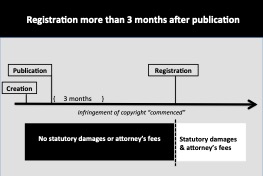
Image description: A visual timeline illustrating the points made in the text above.
In contrast, as seen in the figure below, as long as the copyright owner registers within the three month window, she is eligible for statutory damages or attorneys’ fees from the date of publication going forward. The copyright owner would still not be entitled to statutory damages or attorney’s fees for any pre-publication infringement.
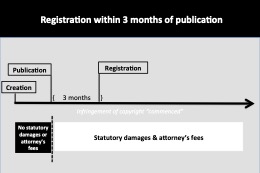
Image description: A visual timeline illustrating the points made in the text above.
Lastly, although this is rare, the copyright owner can register prior to publication, in which case, as seen in the figure below, she is eligible for statutory damages and attorneys’ fees from the date of registration.
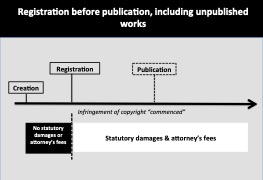
Image description: A visual timeline illustrating the points made in the text above.
Incentives for timely registration are important, but timely copyright registration can be difficult or burdensome for authors who create hundreds or thousands of works a year, or those who create works that are constantly changing and evolving. The registration pre-condition can negate much of the real world utility of copyright ownership.
Note also that there is some elasticity in determining when infringement commenced. In Derek Andrew, Inc. v. Poof Apparel Corp., 528 F.3d 696 (9th Cir. 2008), the Ninth Circuit held that §412(2) of the Copyright Act precludes recovery of statutory damages for an infringement that began before the effective date of registration, regardless of whether it continued after the registration. Specifically, the court said: “infringement ‘commences’ for the purposes of § 412 when the first act in a series of acts constituting continuing infringement occurs.” The court said that this rule was consistent with Congress’ intention to “provide copyright owners with an incentive to register their copyrights promptly.”
Procedural Issues in Copyright Litigation
Standing
The Copyright Act has its own unique rules on standing. The first sentence of section 501(b) affirmatively states that “The legal or beneficial owner of an exclusive right under a copyright is entitled” to institute an action for any infringement, and courts have generally read that express standing provision as excluding anyone else from having standing. That is that only the legal or beneficial owner of an exclusive right has standing to sue for copyright infringement.
17 U.S. Code § 501(b)
The legal or beneficial owner of an exclusive right under a copyright is entitled, subject to the requirements of section 411, to institute an action for any infringement of that particular right committed while he or she is the owner of it.
Courts also generally hold the right to sue can’t be assigned to a third party without also assigning the exclusive right.
Federal courts generally hold that you can’t transfer only the right to sue for past infringements without also transferring ownership of the underlying exclusive right. This flows from the idea that § 501(b) confers standing only on owners — not on those holding a “chose in action” for litigation purposes.
In Silvers v. Sony Pictures Entertainment, Inc., 402 F.3d 881 (9th Cir. 2005) (en banc), the court held that an assignment of “the right to sue” without an accompanying ownership interest in the copyright was insufficient for standing. The dispute concerned a television screenplay titled The Other Woman, written by Victoria Silvers and registered with the U.S. Copyright Office. Silvers had sold the copyright to a production company, which later transferred it to Stephen Cannell Productions (SCP). Believing that Sony’s film Stepmom copied elements from her script, Silvers sought to bring an infringement action even though she no longer owned the copyright. SCP had assigned to her only “the right to sue for past infringement,” without transferring any ownership interest in the underlying copyright. On that limited basis, Silvers filed suit against Sony Pictures.
The Ninth Circuit noted that the Copyright Act limits standing to those who own an exclusive right under §106 and that a “bare right to sue” is not one of those rights. It was also concerned that allowing such “bare right” assignments would create a market for copyright lawsuits and separate the enforcement of rights from ownership. This could result in multiplicity of suits, speculative litigation, and abuse of the judicial process.
This restrictive approach to standing prevents the market in bare litigation rights and preserves the link between substantive copyright ownership and enforcement. If an individual creator or rights holder signs an agreement giving an association, law firm, or agent “the right to sue” on their behalf — without transferring ownership of the relevant exclusive right — that arrangement will usually not create statutory standing in the representative. Likewise, a representation agreement that simply authorizes an association to bring claims in its own name will likely fail under § 501(b) unless the association is itself an owner or beneficial owner.
John Wiley & Sons, Inc. v. DRK Photo, 882 F.3d 394 (2d Cir. 2018)
DRK Photo (“DRK”) entered into a number of representation agreements with photographers making it their non-exclusive agent. DRK licensed hundreds of images to John Wiley & Sons, Inc. (“Wiley”) for a limited use and alleged that Wiley exceeded the scope of its license with respect to 295 of those images and thus infringed copyright.
The Second Circuit held that the “plain language of the Act does not authorize infringement actions by mere assignees of the bare right to sue — entities that do not hold and indeed never held any section 106 exclusive right in the allegedly infringed-upon work.” As the court explained, the six exclusive rights in § 106 do not include a “right to sue.” Applying expressio unius, the court held that Congress deliberately limited standing to those with an actual ownership interest in at least one § 106 right. Applying that rule the court found that Representation Agreements made DRK a non-exclusive licensing agent and thus conferred no Section 106 exclusive right. It is worth noting that the Assignment Agreements appeared to convey “all copyrights,” but extrinsic evidence showed they were intended only to allow DRK to register images and pursue infringement claims—not to transfer any genuine § 106 rights.
The court also held that DRK was not a “beneficial owner” of an exclusive right. Legislative history defines “beneficial owner” as someone who has parted with legal title but retains an equitable interest—e.g., an author who transferred exclusive rights for royalties. The court said that even if the term could extend beyond that example, it still requires an equitable interest in an exclusive right.
Notes and questions
(1) In dissent, Judge Parker seemed troubled by the implications of the majority’s decision. He wrote:
John Wiley & Sons, Inc. purchased from photographers for relatively small amounts of money the right to use their works in various of its publications. Wiley then proceeded to use the photographs in additional instances for which it had not obtained permission and for which it did not pay the photographers. The crux of this lawsuit is whether the Copyright Act permits this misappropriation. Stock photography companies like DRK Photo are in the business of aggregating copyright infringement claims that have accrued to their clients. Aggregation provides, as the majority acknowledges, a practical means of affording redress to the photographers and compensating them for repeated small infringements of their copyrights.
Are copyright’s standing rules overly restrictive? Are there good policy arguments for a more liberal interpretation of standing to sue for copyright infringement? See Shyamkrishna Balganesh, Copyright Infringement Markets, 113 Columbia Law Review 2277 (2013).
(2) The law on this question may not be settled. In Minden Pictures, Inc. v. John Wiley & Sons, Inc., 795 F.3d 997 (9th Cir. 2015), the Ninth Circuit held that a stock photography agency that served as the exclusive licensing agent for allegedly infringed photographs had standing to sue for infringement under the Copyright Act. The Ninth Circuit categorized the licenses at issue as “exclusive” despite the fact that under the agreements the copyright owner photographers were permitted to issue some licenses themselves. It was enough, apparently, that Minden was appointed as the “sole and exclusive agent and representative with respect to the Licensing of” the photos and that the any and all uses of photographers were prohibited from hiring a licensing agent other than Minden. Does this make sense? Is it consistent with the Ninth Circuit’s decision in DRK Photo?
(3) If the assignee of the bare right to sue does not have standing to sue for copyright infringement, does this mean that copyright infringement claims can’t ever be assigned? Not quite. Claims can be assigned along with the exclusive rights themselves as illustrated by ABKCO Music, Inc. v. Harrisongs Music, Ltd., 944 F.2d 971 (2d Cir. 1991). In the ABKCO case, the plaintiff had acquired the copyright to a pop song, He’s So Fine, and “any and all rights assertable under copyright against the Infringing Composition in any part of the world which may have heretofore arisen or which may hereafter arise.” Although the infringement in question had occurred before ABKCO bought the copyright, the court (at 981) held that ABKCO could sue the infringer “not out of its ownership of the copyright, but from its ownership of the claims themselves which it purchased, along with the copyright, in 1978.” Courts have permitted assignments of pre-existing claims where (1) an exclusive right is clearly conveyed and (2) the language of the transfer of a right to sue for past infringements is clear and complies with section 204(a)’s writing requirements, for example, an assignment that transferred “all existing or potential causes of action and claims including, without limitation, those for infringement.” See e.g. Davis v. Blige, 505 F.3d 90 (2d Cir. 2007).
(4) Can a joint owner of a copyright retroactively transfer ownership and thereby cut off the accrued rights of the other owner to sue for infringement? The Second Circuit held in Davis v. Blige that the joint owner could not cut off the accrued rights of the other owner to sue for infringement. It held that such retroactive transfers would “violate basic principles of tort and contract law, and undermine the policies embodied by the Copyright Act.” Davis v. Blige, 505 F.3d 90, 97-98 (2d Cir. 2007).
(5) Righthaven.
Is it legal or ethical to execute what appears to be an exclusive license or a complete assignment that is subject to a separate agreement or a verbal understanding that the contract is merely an assignment for the limited purpose of assigning the right to sue?
No.
In 2011, the Nevada-based copyright troll, Righthaven LLC, came unstuck with just such an arrangement. Righthaven was an aggressive copyright troll that identified plausible but largely innocuous cases of copyright infringement online, such as the reposting of newspaper articles on blogs, and then acquired a partial assignment of copyright tailored precisely to the infringement it had identified. Righthaven filed hundreds of lawsuits on this model. Once Righthaven’s conduct came under the microscope, it transpired that the company’s standing to sue was built on “nothing more than a fabrication.” See Righthaven LLC v. Democratic Underground, LLC, 791 F. Supp. 2d 968 (D. Nev. 2011). The limited exclusive rights that Righthaven had received from the original content owners appeared to satisfy the requirement for copyright standing. However, those assignments were essentially a sham—the rights that Righthaven claimed to own were subject to a secret “Strategic Alliance Agreement” giving Righthaven the right to sue, but nothing more. Following these revelations, Righthaven’s suits were dismissed, and the firm quickly succumbed to the weight of legal fees and went into insolvency.
(6) Associational Standing.
In Authors Guild, Inc. v. HathiTrust, 755 F.3d 87 (2d Cir. 2014), three authors’ associations, the Authors Guild, Inc., Australian Society of Authors Limited, and Writers’ Union of Canada, claimed to have standing to seek an injunction for copyright infringement on behalf of their members. The Second Circuit rejected this, noting that “§ 501 of the Copyright Act does not permit copyright holders to choose third parties to bring suits on their behalf.”
However, the court allowed some of the foreign authors’ associations to assert that their countries’ own laws gave them certain exclusive rights to enforce the copyrights of their foreign members. The court drew this distinction because in a 1998 opinion, Itar-Tass Russian News Agency v. Russian Kurier, Inc., 153 F.3d 82, 92 (2d Cir. 1998), the Second Circuit held that the ownership of foreign works was a question of foreign law and suggested that standing might also be a question of foreign law. The court’s conclusion about foreign associational standing is questionable and it should be noted that the issue was not contested by the defendants on appeal to the Second Circuit in HathiTrust. In the face of a clear statutory provision to the contrary, it does not follow from the premise that ownership is a question of foreign law that the standing to sue in U.S. courts should be as well.
Registration and Jurisdiction
In the United States, federal courts have exclusive subject matter jurisdiction over copyright claims. Furthermore, Section 411(a) of the Copyright Act provides that, with the exception of moral rights claims under Section 106A, preregistration or registration is a prerequisite to filing a civil claim for copyright infringement, at least for any “United States work”. The definition of “United States works” is discussed in more detail below.
17 U.S. Code §411(a)
Except for an action brought for a violation of the rights of the author under section 106A(a), and subject to the provisions of subsection (b), no civil action for infringement of the copyright in any United States work shall be instituted until preregistration or registration of the copyright claim has been made in accordance with this title. In any case, however, where the deposit, application, and fee required for registration have been delivered to the Copyright Office in proper form and registration has been refused, the applicant is entitled to institute a civil action for infringement if notice thereof, with a copy of the complaint, is served on the Register of Copyrights. The Register may, at his or her option, become a party to the action with respect to the issue of registrability of the copyright claim by entering an appearance within sixty days after such service, but the Register’s failure to become a party shall not deprive the court of jurisdiction to determine that issue.
Registration vs. filing of a registration application
Fourth Estate Public Benefit Corp. v. Wall-Street.com, LLC, 139 S. Ct. 881 (2019)
Justice Ginsburg delivered the opinion of the Court.
Impelling prompt registration of copyright claims, 17 U.S.C. §411(a) states that “no civil action for infringement of the copyright in any United States work shall be instituted until . . . registration of the copyright claim has been made in accordance with this title.” The question this case presents: Has “registration . . . been made in accordance with [Title 17]” as soon as the claimant delivers the required application, copies of the work, and fee to the Copyright Office; or has “registration . . . been made” only after the Copyright Office reviews and registers the copyright? We hold, in accord with the United States Court of Appeals for the Eleventh Circuit, that registration occurs, and a copyright claimant may commence an infringement suit, when the Copyright Office registers a copyright. Upon registration of the copyright, however, a copyright owner can recover for infringement that occurred both before and after registration.
Petitioner Fourth Estate Public Benefit Corporation (Fourth Estate) is a news organization producing online journalism. Fourth Estate licensed journalism works to respondent Wall-Street.com, LLC (Wall-Street), a news website. The license agreement required Wall-Street to remove from its website all content produced by Fourth Estate before canceling the agreement. Wall-Street canceled, but continued to display articles produced by Fourth Estate. Fourth Estate sued Wall-Street and its owner, Jerrold Burden, for copyright infringement. The complaint alleged that Fourth Estate had filed “applications to register the articles licensed to Wall-Street with the Register of Copyrights.” Because the Register had not yet acted on Fourth Estate’s applications, the District Court, on Wall-Street and Burden’s motion, dismissed the complaint, and the Eleventh Circuit affirmed. 856 F.3d 1338 (2017). Thereafter, the Register of Copyrights refused registration of the articles Wall-Street had allegedly infringed.
We granted Fourth Estate’s petition for certiorari to resolve a division among U.S. Courts of Appeals on when registration occurs in accordance with §411(a).
I
Under the Copyright Act of 1976, as amended, copyright protection attaches to “original works of authorship”—prominent among them, literary, musical, and dramatic works—“fixed in any tangible medium of expression.” 17 U.S.C. §102(a). An author gains “exclusive rights” in her work immediately upon the work’s creation, including rights of reproduction, distribution, and display. The Copyright Act entitles a copyright owner to institute a civil action for infringement of those exclusive rights. §501(b).
Before pursuing an infringement claim in court, however, a copyright claimant generally must comply with §411(a)’s requirement that “registration of the copyright claim has been made.” §411(a). Therefore, although an owner’s rights exist apart from registration, see §408(a), registration is akin to an administrative exhaustion requirement that the owner must satisfy before suing to enforce ownership rights.
II
All parties agree that, outside of statutory exceptions not applicable here, §411(a) bars a copyright owner from suing for infringement until “registration . . . has been made.” Fourth Estate and Wall-Street dispute, however, whether “registration . . . has been made” under §411(a) when a copyright owner submits the application, materials, and fee required for registration, or only when the Copyright Office grants registration. Fourth Estate advances the former view—the “application approach”—while Wall-Street urges the latter reading—the “registration approach.” The registration approach, we conclude, reflects the only satisfactory reading of §411(a)’s text. We therefore reject Fourth Estate’s application approach.
A
Under §411(a), “registration . . . has been made,” and a copyright owner may sue for infringement, when the Copyright Office registers a copyright. Section 411(a)’s first sentence provides that no civil infringement action “shall be instituted until preregistration or registration of the copyright claim has been made.” The section’s next sentence sets out an exception to this rule: When the required “deposit, application, and fee . . . have been delivered to the Copyright Office in proper form and registration has been refused,” the claimant “[may] institute a civil action, if notice thereof . . . is served on the Register.” Read together, §411(a)’s opening sentences focus not on the claimant’s act of applying for registration, but on action by the Copyright Office—namely, its registration or refusal to register a copyright claim.
If application alone sufficed to “make” registration, §411(a)’s second sentence—allowing suit upon refusal of registration—would be superfluous. What utility would that allowance have if a copyright claimant could sue for infringement immediately after applying for registration without awaiting the Register’s decision on her application? Proponents of the application approach urge that §411(a)’s second sentence serves merely to require a copyright claimant to serve notice of an infringement suit on the Register. This reading, however, requires the implausible assumption that Congress gave “registration” different meanings in consecutive, related sentences within a single statutory provision. In §411(a)’s first sentence, “registration” would mean the claimant’s act of filing an application, while in the section’s second sentence, “registration” would entail the Register’s review of an application. We resist this improbable construction. See, e.g., Mid-Con Freight Systems, Inc. v. Michigan Pub. Serv. Comm’n, 545 U.S. 440, 448 (2005) (declining to read “the same words” in consecutive sentences as “refer[ring] to something totally different”).
The third and final sentence of §411(a) further persuades us that the provision requires action by the Register before a copyright claimant may sue for infringement. The sentence allows the Register to “become a party to the action with respect to the issue of registrability of the copyright claim.” This allowance would be negated, and the court conducting an infringement suit would lack the benefit of the Register’s assessment, if an infringement suit could be filed and resolved before the Register acted on an application.
[The Court explained that other provisions, such as Section 410(a), (b) and (d) supported its reading of “registration,” as used in §411(a), to mean action by the Register.] Section 408(f)’s preregistration option, too, would have little utility if a completed application constituted registration. Preregistration allows the author of a work vulnerable to predistribution infringement to enforce her exclusive rights in court before obtaining registration or refusal thereof. A copyright owner who fears prepublication infringement would have no reason to apply for preregistration, however, if she could instead simply complete an application for registration and immediately commence an infringement suit.
B
… Fourth Estate’s contrary reading of §411(a) stems in part from its misapprehension of the significance of certain 1976 revisions to the Copyright Act. Before that year, §411(a)’s precursor provided that “no action or proceeding shall be maintained for infringement of copyright in any work until the provisions of this title with respect to the deposit of copies and registration of such work shall have been complied with.” 17 U. S. C. §13 (1970 ed.). Fourth Estate urges that this provision posed the very question we resolve today—namely, whether a claimant’s application alone effects registration. The Second Circuit addressed that question, Fourth Estate observes, in Vacheron & Constantin-Le Coultre Watches, Inc. v. Benrus Watch Co., 260 F.2d 637 (1958). In that case, in an opinion by Judge Learned Hand, the court held that a copyright owner who completed an application could not sue for infringement immediately upon the Copyright Office’s refusal to register. Vacheron, 260 F. 3d, at 640–641. Instead, the owner first had to obtain a registration certificate by bringing a mandamus action against the Register. The Second Circuit dissenter would have treated the owner’s application as sufficient to permit commencement of an action for infringement. Id., at 645.
Fourth Estate sees Congress’ 1976 revision of the registration requirement as an endorsement of the Vacheron dissenter’s position. We disagree. The changes made in 1976 instead indicate Congress’ agreement with Judge Hand that it is the Register’s action that triggers a copyright owner’s entitlement to sue. In enacting 17 U. S. C. §411(a), Congress both reaffirmed the general rule that registration must precede an infringement suit, and added an exception in that provision’s second sentence to cover instances in which registration is refused. See House Report p. 157 (1976). That exception would have no work to do if, as Fourth Estate urges, Congress intended the 1976 revisions to clarify that a copyright claimant may sue immediately upon applying for registration. A copyright claimant would need no statutory authorization to sue after refusal of her application if she could institute suit as soon as she has filed the application.
Noteworthy, too, in years following the 1976 revisions, Congress resisted efforts to eliminate §411(a) and the registration requirement embedded in it. In 1988, Congress removed foreign works from §411(a)’s dominion in order to comply with the Berne Convention for the Protection of Literary and Artistic Works’ bar on copyright formalities for such works. Despite proposals to repeal §411(a)’s registration requirement entirely, however, Congress maintained the requirement for domestic works. Subsequently, in 1993, Congress considered, but declined to adopt, a proposal to allow suit immediately upon submission of a registration application. And in 2005, Congress made a preregistration option available for works vulnerable to predistribution infringement. Congress chose that course in face of calls to eliminate registration in cases of predistribution infringement. Time and again, then, Congress has maintained registration as prerequisite to suit, and rejected proposals that would have eliminated registration or tied it to the copyright claimant’s application instead of the Register’s action.
Fourth Estate additionally argues that, as “registration is not a condition of copyright protection,” 17 U.S.C. §408(a), §411(a) should not be read to bar a copyright claimant from enforcing that protection in court once she has submitted a proper application for registration. But as explained supra, the Copyright Act safeguards copyright owners, irrespective of registration, by vesting them with exclusive rights upon creation of their works and prohibiting infringement from that point forward. If infringement occurs before a copyright owner applies for registration, that owner may eventually recover damages for the past infringement, as well as the infringer’s profits. §504. She must simply apply for registration and receive the Copyright Office’s decision on her application before instituting suit. Once the Register grants or refuses registration, the copyright owner may also seek an injunction barring the infringer from continued violation of her exclusive rights and an order requiring the infringer to destroy infringing materials. §§502, 503(b).
Fourth Estate maintains, however, that if infringement occurs while the Copyright Office is reviewing a registration application, the registration approach will deprive the owner of her rights during the waiting period. The Copyright Act’s explicit carveouts from §411(a)’s general registration rule, however, show that Congress adverted to this concern. In the preregistration option, §408(f), Congress provided that owners of works especially susceptible to prepublication infringement should be allowed to institute suit before the Register has granted or refused registration. See §411(a). Congress made the same determination as to live broadcasts. §411(c) As to all other works, however, §411(a)’s general rule requires owners to await action by the Register before filing suit for infringement.
Fourth Estate raises the specter that a copyright owner may lose the ability to enforce her rights if the Copyright Act’s three-year statute of limitations runs out before the Copyright Office acts on her application for registration. Fourth Estate’s fear is overstated, as the average processing time for registration applications is currently seven months, leaving ample time to sue after the Register’s decision, even for infringement that began before submission of an application.
True, the statutory scheme has not worked as Congress likely envisioned. Registration processing times have increased from one or two weeks in 1956 to many months today. Delays in Copyright Office processing of applications, it appears, are attributable, in large measure, to staffing and budgetary shortages that Congress can alleviate, but courts cannot cure. Unfortunate as the current administrative lag may be, that factor does not allow us to revise §411(a)’s congressionally composed text.
* * *
For the reasons stated, we conclude that “registration . . . has been made” within the meaning of 17 U. S. C. §411(a) not when an application for registration is filed, but when the Register has registered a copyright after examining a properly filed application. The judgment of the Court of Appeals for the Eleventh Circuit is accordingly
Affirmed.
Notes and questions
(1) Note the Court’s textual analysis of §411(a)’s three sentences. How does each sentence support the “registration approach” over the “application approach”?
(2) Under the Court’s holding, what happens if a copyright owner discovers ongoing infringement but the Copyright Office takes 8 months to process their application? What remedies are available, and when?
(3) The decision in Fourth Estate leaves copyright owners in the position of having to wait for a registration to either be granted or denied before they can bring suit in federal court, even to obtain injunctive relief. Copyright owners in this situation may request special handling by the Copyright Office to expedite their registration; otherwise it typically takes months to process a copyright registration.
(4) Alternatively, the Copyright Office also has a system for preregistration for certain classes of works that the Register of Copyrights has determined have a history of pre-release infringement. Preregistration is a limited place-holder for an actual registration, not a substitute, but it is useful where a copyright owner needs to sue for infringement while a work is still being prepared for commercial release. See Section 408(f) of the Copyright Act.
Different rules for some foreign works
“United States work” is a defined term in the Copyright Act that rewards detailed inspection. However, the basic gist of Section 411’s reference to “United States works” is that works first published overseas will not be subject to the registration prerequisite unless the country of first publication is not a copyright treaty party with the U.S. (but almost all nations are). If the work is unpublished, the work will also be a United States work if the authors are nationals, domiciliaries, or habitual residents of the United States. See Section 101 (defining United States work).
Copyright Notice
Copyright notice is the familiar © that you have no doubt seen thousands of times. Technically, a copyright notice must contain the word copyright or some abbreviation thereof, the name of the copyright owner and the date of first publication.
The failure to include copyright notice has no effect on works published after March 1, 1989, however the inclusion of copyright notices is still commonplace and it has some significance in relation to statutory damages for copyright infringement. Publication without proper notice from January 1, 1978, to February 28, 1989 could have resulted in copyright ineligibility, if corrective steps were not taken within a certain amount of time.
In contrast, publication without the appropriate copyright notice prior to January 1, 1978—the date at which the Copyright Act of 1976 became effective—makes a work ineligible for copyright protection.
Works published between 1978 and 1989 were still subject to the notice requirement, however the 1976 copyright act included provisions excusing the omission of notice where only a few copies lack notice or the omission was due to a publisher’s error. The 1976 act also provided a mechanism to cure defective notice within five years of publication provided that the copyright owner undertook reasonable efforts to add notice to all domestically distributed copies after becoming aware of the omission.
Registration & deposit
United States law still provides that two copies of the best edition of a work must be deposited in the copyright office within three months of first publication in the United States. However, deposit is not a condition of copyright protection. Nonetheless, deposit is required as part of the registration process.
The current Copyright Act does not require registration for a valid copyright to exist. However, registration is a prerequisite for bringing an action for copyright infringement for United States works. In compliance with the Berne Convention, the owners of foreign works are entitled to bring a suit without registration. What exactly makes a work a foreign work depends on the nationality and residence and the place of first publication of the work. See the definition of “United States work” in Section 101 for details.
Copyright registration is strongly encouraged by the fact that a certificate of registration is prima facie evidence of ownership and validity. More importantly, the powerful remedies of statutory damages and attorney’s fees do not generally apply to infringements that took place prior to registration, unless the author registered within three months of first publication. The qualification in the previous sentence is required because of the Copyright Alternative in Small-Claims Enforcement Act of 2020 (the CASE Act). The CASE Act established a Copyright Claims Board (CCB) within the Copyright Office that is intended to function as a copyright small claims court. Of particular relevance here, infringement claims that took place prior to registration may still be subject to statutory damage in this new forum, but only up to a maximum of $7,500 per work and a maximum total award of $15,000.
The CCB began accepting claims on Thursday, June 16, 2022. Additional information about the CCB can be found on the Copyright Office’s dedicated website, www.ccb.gov.
Interestingly, the U.S. Court of Appeals for the D.C. Circuit held in Valancourt Books, LLC v. Garland, 82 F.4th 1222 (D.C. Cir. 2023) that the requirement that two copies of a copyrighted work be deposited in the Copyright Office within three months of publication, on pain of fines, was an unconstitutional taking of private property in violation of the Fifth Amendment’s Takings Clause. Interestingly, the court noted that “because the requirement to turn over copies of the works is not a condition of attaining (or retaining) copyright protection in them, the demand to forfeit property cannot be justified as the conferral of a benefit—i.e., copyright protection—in exchange for property.” Does that suggest Congress should make copyright registration conditional on deposit?
Choice of law
The ownership of a copyright is generally determined under the laws of the state with the most significant relationship to the property and the parties, but the scope of protection afforded to the copyright owner is determined by the laws of the state in which infringement is alleged to have occurred. See Itar-Tass Russian News Agency v. Russian Kurier, Inc., 153 F.3d 82, 90-91 (2d Cir.1998) (applying Russian law to issue of copyright ownership and American law to infringement issue).
Class actions
Plaintiff class actions are not common in copyright litigation because usually there are not enough plaintiffs to meet the numerosity requirement, or the plaintiffs are too different in terms of rights affected, ownership interests, or damages. See e.g. The Football Association Premier League Limited v. YouTube, Inc., 2013 WL 2096411 (S.D.N.Y. May 15, 2013). But uncommon does not mean impossible. See e.g. In re Napster Copyright Litigation v. Bertelsmann AG, 2005 WL 1287611 (N.D. Cal. June 1, 2005) wherein the court was willing to certify a class of music publishers “that owned or controlled at least one copyrighted musical work at the time that it was made available without their permission through the Napster service on or after October 30, 2000.”
In In re Literary Works in Electronic Databases Copyright Litigation, 509 F.3d 116, 128 (2d Cir. 2007), freelance writers whose work was published in certain print periodicals, and who retained the copyrights in those works, brought a class action against the publishers alleging electronic reproduction of the works by the publisher who infringed their copyrights. The district court certified the class and approved settlement. On appeal, the Second Circuit vacated and remanded because some of the members of the class owned works that had not been registered. The court of appeals concluded sua sponte that the registration requirement imposed by Section 411(a) of the Copyright Act was jurisdictional, and thus the district court lacked subject-matter jurisdiction to approve the settlement of claims for the infringement of unregistered copyrights. However, the Supreme Court took a different view and held that Section 411(a) imposes only a nonjurisdictional precondition to filing a claim, and thus the district court did indeed have jurisdiction over the settlement. Reed Elsevier, Inc. v. Muchnick, 559 U.S. 154 (2010).
Class actions in the generative AI litigation
That picture has changed. In Bartz v. Anthropic PBC, No. 4:24-cv-05417 (N.D. Cal.), a class of authors settled for approximately $1.5 billion, with final approval granted on 20 July 2026. The class encompassed nearly half a million copyrighted works and roughly 595,000 identified potential rightsholders. It might be tempting to conclude that the numerosity and commonality difficulties described above are not necessarily fatal where a single defendant has copied a very large number of works in substantially the same way. But it is far from clear that Bartz will be a useful template to address the legality of AI training on copyrighted works more generally.
As discussed in the chapter on nonexpressive use, Judge Alsup held that training a large language model on lawfully acquired books was fair use. Anthropic did not pay to settle that issue. The settlement instead followed the separate finding that Anthropic had downloaded books from shadow libraries not only for model training, but also to create a permanent, general-purpose research library, and that this latter use was not fair.
That factual finding is open to question. The evidentiary basis for it seems quite thin, and stepping back to consider its plausibility, it doesn’t make much sense. Anthropic’s only line of business is developing and studying AI models, and so it is hard to imagine they downloaded the pirated works with anything else in mind. We are faced with two independently unlikely possibilities: if it is true that Anthropic decided to create a general pirate library for purposes broader than AI training, their legal advice and internal controls seem quite suspect; if it is not true, we have an experienced and highly respected judge making an elementary mistake on the factual record, and one that conveniently insulates his opinion from appeal. To elaborate, a ruling that the use of pirated works for AI training is not fair use would present a relatively clean legal question for appeal. But the holding in Bartz is tied to a much broader use of the pirated materials that was never likely to be held fair use on appeal.
The Bartz settlement provides fairly weak evidence that the AI-training disputes can be resolved through class settlements, because the adequacy of the class and its representation was never squarely tested in a contested certification proceeding. This is important because the Supreme Court has for some time been skeptical of very large damages classes, and there is little reason to assume that position will change.
Statute of limitations
The Copyright Act contains two relevant statute of limitations provisions, one criminal and one civil.
17 U.S. Code §507
(a) Criminal Proceedings. Except as expressly provided otherwise in this title, no criminal proceeding shall be maintained under the provisions of the title unless it is commenced within five years after the cause of action arose.
(b) Civil Actions. No civil action shall be maintained under the provisions of this title unless it is commenced within three years after the claim accrued.
The statute of limitations period for copyright law applies to more than just infringement. It also applies to disputes about ownership, see Merchant v. Levy, 92 F.3d 51, 56 (2d Cir. 1996), and it even bars claims of infringement that are within the three year period if those claims are in substance claims of ownership that are time barred, see Kwan v. Schlein, 634 F.3d 224 (2d Cir. 2011). As the Second Circuit explained, Kwan’s claim was barred because the statute of limitations for ownership actions “cannot be defeated by portraying an action as one for infringement when copyright ownership rights are the true matter at issue.”
In 2014, the Supreme Court addressed the question of whether the equitable defense of laches (unreasonable, prejudicial delay in commencing suit) could bar relief on a copyright infringement claim brought within § 507(b)’s three-year limitations period. In Petrella v. Metro-Goldwyn-Mayer, Inc., 134 S. Ct. 1962 (2014), the Court held on a 6-3 vote that it could not.
Petrella v. Metro-Goldwyn-Mayer, Inc., 134 S. Ct. 1962 (2014)
Justice Ginsburg delivered the opinion of the Court.
The Copyright Act provides that “no civil action shall be maintained under the [Act] unless it is commenced within three years after the claim accrued.” 17 U.S.C. § 507(b). This case presents the question whether the equitable defense of laches (unreasonable, prejudicial delay in commencing suit) may bar relief on a copyright infringement claim brought within § 507(b)’s three-year limitations period. Section 507(b), it is undisputed, bars relief of any kind for conduct occurring prior to the three-year limitations period. To the extent that an infringement suit seeks relief solely for conduct occurring within the limitations period, however, courts are not at liberty to jettison Congress’ judgment on the timeliness of suit. Laches, we hold, cannot be invoked to preclude adjudication of a claim for damages brought within the three-year window. As to equitable relief, in extraordinary circumstances, laches may bar at the very threshold the particular relief requested by the plaintiff. And a plaintiff’s delay can always be brought to bear at the remedial stage, in determining appropriate injunctive relief, and in assessing the “profits of the infringer ... attributable to the infringement.” § 504(b).
Petitioner Paula Petrella, in her suit for copyright infringement, sought no relief for conduct occurring outside § 507(b)’s three-year limitations period. Nevertheless, the courts below held that laches barred her suit in its entirety, without regard to the currency of the conduct of which Petrella complains. That position, we hold, is contrary to § 507(b) and this Court’s precedent on the province of laches.
I
The Copyright Act (Act) grants copyright protection to original works of authorship. § 102(a). Four aspects of copyright law bear explanation at the outset.
First, the length of a copyright term. Under the Act, a copyright “vests initially in the author or authors of the work,” who may transfer ownership to a third party. § 201. The Act confers on a copyright owner certain exclusive rights, including the rights to reproduce and distribute the work and to develop and market derivative works. § 106. Copyrighted works published before 1978 — as was the work at issue — are protected for an initial period of 28 years, which may be — and in this case was — extended for a renewal period of up to 67 years. § 304(a). From and after January 1, 1978, works are generally protected from the date of creation until 70 years after the author’s death. § 302(a).
Second, copyright inheritance. For works copyrighted under the pre-1978 regime in which an initial period of protection may be followed by a renewal period, Congress provided that the author’s heirs inherit the renewal rights. See § 304(a)(1)(C)(ii)-(iv). We held in Stewart v. Abend, 495 U.S. 207 (1990), that if an author who has assigned her rights away “dies before the renewal period, then the assignee may continue to use the original work [to produce a derivative work] only if the author’s successor transfers the renewal rights to the assignee.” Id., at 221.2
Footnote 2: For post-1978 works, heirs still have an opportunity to recapture rights of the author.
Third, remedies. The Act provides a variety of civil remedies for infringement, both equitable and legal. A court may issue an injunction “on such terms as it may deem reasonable to prevent or restrain infringement of a copyright.” § 502(a). At the election of the copyright owner, a court may also award either (1) “the copyright owner’s actual damages and any additional profits of the infringer,” § 504(a)(1), which petitioner seeks in the instant case, or (2) statutory damages within a defined range, § 504(c).
Fourth, and most significant here, the statute of limitations. Until 1957, federal copyright law did not include a statute of limitations for civil suits. Federal courts therefore used analogous state statutes of limitations to determine the timeliness of infringement claims. See Senate Report at 2. And they sometimes invoked laches to abridge the state-law prescription. As explained in Teamsters & Employers Welfare Trust of Ill. v. Gorman Bros. Ready Mix, 283 F.3d 877, 881 (C.A.7 2002): “When Congress fails to enact a statute of limitations, a [federal] court that borrows a state statute of limitations but permits it to be abridged by the doctrine of laches is not invading congressional prerogatives. It is merely filling a legislative hole.” In 1957, Congress addressed the matter and filled the hole; it prescribed a three-year look-back limitations period for all civil claims arising under the Copyright Act. The provision, as already noted, reads: “No civil action shall be maintained under the provisions of this title unless it is commenced within three years after the claim accrued.” § 507(b).3
Footnote 3: The Copyright Act was pervasively revised in 1976, but the three-year look-back statute of limitations has remained materially unchanged.
The federal limitations prescription governing copyright suits serves two purposes: (1) to render uniform and certain the time within which copyright claims could be pursued; and (2) to prevent the forum shopping invited by disparate state limitations periods, which ranged from one to eight years. To comprehend how the Copyright Act’s limitations period works, one must understand when a copyright infringement claim accrues.
A claim ordinarily accrues “when [a] plaintiff has a complete and present cause of action.” Bay Area Laundry and Dry Cleaning Pension Trust Fund v. Ferbar Corp. of Cal., 522 U.S. 192, 201, (1997) (internal quotation marks omitted). In other words, the limitations period generally begins to run at the point when “the plaintiff can file suit and obtain relief.” Ibid. A copyright claim thus arises or “accrue[s]” when an infringing act occurs.4
Footnote 4: Although we have not passed on the question, nine Courts of Appeals have adopted, as an alternative to the incident of injury rule, a “discovery rule,” which starts the limitations period when “the plaintiff discovers, or with due diligence should have discovered, the injury that forms the basis for the claim.” William A. Graham Co. v. Haughey, 568 F.3d 425, 433 (C.A.3 2009) (internal quotation marks omitted). See also 6 W. Patry, Copyright § 20:19, p. 20-28 (2013) (hereinafter Patry) (“The overwhelming majority of courts use discovery accrual in copyright cases.”).
It is widely recognized that the separate-accrual rule attends the copyright statute of limitations. Under that rule, when a defendant commits successive violations, the statute of limitations runs separately from each violation. Each time an infringing work is reproduced or distributed, the infringer commits a new wrong. Each wrong gives rise to a discrete “claim” that “accrues” at the time the wrong occurs. In short, each infringing act starts a new limitations period. See Stone v. Williams, 970 F.2d 1043, 1049 (C.A.2 1992) (“Each act of infringement is a distinct harm giving rise to an independent claim for relief.”).
Under the Act’s three-year provision, an infringement is actionable within three years, and only three years, of its occurrence. And the infringer is insulated from liability for earlier infringements of the same work. See Nimmer on Copyright § 12.05[B][1][b] (“If infringement occurred within three years prior to filing, the action will not be barred even if prior infringements by the same party as to the same work are barred because they occurred more than three years previously.”). Thus, when a defendant has engaged (or is alleged to have engaged) in a series of discrete infringing acts, the copyright holder’s suit ordinarily will be timely under § 507(b) with respect to more recent acts of infringement (i.e., acts within the three-year window), but untimely with respect to prior acts of the same or similar kind.
In sum, Congress provided two controlling time prescriptions: the copyright term, which endures for decades, and may pass from one generation to another; and § 507(b)’s limitations period, which allows plaintiffs during that lengthy term to gain retrospective relief running only three years back from the date the complaint was filed.
II
A
The allegedly infringing work in this case is the critically acclaimed motion picture Raging Bull, based on the life of boxing champion Jake LaMotta. After retiring from the ring, LaMotta worked with his longtime friend, Frank Petrella, to tell the story of the boxer’s career. Their venture resulted in three copyrighted works: two screenplays, one registered in 1963, the other in 1973, and a book, registered in 1970. This case centers on the screenplay registered in 1963. The registration identified Frank Petrella as sole author, but also stated that the screenplay was written “in collaboration with” LaMotta.
In 1976, Frank Petrella and LaMotta assigned their rights in the three works, including renewal rights, to Chartoff-Winkler Productions, Inc. Two years later, respondent United Artists Corporation, a subsidiary of respondent Metro-Goldwyn-Mayer, Inc. (collectively, MGM), acquired the motion picture rights to the book and both screenplays, rights stated by the parties to be “exclusiv[e] and forever, including all periods of copyright and renewals and extensions thereof.” Id., at 49. In 1980, MGM released, and registered a copyright in, the film Raging Bull, directed by Martin Scorcese and starring Robert De Niro, who won a Best Actor Academy Award for his portrayal of LaMotta. MGM continues to market the film, and has converted it into formats unimagined in 1980, including DVD and Blu-ray.
Frank Petrella died in 1981, during the initial terms of the copyrights in the screenplays and book. As this Court’s decision in Stewart confirmed, Frank Petrella’s renewal rights reverted to his heirs, who could renew the copyrights unburdened by any assignment previously made by the author.
Plaintiff below, petitioner here, Paula Petrella (Petrella) is Frank Petrella’s daughter. Learning of this Court’s decision in Stewart, Petrella engaged an attorney who, in 1991, renewed the copyright in the 1963 screenplay. Because the copyrights in the 1973 screenplay and the 1970 book were not timely renewed, the infringement claims in this case rest exclusively on the screenplay registered in 1963. Petrella is now sole owner of the copyright in that work.
In 1998, seven years after filing for renewal of the copyright in the 1963 screenplay, Petrella’s attorney informed MGM that Petrella had obtained the copyright to that screenplay. Exploitation of any derivative work, including Raging Bull, the attorney asserted, infringed on the copyright now vested in Petrella. During the next two years, counsel for Petrella and MGM exchanged letters in which MGM denied the validity of the infringement claims, and Petrella repeatedly threatened to take legal action.
B
Some nine years later, on January 6, 2009, Petrella filed a copyright infringement suit in the United States District Court for the Central District of California. She alleged that MGM violated and continued to violate her copyright in the 1963 screenplay by using, producing, and distributing Raging Bull, a work she described as derivative of the 1963 screenplay. Petrella’s complaint sought monetary and injunctive relief. Because the statute of limitations for copyright claims requires commencement of suit “within three years after the claim accrued,” § 507(b), Petrella sought relief only for acts of infringement occurring on or after January 6, 2006. No relief, she recognizes, can be awarded for infringing acts prior to that date.
MGM moved for summary judgment on several grounds, among them, the equitable doctrine of laches. Petrella’s 18-year delay, from the 1991 renewal of the copyright on which she relied, until 2009, when she commenced suit, MGM maintained, was unreasonable and prejudicial to MGM.
The District Court granted MGM’s motion. As to the merits of the infringement claims, the court found, disputed issues of material fact precluded summary adjudication. Even so, the court held, laches barred Petrella’s complaint. Petrella had unreasonably delayed suit by not filing until 2009, the court concluded, and further determined that MGM was prejudiced by the delay. In particular, the court stated, MGM had shown “expectations-based prejudice,” because the company had “made significant investments in exploiting the film”; in addition, the court accepted that MGM would encounter “evidentiary prejudice,” because Frank Petrella had died and LaMotta, then aged 88, appeared to have sustained a loss of memory.
The U.S. Court of Appeals for the Ninth Circuit affirmed the laches-based dismissal. 695 F.3d 946 (2012). Under Ninth Circuit precedent, the Court of Appeals first observed, “if any part of the alleged wrongful conduct occurred outside of the limitations period, courts presume that the plaintiff’s claims are barred by laches.” Id., at 951. The presumption was applicable here, the court indicated, because “the statute of limitations for copyright claims in civil cases is three years,” ibid. (citing § 507(b)), and Petrella was aware of her potential claims many years earlier (as was MGM), id., at 952. “The true cause of Petrella’s delay,” the court suggested, “was, as [Petrella] admits, that ‘the film hadn’t made money’ [in years she deferred suit].” Id., at 953. Agreeing with the District Court, the Ninth Circuit determined that MGM had established expectations-based prejudice: the company had made a large investment in Raging Bull, believing it had complete ownership and control of the film.
Judge Fletcher concurred only because Circuit precedent obliged him to do so. Id., at 958. Laches in copyright cases, he observed, is “entirely a judicial creation,” one notably “in tension with Congress’ [provision of a three-year limitations period].” Ibid.
We granted certiorari to resolve a conflict among the Circuits on the application of the equitable defense of laches to copyright infringement claims brought within the three-year look-back period prescribed by Congress.
III
We consider first whether, as the Ninth Circuit held, laches may be invoked as a bar to Petrella’s pursuit of legal remedies under 17 U.S.C. § 504(b). The Ninth Circuit erred, we hold, in failing to recognize that the copyright statute of limitations, § 507(b), itself takes account of delay. As earlier observed, a successful plaintiff can gain retrospective relief only three years back from the time of suit. No recovery may be had for infringement in earlier years. Profits made in those years remain the defendant’s to keep. Brought to bear here, § 507(b) directs that MGM’s returns on its investment in Raging Bull in years outside the three-year window (years before 2006) cannot be reached by Petrella. Only by disregarding that feature of the statute, and the separate-accrual rule attending § 507(b), could the Court of Appeals presume that infringing acts occurring before January 6, 2006 bar all relief, monetary and injunctive, for infringement occurring on and after that date.13
Footnote 13: Assuming Petrella had a winning case on the merits, the Court of Appeals’ ruling on laches would effectively give MGM a cost-free license to exploit Raging Bull throughout the long term of the copyright. The value to MGM of such a free, compulsory license could exceed by far MGM’s expenditures on the film.
Moreover, if infringement within the three-year look-back period is shown, the Act allows the defendant to prove and offset against profits made in that period “deductible expenses” incurred in generating those profits. § 504(b). In addition, the defendant may prove and offset “elements of profit attributable to factors other than the copyrighted work.” § 504(b). The defendant thus may retain the return on investment shown to be attributable to its own enterprise, as distinct from the value created by the infringed work. See Sheldon v. Metro-Goldwyn Pictures Corp., 309 U.S. 390, 402, 407 (1940) (equitably apportioning profits to account for independent contributions of infringing defendant). See also infra, at 1977-1979 (delay in commencing suit as a factor in determining contours of relief appropriately awarded).
Last, but hardly least, laches is a defense developed by courts of equity; its principal application was, and remains, to claims of an equitable cast for which the Legislature has provided no fixed time limitation. See 1 D. Dobbs, Law of Remedies § 2.4(4), p. 104 (2d ed. 1993) (hereinafter Dobbs) (“laches ... may have originated in equity because no statute of limitations applied, ... suggesting that laches should be limited to cases in which no statute of limitations applies”). Both before and after the merger of law and equity in 1938, this Court has cautioned against invoking laches to bar legal relief.
IV
We turn now to MGM’s principal arguments regarding the contemporary scope of the laches defense, all of them embraced by the dissent.
A
Laches is listed among affirmative defenses, along with, but discrete from, the statute of limitations, in Federal Rule of Civil Procedure 8(c). Accordingly, MGM maintains, the plea is “available ... in every civil action” to bar all forms of relief. To the Court’s question, could laches apply where there is an ordinary six-year statute of limitations, MGM’s counsel responded yes, case-specific circumstances might warrant a ruling that a suit brought in year five came too late.
The expansive role for laches MGM envisions careens away from understandings, past and present, of the essentially gap-filling, not legislation-overriding, office of laches. Nothing in this Court’s precedent suggests a doctrine of such sweep. Quite the contrary, we have never applied laches to bar in their entirety claims for discrete wrongs occurring within a federally prescribed limitations period. Inviting individual judges to set a time limit other than the one Congress prescribed, we note, would tug against the uniformity Congress sought to achieve when it enacted § 507(b).
B
MGM observes that equitable tolling “is read into every federal statute of limitation,” Holmberg, 327 U.S., at 397, and asks why laches should not be treated similarly. Tolling, which lengthens the time for commencing a civil action in appropriate circumstances, applies when there is a statute of limitations; it is, in effect, a rule of interpretation tied to that limit. Laches, in contrast, originally served as a guide when no statute of limitations controlled the claim; it can scarcely be described as a rule for interpreting a statutory prescription. That is so here, because the statute, § 507(b), makes the starting trigger an infringing act committed three years back from the commencement of suit, while laches, as conceived by the Ninth Circuit and advanced by MGM, makes the presumptive trigger the defendant’s initial infringing act.
C
MGM insists that the defense of laches must be available to prevent a copyright owner from sitting still, doing nothing, waiting to see what the outcome of an alleged infringer’s investment will be. In this case, MGM stresses, “Petrella conceded that she waited to file because ‘the film was deeply in debt and in the red and would probably never recoup.’” The Ninth Circuit similarly faulted Petrella for waiting to sue until the film Raging Bull “made money.” 695 F.3d, at 953.
It is hardly incumbent on copyright owners, however, to challenge each and every actionable infringement. And there is nothing untoward about waiting to see whether an infringer’s exploitation undercuts the value of the copyrighted work, has no effect on the original work, or even complements it. Fan sites prompted by a book or film, for example, may benefit the copyright owner. See Wu, Tolerated Use, 31 Columbia Journal of Law & the Arts 617, 619-620 (2008). Even if an infringement is harmful, the harm may be too small to justify the cost of litigation.
If the rule were, as MGM urges, “sue soon, or forever hold your peace,” copyright owners would have to mount a federal case fast to stop seemingly innocuous infringements, lest those infringements eventually grow in magnitude. Section 507(b)’s three-year limitations period, however, coupled to the separate-accrual rule, see supra, at 1968-1970, avoids such litigation profusion. It allows a copyright owner to defer suit until she can estimate whether litigation is worth the candle. She will miss out on damages for periods prior to the three-year look-back, but her right to prospective injunctive relief should, in most cases, remain unaltered.
D
MGM points to the danger that evidence needed or useful to defend against liability will be lost during a copyright owner’s inaction. Recall, however, that Congress provided for reversionary renewal rights exercisable by an author’s heirs, rights that can be exercised, at the earliest for pre-1978 copyrights, 28 years after a work was written and copyrighted. At that time, the author, and perhaps other witnesses to the creation of the work, will be dead. See supra, at 1970. Congress must have been aware that the passage of time and the author’s death could cause a loss or dilution of evidence. Congress chose, nonetheless, to give the author’s family “a second chance to obtain fair remuneration.” Stewart, 495 U.S., at 220.
Moreover, a copyright plaintiff bears the burden of proving infringement. Any hindrance caused by the unavailability of evidence, therefore, is at least as likely to affect plaintiffs as it is to disadvantage defendants. That is so in cases of the kind Petrella is pursuing, for a deceased author most probably would have supported his heir’s claim.
The registration mechanism, we further note, reduces the need for extrinsic evidence. Although registration is “permissive,” both the certificate and the original work must be on file with the Copyright Office before a copyright owner can sue for infringement. §§ 408(b), 411(a). Key evidence in the litigation, then, will be the certificate, the original work, and the allegedly infringing work. And the adjudication will often turn on the factfinder’s direct comparison of the original and the infringing works, i.e., on the factfinder’s “good eyes and common sense” in comparing the two works’ “total concept and overall feel.” Peter F. Gaito Architecture, LLC v. Simone Development Corp., 602 F.3d 57, 66 (C.A.2 2010).
E
Finally, when a copyright owner engages in intentionally misleading representations concerning his abstention from suit, and the alleged infringer detrimentally relies on the copyright owner’s deception, the doctrine of estoppel may bar the copyright owner’s claims completely, eliminating all potential remedies. The test for estoppel is more exacting than the test for laches, and the two defenses are differently oriented. The gravamen of estoppel, a defense long recognized as available in actions at law, see Wehrman v. Conklin, 155 U.S. 314, 327 (1894), is misleading and consequent loss. Delay may be involved, but is not an element of the defense. For laches, timeliness is the essential element. In contrast to laches, urged by MGM entirely to override the statute of limitations Congress prescribed, estoppel does not undermine Congress’ prescription, for it rests on misleading, whether engaged in early on, or later in time.
Stating that the Ninth Circuit “had taken a wrong turn in its formulation and application of laches in copyright cases,” Judge Fletcher called for fresh consideration of the issue. 695 F.3d, at 959. “A recognition of the distinction between ... estoppel and laches,” he suggested, “would be a good place to start.” Ibid. We agree.
V
The courts below summarily disposed of Petrella’s case based on laches, preventing adjudication of any of her claims on the merits and foreclosing the possibility of any form of relief. That disposition, we have explained, was erroneous. Congress’ time provisions secured to authors a copyright term of long duration, and a right to sue for infringement occurring no more than three years back from the time of suit. That regime leaves “little place” for a doctrine that would further limit the timeliness of a copyright owner’s suit. See 1 Dobbs § 2.6(1), at 152. In extraordinary circumstances, however, the consequences of a delay in commencing suit may be of sufficient magnitude to warrant, at the very outset of the litigation, curtailment of the relief equitably awardable.
Chirco v. Crosswinds Communities, Inc., 474 F.3d 227 (C.A.6 2007), is illustrative. In that case, the defendants were alleged to have used without permission, in planning and building a housing development, the plaintiffs’ copyrighted architectural design. Long aware of the defendants’ project, the plaintiffs took no steps to halt the housing development until more than 168 units were built, 109 of which were occupied. Id., at 230. Although the action was filed within § 507(b)’s three-year statute of limitations, the District Court granted summary judgment to the defendants, dismissing the entire case on grounds of laches. The trial court’s rejection of the entire suit could not stand, the Court of Appeals explained, for it was not within the Judiciary’s ken to debate the wisdom of § 507(b)’s three-year look-back prescription. Id., at 235. Nevertheless, the Court of Appeals affirmed the District Court’s judgment to this extent: The plaintiffs, even if they might succeed in proving infringement of their copyrighted design, would not be entitled to an order mandating destruction of the housing project. That relief would be inequitable, the Sixth Circuit held, for two reasons: the plaintiffs knew of the defendants’ construction plans before the defendants broke ground, yet failed to take readily available measures to stop the project; and the requested relief would “work an unjust hardship” upon the defendants and innocent third parties. Id., at 236. See also New Era Publications Int’l v. Henry Holt & Co., 873 F.2d 576, 584-585 (C.A.2 1989) (despite awareness since 1986 that book containing allegedly infringing material would be published in the United States, copyright owner did not seek a restraining order until 1988, after the book had been printed, packed, and shipped; as injunctive relief would have resulted in the total destruction of the work, the court relegated plaintiff to its damages remedy).
In sum, the courts below erred in treating laches as a complete bar to Petrella’s copyright infringement suit. The action was commenced within the bounds of § 507(b), the Act’s time-to-sue prescription, and does not present extraordinary circumstances of the kind involved in Chirco and New Era. Petrella notified MGM of her copyright claims before MGM invested millions of dollars in creating a new edition of Raging Bull. And the equitable relief Petrella seeks — e.g., disgorgement of unjust gains and an injunction against future infringement — would not result in “total destruction” of the film, or anything close to it. MGM released Raging Bull more than three decades ago and has marketed it continuously since then. Allowing Petrella’s suit to go forward will put at risk only a fraction of the income MGM has earned during that period and will work no unjust hardship on innocent third parties, such as consumers who have purchased copies of Raging Bull. Cf. Chirco, 474 F.3d, at 235-236 (destruction remedy would have ousted families from recently purchased homes). The circumstances here may or may not (we need not decide) warrant limiting relief at the remedial stage, but they are not sufficiently extraordinary to justify threshold dismissal.
Should Petrella ultimately prevail on the merits, the District Court, in determining appropriate injunctive relief and assessing profits, may take account of her delay in commencing suit. In doing so, however, that court should closely examine MGM’s alleged reliance on Petrella’s delay. This examination should take account of MGM’s early knowledge of Petrella’s claims, the protection MGM might have achieved through pursuit of a declaratory judgment action, the extent to which MGM’s investment was protected by the separate-accrual rule, the court’s authority to order injunctive relief “on such terms as it may deem reasonable,” § 502(a), and any other considerations that would justify adjusting injunctive relief or profits. See Haas v. Leo Feist, Inc., 234 F. 105, 107-108 (S.D.N.Y.1916) (adjudicating copyright infringement suit on the merits and decreeing injunctive relief, but observing that, in awarding profits, account may be taken of copyright owner’s inaction until infringer had spent large sums exploiting the work at issue). See also Tr. of Oral Arg. 23 (Government observation that, in fashioning equitable remedies, court has considerable leeway; it could, for example, allow MGM to continue using Raging Bull as a derivative work upon payment of a reasonable royalty to Petrella). Whatever adjustments may be in order in awarding injunctive relief, and in accounting for MGM’s gains and profits, on the facts thus far presented, there is no evident basis for immunizing MGM’s present and future uses of the copyrighted work, free from any obligation to pay royalties.
* * *
For the reasons stated, the judgment of the United States Court of Appeals for the Ninth Circuit is reversed, and the case is remanded for further proceedings consistent with this opinion.
Notes and questions
(1) In Petrella v. Metro-Goldwyn-Mayer, Inc., 134 S. Ct. 1962 (2014), the Supreme Court held that laches may not be invoked as a bar to a copyright claim for damages brought within the three-year period set by the copyright statute of limitations, 17 U.S.C. § 507(b).
(2) In Derek Andrew, Inc. v. Poof Apparel Corp., 528 F.3d 696 (9th Cir. 2008), the Ninth Circuit held that §412(2) of the Copyright Act precludes recovery of statutory damages for an infringement that began before the effective date of registration, regardless of whether it continued after the registration.
We also recognize that § 412 is designed to implement two fundamental purposes. First, by denying an award of statutory damages and attorney’s fees where infringement takes place before registration, Congress sought to provide copyright owners with an incentive to register their copyrights promptly. See House Report at 158 (1976) (“Copyright registration ... is useful and important to users and the public at large ... and should therefore be induced in some practical way.”). Second, § 412 encourages potential infringers to check the Copyright Office’s database. To allow statutory damages and attorneys’ fees where an infringing act occurs before registration and then reoccurs thereafter clearly would defeat the dual incentives of § 412.
Every court to consider the issue has held that infringement ‘commences’ for the purposes of § 412 when the first act in a series of acts constituting continuing infringement occurs. Indeed, if the incentive structure of § 412 is to be properly applied, Andrew, having waited nearly two years from the date of first publication to register its copyright, should not receive the reward of statutory damages.
Accordingly, we join those circuits that addressed the issue before us4 and hold that the first act of infringement in a series of ongoing infringements of the same kind marks the commencement of one continuing infringement under § 412. This interpretation, we believe, furthers Congress’ intent to promote the early registration of copyrights.
The Ninth Circuit held, consistent with Congress’ intention to “provide copyright owners with an incentive to register their copyrights promptly”, that “infringement ‘commences’ for the purposes of § 412 when the first act in a series of acts constituting continuing infringement occurs.” (emphasis added). Other circuits have ruled in a similar fashion, but is this consistent with the Supreme Court’s decision in Petrella v. MGM?
(3) When does a cause of action for copyright infringement accrue? Section 507(b) requires that all civil actions under Title 17 be commenced within three years after the claim accrues. In Petrella, the Supreme Court held that a cause of action accrues, and therefore the limitation period begins, when a “plaintiff has a complete and present cause of action.” Some authorities suggest that accrual means the point at which plaintiff has a cognizable claim, i.e., the date on which the violation of an exclusive right occurs (“violation accrual”). But, “accrual” could also mean the point at which plaintiff is aware of facts supporting a cognizable claim or should have been aware of those facts, i.e., when plaintiff is deemed to have “discovered” the violation (“discovery accrual”).
Warner Chappell Music, Inc. v. Nealy, 601 U.S. 366 (2024)
Music Specialist, Inc., founded by Sherman Nealy and Tony Butler in 1983, produced a brief catalog of music before dissolving. While Nealy was incarcerated, Butler licensed these works to Warner Chappell Music, Inc., leading to significant use in popular media, including Flo Rida’s hit “In the Ayer.” After his release from prison in 2018, Nealy sued Warner Chappell for copyright infringement, claiming unauthorized use of the music dating back to 2008 and seeking damages under the Copyright Act.
Justice Kagan delivered the opinion of the Court, holding—disappointingly to those who believed it was high time the Court brought clarity to this issue—the controversy between Nealy and Warner Chappell Music was not appropriately set up to rule on the validity of the discovery rule. Why not? Although Warner Chappell accepted that the discovery rule governed the timeliness of Nealy’s claims in the district court, it argued that even if Nealy could sue under that rule for infringements going back ten years, he could recover damages or profits for only those occurring in the last three. The District Court agreed. Relying on a decision from the Second Circuit, Sohm v. Scholastic Inc., 959 F.3d 39 (2d Cir. 2020), the court held that even when claims for old infringements are timely, monetary relief is “limited” to “the three years prior to the filing” of the action.
The Court of Appeals for the Eleventh Circuit reversed, rejecting the notion of a three-year damages bar on a timely claim, thus siding with the Ninth Circuit, rather than the Second. Writing for the majority, Justice Kagan ducked the more interesting question of the validity of the discovery rule and sided with the Eleventh Circuit on the narrow question presented on cert. Based on the text and logic of the Copyright Act, Justice Kagan held: “There is no time limit on monetary recovery. So a copyright owner possessing a timely claim for infringement is entitled to damages, no matter when the infringement occurred.”
GORSUCH, J., dissenting (Joined by THOMAS and ALITO, JJ.)
The Court discusses how a discovery rule of accrual should operate under the Copyright Act. But in doing so it sidesteps the logically antecedent question whether the Act has room for such a rule. Rather than address that question, the Court takes care to emphasize that its resolution must await a future case. The trouble is, the Act almost certainly does not tolerate a discovery rule. And that fact promises soon enough to make anything we might say today about the rule’s operational details a dead letter. “Ordinarily,” this Court has said, a claim “accrues when a plaintiff has a complete and present cause of action.” Petrella v. Metro-Goldwyn-Mayer, Inc., 572 U. S. 663, 670 (2014). “In other words, the limitations period generally begins to run at the point when the plaintiff can file suit and obtain relief.” We call this the “incident of injury rule.” And we interpret statutes with that standard rule in mind. Rotkiske v. Klemm, 589 U. S. 8, 13 (2019).
What of the discovery rule? It starts the limitations period when the plaintiff discovers, or with due diligence should have discovered, the injury that forms the basis for the claim. We have said, however, that the rule is not applicable across all contexts. Far from it: Unless the statute at hand directs otherwise, we proceed consistent with traditional equitable practice and ordinarily apply the discovery rule only in cases of fraud or concealment. We have long warned lower courts, too, against taking any more expansive approach to the discovery rule.
There is little reason to suppose the Copyright Act’s provisions at issue in this case contemplate any departure from the usual rules. Section 507(b) provides that “no civil action shall be maintained . . . unless it is commenced within three years after the claim accrued.” As the Court observed in Petrella v. Metro-Goldwyn-Mayer, Inc., standard language like that calls for the application of the standard incident of injury rule: A copyright claim thus arises or accrues when an infringing act occurs, not at some later date. What this should mean for the case before us seems equally evident: Because everyone agrees Sherman Nealy filed suit more than three years after many of Warner Chappell’s alleged infringing acts, some (if not all) of his claims are untimely. Everyone agrees, too, that he has not alleged any fraud or concealment that would entitle him to equitable tolling. The discovery rule thus has no role to play here—or, indeed, in the mine run of copyright cases.
In one sense, the Court’s decision to pass over this complication may be understandable. After all, none of the parties before us questioned the application of a discovery rule in proceedings below, but joined issue only over how it should work. And the Court may, as it does, resolve the parties’ dispute while leaving for another day the antecedent question whether a discovery rule exists under the Act.
But if that is a permissible course, it does not strike me as the most sensible one. Nothing requires us to play along with these particular parties and expound on the details of a rule of law that they may assume but very likely does not exist. Respectfully, rather than devote our time to this case, I would have dismissed it as improvidently granted and awaited another squarely presenting the question whether the Copyright Act authorizes the discovery rule. Better, in my view, to answer a question that does matter than one that almost certainly does not.
Notes and questions
(1) Recall that, writing for the majority in Petrella, Justice Ginsburg held that laches is not a bar to actual damages for actions brought within the limitations period. Justice Ginsburg noted that the majority of circuits have adopted the discovery approach, but declined to endorse (or reject) it. Even though the majority of circuits continue to use the discovery approach, surely it is just a matter of time until Justice Gorsuch’s dissent becomes the majority?
(2) The discovery rule is still going strong in the Second Circuit. In Michael Grecco Productions, Inc. v. RADesign, Inc. (2d Cir. 2024) the Second Circuit reversed and remanded a district court ruling that a “sophisticated” copyright infringement plaintiff could benefit from the discovery rule. The panel held that:
the discovery rule determines when an infringement claim accrues under the Copyright Act, regardless of a copyright holder’s ‘sophistication’ in detecting and litigating infringements. ... a copyright holder’s general diligence or allegations of diligence in seeking out and litigating infringements, alone, are insufficient to make it clear that the holder’s particular claims in any given case should have been discovered more than three years before the action’s commencement. There is no “sophisticated plaintiff” exception to the discovery rule, or to a defendant’s burden to plead and prove a statute-of-limitations defense.
The Supreme Court declined to take the question up. Certiorari was denied in RADesign, Inc. v. Michael Grecco Productions, Inc., No. 24-768, on 16 June 2025, having been denied the previous year in Hearst Newspapers, L.L.C. v. Martinelli.
Sovereign immunity
The theory behind state sovereign immunity
States, instrumentalities of States, and State officials are presently immune from liability for copyright infringement.
United States Constitution, Amendment XI
The judicial power of the United States shall not be construed to extend to any suit in law or equity, commenced or prosecuted against one of the United States by citizens of another state, or by citizens or subjects of any foreign state.
The Eleventh Amendment and principles of state sovereignty generally prohibit federal courts from hearing lawsuits against a state unless the state waives its immunity. This foundational limitation on federal judicial power, though not explicit in the Constitution, derives from the understanding that states, as sovereign entities, are immune from suit without their consent. Congress may, however, abrogate this immunity under two conditions: it must issue a clear statement expressing its intent to do so, and it must act pursuant to a constitutional provision granting it the authority to override state sovereign immunity.
In 1990, Congress attempted to override state sovereign immunity with respect to copyright infringement in the Copyright Remedy Clarification Act (“CRCA”). The CRCA introduced Section 511 which provides that States, instrumentalities of States, and State officials may be held liable for infringement of copyright.
Allen v. Cooper, 589 U.S. 248 (2020)
In 1717, the pirate Edward Teach, known as Blackbeard, seized a French slave ship in the West Indies, renamed it Queen Anne’s Revenge, and used it as his heavily armed flagship until it ran aground off Beaufort, North Carolina, in 1718. The wreck lay undisturbed until its discovery in 1996 by Intersal, Inc., which contracted with the State of North Carolina to recover artifacts and hired Frederick Allen to film and photograph the operation. Allen later accused the State of infringing his copyrights by publishing his work online without permission, leading to a $15,000 settlement that failed to resolve all disputes. When further alleged infringements occurred, Allen sued in federal court for copyright infringement. North Carolina sought dismissal, citing sovereign immunity, but Allen argued that the Copyright Remedy Clarification Act (CRCA) eliminated such immunity. The district court agreed, finding the CRCA a valid abrogation under Section 5 of the Fourteenth Amendment due to a pattern of state copyright abuses. However, the Fourth Circuit reversed, holding that under Florida Prepaid and similar precedent, the CRCA’s abrogation was overly broad and not sufficiently “congruent and proportional” to justify overriding state immunity.
Justice Kagan delivered the opinion of the Court. She began by noting that:
In two basically identical statutes passed in the early 1990s, Congress sought to strip the States of their sovereign immunity from patent and copyright infringement suits. Not long after, this Court held in Florida Prepaid Postsecondary Ed. Expense Bd. v. College Savings Bank, 527 U.S. (1999), that the patent statute lacked a valid constitutional basis. Today, we take up the copyright statute. We find that our decision in Florida Prepaid compels the same conclusion.
Justice Kagan began by reaffirming that although the Eleventh Amendment’s text does not fully define the limits of state sovereign immunity, longstanding precedent interprets it to reflect a broader constitutional presupposition: States are sovereign entities not subject to suit without consent, and that immunity constrains federal judicial authority. However, a federal court may hear a suit against a nonconsenting State only if Congress (1) clearly states its intent to abrogate immunity and (2) acts pursuant to valid constitutional authority.
While the Copyright Remedy Clarification Act (CRCA) unmistakably expresses Congress’s intent to remove state immunity from copyright suits, the question is whether Congress had the constitutional power to do so. Allen argued that authority came from Article I’s Intellectual Property Clause or from Section 5 of the Fourteenth Amendment, but the Court held that prior precedent, particularly Florida Prepaid, foreclosed both routes.
Under Article I, the Court noted that the Intellectual Property Clause covers both patents and copyrights, and that Florida Prepaid already held Congress cannot use Article I to strip States of immunity in patent suits because of Seminole Tribe’s rule that Article I powers cannot override sovereign immunity. Allen’s reliance on Central Va. Community College v. Katz, 546 U.S. 356 (2006), a bankruptcy case, failed because the Court there found the Bankruptcy Clause uniquely different—rooted in history, in rem jurisdiction, and the Framers’ specific intent to limit state authority—making it an exception not applicable to intellectual property. Extending Katz to copyrights would require overruling Florida Prepaid, which stare decisis strongly counsels against absent special justification, and Allen offered none beyond disagreement with the earlier decision.
Turning to Section 5 of the Fourteenth Amendment, the Court explained that Congress may abrogate state immunity when remedying or preventing violations of constitutional rights, but its legislation must be “congruent and proportional” to the harm. Copyrights are property, so intentional or reckless infringement without adequate state remedies might violate due process—but negligent or innocently mistaken infringement would not. In Florida Prepaid, Congress’s record of patent infringement was sparse, largely negligent, and lacking proof of inadequate remedies, so the Patent Remedy Act was deemed overly broad. For the CRCA to stand, Congress would have needed a materially stronger record for copyrights, yet the Oman Report identified only about a dozen possible state infringements, most unintentional, with no evidence on the adequacy of state remedies. Even its author conceded state violations were not widespread. The legislative record thus mirrored the deficiencies in Florida Prepaid, revealing no real pattern of unconstitutional conduct and rendering the CRCA’s sweeping abrogation disproportionate to any proven Fourteenth Amendment harm.
Justice Kagan ended her opinion as follows:
That conclusion, however, need not prevent Congress from passing a valid copyright abrogation law in the future. In doing so, Congress would presumably approach the issue differently than when it passed the CRCA. At that time, the Court had not yet decided Seminole Tribe, so Congress probably thought that Article I could support its all-out abrogation of immunity. And to the extent it relied on Section 5, Congress acted before this Court created the “congruence and proportionality” test. For that reason, Congress likely did not appreciate the importance of linking the scope of its abrogation to the redress or prevention of unconstitutional injuries—and of creating a legislative record to back up that connection. But going forward, Congress will know those rules. And under them, if it detects violations of due process, then it may enact a proportionate response. That kind of tailored statute can effectively stop States from behaving as copyright pirates. Even while respecting constitutional limits, it can bring digital Blackbeards to justice.
Notes and questions
(1) Why would a state government, municipality, or university ever pay for a copyright license?
(2) The litigation itself is now over. On remand, Allen pressed a takings claim and a claim against state officials in their individual capacities; the Fourth Circuit affirmed their dismissal in Allen v. Stein, No. 24-1954 (4th Cir. 23 Jan. 2026). So, nearly two decades after the footage was shot, the photographer has recovered nothing, and Congress has not taken up Justice Kagan’s invitation to enact a valid abrogation statute.
Injunctive relief against state officials
The Eleventh Amendment generally bars suits against states and state officials, but under the doctrine of Ex Parte Young, 209 U.S. 123 (1908), plaintiffs may seek injunctive relief to prevent a continuing violation of federal law. This doctrine was central to the long-running copyright dispute between Georgia State University (“GSU”) and publishers Cambridge University Press, SAGE Publications, and Oxford University Press. Filed in 2008 and resolved in 2020, the litigation focused on whether GSU infringed publishers’ rights by providing students with electronic course reserves. A key procedural issue was whether state officials at GSU could be sued at all.
In Cambridge University Press v. Becker, 863 F. Supp. 2d 1190 (N.D. Ga. 2012), the district court explained that Ex Parte Young allows suits against state actors, in their official capacities, to enjoin ongoing violations of federal law—extending beyond constitutional claims to statutory violations, as recognized in Verizon Maryland Inc. v. Public Service Commission of Maryland, 535 U.S. 635 (2002). The defendants argued the doctrine did not apply because they merely oversaw university policies without directly engaging in infringement.
The court distinguished prior cases where state officials had only general oversight responsibilities, noting that here some defendants were involved in creating and implementing the 2009 Copyright Policy for the University System of Georgia, which may have led to the alleged infringements. It was enough that the claims arose under the federal Copyright Act and sought equitable and declaratory relief. Consequently, the action for injunctive relief could proceed without violating the Eleventh Amendment or principles of sovereign immunity.