Part 1 · Chapter 2
Copyright Subject Matter and Questions of Creativity, Originality, and Intellectual Creation
Introduction
Creativity, originality, and authorship are the fundamental concepts that determine whether a work is entitled to copyright protection and which aspects of a work are protected by the exclusive rights of the copyright owner. The following readings concentrate on how these concepts influence whether a work is eligible for copyright protection in the first place and which aspects of the work are protectable.
Suppose a writer locks herself away in a cabin in the woods to produce a new screenplay that was not based on any pre-existing work. It seems obvious that the screenplay is original and creative and that the writer should be acknowledged as its author. However, copyright extends to a broad range of subject matter that is not always so self-evidently creative.
Should copyright protect the producer’s investment of time and effort in collecting facts for a database or a telephone directory? Should copyright protect a skillfully taken photograph of a work of art that does nothing more than exactly reproduce the original? Should copyright protect a photograph that was taken by accident, or a photograph that was taken by a monkey? The answers to these questions should begin to emerge from consideration of the reading that follows.
Creativity, Originality and Copyright Subject Matter
The Development of the concept of originality before Feist v. Rural Telephone
The Trade-Mark Cases, 100 U.S. 82 (1879)
In 1879, in a consolidated set of cases known as “The Trade-Mark Cases,” the Supreme Court held that the Copyright Clause of the Constitution did not give Congress the power to protect or regulate trademarks. The Trade-Mark Cases, 100 U.S. 82 (1879). The individual cases, U.S. v. Steffens, U.S. v. Wittemann, and U.S. v. Johnson, dealt with the criminal counterfeiting of Champagne and Whisky under an 1870 amendment to the Copyright Act. The Court held, unanimously, that the Congressional power in Article 1, Section 8, Clause 8 of the Constitution “to promote the progress of science and useful arts, by securing for limited times, to authors and inventors, the exclusive right to their respective writings and discoveries” was not a solid foundation for the broad trademark statute Congress had drafted.
As Justice Miller explained:
Any attempt, however, to identify the essential characteristics of a trade-mark with inventions and discoveries in the arts and sciences, or with the writings of authors, will show that the effort is surrounded with insurmountable difficulties.
The ordinary trade-mark has no necessary relation to invention or discovery. The trade-mark recognized by the common law is generally the growth of a considerable period of use, rather than a sudden invention. It is often the result of accident rather than design, and when under the act of Congress it is sought to establish it by registration, neither originality, invention, discovery, science, nor art is in any way essential to the right conferred by that act. If we should endeavor to classify it under the head of writings of authors, the objections are equally strong. In this, as in regard to inventions, originality is required. And while the word writings may be liberally construed, as it has been, to include original designs for engravings, prints, &c., it is only such as are original, and are founded in the creative powers of the mind. The writings which are to be protected are the fruits of intellectual labor, embodied in the form of books, prints, engravings, and the like. The trade-mark may be, and generally is, the adoption of something already in existence as the distinctive symbol of the party using it. At common law the exclusive right to it grows out of its use, and not its mere adoption. By the act of Congress this exclusive right attaches upon registration. But in neither case does it depend upon novelty, invention, discovery, or any work of the brain. It requires no fancy or imagination, no genius, no laborious thought. It is simply founded on priority of appropriation. We look in vain in the statute for any other qualification or condition. If the symbol, however plain, simple, old, or well-known, has been first appropriated by the claimant as his distinctive trade-mark, he may by registration secure the right to its exclusive use. While such legislation may be a judicious aid to the common law on the subject of trade-marks, and may be within the competency of legislatures whose general powers embrace that class of subjects, we are unable to see any such power in the constitutional provision concerning authors and inventors, and their writings and discoveries
Congress responded to the Court’s ruling by passing a new Trade Mark Act of 1881, carefully designed to fall within the scope of the Commerce Clause power. Nonetheless, the Trade-Mark Cases have left an important legacy in copyright law: tying the word “writings” in the Constitution’s IP Clause to the concept of “originality” and those things that “are founded in the creative powers of the mind” or are “the fruits of intellectual labor, embodied in the form of books, prints, engravings, and the like.”
The originality of photography
The invention of the daguerreotype process for capturing images with light sensitive materials in 1839 is generally accepted as the birth of photography. Photography was included in copyright subject matter in the English Fine Arts Copyright Act of 1862 and by a similar provision in the United States in 1865. However, it was not until 1884 that the Supreme Court had the opportunity to consider whether a mechanical process like photography truly belonged under the rubric of copyright law.
Burrow-Giles Lithographic Co. v. Sarony (Photo and Lithograph)
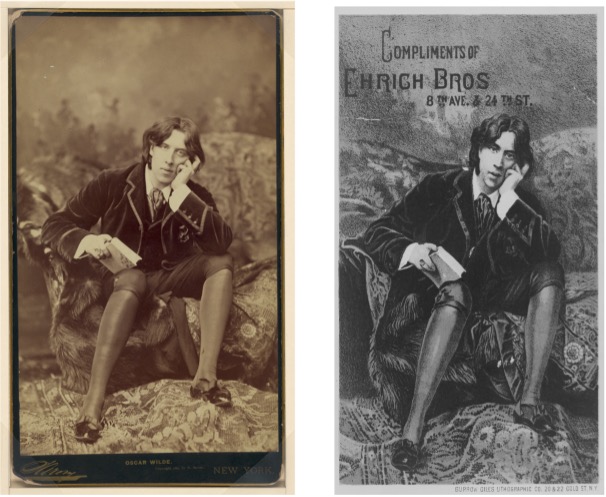
Image description: Left, a sepia-toned portrait of Oscar Wilde seated on an ornate chair, head resting on one hand, a book in the other. He wears a dark velvet jacket, knee-length breeches, stockings, and slippers, posed pensively against a patterned backdrop. Right, a black-and-white reproduction of the same. The patterned background and Wilde’s thoughtful expression are clearly visible.
Burrow-Giles Lithographic Co. v. Sarony, 111 U.S. 53 (1884)
Mr. Justice Miller delivered the opinion of the court
The constitutional question is not free from difficulty.
The eighth section of the first article of the Constitution is the great repository of the powers of Congress, and by the eighth clause of that section Congress is authorized:
To promote the progress of science and useful arts, by securing, for limited times to authors and inventors, the exclusive right to their respective writings and discoveries.
The argument here is, that a photograph is not a writing nor the production of an author. Under the acts of Congress designed to give effect to this section, the persons who are to be benefited are divided into two classes, authors and inventors. The monopoly which is granted to the former is called a copyright, that given to the latter, letters patent, or, in the familiar language of the present day, patent right.
We have, then, copyright and patent right, and it is the first of these under which plaintiff asserts a claim for relief.
It is insisted in argument, that a photograph being a reproduction on paper of the exact features of some natural object or of some person, is not a writing of which the producer is the author.
Section 4952 of the Revised Statutes places photographs in the same class as things which may be copyrighted with “books, maps, charts, dramatic or musical compositions, engravings, cuts, prints, paintings, drawings, statues, statuary, and models or designs intended to be perfected as works of the fine arts.” “According to the practice of legislation in England and America,” says Judge Bouvier, 2 Law Dictionary, 363, “the copyright is confined to the exclusive right secured to the author or proprietor of a writing or drawing which may be multiplied by the arts of printing in any of its branches.”
The first Congress of the United States, sitting immediately after the formation of the Constitution, enacted that the “author or authors of any map, chart, book or books, being a citizen or resident of the United States, shall have the sole right and liberty of printing, reprinting, publishing and vending the same for the period of fourteen years from the recording of the title thereof in the clerk’s office, as afterwards directed.” 1 Stat. 124, 1.
This statute not only makes maps and charts subjects of copyright, but mentions them before books in the order of designation. The second section of an act to amend this act, approved April 29, 1802, 2 Stat. 171, enacts that from the first day of January thereafter, he who shall invent and design, engrave, etch or work, or from his own works shall cause to be designed and engraved, etched or worked, any historical or other print or prints shall have the same exclusive right for the term of fourteen years from recording the title thereof as prescribed by law.
By the first section of the act of February 3d, 1831, 4 Stat. 436, entitled an act to amend the several acts respecting copyright, musical compositions and cuts, in connection with prints and engravings, are added, and the period of protection is extended to twenty-eight years. The caption or title of this act uses the word copyright for the first time in the legislation of Congress.
The construction placed upon the Constitution by the first act of 1790, and the act of 1802, by the men who were contemporary with its formation, many of whom were members of the convention which framed it, is of itself entitled to very great weight, and when it is remembered that the rights thus established have not been disputed during a period of nearly a century, it is almost conclusive.
Unless, therefore, photographs can be distinguished in the classification on this point from the maps, charts, designs, engravings, etchings, cuts, and other prints, it is difficult to see why Congress cannot make them the subject of copyright as well as the others.
These statutes certainly answer the objection that books only, or writing in the limited sense of a book and its author, are within the constitutional provision. Both these words are susceptible of a more enlarged definition than this. An author in that sense is “he to whom anything owes its origin; originator; maker; one who completes a work of science or literature.” Worcester. So, also, no one would now claim that the word writing in this clause of the Constitution, though the only word used as to subjects in regard to which authors are to be secured, is limited to the actual script of the author, and excludes books and all other printed matter. By writings in that clause is meant the literary productions of those authors, and Congress very properly has declared these to include all forms of writing, printing, engraving, etching, &c., by which the ideas in the mind of the author are given visible expression. The only reason why photographs were not included in the extended list in the act of 1802 is probably that they did not exist, as photography as an art was then unknown, and the scientific principle on which it rests, and the chemicals and machinery by which it is operated, have all been discovered long since that statute was enacted.
Nor is it to be supposed that the framers of the Constitution did not understand the nature of copyright and the objects to which it was commonly applied, for copyright, as the exclusive right of a man to the production of his own genius or intellect, existed in England at that time, and the contest in the English courts, finally decided by a very close vote in the House of Lords, whether the statute of 8 Anne, chap. 19, which authorized copyright for a limited time, was a restraint to that extent on the common law or not, was then recent. It had attracted much attention, as the judgment of the King’s Bench, delivered by Lord Mansfield, holding it was not such a restraint, in Millar v. Taylor, 4 Burrows, 2303, decided in 1769, was overruled on appeal in the House of Lords in 1774. Ibid. 2408. In this and other cases the whole question of the exclusive right to literary and intellectual productions had been freely discussed.
We entertain no doubt that the Constitution is broad enough to cover an act authorizing copyright of photographs, so far as they are representatives of original intellectual conceptions of the author.
But it is said that an engraving, a painting, a print, does embody the intellectual conception of its author, in which there is novelty, invention, originality, and therefore comes within the purpose of the Constitution in securing its exclusive use or sale to its author, while the photograph is the mere mechanical reproduction of the physical features or outlines of some object animate or inanimate, and involves no originality of thought or any novelty in the intellectual operation connected with its visible reproduction in shape of a picture. That while the effect of light on the prepared plate may have been a discovery in the production of these pictures, and patents could properly be obtained for the combination of the chemicals, for their application to the paper or other surface, for all the machinery by which the light reflected from the object was thrown on the prepared plate, and for all the improvements in this machinery, and in the materials, the remainder of the process is merely mechanical, with no place for novelty, invention or originality. It is simply the manual operation, by the use of these instruments and preparations, of transferring to the plate the visible representation of some existing object, the accuracy of this representation being its highest merit.
This may be true in regard to the ordinary production of a photograph, and, further, that in such case a copyright is no protection. On the question as thus stated we decide nothing.
In regard, however, to the kindred subject of patents for invention, they cannot by law be issued to the inventor until the novelty, the utility, and the actual discovery or invention by the claimant have been established by proof before the Commissioner of Patents; and when he has secured such a patent, and undertakes to obtain redress for a violation of his right in a court of law, the question of invention, of novelty, of originality, is always open to examination. Our copyright system has no such provision for previous examination by a proper tribunal as to the originality of the book, map, or other matter offered for copyright. A deposit of two copies of the article or work with the Librarian of Congress, with the name of the author and its title page, is all that is necessary to secure a copyright. It is, therefore, much more important that when the supposed author sues for a violation of his copyright, the existence of those facts of originality, of intellectual production, of thought, and conception on the part of the author should be proved, than in the case of a patent right.
In the case before us we think this has been done.
The third finding of facts says, in regard to the photograph in question, that it is a “useful, new, harmonious, characteristic, and graceful picture, and that plaintiff made the same ... entirely from his own original mental conception, to which he gave visible form by posing the said Oscar Wilde in front of the camera, selecting and arranging the costume, draperies, and other various accessories in said photograph, arranging the subject so as to present graceful outlines, arranging and disposing the light and shade, suggesting and evoking the desired expression, and from such disposition, arrangement, or representation, made entirely by plaintiff, he produced the picture in suit.”
These findings, we think, show this photograph to be an original work of art, the product of plaintiff’s intellectual invention, of which plaintiff is the author, and of a class of inventions for which the Constitution intended that Congress should secure to him the exclusive right to use, publish and sell, as it has done by section 4952 of the Revised Statutes.
The question here presented is one of first impression under our Constitution, but an instructive case of the same class is that of Nottage v. Jackson, 11 Q.B.D. 627, decided in that court on appeal, August, 1883.
The plaintiffs in that case described themselves as the authors of the photograph which was pirated, in the registration of it. It appeared that they had arranged with the captain of the Australian cricketers to take a photograph of the whole team in a group; and they sent one of the artists in their employ from London to some country town to do it.
The question in the case was whether the plaintiffs, who owned the establishment in London, where the photographs were made from the negative and were sold, and who had the negative taken by one of their men, were the authors, or the man who, for their benefit, took the negative. It was held that the latter was the author, and the action failed, because plaintiffs had described themselves as authors.
Brett, M.R., said, in regard to who was the author: “The nearest I can come to, is that it is the person who effectively is as near as he can be, the cause of the picture which is produced, that is, the person who has superintended the arrangement, who has actually formed the picture by putting the persons in position, and arranging the place where the people are to be — the man who is the effective cause of that.”
Lord Justice Cotton said: “In my opinion, ‘author’ involves originating, making, producing, as the inventive or master mind, the thing which is to be protected, whether it be a drawing, or a painting, or a photograph;” and Lord Justice Bowen says that photography is to be treated for the purposes of the act as an art, and the author is the man who really represents, creates, or gives effect to the idea, fancy, or imagination.
The appeal of plaintiffs from the original judgment against them was accordingly dismissed.
These views of the nature of authorship and of originality, intellectual creation, and right to protection confirm what we have already said.
The judgment of the Circuit Court is accordingly affirmed.
Notes and questions
(1) In Burrow-Giles Lithographic Co. v. Sarony, 111 U.S. 53 (1884) the Supreme Court held:
By writings in that clause is meant the literary productions of those authors, and Congress very properly has declared these to include all forms of writing, printing, engraving, etching, &c., by which the ideas in the mind of the author are given visible expression.
The Court thus concluded that the term “writing” in the Copyright Clause of the U.S. Constitution was broad enough to include photographs “so far as they are representatives of original intellectual conceptions of the author.” The Court also noted that:
The only reason why photographs were not included in the extended list in the act of 1802 is probably that they did not exist, as photography as an art was then unknown, and the scientific principle on which it rests, and the chemicals and machinery by which it is operated, have all been discovered long since that statute was enacted.
(2) What made the photo in dispute in this case the representation of “original intellectual conceptions of the author”? Do the references to the English cases help you answer this question? How does this apply to a photo you might take on your smartphone? Are there any circumstances where a photo would not be copyrightable?
Other Significant Pre-Feist Cases
Bleistein v. Donaldson Lithographing Co., 188 U.S. 239 (1903)
Justice Holmes delivered the opinion of the court
This case comes here from the United States Circuit Court of Appeals for the Sixth Circuit by writ of error. It is an action brought by the plaintiffs in error to recover the penalties prescribed for infringements of copyrights. The alleged infringements consisted in the copying in reduced form of three chromolithographs prepared by employees of the plaintiffs for advertisements of a circus owned by one Wallace. Each of the three contained a portrait of Wallace in the corner and lettering bearing some slight relation to the scheme of decoration, indicating the subject of the design and the fact that the reality was to be seen at the circus. One of the designs was of an ordinary ballet, one of a number of men and women, described as the Stirk family, performing on bicycles, and one of groups of men and women whitened to represent statues. The Circuit Court directed a verdict for the defendant on the ground that the chromolithographs were not within the protection of the copyright law, and this ruling was sustained by the Circuit Court of Appeals.
We shall do no more than mention the suggestion that painting and engraving unless for a mechanical end are not among the useful arts, the progress of which Congress is empowered by the Constitution to promote. The Constitution does not limit the useful to that which satisfies immediate bodily needs. Burrow-Giles Lithographic Co. v. Sarony, 111 U.S. 53. It is obvious also that the plaintiffs’ case is not affected by the fact, if it be one, that the pictures represent actual groups — visible things. They seem from the testimony to have been composed from hints or description, not from sight of a performance. But even if they had been drawn from the life, that fact would not deprive them of protection. The opposite proposition would mean that a portrait by Velasquez or Whistler was common property because others might try their hand on the same face. Others are free to copy the original. They are not free to copy the copy. The copy is the personal reaction of an individual upon nature. Personality always contains something unique. It expresses its singularity even in handwriting, and a very modest grade of art has in it something irreducible, which is one man’s alone. That something he may copyright unless there is a restriction in the words of the act.
If there is a restriction it is not to be found in the limited pretensions of these particular works. The least pretentious picture has more originality in it than directories and the like, which may be copyrighted. The amount of training required for humbler efforts than those before us is well indicated by Ruskin. “If any young person, after being taught what is, in polite circles, called ‘drawing,’ will try to copy the commonest piece of real work, — suppose a lithograph on the title page of a new opera air, or a woodcut in the cheapest illustrated newspaper of the day — they will find themselves entirely beaten.” Elements of Drawing, 1st ed. 3.
We assume that the construction of Rev. Stat. § 4952, allowing a copyright to the “author, inventor, designer, or proprietor … of any engraving, cut, print . . . [or] chromo” is affected by the act of 1874, c. 301, § 3. That section provides that “in the construction of this act the words ‘engraving,’ ‘cut’ and ‘print’ shall be applied only to pictorial illustrations or works connected with the fine arts.” We see no reason for taking the words “connected with the fine arts” as qualifying anything except the word “works,” but it would not change our decision if we should assume further that they also qualified “pictorial illustrations,” as the defendant contends.
These chromolithographs are “pictorial illustrations.” The word “illustrations” does not mean that they must illustrate the text of a book, and that the etchings of Rembrandt or Steinla’s engraving of the Madonna di San Sisto could not be protected to-day if any man were able to produce them. Again, the act however construed, does not mean that ordinary posters are not good enough to be considered within its scope. The antithesis to “illustrations or works connected with the fine arts” is not works of little merit or of humble degree, or illustrations addressed to the less educated classes; it is “prints or labels designed to be used for any other articles of manufacture.” Certainly works are not the less connected with the fine arts because their pictorial quality attracts the crowd and therefore gives them a real use — if use means to increase trade and to help to make money. A picture is none the less a picture and none the less a subject of copyright that it is used for an advertisement. And if pictures may be used to advertise soap, or the theatre, or monthly magazines, as they are, they may be used to advertise a circus. Of course, the ballet is as legitimate a subject for illustration as any other. A rule cannot be laid down that would excommunicate the paintings of Degas.
Finally, the special adaptation of these pictures to the advertisement of the Wallace shows does not prevent a copyright. That may be a circumstance for the jury to consider in determining the extent of Mr. Wallace’s rights, but it is not a bar. Moreover, on the evidence, such prints are used by less pretentious exhibitions when those for whom they were prepared have given them up.
It would be a dangerous undertaking for persons trained only to the law to constitute themselves final judges of the worth of pictorial illustrations, outside of the narrowest and most obvious limits. At the one extreme some works of genius would be sure to miss appreciation. Their very novelty would make them repulsive until the public had learned the new language in which their author spoke. It may be more than doubted, for instance, whether the etchings of Goya or the paintings of Manet would have been sure of protection when seen for the first time. At the other end, copyright would be denied to pictures which appealed to a public less educated than the judge. Yet if they command the interest of any public, they have a commercial value — it would be bold to say that they have not an aesthetic and educational value — and the taste of any public is not to be treated with contempt. It is an ultimate fact for the moment, whatever may be our hopes for a change. That these pictures had their worth and their success is sufficiently shown by the desire to reproduce them without regard to the plaintiffs’ rights. We are of opinion that there was evidence that the plaintiffs have rights entitled to the protection of the law.
The judgment of the Circuit Court of Appeals is reversed; the judgment of the Circuit Court is also reversed and the cause remanded to that court with directions to set aside the verdict and grant a new trial.
Justice Harlan, with whom concurred Justice McKenna, dissenting.
Judges Lurton, Day and Severens, of the Circuit Court of Appeals, concurred in affirming the judgment of the District Court. Their views were thus expressed in an opinion delivered by Judge Lurton: “What we hold is this: That if a chromo, lithograph, or other print, engraving, or picture has no other use than that of a mere advertisement, and no value aside from this function, it would not be promotive of the useful arts, within the meaning of the constitutional provision, to protect the ‘author’ in the exclusive use thereof, and the copyright statute should not be construed as including such a publication, if any other construction is admissible. If a mere label simply designating or describing an article to which it is attached, and which has no value separated from the article, does not come within the constitutional clause upon the subject of copyright, it must follow that a pictorial illustration designed and useful only as an advertisement, and having no intrinsic value other than its function as an advertisement, must be equally without the obvious meaning of the Constitution. It must have some connection with the fine arts to give it intrinsic value, and that it shall have is the meaning which we attach to the act of June 18, 1874, amending the provisions of the copyright law. We are unable to discover anything useful or meritorious in the design copyrighted by the plaintiffs in error other than as an advertisement of acts to be done or exhibited to the public in Wallace’s show. No evidence, aside from the deductions which are to be drawn from the prints themselves, was offered to show that these designs had any original artistic qualities.”
I entirely concur in these views, and therefore dissent from the opinion and judgment of this court. The clause of the Constitution giving Congress power to promote the progress of science and useful arts, by securing for limited terms to authors and inventors the exclusive right to their respective works and discoveries, does not, as I think, embrace a mere advertisement of a circus.
Notes and questions
(1) Bleistein v. Donaldson Lithographing Co., 188 U.S. 239 (1903) is an important case to come to terms with when addressing the concept of originality and understanding the Constitutional limits on copyright subject matter more generally. The case concerned the unauthorized reproduction of a circus poster, pictured below.
Bleistein v. Donaldson Circus Poster
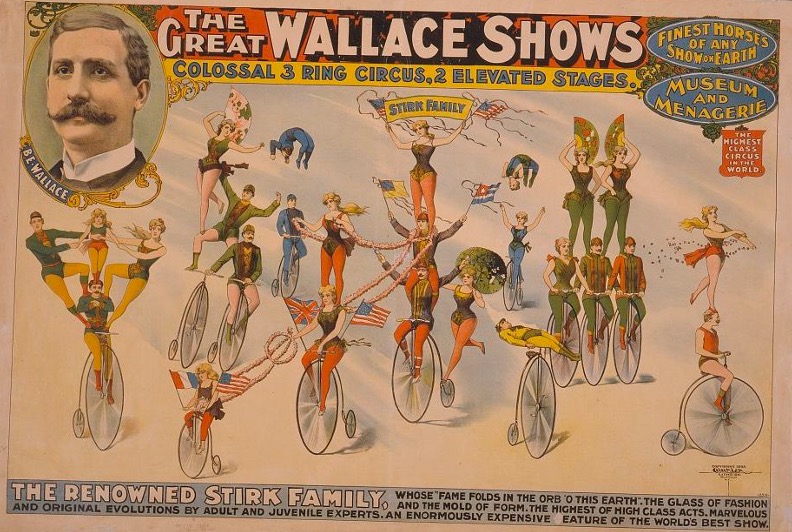
Image description: Colorful vintage circus poster for “The Great Wallace Shows,” featuring the Stirk Family performing elaborate balancing acts on unicycles. Acrobats in bright costumes form human pyramids, wave flags, and jump through hoops.
The defendant’s primary argument was that the kind of low art represented in the poster and its use in advertising meant that it was not the kind of fine art to which the Copyright Act was directed. In the course of rejecting this argument Justice Holmes articulated the now famous Bleistein “anti-discrimination” principle. Justice Holmes warns that copyright should not be reserved for works deemed to have a particular importance or quality, or indeed social value, because these artistic judgments are beyond the institutional competence of the courts.
It would be a dangerous undertaking for persons trained only to the law to constitute themselves final judges of the worth of pictorial illustrations, outside of the narrowest and most obvious limits. At the one extreme some works of genius would be sure to miss appreciation. Their very novelty would make them repulsive until the public had learned the new language in which their author spoke. It may be more than doubted, for instance, whether the etchings of Goya or the paintings of Manet would have been sure of protection when seen for the first time. At the other end, copyright would be denied to pictures which appealed to a public less educated than the judge.
(2) In a 2017 article in the Columbia Law Review, Bleistein, The Problem Of Aesthetic Progress, And The Making Of American Copyright Law, Barton Beebe argues that when Holmes declared that judges should refrain from judging aesthetic merit he was not speaking to the standard of originality, but rather to the dissent’s view that a work that has “no other use than that of a mere advertisement” did not qualify for copyright protection because it did not “promote the progress of” knowledge as required by the Constitution. What are the implications of this argument?
(3) The majority opinion argues that “the least pretentious picture has more originality in it than directories and the like, which may be copyrighted.” It cites a leading copyright treatise of the day and caselaw for that proposition, but as discussed further below, most directories and the like are not in fact copyrightable. See Feist Publications, Inc. v. Rural Telephone Service Co., 499 U.S. 340 (1991).
Alfred Bell & Co., Ltd. v. Catalda Fine Arts, Inc., 191 F.2d 99 (2d Cir. 1951)
Circuit Judge Frank
[Alfred Bell & Co was a British print producer and dealer that had secured United States copyrights in eight mezzotint engravings of certain paintings in the public domain. The plaintiff brought an action against a dealer in lithographs that produced and sold color lithographs of the eight mezzotints.
Although patents and copyrights stem from the same constitutional clause, the Constitution expressly distinguishes “authors” and their “writings” from “inventors” and their “discoveries.” Consequently, the strict novelty and inventiveness requirements applied to patents do not apply to copyrights. Historical practice—both pre-constitutional state laws and early federal statutes—shows that works like books, maps, and charts were protected without demanding patent-level originality. Reflecting this distinction, the first Congress enacted separate 1790 statutes: patents required demonstrated novelty, usefulness, and detailed specification, while copyrights simply covered maps, charts, and books with registration and deposit formalities. Congress broadened this copyright category in 1802 to include engravings, etchings, and prints.]
Thus legislators peculiarly familiar with the purpose of the Constitutional grant, by statute, imposed far less exacting standards in the case of copyrights. They authorized the copyrighting of a mere map which, patently, calls for no considerable uniqueness. They exacted far more from an inventor. And, while they demanded that an official should be satisfied as to the character of an invention before a patent issued, they made no such demand in respect of a copyright. … Accordingly, the Constitution, as so interpreted, recognizes that the standards for patents and copyrights are basically different.
“Original” in reference to a copyrighted work means that the particular work “owes its origin” to the “author.”(Burrow-Giles Lithographic Co. v. Sarony, 111 U.S. 53, 57-58) No large measure of novelty is necessary.
It is clear, then, that nothing in the Constitution commands that copyrighted matter be strikingly unique or novel. Accordingly, we were not ignoring the Constitution when we stated that a “copy of something in the public domain” will support a copyright if it is a “distinguishable variation”; or when we rejected the contention that “like a patent, a copyrighted work must be not only original, but new”, adding, “That is not the law as is obvious in the case of maps or compendia, where later works will necessarily be anticipated.”(Sheldon v. Metro-Goldwyn Pictures Corp., 2 Cir., 81 F.2d 49, 53.) All that is needed to satisfy both the Constitution and the statute is that the “author” contributed something more than a “merely trivial” variation, something recognizably “his own.” Originality in this context “means little more than a prohibition of actual copying.” No matter how poor artistically the “author’s” addition, it is enough if it be his own. Bleistein v. Donaldson Lithographing Co., 188 U.S. 239, 250.
On that account, we have often distinguished between the limited protection accorded a copyright owner and the extensive protection granted a patent owner. So we have held that “independent reproduction of a copyrighted work is not infringement”, (Arnstein v. Edward B. Marks Music Corp., 2 Cir., 82 F.2d 275) whereas it is vis a vis a patent. Correlative with the greater immunity of a patentee is the doctrine of anticipation which does not apply to copyrights: The alleged inventor is chargeable with full knowledge of all the prior art, although in fact he may be utterly ignorant of it. The “author” is entitled to a copyright if he independently contrived a work completely identical with what went before; similarly, although he obtains a valid copyright, he has no right to prevent another from publishing a work identical with his, if not copied from his. A patentee, unlike a copyrightee, must not merely produce something “original”; he must also be “the first inventor or discoverer.” “Hence it is possible to have a plurality of valid copyrights directed to closely identical or even identical works. Moreover, none of them, if independently arrived at without copying, will constitute an infringement of the copyright of the others.”
We consider untenable defendants’ suggestion that plaintiff’s mezzotints could not validly be copyrighted because they are reproductions of works in the public domain. Not only does the Act include “Reproductions of a work of art”, but — while prohibiting a copyright of “the original text of any work … in the public domain” — it explicitly provides for the copyrighting of “translations, or other versions of works in the public domain”.
The mezzotints were such “versions.” They “originated” with those who made them, and — on the trial judge’s findings well supported by the evidence — amply met the standards imposed by the Constitution and the statute. There is evidence that they were not intended to, and did not, imitate the paintings they reproduced. But even if their substantial departures from the paintings were inadvertent, the copyrights would be valid. A copyist’s bad eyesight or defective musculature, or a shock caused by a clap of thunder, may yield sufficiently distinguishable variations. Having hit upon such a variation unintentionally, the “author” may adopt it as his and copyright it.
Accordingly, defendants’ arguments about the public domain become irrelevant. They could be relevant only in their bearing on the issue of infringement, i.e., whether the defendants copied the mezzotints. But on the findings, again well grounded in the evidence, we see no possible doubt that defendants, who did deliberately copy the mezzotints, are infringers. For a copyright confers the exclusive right to copy the copyrighted work — a right not to have others copy it.
Notes and questions
(1) A mezzotint is a printmaking process involving roughening a metal plate with thousands of small dots pressed into a metal plate. The dots retain the ink when the face of the plate is wiped clean. The mezzotint process can be combined with other similar techniques, such as etching and engraving. The process was widely used in England from the eighteenth century to reproduce portraits and other paintings, but is not common today.
Thomas Gainsborough’s painting The Blue Boy (left) Mezzotint (right)
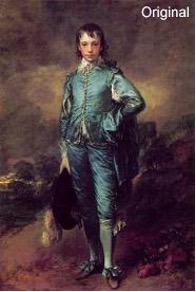
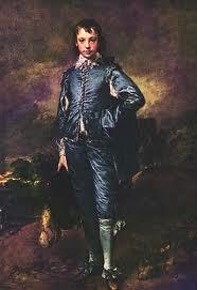
Image description: Classic portrait of a young boy standing outdoors, dressed in an elaborate blue satin outfit with lace trim. He holds a black hat in one hand and gazes directly at the viewer. The background features a dark, moody landscape with clouds and muted foliage. The second version has deeper, more saturated colors, especially in the blues and background, giving it a higher-contrast, more vivid appearance.
(2) According to the Second Circuit in Alfred Bell & Co. v. Catalda Fine Arts, what features of the mezzotints made them sufficiently “original” to qualify for copyright protection, and why did the court consider even inadvertent variations to be legally significant?
(3) The distinction between originality and novelty was not new to this case. In Sheldon v. Metro-Goldwyn Pictures Corp., 81 F.2d 49 (2d Cir. 1936) Judge Learned Hand invokes a vivid, if implausible hypothetical to illustrate the distinction. He said:
… if by some magic a man who had never known it were to compose anew Keats’s Ode on a Grecian Urn, he would be an ‘author,’ and, if he copyrighted it, others might not copy that poem, though they might of course copy Keats’s.
See also Fred Fisher, Inc. v. Dillingham, D.C., 298 F. 145 (S.D.N.Y. 1924).
Authorship and Originality in Feist v. Rural Telephone
The cases addressed so far indicate a fairly relaxed standard of originality or creativity. In Burrow-Giles, a photograph was held to be sufficiently creative because, although the image was reduced to material form by a mechanical process, the photographer executing that process had made important creative and artistic choices with respect to lighting, shade and composition. In Bleistein v. Donaldson Lithographing, Justice Holmes forcefully stated that copyrightability is not a judgment of aesthetic or social value. Low art deployed for commercial purposes merits the same degree of copyright protection as artistic works of genius. In Alfred Bell, the Second Circuit held that even a mezzotint reproduction of a work in the public domain was entitled to copyright protection because, in the course of translating the work to a new medium, the artist could not help but create a distinguishable variation.
In light of these cases, is there anything that would not be sufficiently creative to merit copyright protection? The Supreme Court answered this question in the case that follows.
Rural Telephone Service Phone Books in Feist
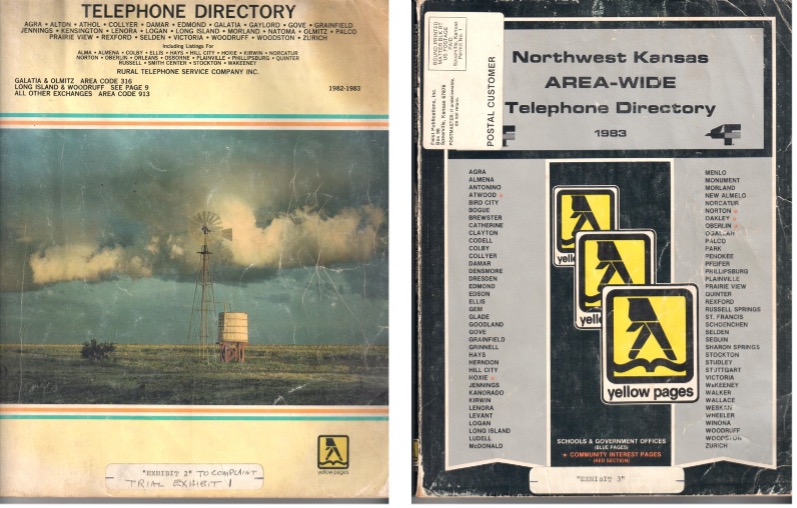
Image description: Side-by-side covers of vintage telephone directories.
Feist Publications, Inc. v. Rural Telephone Service Co., 499 U.S. 340 (1991)
Justice O’Connor delivered the opinion of the Court.
This case requires us to clarify the extent of copyright protection available to telephone directory white pages.
I
Rural Telephone Service Company, Inc., is a certified public utility that provides telephone service to several communities in northwest Kansas. It is subject to a state regulation that requires all telephone companies operating in Kansas to issue annually an updated telephone directory. Accordingly, as a condition of its monopoly franchise, Rural publishes a typical telephone directory, consisting of white pages and yellow pages. The white pages list in alphabetical order the names of Rural’s subscribers, together with their towns and telephone numbers. The yellow pages list Rural’s business subscribers alphabetically by category and feature classified advertisements of various sizes. Rural distributes its directory free of charge to its subscribers, but earns revenue by selling yellow pages advertisements.
Feist Publications, Inc., is a publishing company that specializes in area-wide telephone directories. Unlike a typical directory, which covers only a particular calling area, Feist’s area-wide directories cover a much larger geographical range, reducing the need to call directory assistance or consult multiple directories. The Feist directory that is the subject of this litigation covers 11 different telephone service areas in 15 counties and contains 46,878 white pages listings—compared to Rural’s approximately 7,700 listings. Like Rural’s directory, Feist’s is distributed free of charge and includes both white pages and yellow pages. Feist and Rural compete vigorously for yellow pages advertising.
As the sole provider of telephone service in its service area, Rural obtains subscriber information quite easily. Persons desiring telephone service must apply to Rural and provide their names and addresses; Rural then assigns them a telephone number. Feist is not a telephone company, let alone one with monopoly status, and therefore lacks independent access to any subscriber information. To obtain white pages listings for its area-wide directory, Feist approached each of the 11 telephone companies operating in northwest Kansas and offered to pay for the right to use its white pages listings.
Of the 11 telephone companies, only Rural refused to license its listings to Feist. Rural’s refusal created a problem for Feist, as omitting these listings would have left a gaping hole in its area-wide directory, rendering it less attractive to potential yellow pages advertisers. In a decision subsequent to that which we review here, the District Court determined that this was precisely the reason Rural refused to license its listings. The refusal was motivated by an unlawful purpose “to extend its monopoly in telephone service to a monopoly in yellow pages advertising.” Rural Telephone Service Co. v. Feist Publications, Inc., 737 F. Supp. 610, 622 (Kan. 1990).
Unable to license Rural’s white pages listings, Feist used them without Rural’s consent. Feist began by removing several thousand listings that fell outside the geographic range of its area-wide directory, then hired personnel to investigate the 4,935 that remained. These employees verified the data reported by Rural and sought to obtain additional information. As a result, a typical Feist listing includes the individual’s street address; most of Rural’s listings do not. Notwithstanding these additions, however, 1,309 of the 46,878 listings in Feist’s 1983 directory were identical to listings in Rural’s 1982-1983 white pages. Four of these were fictitious listings that Rural had inserted into its directory to detect copying.
Rural sued for copyright infringement in the District Court for the District of Kansas taking the position that Feist, in compiling its own directory, could not use the information contained in Rural’s white pages. Rural asserted that Feist’s employees were obliged to travel door-to-door or conduct a telephone survey to discover the same information for themselves. Feist responded that such efforts were economically impractical and, in any event, unnecessary because the information copied was beyond the scope of copyright protection. The District Court granted summary judgment to Rural, explaining that “courts have consistently held that telephone directories are copyrightable” and citing a string of lower court decisions. In an unpublished opinion, the Court of Appeals for the Tenth Circuit affirmed “for substantially the reasons given by the district court.” We granted certiorari, to determine whether the copyright in Rural’s directory protects the names, towns, and telephone numbers copied by Feist.
II
A
This case concerns the interaction of two well-established propositions. The first is that facts are not copyrightable; the other, that compilations of facts generally are. Each of these propositions possesses an impeccable pedigree. That there can be no valid copyright in facts is universally understood. The most fundamental axiom of copyright law is that “no author may copyright his ideas or the facts he narrates.” Harper & Row, Publishers, Inc. v. Nation Enterprises, 471 U. S. 539, 556 (1985). Rural wisely concedes this point, noting in its brief that “facts and discoveries, of course, are not themselves subject to copyright protection.” At the same time, however, it is beyond dispute that compilations of facts are within the subject matter of copyright. Compilations were expressly mentioned in the Copyright Act of 1909, and again in the Copyright Act of 1976.
There is an undeniable tension between these two propositions. Many compilations consist of nothing but raw data— i.e., wholly factual information not accompanied by any original written expression. On what basis may one claim a copyright in such a work? Common sense tells us that 100 uncopyrightable facts do not magically change their status when gathered together in one place. Yet copyright law seems to contemplate that compilations that consist exclusively of facts are potentially within its scope.
The key to resolving the tension lies in understanding why facts are not copyrightable. The sine qua non of copyright is originality. To qualify for copyright protection, a work must be original to the author. Original, as the term is used in copyright, means only that the work was independently created by the author (as opposed to copied from other works), and that it possesses at least some minimal degree of creativity. To be sure, the requisite level of creativity is extremely low; even a slight amount will suffice. The vast majority of works make the grade quite easily, as they possess some creative spark, “no matter how crude, humble or obvious” it might be. Originality does not signify novelty; a work may be original even though it closely resembles other works so long as the similarity is fortuitous, not the result of copying. To illustrate, assume that two poets, each ignorant of the other, compose identical poems. Neither work is novel, yet both are original and, hence, copyrightable. See Sheldon v. Metro-Goldwyn Pictures Corp., 81 F. 2d 49, 54 (CA2 1936).
Originality is a constitutional requirement. The source of Congress’ power to enact copyright laws is Article I, § 8, cl. 8, of the Constitution, which authorizes Congress to “secur[e] for limited Times to Authors . . . the exclusive Right to their respective Writings.” In two decisions from the late 19th century—The Trade-Mark Cases, 100 U. S. 82 (1879); and Burrow-Giles Lithographic Co. v. Sarony, 111 U.S. 53 (1884)—this Court defined the crucial terms “authors” and “writings.” In so doing, the Court made it unmistakably clear that these terms presuppose a degree of originality.
In The Trade-Mark Cases, the Court addressed the constitutional scope of “writings.” For a particular work to be classified “under the head of writings of authors,” the Court determined, “originality is required.” 100 U.S., at 94. The Court explained that originality requires independent creation plus a modicum of creativity: “While the word writings may be liberally construed, as it has been, to include original designs for engraving, prints, &c., it is only such as are original, and are founded in the creative powers of the mind. The writings which are to be protected are the fruits of intellectual labor, embodied in the form of books, prints, engravings, and the like.” Ibid. (emphasis in original).
In Burrow-Giles, the Court distilled the same requirement from the Constitution’s use of the word “authors.” The Court defined “author,” in a constitutional sense, to mean “he to whom anything owes its origin; originator; maker.” As in The Trade-Mark Cases, the Court emphasized the creative component of originality. It described copyright as being limited to “original intellectual conceptions of the author,”, and stressed the importance of requiring an author who accuses another of infringement to prove “the existence of those facts of originality, of intellectual production, of thought, and conception.”
The originality requirement articulated in The Trade-Mark Cases and Burrow-Giles remains the touchstone of copyright protection today. It is the very “premise of copyright law.” Miller v. Universal City Studios, Inc., 650 F. 2d 1365, 1368 (CA5 1981). Leading scholars agree on this point. As one pair of commentators succinctly puts it: “The originality requirement is constitutionally mandated for all works.” Patterson & Joyce, Monopolizing the Law: The Scope of Copyright Protection for Law Reports and Statutory Compilations, 36 UCLA Law Review 719, 763, n. 155 (1989) (emphasis in original). Accord, Nimmer (“originality is a statutory as well as a constitutional requirement”); (“a modicum of intellectual labor . . . clearly constitutes an essential constitutional element”).
It is this bedrock principle of copyright that mandates the law’s seemingly disparate treatment of facts and factual compilations. “No one may claim originality as to facts.” This is because facts do not owe their origin to an act of authorship. The distinction is one between creation and discovery: The first person to find and report a particular fact has not created the fact; he or she has merely discovered its existence. To borrow from Burrow-Giles, one who discovers a fact is not its “maker” or “originator.” The discoverer merely finds and records. Census takers, for example, do not “create” the population figures that emerge from their efforts; in a sense, they copy these figures from the world around them. Census data therefore do not trigger copyright because these data are not “original” in the constitutional sense. The same is true of all facts—scientific, historical, biographical, and news of the day. “[T]hey may not be copyrighted and are part of the public domain available to every person.” Miller, supra, at 1369.
Factual compilations, on the other hand, may possess the requisite originality. The compilation author typically chooses which facts to include, in what order to place them, and how to arrange the collected data so that they may be used effectively by readers. These choices as to selection and arrangement, so long as they are made independently by the compiler and entail a minimal degree of creativity, are sufficiently original that Congress may protect such compilations through the copyright laws. Thus, even a directory that contains absolutely no protectible written expression, only facts, meets the constitutional minimum for copyright protection if it features an original selection or arrangement.
This protection is subject to an important limitation. The mere fact that a work is copyrighted does not mean that every element of the work may be protected. Originality remains the sine qua non of copyright; accordingly, copyright protection may extend only to those components of a work that are original to the author. Thus, if the compilation author clothes facts with an original collocation of words, he or she may be able to claim a copyright in this written expression. Others may copy the underlying facts from the publication, but not the precise words used to present them. In Harper & Row, for example, we explained that President Ford could not prevent others from copying bare historical facts from his autobiography, but that he could prevent others from copying his “subjective descriptions and portraits of public figures.” Where the compilation author adds no written expression but rather lets the facts speak for themselves, the expressive element is more elusive. The only conceivable expression is the manner in which the compiler has selected and arranged the facts. Thus, if the selection and arrangement are original, these elements of the work are eligible for copyright protection. No matter how original the format, however, the facts themselves do not become original through association.
This inevitably means that the copyright in a factual compilation is thin. Notwithstanding a valid copyright, a subsequent compiler remains free to use the facts contained in another’s publication to aid in preparing a competing work, so long as the competing work does not feature the same selection and arrangement. As one commentator explains it: “No matter how much original authorship the work displays, the facts and ideas it exposes are free for the taking. … The very same facts and ideas may be divorced from the context imposed by the author, and restated or reshuffled by second comers, even if the author was the first to discover the facts or to propose the ideas.” Ginsburg 1868.
It may seem unfair that much of the fruit of the compiler’s labor may be used by others without compensation. As Justice Brennan has correctly observed, however, this is not “some unforeseen byproduct of a statutory scheme.” Harper & Row, 471 U.S., at 589 (dissenting opinion). It is, rather, “the essence of copyright,” and a constitutional requirement. The primary objective of copyright is not to reward the labor of authors, but “[t]o promote the Progress of Science and useful Arts.” Art. I, § 8, cl. 8. Accord, Twentieth Century Music Corp. v. Aiken, 422 U.S. 151, 156 (1975). To this end, copyright assures authors the right to their original expression, but encourages others to build freely upon the ideas and information conveyed by a work. This principle, known as the idea/expression or fact/expression dichotomy, applies to all works of authorship. As applied to a factual compilation, assuming the absence of original written expression, only the compiler’s selection and arrangement may be protected; the raw facts may be copied at will. This result is neither unfair nor unfortunate. It is the means by which copyright advances the progress of science and art.
This Court has long recognized that the fact/expression dichotomy limits severely the scope of protection in fact-based works. More than a century ago, the Court observed: “The very object of publishing a book on science or the useful arts is to communicate to the world the useful knowledge which it contains. But this object would be frustrated if the knowledge could not be used without incurring the guilt of piracy of the book.” Baker v. Selden, 101 U.S. 99, 103 (1880). We reiterated this point in Harper & Row:
“No author may copyright facts or ideas. The copyright is limited to those aspects of the work—termed ‘expression’—that display the stamp of the author’s originality.
“Copyright does not prevent subsequent users from copying from a prior author’s work those constituent elements that are not original—for example . . . facts, or materials in the public domain—as long as such use does not unfairly appropriate the author’s original contributions.” 471 U.S., at 547-548 (citation omitted).
This, then, resolves the doctrinal tension: Copyright treats facts and factual compilations in a wholly consistent manner. Facts, whether alone or as part of a compilation, are not original and therefore may not be copyrighted. A factual compilation is eligible for copyright if it features an original selection or arrangement of facts, but the copyright is limited to the particular selection or arrangement. In no event may copyright extend to the facts themselves.
B
As we have explained, originality is a constitutionally mandated prerequisite for copyright protection. The Court’s decisions announcing this rule predate the Copyright Act of 1909, but ambiguous language in the 1909 Act caused some lower courts temporarily to lose sight of this requirement.
The 1909 Act embodied the originality requirement, but not as clearly as it might have. The subject matter of copyright was set out in §§ 3 and 4 of the Act. Section 4 stated that copyright was available to “all the writings of an author.” By using the words “writings” and “author”—the same words used in Article I, § 8, of the Constitution and defined by the Court in The Trade-Mark Cases and Burrow-Giles—the statute necessarily incorporated the originality requirement articulated in the Court’s decisions. It did so implicitly, however, thereby leaving room for error.
Section 3 was similarly ambiguous. It stated that the copyright in a work protected only “the copyrightable component parts of the work.” It thus stated an important copyright principle, but failed to identify the specific characteristic—originality—that determined which component parts of a work were copyrightable and which were not.
Most courts construed the 1909 Act correctly, notwithstanding the less-than-perfect statutory language. They understood from this Court’s decisions that there could be no copyright without originality. As explained in the Nimmer treatise:
“The 1909 Act neither defined originality, nor even expressly required that a work be ‘original’ in order to command protection. However, the courts uniformly inferred the requirement from the fact that copyright protection may only be claimed by ‘authors’. . . . It was reasoned that since an author is ‘the … creator, originator’ it follows that a work is not the product of an author unless the work is original.” Nimmer § 2.01.
But some courts misunderstood the statute. See, e.g., Leon v. Pacific Telephone & Telegraph Co., 91 F. 2d 484 (CA9 1937); Jeweler’s Circular Publishing Co. v. Keystone Publishing Co., 281 F. 83 (CA2 1922). These courts ignored §§ 3 and 4, focusing their attention instead on § 5 of the Act. Section 5, however, was purely technical in nature: It provided that a person seeking to register a work should indicate on the application the type of work, and it listed 14 categories under which the work might fall. One of these categories was “books, including composite and cyclopædic works, directories, gazetteers, and other compilations.” § 5(a). Section 5 did not purport to say that all compilations were automatically copyrightable. Indeed, it expressly disclaimed any such function, pointing out that “the subject-matter of copyright is defined in section four.” Nevertheless, the fact that factual compilations were mentioned specifically in § 5 led some courts to infer erroneously that directories and the like were copyrightable per se, without any further or precise showing of original—personal—authorship.
Making matters worse, these courts developed a new theory to justify the protection of factual compilations. Known alternatively as “sweat of the brow” or “industrious collection,” the underlying notion was that copyright was a reward for the hard work that went into compiling facts. The classic formulation of the doctrine appeared in Jeweler’s Circular Publishing Co., 281 F., at 88:
“The right to copyright a book upon which one has expended labor in its preparation does not depend upon whether the materials which he has collected consist or not of matters which are publici juris, or whether such materials show literary skill or originality, either in thought or in language, or anything more than industrious collection. The man who goes through the streets of a town and puts down the names of each of the inhabitants, with their occupations and their street number, acquires material of which he is the author” (emphasis added).
The “sweat of the brow” doctrine had numerous flaws, the most glaring being that it extended copyright protection in a compilation beyond selection and arrangement—the compiler’s original contributions—to the facts themselves. Under the doctrine, the only defense to infringement was independent creation. A subsequent compiler was “not entitled to take one word of information previously published,” but rather had to “independently work out the matter for himself, so as to arrive at the same result from the same common sources of information.” Id., at 88-89 (internal quotation marks omitted). “Sweat of the brow” courts thereby eschewed the most fundamental axiom of copyright law—that no one may copyright facts or ideas.
…
Decisions of this Court applying the 1909 Act make clear that the statute did not permit the “sweat of the brow” approach. The best example is International News Service v. Associated Press, 248 U.S. 215 (1918). In that decision, the Court stated unambiguously that the 1909 Act conferred copyright protection only on those elements of a work that were original to the author. International News Service had conceded taking news reported by Associated Press and publishing it in its own newspapers. Recognizing that § 5 of the Act specifically mentioned “‘periodicals, including newspapers,’” § 5(b), the Court acknowledged that news articles were copyrightable. It flatly rejected, however, the notion that the copyright in an article extended to the factual information it contained: “The news element— the information respecting current events contained in the literary production—is not the creation of the writer, but is a report of matters that ordinarily are publici juris; it is the history of the day.”
Without a doubt, the “sweat of the brow” doctrine flouted basic copyright principles. Throughout history, copyright law has “recognized a greater need to disseminate factual works than works of fiction or fantasy.” Harper & Row, 471 U.S., at 563. But “sweat of the brow” courts took a contrary view; they handed out proprietary interests in facts and declared that authors are absolutely precluded from saving time and effort by relying upon the facts contained in prior works. In truth, “it is just such wasted effort that the proscription against the copyright of ideas and facts . . . [is] designed to prevent.” Rosemont Enterprises, Inc. v. Random House, Inc., 366 F. 2d 303, 310 (CA2 1966), cert. denied, 385 U.S. 1009 (1967). “Protection for the fruits of such research may in certain circumstances be available under a theory of unfair competition. But to accord copyright protection on this basis alone distorts basic copyright principles in that it creates a monopoly in public domain materials without the necessary justification of protecting and encouraging the creation of ‘writings’ by ‘authors.’” Nimmer § 3.04.
C
“Sweat of the brow” decisions did not escape the attention of the Copyright Office. When Congress decided to over-haul the copyright statute and asked the Copyright Office to study existing problems, see Mills Music, Inc. v. Snyder, 469 U.S. 153, 159 (1985), the Copyright Office promptly recommended that Congress clear up the confusion in the lower courts as to the basic standards of copyrightability. The Register of Copyrights explained in his first report to Congress that “originality” was a “basic requisite” of copyright under the 1909 Act, but that “the absence of any reference to [originality] in the statute seems to have led to misconceptions as to what is copyrightable matter.” Report of the Register of Copyrights on the General Revision of the U.S. Copyright Law, 87th Cong., 1st Sess., p. 9 (H. Judiciary Comm. Print 1961). The Register suggested making the originality requirement explicit. Ibid.
Congress took the Register’s advice. In enacting the Copyright Act of 1976, Congress dropped the reference to “all the writings of an author” and replaced it with the phrase “original works of authorship.” 17 U.S.C. § 102(a). In making explicit the originality requirement, Congress announced that it was merely clarifying existing law: “The two fundamental criteria of copyright protection [are] originality and fixation in tangible form . . . . The phrase ‘original works of authorship,’ which is purposely left undefined, is intended to incorporate without change the standard of originality established by the courts under the present [1909] copyright statute.” House Report p. 51 (1976) (emphasis added); Senate Report p. 50 (1975) (emphasis added). This sentiment was echoed by the Copyright Office: “Our intention here is to maintain the established standards of originality. . . .” Supplementary Report of the Register of Copyrights on the General Revision of U.S. Copyright Law, 89th Cong., 1st Sess., pt. 6, p. 3 (H. Judiciary Comm. Print 1965) (emphasis added).
To ensure that the mistakes of the “sweat of the brow” courts would not be repeated, Congress took additional measures. For example, § 3 of the 1909 Act had stated that copyright protected only the “copyrightable component parts” of a work, but had not identified originality as the basis for distinguishing those component parts that were copyrightable from those that were not. The 1976 Act deleted this section and replaced it with § 102(b), which identifies specifically those elements of a work for which copyright is not available: “In no case does copyright protection for an original work of authorship extend to any idea, procedure, process, system, method of operation, concept, principle, or discovery, regardless of the form in which it is described, explained, illustrated, or embodied in such work.” Section 102(b) is universally understood to prohibit any copyright in facts. As with § 102(a), Congress emphasized that § 102(b) did not change the law, but merely clarified it: “Section 102(b) in no way enlarges or contracts the scope of copyright protection under the present law. Its purpose is to restate . . . that the basic dichotomy between expression and idea remains unchanged.” House Report at 57; Senate Report at 54.
Congress took another step to minimize confusion by deleting the specific mention of “directories . . . and other compilations” in § 5 of the 1909 Act. As mentioned, this section had led some courts to conclude that directories were copyrightable per se and that every element of a directory was protected. In its place, Congress enacted two new provisions. First, to make clear that compilations were not copyrightable per se, Congress provided a definition of the term “compilation.” Second, to make clear that the copyright in a compilation did not extend to the facts themselves, Congress enacted § 103.
The definition of “compilation” is found in § 101 of the 1976 Act. It defines a “compilation” in the copyright sense as “a work formed by the collection and assembling of preexisting materials or of data that are selected, coordinated, or arranged in such a way that the resulting work as a whole constitutes an original work of authorship” (emphasis added).
The purpose of the statutory definition is to emphasize that collections of facts are not copyrightable per se. It conveys this message through its tripartite structure, as emphasized above by the italics. The statute identifies three distinct elements and requires each to be met for a work to qualify as a copyrightable compilation: (1) the collection and assembly of pre-existing material, facts, or data; (2) the selection, coordination, or arrangement of those materials; and (3) the creation, by virtue of the particular selection, coordination, or arrangement, of an “original” work of authorship.
At first glance, the first requirement does not seem to tell us much. It merely describes what one normally thinks of as a compilation—a collection of pre-existing material, facts, or data. What makes it significant is that it is not the sole requirement. It is not enough for copyright purposes that an author collects and assembles facts. To satisfy the statutory definition, the work must get over two additional hurdles. In this way, the plain language indicates that not every collection of facts receives copyright protection. Otherwise, there would be a period after “data.”
The third requirement is also illuminating. It emphasizes that a compilation, like any other work, is copyrightable only if it satisfies the originality requirement (“an original work of authorship”). Although § 102 states plainly that the originality requirement applies to all works, the point was emphasized with regard to compilations to ensure that courts would not repeat the mistake of the “sweat of the brow” courts by concluding that fact-based works are treated differently and measured by some other standard. As Congress explained it, the goal was to “make plain that the criteria of copyrightable subject matter stated in section 102 apply with full force to works . . . containing preexisting material.” House Report at 57; Senate Report at 55.
The key to the statutory definition is the second requirement. It instructs courts that, in determining whether a fact-based work is an original work of authorship, they should focus on the manner in which the collected facts have been selected, coordinated, and arranged. This is a straightforward application of the originality requirement. Facts are never original, so the compilation author can claim originality, if at all, only in the way the facts are presented. To that end, the statute dictates that the principal focus should be on whether the selection, coordination, and arrangement are sufficiently original to merit protection.
Not every selection, coordination, or arrangement will pass muster. This is plain from the statute. It states that, to merit protection, the facts must be selected, coordinated, or arranged “in such a way” as to render the work as a whole original. This implies that some “ways” will trigger copyright, but that others will not. Otherwise, the phrase “in such a way” is meaningless and Congress should have defined “compilation” simply as “a work formed by the collection and assembly of preexisting materials or data that are selected, coordinated, or arranged.” That Congress did not do so is dispositive. In accordance with the established principle that a court should give effect, if possible, to every clause and word of a statute, we conclude that the statute envisions that there will be some fact-based works in which the selection, coordination, and arrangement are not sufficiently original to trigger copyright protection.
As discussed earlier, however, the originality requirement is not particularly stringent. A compiler may settle upon a selection or arrangement that others have used; novelty is not required. Originality requires only that the author make the selection or arrangement independently (i.e., without copying that selection or arrangement from another work), and that it display some minimal level of creativity. Presumably, the vast majority of compilations will pass this test, but not all will. There remains a narrow category of works in which the creative spark is utterly lacking or so trivial as to be virtually nonexistent. See generally Bleistein v. Donaldson Lithographing Co., 188 U.S. 239, 251 (1903) (referring to “the narrowest and most obvious limits”). Such works are incapable of sustaining a valid copyright.
…
Even if a work qualifies as a copyrightable compilation, it receives only limited protection. This is the point of § 103 of the Act. Section 103 explains that “[t]he subject matter of copyright . . . includes compilations,” § 103(a), but that copyright protects only the author’s original contributions—not the facts or information conveyed:
“The copyright in a compilation . . . extends only to the material contributed by the author of such work, as distinguished from the preexisting material employed in the work, and does not imply any exclusive right in the preexisting material.” § 103(b).
As § 103 makes clear, copyright is not a tool by which a compilation author may keep others from using the facts or data he or she has collected. “The most important point here is one that is commonly misunderstood today: copyright. . . has no effect one way or the other on the copyright or public domain status of the preexisting material.” H. R. Rep., at 57; S. Rep., at 55. The 1909 Act did not require, as “sweat of the brow” courts mistakenly assumed, that each subsequent compiler must start from scratch and is precluded from relying on research undertaken by another. See, e.g., Jeweler’s Circular Publishing Co., 281 F., at 88-89. Rather, the facts contained in existing works may be freely copied because copyright protects only the elements that owe their origin to the compiler—the selection, coordination, and arrangement of facts.
In summary, the 1976 revisions to the Copyright Act leave no doubt that originality, not “sweat of the brow,” is the touchstone of copyright protection in directories and other fact-based works. Nor is there any doubt that the same was true under the 1909 Act. The 1976 revisions were a direct response to the Copyright Office’s concern that many lower courts had misconstrued this basic principle, and Congress emphasized repeatedly that the purpose of the revisions was to clarify, not change, existing law. The revisions explain with painstaking clarity that copyright requires originality, § 102(a); that facts are never original, § 102(b); that the copyright in a compilation does not extend to the facts it contains, § 103(b); and that a compilation is copyrightable only to the extent that it features an original selection, coordination, or arrangement, § 101.
The 1976 revisions have proven largely successful in steering courts in the right direction. A good example is Miller v. Universal City Studios, Inc., 650 F. 2d, at 1369-1370: “A copyright in a directory . . . is properly viewed as resting on the originality of the selection and arrangement of the factual material, rather than on the industriousness of the efforts to develop the information. Copyright protection does not extend to the facts themselves, and the mere use of information contained in a directory without a substantial copying of the format does not constitute infringement” (citation omitted). Additionally, the Second Circuit, which almost 70 years ago issued the classic formulation of the “sweat of the brow” doctrine in Jeweler’s Circular Publishing Co., has now fully repudiated the reasoning of that decision. See, e.g., Financial Information, Inc. v. Moody’s Investors Service, Inc., 808 F. 2d 204, 207 (CA2 1986), cert. denied, 484 U.S. 820 (1987); Financial Information, Inc. v. Moody’s Investors Service, Inc., 751 F. 2d 501, 510 (CA2 1984) (Newman, J., concurring); Hoehling v. Universal City Studios, Inc., 618 F. 2d 972, 979 (CA2 1980). Even those scholars who believe that “industrious collection” should be rewarded seem to recognize that this is beyond the scope of existing copyright law.
III
There is no doubt that Feist took from the white pages of Rural’s directory a substantial amount of factual information. At a minimum, Feist copied the names, towns, and telephone numbers of 1,309 of Rural’s subscribers. Not all copying, however, is copyright infringement. To establish infringement, two elements must be proven: (1) ownership of a valid copyright, and (2) copying of constituent elements of the work that are original. See Harper & Row, 471 U.S., at 548. The first element is not at issue here; Feist appears to concede that Rural’s directory, considered as a whole, is subject to a valid copyright because it contains some foreword text, as well as original material in its yellow pages advertisements.
The question is whether Rural has proved the second element. In other words, did Feist, by taking 1,309 names, towns, and telephone numbers from Rural’s white pages, copy anything that was “original” to Rural? Certainly, the raw data does not satisfy the originality requirement. Rural may have been the first to discover and report the names, towns, and telephone numbers of its subscribers, but this data does not owe its origin to Rural. Rather, these bits of information are uncopyrightable facts; they existed before Rural reported them and would have continued to exist if Rural had never published a telephone directory. The originality requirement rules out protecting names, addresses, and telephone numbers of which the plaintiff by no stretch of the imagination could be called the author.
Rural essentially concedes the point by referring to the names, towns, and telephone numbers as “preexisting material.” Section 103(b) states explicitly that the copyright in a compilation does not extend to “the preexisting material employed in the work.”
The question that remains is whether Rural selected, coordinated, or arranged these uncopyrightable facts in an original way. As mentioned, originality is not a stringent standard; it does not require that facts be presented in an innovative or surprising way. It is equally true, however, that the selection and arrangement of facts cannot be so mechanical or routine as to require no creativity whatsoever. The standard of originality is low, but it does exist. As this Court has explained, the Constitution mandates some minimal degree of creativity, see The Trade-Mark Cases, 100 U.S., at 94; and an author who claims infringement must prove “the existence of . . . intellectual production, of thought, and conception.” Burrow-Giles, supra, at 59-60.
The selection, coordination, and arrangement of Rural’s white pages do not satisfy the minimum constitutional standards for copyright protection. As mentioned at the outset, Rural’s white pages are entirely typical. Persons desiring’ telephone service in Rural’s service area fill out an application and Rural issues them a telephone number. In preparing its white pages, Rural simply takes the data provided by its subscribers and lists it alphabetically by surname. The end product is a garden-variety white pages directory, devoid of even the slightest trace of creativity.
Rural’s selection of listings could not be more obvious: It publishes the most basic information—name, town, and telephone number—about each person who applies to it for telephone service. This is “selection” of a sort, but it lacks the modicum of creativity necessary to transform mere selection into copyrightable expression. Rural expended sufficient effort to make the white pages directory useful, but insufficient creativity to make it original.
We note in passing that the selection featured in Rural’s white pages may also fail the originality requirement for another reason. Feist points out that Rural did not truly “select” to publish the names and telephone numbers of its subscribers; rather, it was required to do so by the Kansas Corporation Commission as part of its monopoly franchise. Accordingly, one could plausibly conclude that this selection was dictated by state law, not by Rural.
Nor can Rural claim originality in its coordination and arrangement of facts. The white pages do nothing more than list Rural’s subscribers in alphabetical order. This arrangement may, technically speaking, owe its origin to Rural; no one disputes that Rural undertook the task of alphabetizing the names itself. But there is nothing remotely creative about arranging names alphabetically in a white pages directory. It is an age-old practice, firmly rooted in tradition and so commonplace that it has come to be expected as a matter of course. It is not only unoriginal, it is practically inevitable. This time-honored tradition does not possess the minimal creative spark required by the Copyright Act and the Constitution.
We conclude that the names, towns, and telephone numbers copied by Feist were not original to Rural and therefore were not protected by the copyright in Rural’s combined white and yellow pages directory. As a constitutional matter, copyright protects only those constituent elements of a work that possess more than a de minimis quantum of creativity. Rural’s white pages, limited to basic subscriber information and arranged alphabetically, fall short of the mark. As a statutory matter, 17 U.S.C. § 101 does not afford protection from copying to a collection of facts that are selected, coordinated, and arranged in a way that utterly lacks originality. Given that some works must fail, we cannot imagine a more likely candidate. Indeed, were we to hold that Rural’s white pages pass muster, it is hard to believe that any collection of facts could fail.
Because Rural’s white pages lack the requisite originality, Feist’s use of the listings cannot constitute infringement. This decision should not be construed as demeaning Rural’s efforts in compiling its directory, but rather as making clear that copyright rewards originality, not effort. As this Court noted more than a century ago, “great praise may be due to the plaintiffs for their industry and enterprise in publishing this paper, yet the law does not contemplate their being rewarded in this way.” Baker v. Selden, 101 U.S., at 105.
The judgment of the Court of Appeals is Reversed.
Justice Blackmun concurs in the judgment.
Notes and questions
(1) In Feist Publications, Inc. v. Rural Telephone Service Co., 499 U.S. 340 (1991), a unanimous Supreme Court held that originality is a Constitutional and statutory prerequisite for copyright protection: indeed, “the sine qua non of copyright is originality.” Originality, as the term is used in copyright law, means that the work was independently created by the author and possesses “at least some minimal degree of creativity.”
(2) Why does the Court reject the labor theory of copyright reflected in “sweat of the brow decisions” or “industrious collection,” seen in cases such as the Second Circuit’s 1922 decision in Jeweler’s Circular v. Keystone Publishing?
(3) What is creativity? What degree of creativity is required to make a work original?
(4) What does Feist tell us about the copyrightability of facts and collections of facts?
(5) Was the alphabetical listing of names and addresses unprotectable because it was not creative, because it was functional, or both?
(6) How broadly should the courts understand the Constitutional term “writings”? Should we treat writings as simply limiting copyright protection to anything fixed in material form, or does it mean something more than that? Arguably, writing means not just fixed, but also something that has the ability to express. If so, then where do we draw the line between writing that humans can read and instructions to a machine that produce an effect, like the instructions a computer gives to a processor or the instructions that a piano roll gives to a player piano?
The implications of thin copyright after Feist
Even if Rural Telephone’s white pages had somehow demonstrated the necessary level of creativity to obtain copyright protection, it may have still been possible to copy all of the relevant information in that directory without infringing the copyright.
Justice O’Connor explained that any resulting copyright in a factual compilation was inevitably thin. The facts in a compilation can be recycled and organized with a different selection and arrangement with no resulting copyright liability. Justice O’Connor explained:
This inevitably means that the copyright in a factual compilation is thin. Notwithstanding a valid copyright, a subsequent compiler remains free to use the facts contained in another’s publication to aid in preparing a competing work, so long as the competing work does not feature the same selection and arrangement.
This is also made clear in the Copyright Act of 1976 itself. The subject matter of copyright includes compilations, but copyright protects only the author’s original contributions—not the facts or information conveyed.
17 U.S. Code § 103(b).
The copyright in a compilation . . . extends only to the material contributed by the author of such work, as distinguished from the preexisting material employed in the work, and does not imply any exclusive right in the preexisting material.
As Section 103 makes clear, copyright is not a tool by which a compilation author may keep others from using the facts or data he or she has collected.
Originality in legal headnotes
The most significant recent application of Feist to a compilation of legal material is Thomson Reuters Enterprise Centre GmbH v. ROSS Intelligence Inc., No. 1:20-cv-613-SB (D. Del. Feb. 11, 2025) (Bibas, J., sitting by designation). This case arose because Ross Intelligence had used Westlaw headnotes to compile a series of question-and-answer memos about law and then, in turn, used the memos to train a machine learning model that would take questions about law as the input and output primary legal sources. Revising his own earlier summary judgment opinion, 694 F. Supp. 3d 467 (D. Del. 2023), Judge Bibas held that there was no genuine dispute that Westlaw’s headnotes and its Key Number System clear the minimal originality threshold. Headnotes were original in two ways, he reasoned: as a compilation, through the selection and arrangement of material, and individually. On the second point he offered an analogy: “A block of raw marble, like a judicial opinion, is not copyrightable. Yet a sculptor creates a sculpture by choosing what to cut away.” On that reasoning even a headnote that quotes an opinion verbatim has “original value as individual works.”
This is a dubious analogy. A sculptor who removes marble produces a shape that did not exist before, and the shape is the expression. An editor who selects a sentence from a judicial opinion and reproduces it verbatim has produced nothing that was not already there; what the editor contributed was the judgment that this sentence, rather than some other, was important. That is an act of skill, and it may well be valuable, but Feist holds that effort and value are not what copyright rewards. If the selection is the original contribution, then the originality lies in the compilation, and § 103(b) confines the resulting copyright to the selection rather than to the material selected. It is hard to see what is left over to make the verbatim headnote original “as an individual work.” The alternative reading, that choosing which of another author’s sentences to quote generates a fresh copyright in the sentence, would give an editor rights in words the editor did not write. Whether that survives contact with Feist is precisely what is now on appeal to the Third Circuit, No. 25-2153, argued on June 11, 2026 and undecided at the time of writing.
Locating the Threshold of Copyrightability
The minimum requirements for copyrightability are copyrightable subject matter, originality (discussed above) and fixation.
Words, Titles, and Short Phrases Usually Lack Sufficient Originality
We have already addressed originality in general, but it is worth noting its implications for copyrightability of individual words and short phrases. In theory, every copyrightable work embodies the “minimal degree of creativity” set out by the Supreme Court in Feist Publications, Inc. v. Rural Telephone Service Co., 499 U.S. 340 (1991), but courts rarely have cause to define what that quantum of creativity is, although they often observe its absence in particular contexts. Usually, we don’t need to know much more than the fact that telephone books lack creativity entirely and that novels possess it in abundance.
Individual words, titles and phrases usually (almost always) will not. The implications of the originality requirement for the minimum size of copyrightable works can be seen in the Copyright Office’s long-established practice of refusing registration to words and short phrases.
37 C.F.R. § 202.1(a) Material not subject to copyright.
The following are examples of works not subject to copyright and applications for registration of such works cannot be entertained:
(a) Words and short phrases such as names, titles, and slogans; familiar symbols or designs; mere variations of typographic ornamentation, lettering or coloring; mere listing of ingredients or contents; …
The requirement of originality is a good enough reason to preclude copyright for most words and short phrases. For example, in Perma Greetings, Inc. v. Russ Berrie & Co., 598 F. Supp. 445 (E.D. Mo. 1984) the court concluded that phrases such as “hang in there,” “message,” and “along the way take time to smell the flowers” were unprotected.1
But perhaps not all words and short phrases lack originality in the sense of owing their origin to a distinct author. Words and short phrases that are novel (in the patent law sense of being entirely new) arguably are original in that they owe their existence to the author, but they should probably be denied independent copyright status by virtue of the merger doctrine and the idea-expression distinction, rather than a lack of creativity as such. For example, the word “Quidditch” was new and creative when JK Rowling invented it. She apparently selected it from five notebook pages of words beginning with “Q”. The word Quidditch could not be copyrighted without depriving the public of the only plausible way of referring to the popular contact sport played on flying broomsticks in the Harry Potter fantasy series. The word Quidditch is uncopyrightable because it is merged with the much more complicated set of ideas the word represents.
On the other hand, “supercalifragilisticexpialidocious” in Mary Poppins is also creative, and more importantly, because it is nonsense it is hard to see that merger and idea-expression distinction would bar it from copyright protection. But even if it could have been registered as a one-word literary work, the fact that it was not should mean something for copyright analysis. Once the nonsense word is made public in a larger literary work, the chance to claim that it is a standalone micro-work—presuming for the sake of argument that there was such a chance—is lost. We return to this issue in a later chapter on the boundaries of the copyrighted work.
Categories of work recognized by the Copyright Act.
It is important to understand the way the 1976 Act categorizes copyrightable subject matter.
17 U.S. Code § 102 - Subject matter of copyright: In general
(a) Copyright protection subsists, in accordance with this title, in original works of authorship fixed in any tangible medium of expression, now known or later developed, from which they can be perceived, reproduced, or otherwise communicated, either directly or with the aid of a machine or device. Works of authorship include the following categories:
(1) literary works;
(2) musical works, including any accompanying words;
(3) dramatic works, including any accompanying music;
(4) pantomimes and choreographic works;
(5) pictorial, graphic, and sculptural works;
(6) motion pictures and other audiovisual works;
(7) sound recordings; and
(8) architectural works.
Section 102(a) lists eight categories of copyrightable subject matter. This list is not definitive; subject matter falling outside of any of the eight categories could potentially be copyrightable so long as it is “an original work of authorship fixed in a tangible medium of expression.” This seems clear from the structure of the section and from the legislative history. As the House Report on the Copyright Act notes: “The use of the word “include,” as defined in section 101, makes clear that the listing is “illustrative and not limitative,” and that the seven categories do not necessarily exhaust the scope of “original works of authorship” that the bill is intended to protect.” (The House Report refers to seven categories because architectural works were not added until the Architectural Works Copyright Protection Act of 1990, Pub. L. No. 101-650, tit. VII, effective December 1, 1990, enacted to bring the United States into compliance with Berne Article 2(1).) However, the Copyright Office takes the view that neither it, nor the federal courts, has the authority to establish new categories of copyright subject matter.
Congress did not delegate authority to the courts to create new categories of authorship. Congress reserved this option to itself. If the federal courts do not have authority to establish new categories of subject matter, it necessarily follows that the Copyright Office also has no such authority… 2
Nonetheless, there is sufficient elasticity within categories such as “literary works” to allow notions of copyrightability to expand and adjust over time.
Examples from the caselaw of things that are not copyright works are few and far between but we can say with authority that athletic events are not “works of authorship” within copyright subject matter, National Basketball Association v. Motorola, Inc., 105 F.3d 841, 846 (2d Cir. 1997); nor is a Christmas parade, Production Contractors, Inc. v. WGN Continental Broadcasting Co., 622 F. Supp. 1500 (N.D. Ill. 1985) and nor, according to the Copyright Office is a genetically altered fish is GloFish, see registration denial re Red Zebra Danio Glowing in Artificial Sunlight, Correspondence ID 1-5J9TKJ (Sept. 5, 2013). The Copyright Office rejected the argument that a modified GloFish was a “living work of authorship.”
The Copyright Act unequivocally protects new ways of expressing currently copyrightable subject matter; but, does not protect entirely new subject matter. We find that for purposes of analysis under the Copyright Act “living works of authorship” and genetically modified living organisms are new subject matter. Accordingly the Work is ineligible for registration.
The Copyright Office also said that it would reject the application for lack of authorship because the appearance of the fish was “subject to the forces of nature.” The Office rejected the idea that the work was similar to a painter using paint on a canvas with the paint being non-native DNA and the canvas being the fish.
Note that some material outside the Section 102 categories of copyright subject matter is protected under Title 17 of the U.S. Code, but these sui generis rights are different to copyright. Title 17 includes protection for semiconductor-chip mask works, functional designs of boat hulls and decks, and live musical performances (the anti-bootlegging provisions). It also includes protection for sound recordings made prior to February 15, 1972 that closely parallels the copyright rights of sound recordings made after that date.
Fixation in general
The Copyright Clause gives Congress the power to “promote the Progress of Science and the useful Arts, by securing for limited Times to Authors and Inventors the exclusive Right to their respective Writings and Discoveries.” The Supreme Court has given the word “writings” a broad interpretation—see e.g. Burrow-Giles Lithographic Co. v. Sarony, 111 U.S. 53 (1884) (photographs copyrightable as writings)—but always subject to the limitation of a fixed material form.
The fixation requirement for copyright protection is both Constitutional and statutory. Congress has enacted anti-bootlegging laws which prohibit the unauthorized recording of live performances. The right to prevent bootlegging may look like a copyright right, but it isn’t because it protects unfixed performances. The Constitutional solution was to pass the anti-bootlegging laws under the authority of the commerce clause to circumvent the fixation requirement. See 17 U.S.C. § 1101, prohibiting the unauthorized fixation and trafficking in sound recordings and music videos, and 18 U.S.C. § 2319A, a criminal anti-bootlegging provision. The constitutionality of both of these provisions has been challenged as exceeding the scope of the Copyright Clause but upheld. See e.g. United States v. Martignon, 492 F.3d 140 (2d Cir. 2007).
As noted above, Section 102(a) provides that for something to be eligible for copyright protection it must be an original work of authorship and it must be “fixed” in some “tangible medium of expression”.
17 U.S. Code § 102(a)
Copyright protection subsists, in accordance with this title, in original works of authorship fixed in any tangible medium of expression, now known or later developed, from which they can be perceived, reproduced, or otherwise communicated, either directly or with the aid of a machine or device.
17 U.S. Code § 101
A work is “fixed” in a tangible medium of expression when its embodiment in a copy or phonorecord, by or under the authority of the author, is sufficiently permanent or stable to permit it to be perceived, reproduced, or otherwise communicated for a period of more than transitory duration. A work consisting of sounds, images, or both, that are being transmitted, is “fixed” for purposes of this title if a fixation of the work is being made simultaneously with its transmission.
“Copies” are material objects, other than phonorecords, in which a work is fixed by any method now known or later developed, and from which the work can be perceived, reproduced, or otherwise communicated, either directly or with the aid of a machine or device. The term “copies” includes the material object, other than a phonorecord, in which the work is first fixed.
“Phonorecords” are material objects in which sounds, other than those accompanying a motion picture or other audiovisual work, are fixed by any method now known or later developed, and from which the sounds can be perceived, reproduced, or otherwise communicated, either directly or with the aid of a machine or device. The term “phonorecords” includes the material object in which the sounds are first fixed.
The definition of when a work is “fixed in a tangible medium of expression” in Section 101 refers specifically to reduction to material form in a “copy” or a “phonorecord.” The terms “copies” and “phonorecords” are also defined in Section 101. For most purposes we can think of phonorecords as a subset of copies, although technically each term is defined in exclusion to the other. A “copy” in this broader sense is the physical embodiment of the work and it includes the first or original copy. The term is meant to be technologically neutral, so it does not matter if the work is fixed in computer memory or papyrus, the only limitation is that one must be able to “perceive,” “reproduce”, or “otherwise communicate” the work from the copy. There is no requirement that a copy is directly human readable (obviously anything digital is not), so long as it can be “perceived, reproduced, or otherwise communicated … with the aid of a machine or device.”
Why do we have a fixation requirement at all? The fixation requirement establishes when federal copyright protection begins, as a work must be fixed in a tangible form to be eligible. It also helps differentiate between protected expressions and unprotected ideas, as having the work in a fixed medium makes it easier to identify its expressive elements. Furthermore, fixation provides critical evidence, offering proof that the work was indeed created and making it possible to precisely identify the “work of authorship” that qualifies for copyright protection.
Fixation, Authority and Permanence
Notice that to be “fixed in a tangible medium of expression” requires a bit more than identifying a copy/phonorecord, the work must be fixed “by or under the authority of the author” and it must be “sufficiently permanent or stable to permit it to be perceived, reproduced, or otherwise communicated for a period of more than transitory duration.” The permanence requirement has some interesting implications when it comes to infringement and the cases on that issue are discussed elsewhere in these materials.
Kelley v. Chicago Park District, 635 F.3d 290, 303 (7th Cir. 2011)
SYKES, Circuit Judge.
[Chapman Kelley, a nationally recognized artist known for his landscape and floral paintings, created “Wildflower Works” in 1984 in Chicago’s Grant Park. The installation featured two large elliptical wildflower beds, nearly the size of football fields, and was acclaimed as a form of “living art.” For years, Kelley and volunteers maintained the garden, but by 2004 it had deteriorated, and the Chicago Park District altered it, reducing its size and changing the layout. Objecting to the modifications, Kelley sued the Park District for violating his “right of integrity” under the Visual Artists Rights Act of 1990 (“VARA”), 17 U.S.C. § 106A, and also for breach of contract. To qualify for protection under VARA, a work must be copyrightable.]
VARA’s definition of “work of visual art” is limited to a narrow subset of this broader universe of “pictorial, graphic, and sculptural works” that are otherwise eligible for copyright; only a select few categories of art get the extra protection provided by the moral-rights concept. …
To merit copyright protection, Wildflower Works must be an “original work[] of authorship fixed in a[] tangible medium of expression ... from which [it] can be perceived, reproduced, or otherwise communicated.” 17 U.S.C. § 102(a).
[The district court held that Wildflower Works was ineligible for copyright because it lacked originality because Kelley was not “the first person to ever conceive of and express an arrangement of growing wildflowers in ellipse-shaped enclosed areas.” The Court of Appeals disagreed, noting that in Feist the Supreme Court clearly differentiated originality from novelty and that Wildflower Works “plainly possesses more than a little creative spark” in the expressive combination or arrangement of otherwise noncopyrightable elements (the elliptical shapes).]
The real impediment to copyright here is not that Wildflower Works fails the test for originality (understood as “not copied” and “possessing some creativity”) but that a living garden lacks the kind of authorship and stable fixation normally required to support copyright. Unlike originality, authorship and fixation are explicit constitutional requirements; the Copyright Clause empowers Congress to secure for “authors” exclusive rights in their “writings.” The originality requirement is implicit in these express limitations on the congressional copyright power. See Feist, 499 U.S. at 346 (The constitutional reference to “authors” and “writings” “presuppose[s] a degree of originality.”). The Supreme Court has “repeatedly construed all three terms in relation to one another or perhaps has collapsed them into a single concept”; therefore, “writings are what authors create, but for one to be an author, the writing has to be original.” 2 PATRY § 3:20.
Without fixation, moreover, there cannot be a writing. The Nimmer treatise elaborates:
Fixation in tangible form is not merely a statutory condition to copyright. It is also a constitutional necessity. That is, unless a work is reduced to tangible form it cannot be regarded as a “writing” within the meaning of the constitutional clause authorizing federal copyright legislation. Thus, certain works of conceptual art stand outside of copyright protection.
A work is “fixed” in a tangible medium of expression “when its embodiment in a copy or phonorecord ... is sufficiently permanent or stable to permit it to be perceived, reproduced, or otherwise communicated for a period of more than transitory duration.” 17 U.S.C. § 101. As William Patry explains:
Fixation serves two basic roles: (1) easing problems of proof of creation and infringement, and (2) providing the dividing line between state common law protection and protection under the federal Copyright Act, since works that are not fixed are ineligible for federal protection but may be protected under state law. The distinction between the intangible intellectual property (the work of authorship) and its fixation in a tangible medium of expression (the copy) is an old and fundamental and important one. The distinction may be understood by examples of multiple fixations of the same work: A musical composition may be embodied in sheet music, on an audio-tape, on a compact disc, on a computer hard drive or server, or as part of a motion picture soundtrack. In each of the fixations, the intangible property remains a musical composition.
2 PATRY § 3:22 (internal quotation marks omitted).
Finally, authorship is an entirely human endeavor. Authors of copyrightable works must be human; works owing their form to the forces of nature cannot be copyrighted.
Recognizing copyright in Wildflower Works presses too hard on these basic principles. We fully accept that the artistic community might classify Kelley’s garden as a work of postmodern conceptual art. We acknowledge as well that copyright’s prerequisites of authorship and fixation are broadly defined. But the law must have some limits; not all conceptual art may be copyrighted. In the ordinary copyright case, authorship and fixation are not contested; most works presented for copyright are unambiguously authored and unambiguously fixed. But this is not an ordinary case. A living garden like Wildflower Works is neither “authored” nor “fixed” in the senses required for copyright. See Toney v. L’Oreal USA, Inc., 406 F.3d 905, 910 (7th Cir. 2005) (“A person’s likeness — her persona — is not authored and it is not fixed.”)
Simply put, gardens are planted and cultivated, not authored. A garden’s constituent elements are alive and inherently changeable, not fixed. Most of what we see and experience in a garden — the colors, shapes, textures, and scents of the plants — originates in nature, not in the mind of the gardener. At any given moment in time, a garden owes most of its form and appearance to natural forces, though the gardener who plants and tends it obviously assists. All this is true of Wildflower Works, even though it was designed and planted by an artist.
Of course, a human “author” — whether an artist, a professional landscape designer, or an amateur backyard gardener — determines the initial arrangement of the plants in a garden. This is not the kind of authorship required for copyright. To the extent that seeds or seedlings can be considered a “medium of expression,” they originate in nature, and natural forces — not the intellect of the gardener — determine their form, growth, and appearance. Moreover, a garden is simply too changeable to satisfy the primary purpose of fixation; its appearance is too inherently variable to supply a baseline for determining questions of copyright creation and infringement. If a garden can qualify as a “work of authorship” sufficiently “embodied in a copy,” at what point has fixation occurred? When the garden is newly planted? When its first blossoms appear? When it is in full bloom? How — and at what point in time — is a court to determine whether infringing copying has occurred?
In contrast, when a landscape designer conceives of a plan for a garden and puts it in writing — records it in text, diagrams, or drawings on paper or on a digital-storage device — we can say that his intangible intellectual property has been embodied in a fixed and tangible “copy.” This writing is a sufficiently permanent and stable copy of the designer’s intellectual expression and is vulnerable to infringing copying, giving rise to the designer’s right to claim copyright. The same cannot be said of a garden, which is not a fixed copy of the gardener’s intellectual property. Although the planting material is tangible and can be perceived for more than a transitory duration, it is not stable or permanent enough to be called “fixed.” Seeds and plants in a garden are naturally in a state of perpetual change; they germinate, grow, bloom, become dormant, and eventually die. This life cycle moves gradually, over days, weeks, and season to season, but the real barrier to copyright here is not temporal but essential. The essence of a garden is its vitality, not its fixedness. It may endure from season to season, but its nature is one of dynamic change.
We are not suggesting that copyright attaches only to works that are static or fully permanent (no medium of expression lasts forever), or that artists who incorporate natural or living elements in their work can never claim copyright. Kelley compares Wildflower Works to the Crown Fountain, a sculpture by Spanish artist Jaume Plensa that sits nearby in Chicago’s Millennium Park. The surfaces of Plensa’s fountain are embedded with LED screens that replay recorded video images of the faces of 1,000 Chicagoans. But the Copyright Act specifically contemplates works that incorporate or consist of sounds or images that are broadcast or transmitted electronically, such as telecasts of sporting events or other live performances, video games, and the like. See 17 U.S.C. § 101 (defining “fixed” as including a “work consisting of sounds, images, or both, that are being transmitted... if a fixation of the work is being made simultaneously with its transmission”). Wildflower Works does not fit in this category; the Crown Fountain is not analogous.
Though not addressing the requirement of fixation directly, the district court compared Wildflower Works to the mobiles of Alexander Calder and Jeff Koons’ “Puppy,” a 43-foot flowering topiary. These analogies are also inapt. Although the aesthetic effect of a Calder mobile is attributable in part to its subtle movement in response to air currents, the mobile itself is obviously fixed and stable. In “Puppy” the artist assembled a huge metal frame in the shape of a puppy and covered it with thousands of blooming flowers sustained by an irrigation system within the frame. This may be sufficient fixation for copyright (we venture no opinion on the question), but Wildflower Works is quite different. It is quintessentially a garden; “Puppy” is not.
In short, Wildflower Works presents serious problems of authorship and fixation that these and other examples of conceptual or kinetic art do not. Because Kelley’s garden is neither “authored” nor “fixed” in the senses required for basic copyright, it cannot qualify for moral rights protection under VARA.
Notes and questions
(1) The fixation requirement does not require works etched in stone that will last until the end of time, it usually simply requires minimal persistence in a stable form. In Kelley v. Chicago Park District, however, the Seventh Circuit held that “a living garden lacks the kind of authorship and stable fixation normally required to support copyright.” Why so? Because the garden owed “most of its form and appearance to natural forces” and was “not stable or permanent enough” to be a work of fixed authorship. For a similar case, see Kim Seng Co. v. J & A Importers, 810 F. Supp. 2d 1046, 1054 (C.D. Cal. 2011) (a bowl of food “which, once it spoils is gone forever, cannot be considered ‘fixed’ for the purposes of § 101.”)
(2) Was the court saying that the garden, “Wildflower Works” was not art?
(3) Does Kelley imply that a garden could never be copyrightable? What if the garden is designed and/or maintained in a way that constrains the natural changes and stabilizes the garden for long enough to communicate a short original poem, an original picture, or an original geometric pattern. The Copyright Restatement cautions that although the garden in Kelley was not fixed, “that should not bar the protectability of otherwise protectable works merely because they are made of living or perishable materials.” The Restatement also casts doubt on the conclusion in Kim Seng. See Restatement of the Law, Copyright § 8.
(4) How does the fixation requirement apply to video games? In Williams Electronics, Inc. v. Arctic International, Inc., 685 F.2d 870 (3d Cir. 1982), the court ruled that video game images were fixed in computer code, stored in the console’s memory. However, the court also incorrectly claimed the images were fixed on the screen because they repeated continuously. A flickering cathode ray is not fixed. The Copyright Act’s legislative history explains that purely transient reproductions, like those briefly shown on a screen or captured momentarily in computer memory, are excluded from fixation. Each screen image in 1980s video games lasted only a fraction of a second before being replaced, meaning no image persisted long enough to be fixed. The Third Circuit’s ruling conflicts with Congress’ clear stance that cathode-ray images are not fixed.
(5) What kind of authority is required for fixation? The Copyright Act requires that for a work to be fixed for purposes of copyright protection, fixation must be undertaken “by or under the authority of the author.” 17 U.S.C. § 101. The Act does not say how that authority should be manifested, thus leaving open written authorization, or authority expressed in words or implied in action or inaction. A surreptitious recording of a live unscripted performance would not be fixed by or under the authority of the author, but what if a member of the audience held up a video camera so that the members of the theater group could see it, and received no sign of disapproval? Would that be enough for the performance to be fixed under the implied authority of the theater group? Would additional facts be required to the effect that the theater group was known to encourage and approve of audience recording of the group’ performances? See Restatement of the Law, Copyright § 8(c) Illustration 5. TD No 2 (2021).
Originality and Derivative Works
The Copyright Act instructs that copyright protection extends to “original works of authorship fixed in any tangible medium of expression,” see Section 102(a), and we have already considered the implications of the originality requirement in general terms in the text above. Here we consider how the originality requirement—apparently the sine qua non of copyright—relates to derivative works. Derivative works are part of the subject matter of copyright, they are defined (somewhat imprecisely) as “A work based upon one or more preexisting works.”
It seems obvious that a derivative work is more than an exact copy of the original, but the harder question is how much more is required for an inexact copy to be a copyrightable work itself?
L. Batlin & Son, Inc. v. Snyder, 536 F.2d 486 (2d Cir. 1976)
Oakes, Circuit Judge
Uncle Sam mechanical banks have been on the American scene at least since June 8, 1886, when Design Patent No. 16,728, issued on a toy savings bank of its type. The basic delightful design has long since been in the public domain. The banks are well documented in collectors’ books and known to the average person interested in Americana. A description of the bank is that Uncle Sam, dressed in his usual stove pipe hat, blue full dress coat, starred vest and red and white striped trousers, and leaning on his umbrella, stands on a four- or five-inch wide base, on which sits his carpetbag. A coin may be placed in Uncle Sam’s extended hand. When a lever is pressed, the arm lowers, and the coin falls into the bag, while Uncle Sam’s whiskers move up and down. The base has an embossed American eagle on it with the words “Uncle Sam” on streamers above it, as well as the word “Bank” on each side. Such a bank is listed in a number of collectors’ books, the most recent of which may be F. H. Griffith, Mechanical Banks (1972 ed.) where it was listed as No. 280, and is said to be not particularly rare.
Appellant Jeffrey Snyder doing business as “J.S.N.Y.” obtained a registration of copyright on a plastic “Uncle Sam bank” in Class G (“Works of Art”) as “sculpture” on January 23, 1975. According to Snyder’s affidavit, in January, 1974, he had seen a cast metal antique Uncle Sam bank with an overall height of the figure and base of 11 inches.1
Footnote 1: No cast iron antique bank was introduced in evidence below. A cast metal replica bank was, and the court below, the parties, the witnesses, and this court have treated the case as if the appellants’ plastic bank were to be compared to the cast metal replica.
In April, 1974, he flew to Hong Kong to arrange for the design and eventual manufacture of replicas of the bank as Bicentennial items, taking the cast metal Uncle Sam bank with him. His Hong Kong buying agent selected a firm, “Unitoy,” to make the plastic “prototype” because of its price and the quality of its work. Snyder wanted his bank to be made of plastic and to be shorter than the cast metal sample “in order to fit into the required price range and quality and quantity of material to be used.” The figure of Uncle Sam was thus shortened from 11 to nine inches, and the base shortened and narrowed. It was also decided, Snyder averred, to change the shape of the carpetbag and to include the umbrella in a one-piece mold for the Uncle Sam figure, “so as not to have a problem with a loose umbrella or a separate molding process.” The Unitoy representative made his sketches while looking at the cast metal bank. After a “clay model” was made, a plastic “prototype” was approved by Snyder and his order placed in May, 1974. The plastic bank carried the legend “© Copyright J.S.N.Y.” and was assertedly first “published” on October 15, 1974, before being filed with the Register of Copyrights in January, 1975.
Appellee Batlin is also in the novelty business and as early as August 9, 1974, ordered 30 cartons of cast iron Uncle Sam mechanical banks from Taiwan where its president had seen the bank made. When he became aware of the existence of a plastic bank, which he considered “an almost identical copy” of the cast iron bank, Batlin’s trading company in Hong Kong procured a manufacturer and the president of Batlin ordered plastic copies also. Beginning in April, 1975, Batlin was notified by the United States Customs Service that the plastic banks it was receiving were covered by appellants’ copyright. In addition the Customs Service was also refusing entry to cast iron banks previously ordered, according to the Batlin affidavit. Thus Batlin instituted suit for a judgment declaring appellants’ copyright void and for damages for unfair competition and restraint of trade. The sole question on this appeal is whether Judge Metzner abused his discretion in granting Batlin a preliminary injunction. We find that he did not.
This court has examined both the appellants’ plastic Uncle Sam bank made under Snyder’s copyright and the uncopyrighted model cast iron mechanical bank which is itself a reproduction of the original public domain Uncle Sam bank. Appellant Snyder claims differences not only of size but also in a number of other very minute details: the carpetbag shape of the plastic bank is smooth, the iron bank rough; the metal bank bag is fatter at its base; the eagle on the front of the platform in the metal bank is holding arrows in his talons while in the plastic bank he clutches leaves, this change concededly having been made, however, because “the arrows did not reproduce well in plastic on a smaller size.” The shape of Uncle Sam’s face is supposedly different, as is the shape and texture of the hats, according to the Snyder affidavit. In the metal version the umbrella is hanging loose while in the plastic item it is included in the single mold. The texture of the clothing, the hairline, shape of the bow ties and of the shirt collar and left arm as well as the flag carrying the name on the base of the statue are all claimed to be different, along with the shape and texture of the eagles on the side. Many of these differences are not perceptible to the casual observer. Appellants make no claim for any difference based on the plastic mold lines in the Uncle Sam figure which are perceptible.
Our examination of the banks results in the same conclusion as that of Judge Metzner in Etna Products, the earlier case enjoining Snyder’s copyright, that the Snyder bank is “extremely similar to the cast iron bank, save in size and material” with the only other differences, such as the shape of the satchel and the leaves in the eagle’s talons being “by all appearances, minor.” Similarities include, more importantly, the appearance and number of stripes on the trousers, buttons on the coat, and stars on the vest and hat, the attire and pose of Uncle Sam, the decor on his base and bag, the overall color scheme, the method of carpetbag opening, to name but a few. After seeing the banks and hearing conflicting testimony from opposing expert witnesses as to the substantiality or triviality of the variations and as to the skill necessary to make the plastic model, the court below stated:
I am making a finding of fact that as far as I’m concerned, it is practically an exact copy and whatever you point to in this [sic] differences are so infinitesimal they make no difference. All you have proved here by the testimony today is that if you give a man a seven-inch model and you say I want this to come out in a five-inch model, and he copies it, the fact that he has to have some artistic ability to make a model by reducing the seven to the five adds something to it. That is the only issue in this case.
… [Copyright treatise author Melville Nimmer] has called “the one pervading element prerequisite to copyright protection regardless of the form of the work” is the requirement of originality — that the work be the original product of the claimant. This derives from the fact that, constitutionally, copyright protection may be claimed only by “authors.” U.S. Constitution, article I, § 8; Burrow-Giles Lithographic Co. v. Sarony, 111 U.S. 53, 58 (1884). Thus, one who has slavishly or mechanically copied from others may not claim to be an author. Since the constitutional requirement must be read into the Copyright Act, 17 U.S.C. § 1 et seq., the requirement of originality is also a statutory one. …
Originality is, however, distinguished from novelty; there must be independent creation, but it need not be invention in the sense of striking uniqueness, ingeniousness, or novelty, since the Constitution differentiates “authors” and their “writings” from “inventors” and their “discoveries.” Alfred Bell & Co. v. Catalda Fine Arts, Inc., supra, 191 F.2d at 100. Originality means that the work owes its creation to the author and this in turn means that the work must not consist of actual copying. Alfred Bell & Co. v. Catalda Fine Arts, Inc., supra, 191 F.2d at 102-03; Sheldon v. Metro-Goldwyn Pictures Corp., 81 F.2d 49, 54 (2d Cir. 1936), aff’d, 309 U.S. 390 (1940).3
Footnote 3: The only case that appears to be an exception to this rule is the “Hand of God” case. Alva Studios, Inc. v. Winninger, 177 F.Supp. 265 (S.D.N.Y.1959) (exact scale artistic reproduction of highly complicated statue made with great precision was “original” as requiring “great skill and originality”). This case is discussed in the text infra.
The test of originality is concededly one with a low threshold in that “all that is needed . . . is that the author contributed something more than a merely trivial variation, something recognizably his own.” Alfred Bell & Co. v. Catalda Fine Arts, Inc., 191 F.2d at 103. But as this court said many years ago, “while a copy of something in the public domain will not, if it be merely a copy, support a copyright, a distinguishable variation will. . . .” Gerlach-Barklow Co. v. Morris & Bendien, Inc., 23 F.2d 159, 161 (2d Cir. 1927).
Necessarily, none of these underlying principles is different in the case of “reproductions of a work of art,” 17 U.S.C. § 5(h), from the case of “works of art . . .,” 17 U.S.C. § 5(g). The requirement of substantial as opposed to trivial variation and the prohibition of mechanical copying, both of which are inherent in and subsumed by the concept of originality, apply to both statutory categories. There is implicit in that concept a minimal element of creativity over and above the requirement of independent effort. While the quantum of originality that is required may be modest indeed, Herbert Rosenthal Jewelry Corp. v. Grossbardt, 436 F.2d 315, 316 (2d Cir. 1970), we are not inclined to abandon that requirement, even if in the light of the constitutional and statutory bases therefor and our precedents we could do so.
A reproduction of a work of art obviously presupposes an underlying work of art. Since Mazer v. Stein, 347 U.S. 201, 218 (1954) (statuette of Balinese dancer copyrightable despite intended use as lamp base), it has been established that mass-produced commercial objects with a minimal element of artistic craftsmanship may satisfy the statutory requirement of such a work. … The underlying work of art may as here be in the public domain. But even to claim the more limited protection given to a reproduction of a work of art (that to the distinctive features contributed by the reproducer), the reproduction must contain an original contribution not present in the underlying work of art and be more than a mere copy.
According to Professor Nimmer, moreover, “the mere reproduction of a work of art in a different medium should not constitute the required originality for the reason that no one can claim to have independently evolved any particular medium.” See Millworth Converting Corp. v. Slifka, 276 F.2d 443, 444-45 (2d Cir. 1960). Cf. Gardenia Flowers, Inc. v. Joseph Markovitz, Inc., 280 F.Supp. 776, 781 (S.D.N.Y.1968). Professor Nimmer refers to Doran v. Sunset House Distributing Corp., 197 F.Supp. 940 (S.D.Cal.1961), aff’d, 304 F.2d 251 (9th Cir. 1962), as suggesting “the ludicrous result that the first person to execute a public domain work of art in a different medium thereafter obtains a monopoly on such work in such medium, at least as to those persons aware of the first such effort.” We do not follow the Doran case. We do follow the school of cases in this circuit and elsewhere supporting the proposition that to support a copyright there must be at least some substantial variation, not merely a trivial variation such as might occur in the translation to a different medium.
Nor can the requirement of originality be satisfied simply by the demonstration of “physical skill” or “special training” which, to be sure, Judge Metzner found was required for the production of the plastic molds that furnished the basis for appellants’ plastic bank. A considerably higher degree of skill is required, true artistic skill, to make the reproduction copyrightable. Thus in Alfred Bell Judge Frank pointed out that the mezzotint engraver’s art there concerned required “great labour and talent” to effectuate the “management of light and shade . . . produced by different lines and dots,” means “very different from those employed by the painter or draughtsman from whom he copies. . . .” See also Millworth Converting Corp. v. Slifka, supra (fabric designer required one month of work to give three-dimensional color effect to flat surface). Here on the basis of appellants’ own expert’s testimony it took the Unitoy representative “about a day and a half, two days work” to produce the plastic mold sculpture from the metal Uncle Sam bank. If there be a point in the copyright law pertaining to reproductions at which sheer artistic skill and effort can act as a substitute for the requirement of substantial variation, it was not reached here.
Appellants rely heavily upon Alva Studios, Inc. v. Winninger, the “Hand of God” case, where the court held that “great skill and originality [were required] to produce a scale reduction of a great work with exactitude.” 177 F.Supp. at 267. There, the original sculpture was, “one of the most intricate pieces of sculpture ever created” with “innumerable planes, lines and geometric patterns . . . interdependent in [a] multi-dimensional work.” Id. Originality was found by the district court to consist primarily in the fact that “it takes ‘an extremely skilled sculptor’ many hours working directly in front of the original” to effectuate a scale reduction. Id. at 266. The court, indeed, found the exact replica to be so original, distinct, and creative as to constitute a work of art in itself. The complexity and exactitude there involved distinguishes that case amply from the one at bar. As appellants themselves have pointed out, there are a number of trivial differences or deviations from the original public domain cast iron bank in their plastic reproduction. Thus concededly the plastic version is not, and was scarcely meticulously produced to be, an exactly faithful reproduction. Nor is the creativity in the underlying work of art of the same order of magnitude as in the case of the “Hand of God.” Rodin’s sculpture is, furthermore, so unique and rare, and adequate public access to it such a problem that a significant public benefit accrues from its precise, artistic reproduction. No such benefit can be imagined to accrue here from the “knock-off” reproduction of the cast iron Uncle Sam bank. Thus appellants’ plastic bank is neither in the category of exactitude required by Alva Studios nor in a category of substantial originality; it falls within what has been suggested by the amicus curiae is a copyright no-man’s land.
Absent a genuine difference between the underlying work of art and the copy of it for which protection is sought, the public interest in promoting progress in the arts — indeed, the constitutional demand — could hardly be served. To extend copyrightability to minuscule variations would simply put a weapon for harassment in the hands of mischievous copiers intent on appropriating and monopolizing public domain work. Even in Mazer v. Stein, supra, which held that the statutory terms “works of art” and “reproduction of works of art” (terms which are clearly broader than the earlier term “works of the fine arts”) permit copyright of quite ordinary mass-produced items, the Court expressly held that the objects to be copyrightable, “must be original, that is, the author’s tangible expression of his ideas.” 347 U.S. at 214. No such originality, no such expression, no such ideas here appear.
To be sure, the test of “originality” may leave a lot to be desired, although it is the only one we have, in that as one scholar has said, the originality requirement does not perform the function of excluding commonplace matters in the public domain from copyright status very effectively. In any event, however, the articles should be judged on their own merits, and on these merits appellants’ claim must fail. Here as elsewhere in the copyright law there are lines that must be drawn even though reasonable men may differ where.
Judgment affirmed.
Notes and questions
(1) Compare the original and the copy as pictured below.
Uncle Sam Banks in L. Batlin & Son v. Snyder
Image description: Side-by-side black-and-white photos of a vintage mechanical bank shaped like Uncle Sam. The “Original” version (left) has sharper details and slightly different facial features, while the “Copy” version (right) appears less detailed and with subtle design variations in the hat, face, and clothing.
(2) Batlin & Son suggests that for a copy of a work in the public domain to merit an independent copyright as a new derivative work it must satisfy (1) the originality standard in Feist in general terms—i.e., it must demonstrate a modicum of creativity—and (2) that it must also constitute a “distinguishable variation” from the original. At 491 the court says:
to support a copyright there must be at least some substantial variation, not merely a trivial variation such as might occur in the translation to a different medium.
Is this right? Is there really a different standard for derivative works? Probably not. The weight of authority now seems to be that there is no heightened originality standard for derivative works. To be sure, courts need to be careful not to find originality in trivial or obligatory differences, but it is hard to justify a separate standard that applies to derivative works alone. In Schrock v. Learning Curve Int’l, Inc., 586 F.3d 513, 521 (7th Cir. 2009), the Seventh Circuit rejected the dual standard approach and noted that “the key inquiry is whether there is sufficient nontrivial expressive variation in the derivative work to make it distinguishable from the underlying work in some meaningful way.” See also, Meshwerks, Inc. v. Toyota Motor Sales U.S.A., Inc., 528 F.3d 1258, 1266 n.7 (10th Cir. 2008) (“[T]he originality analysis ought to be the same.”)
(3) In Entertainment Research Group, Inc. v. Genesis Creative Group, Inc., 122 F.3d 1211 (9th Cir. 1997) the Ninth Circuit found that three-dimensional inflatable costumes based on copyrighted characters were not copyrightable as derivative works. The inflatable costumes were not exact replicas of the original works, but the changes that had been made were required by the new medium and did not meet the distinguishable variation standard. See also, Durham Industries, Inc. v. Tomy Corp., 630 F.2d 905, 910 (2d Cir. 1980) (“[M]ere reproduction of the Disney characters in plastic, even though the adaptation of the preexisting works to this medium undoubtedly involved some degree of manufacturing skill, does not constitute originality as this Court has defined the term.”) See also, Compendium of the U.S. Copyright Office Practices § 311.2 (“Merely recasting a work from one medium to another alone does not support a claim in derivative authorship.”)
(4) In We Shall Overcome Foundation v. Richmond Organization, Inc., 2017 WL 3981311 (S.D.N.Y. Sept. 9, 2017) the Southern District of New York found that changes made to the classic folk/protest song “We Shall Overcome” were insufficient to support a derivative copyright. The defendant copyright owners relied primarily on a single word change: they argued that changing the word “will” to “shall” was transformative because the two words have different meanings. They argued that “In the context of the first person (‘I’ and ‘we’), ‘shall’ is used to form the simple future tense, while ‘will’ is used to express a strong determination to do something.” The word “shall”, they contended, carries a sense of solemnity that is absent from the word “will” and is better fitted to the peaceful, non-violent Civil Rights Movement that adopted the Song. The district court was unmoved:
This single word substitution is quintessentially trivial and does not raise a question of fact requiring a trial to assess whether it is more than trivial. The words will and shall are both common words. Neither is unusual. Grammatically, both words perform similar functions in a phrase or sentence, as they were here. They can be readily substituted in a sentence.
(5) In ABS Entertainment, Inc. v. CBS Corporation, 908 F.3d 405 (9th Cir. 2018) the Ninth Circuit concluded that “a remastered sound recording is not eligible for independent copyright protection as a derivative work unless its essential character and identity reflect a level of independent sound recording authorship that makes it a variation distinguishable from the underlying work.”
(6) In sum, the current view appears to be that for a work to qualify as a copyrightable, derivative work, someone must contribute new copyrightable authorship to a preexisting work. Trivial modifications are not sufficient, but there is no standard separate from the Supreme Court’s general elucidation of the concept of originality in Feist.
(7) The problem in Batlin and Alfred Bell is the problem of originality in a work built from material the second author did not create. Compare the note on legal headnotes following “The implications of thin copyright after Feist,” above. A headnote chiseled out of a public domain judicial opinion is a close analogue: the source material is unprotectable rather than merely preexisting, and the question is again what the second author must add before the result is an original work. Does it help or hinder the analysis that the underlying material in the headnote case is in the public domain as a matter of law rather than because its copyright has expired?
Comparative: The Originality/Creativity Requirement in International Copyright Law
One of the bedrock principles of copyright law in the United States is the concept of originality: to qualify for copyright protection a work must be a work of authorship in the sense that it displays some minimal degree of human creativity in its expression. Given that the requirement is said to spring from the U.S. Constitution, we should consider whether the obsession with originality is just a quirk of United States jurisprudence, or whether it is a more general and fundamental principle of copyright law.
Neither the TRIPs Agreement nor the Berne Convention clearly express a universal requirement of authorship or originality, however both agreements refer to works being a product of “intellectual creation” in the contexts of compilations and collections. This requirement of “intellectual creation” is arguably implicit in the Berne Convention’s focus on “literary and artistic works”; after all, if a work does not display any creativity or intellectual creation, how can we call it a literary or artistic work?
The next few paragraphs highlight some of the key provisions of Berne and TRIPs defining the subject matter of copyright. The Berne Convention calls for the protection of “literary and artistic works” and it does so in broad terms.
Berne Convention Article 2.
(1) The expression “literary and artistic works” shall include every production in the literary, scientific and artistic domain, whatever may be the mode or form of its expression, such as books, pamphlets and other writings; lectures, addresses, sermons and other works of the same nature; dramatic or dramatico-musical works; choreographic works and entertainments in dumb show; musical compositions with or without words; cinematographic works to which are assimilated works expressed by a process analogous to cinematography; works of drawing, painting, architecture, sculpture, engraving and lithography; photographic works to which are assimilated works expressed by a process analogous to photography; works of applied art; illustrations, maps, plans, sketches and three-dimensional works relative to geography, topography, architecture or science.
(3) Translations, adaptations, arrangements of music and other alterations of a literary or artistic work shall be protected as original works without prejudice to the copyright in the original work.
(5) Collections of literary or artistic works such as encyclopedias and anthologies which, by reason of the selection and arrangement of their contents, constitute intellectual creations shall be protected as such, without prejudice to the copyright in each of the works forming part of such collections.
Under Article 2(1), the broad category of “literary and artistic works” includes “every production in the literary, scientific and artistic domain, whatever may be the mode or form of expression,” and the Article then continues with a number of examples to illustrate this broad definition.
The Berne Convention also treats translations, adaptations, and arrangements as original works in the sense that they are entitled to copyright protection, even though they are derived from previous works which may already have their own independent copyright protection. This is what Article 2(3) means by the phrase: “shall be protected as original works without prejudice to the copyright in the original work”. Berne Article 2(5) also treats collections of literary or artistic works as “original works”, but only if they “constitute intellectual creations” “by reason of the selection and arrangement of their contents”.
The TRIPs Agreement deals with copyright subject matter more succinctly. TRIPs Article 9(2) states simply that “copyright shall extend to expressions and not to ideas, procedures, methods of operations or mathematical concepts as such.”
TRIPs Article 9(2)
Copyright protection shall extend to expressions and not to ideas, procedures, methods of operation or mathematical concepts as such.
Article 10(1) of TRIPs represents an important development in the history of copyright law, the extension of copyright subject matter to include computer programs. There is no parallel provision in the Berne Convention. TRIPs Article 10(2) covers the same ground as Berne Article 2(5) discussed above. This provision provides that compilations of data or other material, “which by reason of the selection or arrangement of the contents constitute intellectual creations” should be protected as literary works.
TRIPs Article 10. Computer Programs and Compilations of Data
1. Computer programs, whether in source or object code, shall be protected as literary works under the Berne Convention (1971).
2. Compilations of data or other material, whether in machine readable or other form, which by reason of the selection or arrangement of their contents constitute intellectual creations shall be protected as such. Such protection, which shall not extend to the data or material itself, shall be without prejudice to any copyright subsisting in the data or material itself.
Neither Berne nor TRIPs provide any definition of the concept of “intellectual creation”.
The European Union has supplied one. The CJEU has harmonized EU copyright originality around a single test: the subject matter must be the author’s own intellectual creation (Infopaq International A/S v Danske Dagblades Forening, Case C-5/08, EU:C:2009:465, paras 35–37), reflecting the author’s personality through free and creative choices (Painer v Standard VerlagsGmbH and Others, Case C-145/10, EU:C:2011:798, paras 87–94). Cofemel confirms that this originality test is both necessary and sufficient—Member States may not require artistic or aesthetic merit—and that the protected subject matter must be expressed in a sufficiently precise and objectively identifiable form (Cofemel v G-Star Raw, Case C-683/17, EU:C:2019:721, paras 29–35, 48–56). The Court’s most recent authoritative gloss on what “intellectual creation” means is its judgment in the joined cases of Mio (C-580/23) and konektra (C-795/23) of 4 December 2025, which confirms that works of applied art are subject to the same originality standard as any other work and are entitled to no lesser and no greater scrutiny on that account.
The originality requirement is expressly included in the majority of copyright statutes world-wide. Section 102 of the United States Copyright Act provides that “Copyright protection subsists, in accordance with this title, in original works of authorship fixed in any tangible medium of expression …”; Section 1(1) of the U.K. Copyright, Designs and Patents Act, 1988 provides that “Copyright is a property right which subsists in … (a) original literary, dramatic, musical or artistic works, (b) sound recordings, films or broadcasts, and (c) the typographical arrangement of published editions.” The Indian Copyright Act uses almost identical terms. Section 32 of the Australian Copyright Act also states that “copyright subsists in an original literary …”
Jurisdictions tend to agree that originality requires some identifiable quantum of contribution by the person claiming authorship, but they may diverge on the nature of the contribution.