Part 2 · Chapter 11
Transformative Use Since Campbell
Transformative Use in Google v. Oracle and in Andy Warhol Foundation
We begin with an abridged extract of the Supreme Court’s 2021 decision in Google v. Oracle—a longer version of the case is in the chapter on computer software. The dispute arose when Google used portions of Oracle’s Java API code—specifically, 37 Java API packages—when developing its Android operating system. Although Google wrote its own implementing code, it copied the names, organization, and structure of the Java APIs to allow developers familiar with Java to easily create applications for Android. Oracle, which had acquired the rights to Java from Sun Microsystems, claimed this constituted copyright infringement. Google argued that the Java APIs were not copyrightable or, alternatively, that its use qualified as fair use.
Google LLC v. Oracle America, Inc., 141 S. Ct. 1183 (2021)
JUSTICE BREYER, delivered the opinion of the Court.
We have described the “fair use” doctrine, originating in the courts, as an “equitable rule of reason” that “permits courts to avoid rigid application of the copyright statute when, on occasion, it would stifle the very creativity which that law is designed to foster.” Stewart v. Abend, 495 U. S. 207, 236 (1990). The statutory provision that embodies the doctrine indicates, rather than dictates, how courts should apply it. The provision says:
“[T]he fair use of a copyrighted work,... for purposes such as criticism, comment, news reporting, teaching... scholarship, or research, is not an infringement of copyright. In determining whether the use made of a work in any particular case is a fair use the factors to be considered shall include—
(1) the purpose and character of the use, including whether such use is of a commercial nature or is for nonprofit educational purposes;
(2) the nature of the copyrighted work;
(3) the amount and substantiality of the portion used in relation to the copyrighted work as a whole; and
(4) the effect of the use upon the potential market for or value of the copyrighted work.” § 107.
In applying this provision, we, like other courts, have understood that the provision’s list of factors is not exhaustive (note the words “include” and “including”), that the examples it sets forth do not exclude other examples (note the words “such as”), and that some factors may prove more important in some contexts than in others. See Campbell v. Acuff-Rose Music, Inc., 510 U.S. 569, 577 (1994); Harper & Row, Publishers, Inc. v. Nation Enterprises, 471 U.S. 539, 560 (1985); see also Leval, Toward a Fair Use Standard, 103 Harvard Law Review 1105, 1110 (1990) (Leval) (“The factors do not represent a score card that promises victory to the winner of the majority”). In a word, we have understood the provision to set forth general principles, the application of which requires judicial balancing, depending upon relevant circumstances, including “significant changes in technology.” Sony Corp. of America v. Universal City Studios, Inc., 464 U.S. 417, 430 (1984); see also Aiken, 422 U.S., at 156 (“When technological change has rendered its literal terms ambiguous, the Copyright Act must be construed in light of its basic purpose”). …
The language of § 107, the “fair use” provision, reflects its judge-made origins. It is similar to that used by Justice Story in Folsom v. Marsh, 9 F. Cas. 342, 348 (No. 4,901) (CC Mass. 1841). See Campbell, 510 U. S., at 576 (noting how “Justice Story’s summary [of fair use considerations] is discernable” in § 107). That background, as well as modern courts’ use of the doctrine, makes clear that the concept is flexible, that courts must apply it in light of the sometimes conflicting aims of copyright law, and that its application may well vary depending upon context. Thus, copyright’s protection may be stronger where the copyrighted material is fiction, not fact, where it consists of a motion picture rather than a news broadcast, or where it serves an artistic rather than a utilitarian function. See, e.g., Stewart, 495 U.S., at 237-238; Harper & Row, 471 U.S., at 563; see also Nimmer on Copyright (“Copyright protection is narrower, and the corresponding application of the fair use defense greater, in the case of factual works than in the case of works of fiction or fantasy”). Similarly, courts have held that in some circumstances, say, where copyrightable material is bound up with uncopyrightable material, copyright protection is “thin.” See Feist, 499 U.S., at 349 (noting that “the copyright in a factual compilation is thin”); see also Experian Information Solutions, Inc. v. Nationwide Marketing Servs. Inc., 893 F. 3d 1176, 1186 (CA9 2018) (“In the context of factual compilations, … there can be no infringement unless the works are virtually identical”).
Generically speaking, computer programs differ from books, films, and many other “literary works” in that such programs almost always serve functional purposes. These and other differences have led at least some judges to complain that “applying copyright law to computer programs is like assembling a jigsaw puzzle whose pieces do not quite fit.” Lotus Development Corp. v. Borland Int’l, Inc., 49 F. 3d 807, 820 (CA1 1995) (Boudin, J., concurring).
These differences also led Congress to think long and hard about whether to grant computer programs copyright protection. In 1974, Congress established a National Commission on New Technological Uses of Copyrighted Works (CONTU) to look into the matter. After several years of research, CONTU concluded that the “availability of copyright protection for computer programs is desirable.” Final Report 11 (July 31, 1978). At the same time, it recognized that computer programs had unique features. Mindful of not “unduly burdening users of programs and the general public,” it wrote that copyright “should not grant anyone more economic power than is necessary to achieve the incentive to create.” And it believed that copyright’s existing doctrines (e.g., fair use), applied by courts on a case-by-case basis, could prevent holders from using copyright to stifle innovation. Ibid. (“Relatively few changes in the Copyright Act of 1976 are required to attain these objectives”). Congress then wrote computer program protection into the law.
The upshot, in our view, is that fair use can play an important role in determining the lawful scope of a computer program copyright, such as the copyright at issue here. It can help to distinguish among technologies. It can distinguish between expressive and functional features of computer code where those features are mixed. It can focus on the legitimate need to provide incentives to produce copyrighted material while examining the extent to which yet further protection creates unrelated or illegitimate harms in other markets or to the development of other products. In a word, it can carry out its basic purpose of providing a context-based check that can help to keep a copyright monopoly within its lawful bounds. See House Report pp. 65-66 (1976) (explaining that courts are to “adapt the doctrine [of fair use] to particular situations on a case-by-case basis” and in light of “rapid technological change”); see, e.g., Lexmark Int’l, Inc. v. Static Control Components, Inc., 387 F. 3d 522, 543-545 (CA6 2004) (discussing fair use in the context of copying to preserve compatibility); Sony Computer Entertainment, Inc. v. Connectix Corp., 203 F. 3d 596, 603-608 (CA9 2000) (applying fair use to intermediate copying necessary to reverse engineer access to unprotected functional elements within a program); Sega Enterprises Ltd. v. Accolade, Inc., 977 F. 2d 1510, 1521-1527 (CA9 1992) (holding that wholesale copying of copyrighted code as a preliminary step to develop a competing product was a fair use).
VI
We turn now to the basic legal question before us: Was Google’s copying of the Sun Java API, specifically its use of the declaring code and organizational structure for 37 packages of that API, a “fair use.” In answering this question, we shall consider the four factors set forth in the fair use statute as we find them applicable to the kind of computer programs before us. We have reproduced those four statutory factors supra, at 13-14. For expository purposes, we begin with the second.
[Under the first statutory factor, the nature of the copyrighted work, the Court held that the declaring code at issue was “further than are most computer programs (such as the implementing code) from the core of copyright,” because its value derives largely from the investment of programmers who had learned to use it. That analysis is examined in the chapter on copyright in computer software.]
B. “The Purpose and Character of the Use”
In the context of fair use, we have considered whether the copier’s use “adds something new, with a further purpose or different character, altering” the copyrighted work “with new expression, meaning or message.” Id., at 579. Commentators have put the matter more broadly, asking whether the copier’s use “fulfill[s] the objective of copyright law to stimulate creativity for public illumination.” Leval 1111. In answering this question, we have used the word “transformative” to describe a copying use that adds something new and important. Campbell, 510 U. S., at 579. An artistic painting might, for example, fall within the scope of fair use even though it precisely replicates a copyrighted advertising logo to make a comment about consumerism. Or, as we held in Campbell, a parody can be transformative because it comments on the original or criticizes it, for “parody needs to mimic an original to make its point.” 510 U.S., at 580-581.
Google copied portions of the Sun Java API precisely, and it did so in part for the same reason that Sun created those portions, namely, to enable programmers to call up implementing programs that would accomplish particular tasks. But since virtually any unauthorized use of a copyrighted computer program (say, for teaching or research) would do the same, to stop here would severely limit the scope of fair use in the functional context of computer programs. Rather, in determining whether a use is “transformative,” we must go further and examine the copying’s more specifically described “purpose[s]” and “character.” 17 U.S.C. § 107(1).
Here Google’s use of the Sun Java API seeks to create new products. It seeks to expand the use and usefulness of Android-based smartphones. Its new product offers programmers a highly creative and innovative tool for a smartphone environment. To the extent that Google used parts of the Sun Java API to create a new platform that could be readily used by programmers, its use was consistent with that creative “progress” that is the basic constitutional objective of copyright itself. Cf. Feist, 499 U.S., at 349-350 (“The primary objective of copyright is not to reward the labor of authors, but ‘[t]o promote the Progress of Science and useful Arts’” (quoting U. S. Const., Art. I, § 8, cl. 8)).
The jury heard that Google limited its use of the Sun Java API to tasks and specific programming demands related to Android. It copied the API (which Sun created for use in desktop and laptop computers) only insofar as needed to include tasks that would be useful in smartphone programs. And it did so only insofar as needed to allow programmers to call upon those tasks without discarding a portion of a familiar programming language and learning a new one. To repeat, Google, through Android, provided a new collection of tasks operating in a distinct and different computing environment. Those tasks were carried out through the use of new implementing code (that Google wrote) designed to operate within that new environment. Some of the amici refer to what Google did as “reimplementation,” defined as the “building of a system... that repurposes the same words and syntaxes” of an existing system—in this case so that programmers who had learned an existing system could put their basic skills to use in a new one. Brief for R Street Institute et al. as Amici Curiae 2.
The record here demonstrates the numerous ways in which reimplementing an interface can further the development of computer programs. The jury heard that shared interfaces are necessary for different programs to speak to each other. App. 125 (“We have to agree on the APIs so that the application I write to show a movie runs on your device”). It heard that the reimplementation of interfaces is necessary if programmers are to be able to use their acquired skills. Id., at 191 (“If the API labels change, then either the software wouldn’t continue to work anymore or the developer... would have to learn a whole new language to be able to use these API labels”). It heard that the reuse of APIs is common in the industry. It heard that Sun itself had used pre-existing interfaces in creating Java. And it heard that Sun executives thought that widespread use of the Java programming language, including use on a smartphone platform, would benefit the company.
Amici supporting Google have summarized these same points—points that witnesses explained to the jury. See, e.g., Brief for Copyright Scholars as Amici Curiae 25 (“The portions of Java SE that Google reimplemented may have helped preserve consistency of use within the larger Java developer community”); Brief for Microsoft Corporation as Amicus Curiae 22 (“Allowing reasonable fair use of functional code enables innovation that creates new opportunities for the whole market to grow”); Brief for 83 Computer Scientists as Amici Curiae 20 (“Reimplementing interfaces fueled widespread adoption of popular programming languages”); Brief for R Street Institute et al. as Amici Curiae 15-20 (describing Oracle’s reimplementation of other APIs); see also Brief for American Antitrust Institute as Amicus Curiae 7 (“Copyright on largely functional elements of software that [have] become an industry standard gives a copyright holder anti-competitive power”).
C. “The Amount and Substantiality of the Portion Used”
If one considers the declaring code in isolation, the quantitative amount of what Google copied was large. Google copied the declaring code for 37 packages of the Sun Java API, totaling approximately 11,500 lines of code. Those lines of code amount to virtually all the declaring code needed to call up hundreds of different tasks. On the other hand, if one considers the entire set of software material in the Sun Java API, the quantitative amount copied was small. The total set of Sun Java API computer code, including implementing code, amounted to 2.86 million lines, of which the copied 11,500 lines were only 0.4 percent.
The question here is whether those 11,500 lines of code should be viewed in isolation or as one part of the considerably greater whole. We have said that even a small amount of copying may fall outside of the scope of fair use where the excerpt copied consists of the “‘heart’” of the original work’s creative expression. Harper & Row, 471 U. S., at 564-565. On the other hand, copying a larger amount of material can fall within the scope of fair use where the material copied captures little of the material’s creative expression or is central to a copier’s valid purpose. See, e.g., Campbell, 510 U. S., at 588. If a defendant had copied one sentence in a novel, that copying may well be insubstantial. But if that single sentence set forth one of the world’s shortest short stories—“When he awoke, the dinosaur was still there.”—the question looks much different, as the copied material constitutes a small part of the novel but the entire short story.
Several features of Google’s copying suggest that the better way to look at the numbers is to take into account the several million lines that Google did not copy. For one thing, the Sun Java API is inseparably bound to those task-implementing lines. Its purpose is to call them up. For another, Google copied those lines not because of their creativity, their beauty, or even (in a sense) because of their purpose. It copied them because programmers had already learned to work with the Sun Java API’s system, and it would have been difficult, perhaps prohibitively so, to attract programmers to build its Android smartphone system without them. Further, Google’s basic purpose was to create a different task-related system for a different computing environment (smartphones) and to create a platform—the Android platform—that would help achieve and popularize that objective. The “substantiality” factor will generally weigh in favor of fair use where, as here, the amount of copying was tethered to a valid, and transformative, purpose. See Campbell, 510 U.S., at 586-587 (explaining that the factor three “enquiry will harken back to the first of the statutory factors, for … the extent of permissible copying varies with the purpose and character of the use”).
We do not agree with the Federal Circuit’s conclusion that Google could have achieved its Java-compatibility objective by copying only the 170 lines of code that are “necessary to write in the Java language.” 886 F. 3d, at 1206. In our view, that conclusion views Google’s legitimate objectives too narrowly. Google’s basic objective was not simply to make the Java programming language usable on its Android systems. It was to permit programmers to make use of their knowledge and experience using the Sun Java API when they wrote new programs for smartphones with the Android platform. In principle, Google might have created its own, different system of declaring code. But the jury could have found that its doing so would not have achieved that basic objective. In a sense, the declaring code was the key that it needed to unlock the programmers’ creative energies. And it needed those energies to create and to improve its own innovative Android systems.
We consequently believe that this “substantiality” factor weighs in favor of fair use.
D. Market Effects
The fourth statutory factor focuses upon the “effect” of the copying in the “market for or value of the copyrighted work.” 17 U. S. C. § 107(4). Consideration of this factor, at least where computer programs are at issue, can prove more complex than at first it may seem. It can require a court to consider the amount of money that the copyright owner might lose. As we pointed out in Campbell, “verbatim copying of the original in its entirety for commercial purposes” may well produce a market substitute for an author’s work. Making a film of an author’s book may similarly mean potential or presumed losses to the copyright owner. Those losses normally conflict with copyright’s basic objective: providing authors with exclusive rights that will spur creative expression.
But a potential loss of revenue is not the whole story. We here must consider not just the amount but also the source of the loss. As we pointed out in Campbell, a “lethal parody, like a scathing theatre review,” may “kill demand for the original.” Yet this kind of harm, even if directly translated into foregone dollars, is not “cognizable under the Copyright Act.”
Further, we must take into account the public benefits the copying will likely produce. Are those benefits, for example, related to copyright’s concern for the creative production of new expression? Are they comparatively important, or unimportant, when compared with dollar amounts likely lost (taking into account as well the nature of the source of the loss)? Cf. MCA, INC. v. Wilson, 677 F. 2d 180, 183 (CA2 1981) (calling for a balancing of public benefits and losses to copyright owner under this factor).
We do not say that these questions are always relevant to the application of fair use, not even in the world of computer programs. Nor do we say that these questions are the only questions a court might ask. But we do find them relevant here in helping to determine the likely market effects of Google’s reimplementation.
As to the likely amount of loss, the jury could have found that Android did not harm the actual or potential markets for Java SE. And it could have found that Sun itself (now Oracle) would not have been able to enter those markets successfully whether Google did, or did not, copy a part of its API. First, evidence at trial demonstrated that, regardless of Android’s smartphone technology, Sun was poorly positioned to succeed in the mobile phone market. The jury heard ample evidence that Java SE’s primary market was laptops and desktops. It also heard that Sun’s many efforts to move into the mobile phone market had proved unsuccessful. As far back as 2006, prior to Android’s release, Sun’s executives projected declining revenue for mobile phones because of emerging smartphone technology. When Sun’s former CEO was asked directly whether Sun’s failure to build a smartphone was attributable to Google’s development of Android, he answered that it was not. Given the evidence showing that Sun was beset by business challenges in developing a mobile phone product, the jury was entitled to agree with that assessment.
Second, the jury was repeatedly told that devices using Google’s Android platform were different in kind from those that licensed Sun’s technology. For instance, witnesses explained that the broader industry distinguished between smartphones and simpler “feature phones.” As to the specific devices that used Sun-created software, the jury heard that one of these phones lacked a touchscreen, while another did not have a QWERTY keyboard. For other mobile devices, the evidence showed that simpler products, like the Kindle, used Java software, while more advanced technology, like the Kindle Fire, were built on the Android operating system. This record evidence demonstrates that, rather than just “repurposing [Sun’s] code from larger computers to smaller computers,” Google’s Android platform was part of a distinct (and more advanced) market than Java software.
Looking to these important differences, Google’s economic expert told the jury that Android was not a market substitute for Java’s software. As he explained, “the two products are on very different devices,” and the Android platform, which offers “an entire mobile operating stack,” is a “very different type of product” than Java SE, which is “just an applications programming framework.” Taken together, the evidence showed that Sun’s mobile phone business was declining, while the market increasingly demanded a new form of smartphone technology that Sun was never able to offer.
Finally, the jury also heard evidence that Sun foresaw a benefit from the broader use of the Java programming language in a new platform like Android, as it would further expand the network of Java-trained programmers. (“Once an API starts getting reimplemented, you know it has succeeded”). In other words, the jury could have understood Android and Java SE as operating in two distinct markets. And because there are two markets at issue, programmers learning the Java language to work in one market (smartphones) are then able to bring those talents to the other market (laptops). See 4 Nimmer on Copyright § 13.05[A][4] (explaining that factor four asks what the impact of “widespread conduct of the sort engaged in by the defendant” would be on the market for the present work).
Sun presented evidence to the contrary. Indeed, the Federal Circuit held that the “market effects” factor militated against fair use in part because Sun had tried to enter the Android market. (Sun sought licensing agreement with Google). But those licensing negotiations concerned much more than 37 packages of declaring code, covering topics like “the implementation of [Java’s] code” and “branding and cooperation” between the firms. See 4 Nimmer on Copyright § 13.05[A][4] (cautioning against the “danger of circularity posed” by considering unrealized licensing opportunities because “it is a given in every fair use case that plaintiff suffers a loss of a potential market if that potential is defined as the theoretical market for licensing the very use at bar”). In any event, the jury’s fair use determination means that neither Sun’s effort to obtain a license nor Oracle’s conflicting evidence can overcome evidence indicating that, at a minimum, it would have been difficult for Sun to enter the smartphone market, even had Google not used portions of the Sun Java API.
On the other hand, Google’s copying helped Google make a vast amount of money from its Android platform. And enforcement of the Sun Java API copyright might give Oracle a significant share of these funds. It is important, however, to consider why and how Oracle might have become entitled to this money. When a new interface, like an API or a spreadsheet program, first comes on the market, it may attract new users because of its expressive qualities, such as a better visual screen or because of its superior functionality. As time passes, however, it may be valuable for a different reason, namely, because users, including programmers, are just used to it. They have already learned how to work with it. See Lotus Development Corp., 49 F. 3d, at 821 (Boudin, J., concurring).
The record here is filled with evidence that this factor accounts for Google’s desire to use the Sun Java API. This source of Android’s profitability has much to do with third parties’ (say, programmers’) investment in Sun Java programs. It has correspondingly less to do with Sun’s investment in creating the Sun Java API. We have no reason to believe that the Copyright Act seeks to protect third parties’ investment in learning how to operate a created work. Cf. Campbell, 510 U. S., at 591-592 (discussing the need to identify those harms that are “cognizable under the Copyright Act”).
Finally, given programmers’ investment in learning the Sun Java API, to allow enforcement of Oracle’s copyright here would risk harm to the public. Given the costs and difficulties of producing alternative APIs with similar appeal to programmers, allowing enforcement here would make of the Sun Java API’s declaring code a lock limiting the future creativity of new programs. Oracle alone would hold the key. The result could well prove highly profitable to Oracle (or other firms holding a copyright in computer interfaces). But those profits could well flow from creative improvements, new applications, and new uses developed by users who have learned to work with that interface. To that extent, the lock would interfere with, not further, copyright’s basic creativity objectives. See Connectix Corp., 203 F. 3d, at 607; see also Sega Enterprises, 977 F. 2d, at 1523-1524 (“An attempt to monopolize the market by making it impossible for others to compete runs counter to the statutory purpose of promoting creative expression”); Lexmark Int’l, 387 F. 3d, at 544 (noting that where a subsequent user copied a computer program to foster functionality, it was not exploiting the programs “commercial value as a copyrighted work” (emphasis in original)). After all, “copyright supplies the economic incentive to [both] create and disseminate ideas,” Harper & Row, 471 U. S., at 558, and the reimplementation of a user interface allows creative new computer code to more easily enter the market.
The uncertain nature of Sun’s ability to compete in Android’s market place, the sources of its lost revenue, and the risk of creativity-related harms to the public, when taken together, convince that this fourth factor—market effects— also weighs in favor of fair use.
* * *
The fact that computer programs are primarily functional makes it difficult to apply traditional copyright concepts in that technological world. See Lotus Development Corp., 49 F. 3d, at 820 (Boudin, J., concurring). In doing so here, we have not changed the nature of those concepts. We do not overturn or modify our earlier cases involving fair use—cases, for example, that involve “knockoff” products, journalistic writings, and parodies. Rather, we here recognize that application of a copyright doctrine such as fair use has long proved a cooperative effort of Legislatures and courts, and that Congress, in our view, intended that it so continue. As such, we have looked to the principles set forth in the fair use statute, § 107, and set forth in our earlier cases, and applied them to this different kind of copyrighted work.
It is so ordered.
Notes and questions
(1) Why was Google’s use of the Java APIs transformative?
(2) Once you have read the material on nonexpressive use as fair use, come back to Oracle v. Google and ask yourself how similar this case is to the reverse engineering cases.
(3) The Court reasoned that Android and Java SE operated in “two distinct markets” and that Sun (Oracle’s predecessor) was “poorly positioned to succeed” in the smartphone market that Google developed with Android. Should that matter?
(4) The Court concluded that Oracle’s potential loss of revenue was not the “whole story” and that the public benefits derived from Google’s copying—such as enabling new code to enter the market and fostering innovation—had to be taken into account. Does calling for a weighing of “public benefits” in the market harm analysis broaden the fair use defense? If so, is that a good idea? What exactly did Justice Breyer mean when he said that the Court “must take into account the public benefits the copying will likely produce” under the fourth fair use factor?
(5) In Oracle v. Google the Federal Circuit held that Google’s use of the API packages was “not transformative” as a matter of law because Google had copied the Java APIs so that they could perform exactly the same function in Android as they did in the Java platform. The majority in Google rejected Oracle’s argument that Google’s use of the Java declarations could not be transformative because they served the same intrinsic purpose in the Android system. Is that surprising? Is the decision in Google specific to the computer software context? If not, can it be reconciled with the Supreme Court’s decision in Andy Warhol Foundation for the Visual Arts, Inc. v. Goldsmith (see below)?
Andy Warhol Foundation for the Visual Arts, Inc. v. Lynn Goldsmith, 598 U.S. 508 (2023)
Justice SOTOMAYOR delivered the opinion of the Court.
This copyright case involves not one, but two artists. The first, Andy Warhol, is well known. His images of products like Campbell’s soup cans and of celebrities like Marilyn Monroe appear in museums around the world. Warhol’s contribution to contemporary art is undeniable.
The second, Lynn Goldsmith, is less well known. But she too was a trailblazer. Goldsmith began a career in rock-and-roll photography when there were few women in the genre. Her award-winning concert and portrait images, however, shot to the top. Goldsmith’s work appeared in Life, Time, Rolling Stone, and People magazines, not to mention the National Portrait Gallery and the Museum of Modern Art. She captured some of the 20th century’s greatest rock stars: Bob Dylan, Mick Jagger, Patti Smith, Bruce Springsteen, and, as relevant here, Prince.
In 1984, Vanity Fair sought to license one of Goldsmith’s Prince photographs for use as an “artist reference.” The magazine wanted the photograph to help illustrate a story about the musician. Goldsmith agreed, on the condition that the use of her photo be for “one time” only. The artist Vanity Fair hired was Andy Warhol. Warhol made a silkscreen using Goldsmith’s photo, and Vanity Fair published the resulting image alongside an article about Prince. The magazine credited Goldsmith for the “source photograph,” and it paid her $400.
Warhol, however, did not stop there. From Goldsmith’s photograph, he derived 15 additional works. Later, the Andy Warhol Foundation for the Visual Arts, Inc. (AWF) licensed one of those works to Condé Nast, again for the purpose of illustrating a magazine story about Prince. AWF came away with $10,000. Goldsmith received nothing.
When Goldsmith informed AWF that she believed its use of her photograph infringed her copyright, AWF sued her. The District Court granted summary judgment for AWF on its assertion of “fair use,” 17 U. S. C. §107, but the Court of Appeals for the Second Circuit reversed. In this Court, the sole question presented is whether the first fair use factor, “the purpose and character of the use, including whether such use is of a commercial nature or is for nonprofit educational purposes,” §107(1), weighs in favor of AWF’s recent commercial licensing to Condé Nast. On that narrow issue, and limited to the challenged use, the Court agrees with the Second Circuit: The first factor favors Goldsmith, not AWF.
[In 1981 Lynn Goldsmith photographed Prince for Newsweek, then an up-and-coming artist. One of her black-and-white studio portraits is the copyrighted work at issue.]
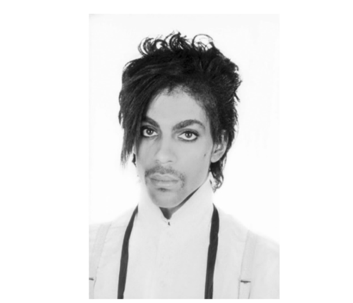
Image description: A black and white portrait photograph of Prince taken in 1981 by Lynn Goldsmith
[In 1984 Goldsmith licensed that photograph to Vanity Fair to serve as an artist reference for a single illustration. Vanity Fair commissioned Andy Warhol, who made a silkscreen portrait of Prince that ran alongside an article about him.]
Footnote 1: A silkscreen is a fine mesh fabric used in screen printing. Warhol’s practice was to deliver a photograph to a professional silkscreen printer with instructions for alterations, such as cropping and high contrasting. The latter alteration would “flatten” the image. Once Warhol approved, the printer would “reproduce” the altered image “like a photographic negative onto the screen.” For canvas prints, Warhol “would then place the screen face down on the canvas, pour ink onto the back of the mesh, and use a squeegee to pull the ink through the weave and onto the canvas.” The resulting “high-contrast half-tone impressions” served as an “‘under-drawing,’” over which Warhol painted colors by hand.
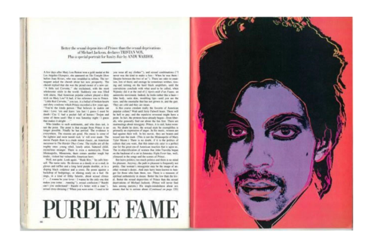
Image description: A purple silkscreen portrait of Prince created in 1984 by Andy Warhol to illustrate an article in Vanity Fair seen in context in a magazine opposite a page of text.
[Beyond the one illustration the license authorized, Warhol created fifteen further works from Goldsmith’s photograph — the Prince Series. Goldsmith did not know of them. After Prince died in 2016, Warhol having died in 1987, Condé Nast licensed Orange Prince from the Andy Warhol Foundation for a commemorative issue, paying the Foundation $10,000 and Goldsmith nothing.]
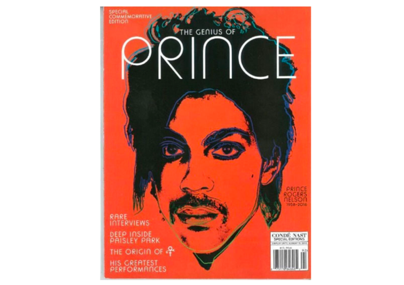
Image description: An orange silkscreen portrait of Prince on the cover of a special edition magazine published in 2016 by Condé Nast
[Goldsmith had licensed her own Prince images to magazines over the years. People paid her $1,000 to use one of her photographs in a special collector’s edition.]
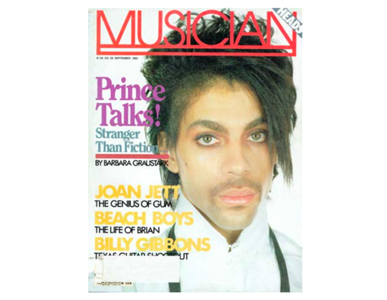
Image description: A magazine cover of Musician featuring a close-up portrait of Prince with styled hair, a faint mustache, and wearing a white shirt with black suspenders.
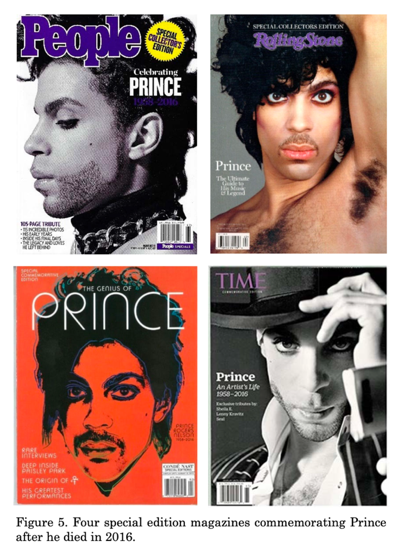
Image description: Four special edition magazines commemorating Prince after he died in 2016.
[Seeing Orange Prince on the cover, Goldsmith recognized her work and notified the Foundation of infringement. The Foundation sued for a declaration of non-infringement or, alternatively, fair use. The District Court granted summary judgment to the Foundation; the Court of Appeals for the Second Circuit reversed.]
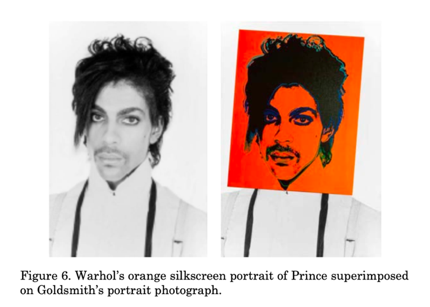
Image description: Warhol’s orange silkscreen portrait of Prince superimposed on Goldsmith’s portrait photograph.
II
AWF does not challenge the Court of Appeals’ holding that Goldsmith’s photograph and the Prince Series works are substantially similar. The question here is whether AWF can defend against a claim of copyright infringement because it made “fair use” of Goldsmith’s photograph. 17 U.S.C. §107.
Although the Court of Appeals analyzed each fair use factor, the only question before this Court is whether the court below correctly held that the first factor, “the purpose and character of the use, including whether such use is of a commercial nature or is for nonprofit educational purposes,” §107(1), weighs in Goldsmith’s favor. AWF contends that the Prince Series works are “transformative,” and that the first factor therefore weighs in its favor, because the works convey a different meaning or message than the photograph. The Court of Appeals erred, according to AWF, by not considering that new expression.
But the first fair use factor instead focuses on whether an allegedly infringing use has a further purpose or different character, which is a matter of degree, and the degree of difference must be weighed against other considerations, like commercialism. Campbell v. Acuff-Rose Music, Inc., 510 U.S. 569, 579 (1994). Although new expression may be relevant to whether a copying use has a sufficiently distinct purpose or character, it is not, without more, dispositive of the first factor.
Here, the specific use of Goldsmith’s photograph alleged to infringe her copyright is AWF’s licensing of Orange Prince to Condé Nast. As portraits of Prince used to depict Prince in magazine stories about Prince, the original photograph and AWF’s copying use of it share substantially the same purpose. Moreover, the copying use is of a commercial nature. Even though Orange Prince adds new expression to Goldsmith’s photograph, as the District Court found, this Court agrees with the Court of Appeals that, in the context of the challenged use, the first fair use factor still favors Goldsmith.
A
The Copyright Act encourages creativity by granting to the author of an original work a bundle of exclusive rights. That bundle includes the rights to reproduce the copyrighted work, to prepare derivative works, and, in the case of pictorial or graphic works, to display the copyrighted work publicly. 17 U.S.C. §106.
The Act, however, “reflects a balance of competing claims upon the public interest: Creative work is to be encouraged and rewarded, but private motivation must ultimately serve the cause of promoting broad public availability of literature, music, and the other arts.” Twentieth Century Music Corp. v. Aiken, 422 U. S. 151, 156 (1975). Copyright thus trades off the benefits of incentives to create against the costs of restrictions on copying. The Act, for example, limits the duration of copyright, §§302-305, as required by the Constitution; makes facts and ideas uncopyrightable, §102; and limits the scope of copyright owners’ exclusive rights, §§107-122.
This balancing act between creativity and availability (including for use in new works) is reflected in one such limitation, the defense of “fair use.” In 1976, Congress codified the common-law doctrine of fair use in §107, which provides: “The fair use of a copyrighted work,... for purposes such as criticism, comment, news reporting, teaching..., scholarship, or research, is not an infringement of copyright.” To determine whether a particular use is “fair,” the statute sets out four factors to be considered:
(1) the purpose and character of the use, including whether such use is of a commercial nature or is for nonprofit educational purposes;
(2) the nature of the copyrighted work;
(3) the amount and substantiality of the portion used in relation to the copyrighted work as a whole; and
(4) the effect of the use upon the potential market for or value of the copyrighted work.
The fair use doctrine “permits courts to avoid rigid application of the copyright statute when, on occasion, it would stifle the very creativity which that law is designed to foster.” Stewart v. Abend, 495 U.S. 207, 236 (1990). The Act’s fair use provision, in turn, “sets forth general principles, the application of which requires judicial balancing, depending upon relevant circumstances.” Google LLC v. Oracle America, Inc., 593 U.S. (2021). Because those principles apply across a wide range of copyrightable material, from books to photographs to software, fair use is a “flexible” concept, and “its application may well vary depending on context.” Id. For example, in applying the fair use provision, “copyright’s protection may be stronger where the copyrighted material... serves an artistic rather than a utilitarian function.” Ibid.
1
The first fair use factor is “the purpose and character of the use, including whether such use is of a commercial nature or is for nonprofit educational purposes.” §107(1). This factor considers the reasons for, and nature of, the copier’s use of an original work. The “central” question it asks is “whether the new work merely ‘supersede[s] the objects’ of the original creation... (‘supplanting’ the original), or instead adds something new, with a further purpose or different character.” Campbell, 510 U. S., at 579 (quoting Folsom v. Marsh, 9 F. Cas. 342, 348 (No. 4,901) (CC Mass. 1841) (Story, J.), and Harper & Row, 471 U. S., at 562). In that way, the first factor relates to the problem of substitution— copyright’s bête noire. The use of an original work to achieve a purpose that is the same as, or highly similar to, that of the original work is more likely to substitute for, or “‘supplant,’” the work, ibid.
Consider the “purposes” listed in the preamble paragraph of §107: “criticism, comment, news reporting, teaching..., scholarship, or research.” Although the examples given are “‘illustrative and not limitative,’” they reflect “the sorts of copying that courts and Congress most commonly ha[ve] found to be fair uses,” and so may guide the first factor inquiry. Campbell, 510 U. S., at 577-578 (quoting §101). As the Court of Appeals observed, the “examples are easily understood,” as they contemplate the use of an original work to “serv[e] a manifestly different purpose from the [work] itself.” 11 F. 4th, at 37. Criticism of a work, for instance, ordinarily does not supersede the objects of, or supplant, the work. Rather, it uses the work to serve a distinct end.4
Footnote 4: Take a critical book review, for example. Not only does the review, as a whole, serve a different purpose than the book; each quoted passage within the review likely serves a different purpose (as an object of criticism) than it does in the book. That may not always be so, however, and a court must consider each use within the whole to determine whether the copying is fair. W. Patry, Fair Use §3:1, pp. 129-130 (2022).
Not every instance will be clear cut, however. Whether a use shares the purpose or character of an original work, or instead has a further purpose or different character, is a matter of degree. Most copying has some further purpose, in the sense that copying is socially useful ex post. Many secondary works add something new. That alone does not render such uses fair. Rather, the first factor (which is just one factor in a larger analysis) asks “whether and to what extent” the use at issue has a purpose or character different from the original. Campbell, 510 U.S., at 579 (emphasis added). The larger the difference, the more likely the first factor weighs in favor of fair use. The smaller the difference, the less likely.
A use that has a further purpose or different character is said to be “‘transformative.’” Ibid. (quoting Leval, Toward a Fair Use Standard). As before, “transformativeness” is a matter of degree. See Campbell, 510 U.S., at 579. That is important because the word “transform,” though not included in §107, appears elsewhere in the Copyright Act. The statute defines derivative works, which the copyright owner has “the exclusive right” to prepare, §106(2), to include “any other form in which a work may be recast, transformed, or adapted,” §101. In other words, the owner has a right to derivative transformations of her work. Such transformations may be substantial, like the adaptation of a book into a movie. To be sure, this right is “subject to” fair use. §106; see also §107. The two are not mutually exclusive. But an overbroad concept of transformative use, one that includes any further purpose, or any different character, would narrow the copyright owner’s exclusive right to create derivative works. To preserve that right, the degree of transformation required to make “transformative” use of an original must go beyond that required to qualify as a derivative.5
Footnote 5: In theory, the question of transformative use or transformative purpose can be separated from the question whether there has been transformation of a work. In practice, however, the two may overlap. Compare, e.g., Núñez v. Caribbean Int’l News Corp., 235 F. 3d 18, 21-23 (CA1 2000) (newspaper’s reproduction, without alteration, of photograph of beauty pageant winner to explain controversy over whether her title should be withdrawn had transformative purpose because “‘the pictures were the story’”), with Leibovitz v. Paramount Pictures Corp., 137 F. 3d 109, 114-115 (CA2 1998) (film advertisement’s alteration of well-known photograph by superimposing actor’s face on actress’ body had transformative purpose of parody).
For example, this Court in Campbell considered whether parody may be fair use. In holding that it may, the Court explained that “parody has an obvious claim to transformative value” because “it can provide social benefit, by shedding light on an earlier work, and, in the process, creating a new one.” 510 U. S., at 579. The use at issue in Campbell was 2 Live Crew’s copying of certain lyrics and musical elements from Roy Orbison’s song, “Oh, Pretty Woman,” to create a rap derivative titled “Pretty Woman.” Without a doubt, 2 Live Crew transformed Orbison’s song by adding new lyrics and musical elements, such that “Pretty Woman” had a new message and different aesthetic than “Oh, Pretty Woman.” Indeed, the whole genre of music changed from rock ballad to rap. That was not enough for the first factor to weigh in favor of fair use, however. The Court found it necessary to determine whether 2 Live Crew’s transformation of Orbison’s song rose to the level of parody, a distinct purpose of commenting on the original or criticizing it. See id., at 580-583.
Distinguishing between parody (which targets an author or work for humor or ridicule) and satire (which ridicules society but does not necessarily target an author or work), the Court further explained that “parody needs to mimic an original to make its point, and so has some claim to use the creation of its victim’s (or collective victims’) imagination, whereas satire can stand on its own two feet and so requires justification for the very act of borrowing.” Id., at 580-581. More generally, when “commentary has no critical bearing on the substance or style of the original composition,... the claim to fairness in borrowing from another’s work diminishes accordingly (if it does not vanish), and other factors, like the extent of its commerciality, loom larger.” Id., at 580; see also id., at 597 (Kennedy, J., concurring).
This discussion illustrates two important points: First, the fact that a use is commercial as opposed to nonprofit is an additional “element of the first factor.” Id., at 584. The commercial nature of the use is not dispositive. Ibid.; Google v. Oracle. But it is relevant. As the Court explained in Campbell, it is to be weighed against the degree to which the use has a further purpose or different character. See 510 U. S., at 579 (“the more transformative the new work, the less will be the significance of other factors, like commercialism, that may weigh against a finding of fair use”); see also id., at 580, 585.6
Footnote 6: The authors of the Copyright Act of 1976 included the language, “‘whether such use is of a commercial nature or is for non-profit educational purposes,’” in the first fair use factor “to state explicitly” that, “as under the present law, the commercial or non-profit character of an activity, while not conclusive with respect to fair use, can and should be weighed along with other factors.” House Report, p. 66 (1976).
Second, the first factor also relates to the justification for the use. In a broad sense, a use that has a distinct purpose is justified because it furthers the goal of copyright, namely, to promote the progress of science and the arts, without diminishing the incentive to create. See id., at 579; Authors Guild v. Google, Inc., 804 F. 3d 202, 214 (CA2 2015) (Leval, J.) (“The more the appropriator is using the copied material for new, transformative purposes, the more it serves copyright’s goal of enriching public knowledge and the less likely it is that the appropriation will serve as a substitute for the original or its plausible derivatives, shrinking the protected market opportunities of the copyrighted work”). A use that shares the purpose of a copyrighted work, by contrast, is more likely to provide “the public with a substantial substitute for matter protected by the [copyright owner’s] interests in the original work or derivatives of [it],” id., at 207, which undermines the goal of copyright.
In a narrower sense, a use may be justified because copying is reasonably necessary to achieve the user’s new purpose. Parody, for example, “needs to mimic an original to make its point.” Campbell, 510 U.S., at 580-581. Similarly, other commentary or criticism that targets an original work may have compelling reason to “‘conjure up’” the original by borrowing from it. Id., at 588.7
Footnote 7: Return to the example of a book review. The review’s use of quoted material may be justified in both the broad and the narrower senses. First, the use is likely to serve a different purpose than the material itself. Second, there may be compelling reason to borrow from the original to achieve that purpose because the review targets the material for comment or criticism. But again, the question of justification will depend on the individual use or uses. Even book reviews are not entitled to a presumption of fairness. Campbell, 510 U.S., at 581.
An independent justification like this is particularly relevant to assessing fair use where an original work and copying use share the same or highly similar purposes, or where wide dissemination of a secondary work would otherwise run the risk of substitution for the original or licensed derivatives of it. See id., at 580, n. 14; Harper & Row, 471 U. S., at 557. Once again, the question of justification is one of degree. See Leval 1111 (“it is not sufficient simply to conclude whether or not justification exists. The question remains how powerful, or persuasive, is the justification, because the court must weigh the strength of the secondary user’s justification against factors favoring the copyright owner”).
In sum, the first fair use factor considers whether the use of a copyrighted work has a further purpose or different character, which is a matter of degree, and the degree of difference must be balanced against the commercial nature of the use. If an original work and a secondary use share the same or highly similar purposes, and the secondary use is of a commercial nature, the first factor is likely to weigh against fair use, absent some other justification for copying.8
Footnote 8: Consider, for example, this Court’s analysis of the first factor in Google LLC v. Oracle America, Inc., 593 U.S. ___ (2021). Google stressed that “[t]he fact that computer programs are primarily functional makes it difficult to apply traditional copyright concepts in that technological world.” Id. Still, in evaluating the purpose and character of Google’s use of Sun Microsystems’ code, the Court looked, first, to whether the purpose of the use was significantly different from that of the original; and, second, to the strength of other justifications for the use. Although Google’s use was commercial in nature, it copied Sun’s code, which was “created for use in desktop and laptop computers,” “only insofar as needed to include tasks that would be useful in smartphones.” Id. That is, Google put Sun’s code to use in the “distinct and different computing environment” of its own Android platform, a new system created for new products. Ibid. Moreover, the use was justified in that context because “shared interfaces are necessary for different programs to speak to each other” and because “reimplementation of interfaces is necessary if programmers are to be able to use their acquired skills.” Ibid.; see also id.
2
The fair use provision, and the first factor in particular, requires an analysis of the specific “use” of a copyrighted work that is alleged to be “an infringement.” §107. The same copying may be fair when used for one purpose but not another. See Campbell, 510 U. S., at 585 (contrasting the use of a copyrighted work “to advertise a product, even in a parody,” with “the sale of a parody for its own sake, let alone one performed a single time by students in school”); Sony Corp. of America v. Universal City Studios, Inc., 464 U.S. 417, 449-451 (1984) (contrasting the recording of TV “for a commercial or profit-making purpose” with “private home use”).
Here, Goldsmith’s copyrighted photograph has been used in multiple ways: After Goldsmith licensed the photograph to Vanity Fair to serve as an artist reference, Warhol used the photograph to create the Vanity Fair illustration and the other Prince Series works. Vanity Fair then used the photograph, pursuant to the license, when it published Warhol’s illustration in 1984. Finally, AWF used the photograph when it licensed an image of Warhol’s Orange Prince to Condé Nast in 2016. Only that last use, however, AWF’s commercial licensing of Orange Prince to Condé Nast, is alleged to be infringing.9
Footnote 9: AWF sought a declaratory judgment that would cover the original Prince Series works, but Goldsmith has abandoned all claims to relief other than her claim as to the 2016 Condé Nast license and her request for prospective relief as to similar commercial licensing.
We limit our analysis accordingly. In particular, the Court expresses no opinion as to the creation, display, or sale of any of the original Prince Series works.10
Footnote 10: The dissent, however, focuses on a case that is not before the Court. No, not whether Francis Bacon would have made fair use of Velásquez’s painting, had American copyright law applied in Europe with a term of 300 years post mortem auctoris. But cf. post, at 32-34 (opinion of KAGAN, J.). Rather, Congress has directed courts to examine the purpose and character of the challenged “use.” 17 U. S. C. §107(1). Yet the dissent assumes that any and all uses of an original work entail the same first-factor analysis based solely on the content of a secondary work. This assumption contradicts the fair use statute and this Court’s precedents. See supra, at 20-21. Had AWF’s use been solely for teaching purposes, that clearly would affect the analysis, and the statute permits no other conclusion. Preferring not to focus on the specific use alleged to infringe Goldsmith’s copyright, the dissent begins with a sleight of hand, see post, at 1, n. 1, and continues with a false equivalence between AWF’s commercial licensing and Warhol’s original creation. The result is a series of misstatements and exaggerations, from the dissent’s very first sentence, post, at 1 (“Today, the Court declares that Andy Warhol’s eye-popping silkscreen of Prince... is (in copyright lingo) not ‘transformative’”), to its very last, post, at 36 (“[The majority opinion] will make our world poorer”).
A typical use of a celebrity photograph is to accompany stories about the celebrity, often in magazines. For example, Goldsmith licensed her photographs of Prince to illustrate stories about Prince in magazines such as Newsweek, Vanity Fair, and People. Supra, at 3-6. She even licensed her photographs for that purpose after Prince died in 2016. Supra, at 7. A photographer may also license her creative work to serve as a reference for an artist, like Goldsmith did in 1984 when Vanity Fair wanted an image of Prince created by Warhol to illustrate an article about Prince. As noted by the Court of Appeals, Goldsmith introduced “uncontroverted” evidence “that photographers generally license others to create stylized derivatives of their work in the vein of the Prince Series.” In fact, Warhol himself paid to license photographs for some of his artistic renditions. Such licenses, for photographs or derivatives of them, are how photographers like Goldsmith make a living. They provide an economic incentive to create original works, which is the goal of copyright.
In 2016, AWF licensed an image of Orange Prince to Condé Nast to appear on the cover of a commemorative edition magazine about Prince. The edition, titled “The Genius of Prince,” celebrates the life and work of “Prince Rogers Nelson, 1958-2016.” It is undisputed here that the edition is “devoted to Prince.” In addition to AWF’s image on the cover, the magazine contains numerous concert and studio photographs of Prince. In that context, the purpose of the image is substantially the same as that of Goldsmith’s photograph. Both are portraits of Prince used in magazines to illustrate stories about Prince.11 Such “environment[s]” are not “distinct and different.” Google v. Oracle.
Footnote 11: The Court of Appeals observed that the “purpose and function of the two works at issue here is identical, not merely in the broad sense that they are created as works of visual art, but also in the narrow but essential sense that they are portraits of the same person.” 11 F. 4th, at 42. This Court goes somewhat “further and examine[s] the copying’s more specifically described ‘purpose[s]’” in the context of the particular use at issue (here, in a magazine about Prince). Google v. Oracle. The Court does not define the purpose as simply “commercial” or “commercial licensing” [As the dissent suggests]. Nor does the Court view Goldsmith’s photograph and Warhol’s illustration as “fungible products in the magazine market.” Rather, the Court finds significant the degree of similarity between the specific purposes of the original work and the secondary use at issue.
According to the dissent, the fact that a magazine editor might prefer one image to the other must mean the secondary use is transformative, either because it has a different aesthetic or conveys a different message. The Court, because it fails to understand the difference, does not have “much of a future in magazine publishing,” the dissent chides. Ibid. While the dissent is probably correct about the Court’s business prospects, the editors of People, Rolling Stone, and Time chose a variety of different photos of Prince for their memorial issues. See fig. 5, supra. Portrait photos, in fact. Some black and white; some depicting Prince’s “‘corporeality’”; some “realistic” or “humanistic.” Post, at 9, 16 (KAGAN, J., dissenting). These variations in aesthetics did not stop the photos from serving the same essential purpose of depicting Prince in a magazine commemorating his life and career.
Fortunately, the dissent’s “magazine editor” test does not have much of a future in fair use doctrine. The flaw in the dissent’s logic is simple: If all that mattered under the first factor were whether a buyer was “drawn aesthetically” to a secondary work (instead of the pre-existing work it adapted) or whether the buyer preferred “to convey the message of” the secondary work, then every derivative work would qualify. The New Yorker might prefer an unauthorized sequel to a short story, rather than the original, but that does not mean the purpose and character of the use would weigh in its favor. Similarly, a rap label might prefer 2 Live Crew’s song, rather than Orbison’s original, based on the new sound and lyrics (i.e., new aesthetic and message), but that was not enough in Campbell, and it is not enough here.
AWF’s licensing of the Orange Prince image thus “‘supersede[d] the objects,’” Campbell, 510 U. S., at 579, i.e., shared the objectives, of Goldsmith’s photograph, even if the two were not perfect substitutes.12
Footnote 12: In this way, the first factor relates to the fourth, market effect. See Campbell, 510 U. S., at 591; cf. also Harper & Row, 471 U. S., at 568 (“The excerpts were employed as featured episodes in a story about the Nixon pardon—precisely the use petitioners had licensed to Time”). While the first factor considers whether and to what extent an original work and secondary use have substitutable purposes, the fourth factor focuses on actual or potential market substitution. Under both factors, the analysis here might be different if Orange Prince appeared in an art magazine alongside an article about Warhol.
While keenly grasping the relationship between The Two Lolitas, the dissent fumbles the relationship between the first and fourth fair use factors. Under today’s decision, as before, the first factor does not ask whether a secondary use causes a copyright owner economic harm. Cf. post, at 21 (opinion of KAGAN, J.). There is, however, a positive association between the two factors: A secondary use that is more different in purpose and character is less likely to usurp demand for the original work or its derivatives, as the Court has explained, see Campbell, 519 U. S., at 591. This relationship should be fairly obvious. But see post, at 22 (KAGAN, J., dissenting) (suggesting that the first factor can favor only the user and the fourth factor only the copyright owner). Still, the relationship is not absolute. For example, copies for classroom use might fulfill demand for an original work. The first factor may still favor the copyist, even if the fourth factor is shown not to. At the same time, other forms of straight copying may be fair if a strong showing on the fourth factor outweighs a weak showing on the first.
The use also “is of a commercial nature.” §107(1). Just as Goldsmith licensed her photograph to Vanity Fair for $400, AWF licensed Orange Prince to Condé Nast for $10,000. The undisputed commercial character of AWF’s use, though not dispositive, “tends to weigh against a finding of fair use.” Harper & Row, 471 U. S., at 562.13
Footnote 13: The dissent misconstrues the role of commercialism in this analysis. The Court does not hold that “all that matters is that [AWF] and the publisher entered into a licensing transaction”; or that the first-factor inquiry “should disregard Warhol’s creative contributions because he licensed his work”; or that an artist may not “market even a transformative follow-on work.” Post, at 3, 19, 34 (opinion of KAGAN, J.). Instead, consistent with the statute, “whether [a] use is of a commercial nature or is for nonprofit educational purposes” is one element of the first factor, §107(1); it does not dispose of that factor, much less the fair use inquiry. As this opinion makes clear, the commercial character of a secondary use should be weighed against the extent to which the use is transformative or otherwise justified.
Taken together, these two elements—that Goldsmith’s photograph and AWF’s 2016 licensing of Orange Prince share substantially the same purpose, and that AWF’s use of Goldsmith’s photo was of a commercial nature—counsel against fair use, absent some other justification for copying. That is, although a use’s transformativeness may outweigh its commercial character, here, both elements point in the same direction.14
Footnote 14: The dissent contends that the Court gives “little role” to “the key term ‘character.’” Post, at 19 (opinion of KAGAN, J.). This is somewhat puzzling, as the Court has previously employed “character” to encompass exactly what the dissent downplays: “‘the commercial or nonprofit character of an activity.’” Sony Corp. of America v. Universal City Studios, Inc., 464 U.S. 417, 448-449 (1984) (quoting House Report, at 66); see also Campbell, 510 U.S., at 572, 584-585 (repeatedly referring to “commercial character”). Rather than looking to this case law, the dissent looks up the word “character” in a dictionary. But the dissent’s preferred definition—“a thing’s ‘main or essential nature, especially as strongly marked and serving to distinguish,’” post, at 20 (quoting Webster’s Third New International Dictionary 376 (1976))—helps Goldsmith, not AWF. Even this definition does not support the implication that “character” is determined by any aesthetic distinctiveness, such as the addition of any new expression. Instead, it is the “main or essential nature” that must be “strongly marked and serv[e] to distinguish.” So return to Orange Prince on the cover of the Condé Nast issue commemorating Prince, see fig. 5, supra, and ask, what is the main or essential nature of the secondary use of Goldsmith’s photograph in that context?
The foregoing does not mean, however, that derivative works borrowing heavily from an original cannot be fair uses. In Google, the Court suggested that “an ‘artistic painting’ might, for example, fall within the scope of fair use even though it precisely replicates a copyrighted ‘advertising logo to make a comment about consumerism.’” That suggestion refers to Warhol’s works that incorporate advertising logos, such as the Campbell’s Soup Cans series. See fig. 7, infra.
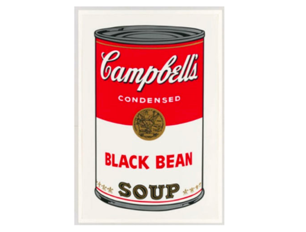
Image description: A print based on the Campbell’s soup can, one of Warhols’s works that replicates a copyrighted advertising logo.
Yet not all of Warhol’s works, nor all uses of them, give rise to the same fair use analysis. In fact, Soup Cans well illustrates the distinction drawn here. The purpose of Campbell’s logo is to advertise soup. Warhol’s canvases do not share that purpose. Rather, the Soup Cans series uses Campbell’s copyrighted work for an artistic commentary on consumerism, a purpose that is orthogonal to advertising soup. The use therefore does not supersede the objects of the advertising logo.15
Footnote 15: The situation might be different if AWF licensed Warhol’s Soup Cans to a soup business to serve as its logo. That use would share much the same purpose of Campbell’s logo, even though Soup Cans has some new meaning or message. This hypothetical, though fanciful, is parallel to the situation here: Both Goldsmith and AWF sold images of Prince (AWF’s copying Goldsmith’s) to magazines to illustrate stories about the celebrity, which is the typical use made of Goldsmith’s photographs.
Moreover, a further justification for Warhol’s use of Campbell’s logo is apparent. His Soup Cans series targets the logo. That is, the original copyrighted work is, at least in part, the object of Warhol’s commentary. It is the very nature of Campbell’s copyrighted logo—well known to the public, designed to be reproduced, and a symbol of an everyday item for mass consumption—that enables the commentary. Hence, the use of the copyrighted work not only serves a completely different purpose, to comment on consumerism rather than to advertise soup, it also “conjures up” the original work to “she[d] light” on the work itself, not just the subject of the work. Campbell, 510 U.S., at 579, 588.16 Here, by contrast, AWF’s use of Goldsmith’s photograph does not target the photograph, nor has AWF offered another compelling justification for the use.
Footnote 16: The dissent either does not follow, or chooses to ignore, this analysis. The point is not simply that the Soup Cans series comments on consumer culture, similar to how Warhol’s celebrity images comment on celebrity culture. Post, at 15 (opinion of KAGAN, J.). Rather, as the discussion makes clear, the degree of difference in purpose and character between Campbell’s soup label and Warhol’s painting is nearly absolute. Plus, Warhol’s use targets Campbell’s logo, at least in part. These features (which are absent in this case) strengthen Warhol’s claim to fairness in copying that logo in a painting.
B
AWF contends, however, that the purpose and character of its use of Goldsmith’s photograph weighs in favor of fair use because Warhol’s silkscreen image of the photograph, like the Campbell’s Soup Cans series, has a new meaning or message. The District Court, for example, understood the Prince Series works to portray Prince as “an iconic, larger-than-life figure.” 382 F. Supp. 3d, at 326. AWF also asserts that the works are a comment on celebrity. In particular, “Warhol’s Prince Series conveys the dehumanizing nature of celebrity.” According to AWF, that new meaning or message, which the Court of Appeals ignored, makes the use “transformative” in the fair use sense. We disagree.
1
Campbell did describe a transformative use as one that “alter[s] the first [work] with new expression, meaning, or message.” 510 U. S., at 579; see also Google v. Oracle. That description paraphrased Judge Leval’s law review article, which referred to “new information, new aesthetics, new insights and understandings.” Leval 1111. (Judge Leval contrasted such additions with secondary uses that “merely repackag[e]” the original. Ibid.) But Campbell cannot be read to mean that §107(1) weighs in favor of any use that adds some new expression, meaning, or message.
Otherwise, “transformative use” would swallow the copyright owner’s exclusive right to prepare derivative works. Many derivative works, including musical arrangements, film and stage adaptions, sequels, spinoffs, and others that “recast, transfor[m] or adap[t]” the original, §101, add new expression, meaning or message, or provide new information, new aesthetics, new insights and understandings. That is an intractable problem for AWF’s interpretation of transformative use. The first fair use factor would not weigh in favor of a commercial remix of Prince’s “Purple Rain” just because the remix added new expression or had a different aesthetic. A film or musical adaptation, like that of Alice Walker’s The Color Purple, might win awards for its “significant creative contribution”; alter the meaning of a classic novel; and add “important new expression,” such as images, performances, original music, and lyrics. Post, at 11, 23 (KAGAN, J., dissenting) (internal quotation marks omitted). But that does not in itself dispense with the need for licensing.17
Footnote 17: The dissent is stumped. Buried in a conclusory footnote, it suggests that the fourth fair use factor alone takes care of derivative works like book-to-film adaptations. This idea appears to come from a Hail Mary lobbed by AWF when it got caught in the same bind. The Court is aware of no authority for the proposition that the first factor favors such uses (on the dissent’s view, the first factor must, because the use modifies the expressive content of an original work), leaving it to the fourth factor to ensure that §106(2) is not a dead letter. Certainly Google, which merely noted in passing that “making a film of an author’s book may... mean potential or presumed losses to the copyright owner,” did not hold as much; see id.
Campbell is again instructive. 2 Live Crew’s version of Orbison’s song easily conveyed a new meaning or message. It also had a different aesthetic. Yet the Court went further, examining whether and to what extent 2 Live Crew’s song had the parodic purpose of “commenting on the original or criticizing it.” 510 U. S., at 583. Parody is, of course, a kind of message. Moreover, the Court considered what the words of the songs might have meant to determine whether parody “reasonably could be perceived.” Ibid. But new meaning or message was not sufficient. If it had been, the Court could have made quick work of the first fair use factor. Instead, meaning or message was simply relevant to whether the new use served a purpose distinct from the original, or instead superseded its objects. That was, and is, the “central” question under the first factor. Id., at 579.
The dissent commits the same interpretive error as AWF: It focuses on Campbell’s paraphrase, yet ignores the rest of that decision’s careful reasoning. Indeed, upon reading the dissent, someone might be surprised to learn that Campbell was about parody at all. Had expert testimony confirmed the obvious fact that 2 Live Crew’s “Pretty Woman” differed in aesthetics and meaning from Orbison’s original, that would have been the end of the dissent’s analysis. Not the Court’s, however. Campbell was the culmination of a long line of cases and scholarship about parody’s claim to fairness in borrowing. “For purposes of copyright law,” the Court explained, “the heart of any parodist’s claim to quote from existing material is the use of some elements of a prior author’s composition to create a new one that, at least in part, comments on that author’s works.” 510 U.S., at 580. Campbell thus drew a nuanced distinction between parody and satire: While parody cannot function unless it conjures up the original, “satire can stand on its own two feet and so requires justification for... borrowing.” Id., at 580-581. The objective meaning or message of 2 Live Crew’s song was relevant to this inquiry into the reasons for copying, but any “new expression, meaning, or message” was not the test.18
Footnote 18: The dissent makes a similar mistake with Google: It fails to read the decision as a whole. So while the dissent claims that the “[Google] Court would have told this one to go back to school,” it might be easier just to go back and read Google. The Court did not hold that any secondary use that is innovative, in some sense, or that a judge or Justice considers to be creative progress consistent with the constitutional objective of copyright, is thereby transformative. The Court instead emphasized that Google used Sun’s code in a “distinct and different” context, and “only insofar as needed” or “necessary” to achieve Google’s new purpose. Google v. Oracle; see also n. 8, supra. In other words, the same concepts of use and justification that the Court relied on in Google are the ones that it applies today.
What role meaning or message played in the Court of Appeals’ analysis here is not entirely clear. The court correctly rejected the idea “that any secondary work that adds a new aesthetic or new expression to its source material is necessarily transformative.” 11 F. 4th, at 38-39. It also appeared correctly to accept that meaning or message is relevant to, but not dispositive of, purpose. See id., at 41 (“the secondary work itself must reasonably be perceived as embodying a distinct artistic purpose, one that conveys a new meaning or message separate from its source material”); id., at 42 (“the judge must examine whether the secondary work’s use of its source material is in service of a fundamentally different and new artistic purpose and character, [which] must, at a bare minimum, comprise something more than the imposition of another artist’s style on the primary work...”).
Elsewhere, however, the Court of Appeals stated that “the district judge should not assume the role of art critic and seek to ascertain the intent behind or meaning of the works at issue.” Id., at 41. That statement is correct in part. A court should not attempt to evaluate the artistic significance of a particular work. See Bleistein v. Donaldson Lithographing Co., 188 U.S. 239, 251 (1903) (Holmes, J.) (“It would be a dangerous undertaking for persons trained only to the law to constitute themselves final judges of the worth of [a work], outside of the narrowest and most obvious limits”).19
Footnote 19: The dissent demonstrates the danger of this approach. On its view, the first fair use factor favors AWF’s use of Goldsmith’s photograph simply because Warhol created worthy art. Goldsmith’s original work, by contrast, is just an “old photo,” one of Warhol’s “templates.” Post, at 2, 17 (opinion of KAGAN, J.). In other words, the dissent (much like the District Court) treats the first factor as determined by a single fact: “It’s a Warhol.” This Court agrees with the Court of Appeals that such logic would create a kind of privilege that has no basis in copyright law. See 11 F. 4th, at 43. Again, the Court does not deny that Warhol was a major figure in American art. But it leaves the worth of his works to the critics. Compare, e.g., D. Antin, Warhol: The Silver Tenement, in Pop Art: A Critical History 287 (S. Madoff ed. 1997), with R. Hughes, The Shock of the New 346-351 (2d ed. 1991). Whatever the contribution of Orange Prince, Goldsmith’s photograph is part of that contribution. A court need not, indeed should not, assess the relative worth of two works to decide a claim of fair use. Otherwise, “some works of genius would be sure to miss appreciation,” and, “at the other end, copyright would be denied to [works] which appealed to a public less educated than the judge.” Bleistein, 188 U.S., at 251-252 (Holmes, J.). That Goldsmith’s photograph “had [its] worth and [its] success is sufficiently shown by the desire to reproduce [it] without regard to [her] rights.” Id., at 252.
Nor does the subjective intent of the user (or the subjective interpretation of a court) determine the purpose of the use. But the meaning of a secondary work, as reasonably can be perceived, should be considered to the extent necessary to determine whether the purpose of the use is distinct from the original, for instance, because the use comments on, criticizes, or provides otherwise unavailable information about the original, see, e.g., Authors Guild, 804 F. 3d, at 215-216.
2
The District Court determined that “the Prince Series works can reasonably be perceived to have transformed Prince from a vulnerable, uncomfortable person to an iconic, larger-than-life figure.” 382 F. Supp. 3d, at 326. To make that determination, the District Court relied, in part, on testimony by Goldsmith that her photographs of Prince show that he “is ‘not a comfortable person’ and that he is ‘a vulnerable human being.’” An expert on Warhol, meanwhile, testified that the Prince Series works depict “Prince as a kind of icon or totem of something,” a “mask-like simulacrum of his actual existence.”
The Court of Appeals noted, correctly, that “whether a work is transformative cannot turn merely on the stated or perceived intent of the artist or the meaning or impression that a critic—or for that matter, a judge—draws from the work.” “Otherwise, the law may well recognize any alteration as transformative.” Whether the purpose and character of a use weighs in favor of fair use is, instead, an objective inquiry into what use was made, i.e., what the user does with the original work.
Granting the District Court’s conclusion that Orange Prince reasonably can be perceived to portray Prince as iconic, whereas Goldsmith’s portrayal is photorealistic, that difference must be evaluated in the context of the specific use at issue. The use is AWF’s commercial licensing of Orange Prince to appear on the cover of Condé Nast’s special commemorative edition. The purpose of that use is, still, to illustrate a magazine about Prince with a portrait of Prince. Although the purpose could be more specifically described as illustrating a magazine about Prince with a portrait of Prince, one that portrays Prince somewhat differently from Goldsmith’s photograph (yet has no critical bearing on her photograph), that degree of difference is not enough for the first factor to favor AWF, given the specific context of the use.
To hold otherwise would potentially authorize a range of commercial copying of photographs, to be used for purposes that are substantially the same as those of the originals. As long as the user somehow portrays the subject of the photograph differently, he could make modest alterations to the original, sell it to an outlet to accompany a story about the subject, and claim transformative use. Many photographs will be open to various interpretations. A subject as open to interpretation as the human face, for example, reasonably can be perceived as conveying several possible meanings. The application of an artist’s characteristic style to bring out a particular meaning that was available in the photograph is less likely to constitute a “further purpose” as Campbell used the term. 510 U. S., at 579.
AWF asserts another, albeit related, purpose, which is to comment on the “dehumanizing nature” and “effects” of celebrity. No doubt, many of Warhol’s works, and particularly his uses of repeated images, can be perceived as depicting celebrities as commodities. But again, even if such commentary is perceptible on the cover of Condé Nast’s tribute to “Prince Rogers Nelson, 1958-2016,” on the occasion of the man’s death, AWF has a problem: The asserted commentary is at Campbell’s lowest ebb. Because it “has no critical bearing on” Goldsmith’s photograph,20 the commentary’s “claim to fairness in borrowing from” her work “diminishes accordingly (if it does not vanish).” 510 U. S., at 580.21 The commercial nature of the use, on the other hand, “loom[s] larger.” Ibid.
Footnote 20: At no point in this litigation has AWF maintained that any of the Prince Series works, let alone Orange Prince on the cover of the 2016 Condé Nast special edition, comment on, criticize, or otherwise target Goldsmith’s photograph. That makes sense, given that the photograph was unpublished when Goldsmith licensed it to Vanity Fair, and that neither Warhol nor Vanity Fair selected the photograph, which was instead provided by Goldsmith’s agency.
Footnote 21: The dissent wonders: Why does targeting matter? The reason, as this opinion explains, is the first factor’s attention to justification. Compare, for example, a film adaptation of Gone With the Wind with a novel, The Wind Done Gone, that “inverts” the original’s “portrait of race relations” to expose its “romantic, idealized” portrayal of the antebellum South. SunTrust Bank v. Houghton Mifflin Co., 268 F. 3d 1257, 1270 (CA11 2001); id., at 1280 (Marcus, J., specially concurring). Or, to build from one of the artistic works the dissent chooses to feature, consider a secondary use that borrows from Manet’s Olympia to shed light on the original’s depiction of race and sex. See R. Storr & C. Armstrong, Lunch With Olympia (2016). Although targeting is not always required, fair use is an affirmative defense, and AWF bears the burden to justify its taking of Goldsmith’s work with some reason other than, “I can make it better.”
Here, the circumstances of AWF’s 2016 licensing outweigh its diminished claim to fairness in copying under the first factor. Like satire that does not target an original work, AWF’s asserted commentary “can stand on its own two feet and so requires justification for the very act of borrowing.” Id., at 581. Moreover, because AWF’s commercial use of Goldsmith’s photograph to illustrate a magazine about Prince is so similar to the photograph’s typical use, a particularly compelling justification is needed. Yet AWF offers no independent justification, let alone a compelling one, for copying the photograph, other than to convey a new meaning or message. As explained, that alone is not enough for the first factor to favor fair use.
Copying might have been helpful to convey a new meaning or message. It often is. But that does not suffice under the first factor. Nor does it distinguish AWF from a long list of would-be fair users: a musician who finds it helpful to sample another artist’s song to make his own, a playwright who finds it helpful to adapt a novel, or a filmmaker who would prefer to create a sequel or spinoff, to name just a few.22
Footnote 22: The dissent oddly suggests that under the Court’s opinion, the first fair use factor favors such uses. This ignores, well, pretty much the entire opinion. In particular, the Court does not hold that the first factor favors any user who “wants to reach different buyers, in different markets, consuming different products.” Post, at 13, n. 5 (opinion of KAGAN, J.). The dissent apparently deduces this proposition from its inverse, which is a common logical fallacy.
As Judge Leval has explained, “[a] secondary author is not necessarily at liberty to make wholesale takings of the original author’s expression merely because of how well the original author’s expression would convey the secondary author’s different message.” Authors Guild, 804 F. 3d, at 215.
The dissent would rather not debate these finer points. It offers no theory of the relationship between transformative uses of original works and derivative works that transform originals. No reason why AWF was justified in using Goldsmith’s original work in this specific instance. And no limiting principle for its apparent position that any use that is creative prevails under the first fair use factor. Instead, the dissent makes the simple (and obvious) point that restrictions on copying can inhibit follow-on works. “Nothing comes from nothing,” the dissent observes, “nothing ever could.” So somewhere in the copyright statute, there must be an “escape valve” to create something good. If AWF must pay Goldsmith to use her creation, the dissent claims, this will “stifle creativity of every sort,” “thwart the expression of new ideas and the attainment of new knowledge,” and “make our world poorer.”
These claims will not age well. It will not impoverish our world to require AWF to pay Goldsmith a fraction of the proceeds from its reuse of her copyrighted work. Recall, payments like these are incentives for artists to create original works in the first place. Nor will the Court’s decision, which is consistent with longstanding principles of fair use, snuff out the light of Western civilization, returning us to the Dark Ages of a world without Titian, Shakespeare, or Richard Rodgers. The dissent goes on at length about the basic premise that copyright (like other forms of intellectual property) involves a tradeoff between stimulating innovative activity, on the one hand, and allowing follow-on innovation, on the other. This theme will be familiar to any student of copyright law. In tracing the history of Renaissance painting, however, the dissent loses sight of the statute and this Court’s cases. The Lives of the Artists undoubtedly makes for livelier reading than the U.S. Code or the U.S. Reports, but as a court, we do not have that luxury.
The dissent thus misses the forest for a tree. Its single-minded focus on the value of copying ignores the value of original works. It ignores the statute’s focus on the specific use alleged to be infringing. It waves away the statute’s concern for derivative works. It fails to appreciate Campbell’s nuance. And it disregards this Court’s repeated emphasis on justification.
The result of these omissions is an account of fair use that is unbalanced in theory and, perhaps relatedly, in tone. The dissent’s conclusion—that whenever a use adds new meaning or message, or constitutes creative progress in the opinion of a critic or judge, the first fair use factor weighs in its favor—does not follow from its basic premise. Fair use instead strikes a balance between original works and secondary uses based in part on objective indicia of the use’s purpose and character, including whether the use is commercial and, importantly, the reasons for copying.
Finally, copyright law is replete with escape valves: the idea-expression distinction; the general rule that facts may not receive protection; the requirement of originality; the legal standard for actionable copying; the limited duration of copyright; and, yes, the defense of fair use, including all its factors, such as whether the amount taken is reasonable in relation to the purpose of the use. These doctrines (and others) provide ample space for artists and other creators to use existing materials to make valuable new works. They account for most, if not all, of the examples given by the dissent, as well as the dissent’s own copying (and the Court’s, too). If the last century of American art, literature, music, and film is any indication, the existing copyright law, of which today’s opinion is a continuation, is a powerful engine of creativity.
III
Lynn Goldsmith’s original works, like those of other photographers, are entitled to copyright protection, even against famous artists. Such protection includes the right to prepare derivative works that transform the original. The use of a copyrighted work may nevertheless be fair if, among other things, the use has a purpose and character that is sufficiently distinct from the original. In this case, however, Goldsmith’s original photograph of Prince, and AWF’s copying use of that photograph in an image licensed to a special edition magazine devoted to Prince, share substantially the same purpose, and the use is of a commercial nature. AWF has offered no other persuasive justification for its unauthorized use of the photograph. Therefore, the “purpose and character of the use, including whether such use is of a commercial nature or is for nonprofit educational purposes,” §107(1), weighs in Goldsmith’s favor.
The Court has cautioned that the four statutory fair use factors may not “be treated in isolation, one from another. All are to be explored, and the results weighed together, in light of the purposes of copyright.” Campbell, 510 U.S., at 578. AWF does not challenge the Court of Appeals’ determinations that the second factor, “the nature of the copyrighted work,” §107(2); third factor, “the amount and substantiality of the portion used in relation to the copyrighted work as a whole,” §107(3); and fourth factor, “the effect of the use upon the potential market for or value of the copyrighted work,” all favor Goldsmith. Because this Court agrees with the Court of Appeals that the first factor likewise favors her, the judgment of the Court of Appeals is affirmed.
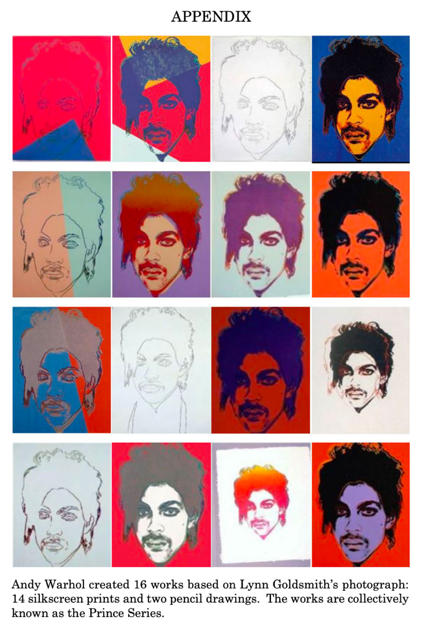
Image description: Sixteen portraits of Prince arranged in a 4x4 grid, created by Andy Warhol in various vivid color schemes and styles. Some are silkscreen prints with bold, contrasting hues, while others are minimal line drawings. The variations alter background colors, facial tones, and shading, producing dramatically different moods. The caption notes: Andy Warhol created 16 works based on Lynn Goldsmith’s photograph: 14 silkscreen prints and two pencil drawings. The works are collectively known as the Prince Series.
Different Views of the Facts
In her dissenting opinion, Justice Kagan, joined by the Chief Justice, took the majority to task for its lack of appreciation of the differences—in terms of aesthetic and meaning—between Warhol’s Prince and Goldsmith’s.
Andy Warhol is the avatar of transformative copying. Cf. Google v. Oracle (selecting Warhol, from the universe of creators, to illustrate what transformative copying is). … To see the method in action, consider one of Warhol’s pre-Prince celebrity silkscreens—this one, of Marilyn Monroe. He began with a publicity photograph of the actress. And then he went to work. He reframed the image, zooming in on Monroe’s face to “produce the disembodied effect of a cinematic close-up.”
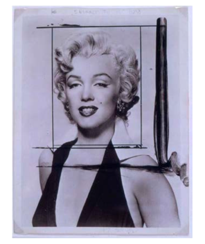
Image description: A black-and-white photograph of Marilyn Monroe wearing a dark halter dress, smiling slightly. The photo has crop marks and black paint streaks on it, suggesting it was used as source material for an art piece or printmaking.
At that point, he produced a high-contrast, flattened image on a sheet of clear acetate. He used that image to trace an outline on the canvas. And he painted on top—applying exotic colors with “a flat, even consistency and an industrial appearance.” The same high-contrast image was then reproduced in negative on a silkscreen, designed to function as a selectively porous mesh. Warhol would “place the screen face down on the canvas, pour ink onto the back of the mesh, and use a squeegee to pull the ink through the weave and onto the canvas.” On some of his Marilyns (there are many), he reordered the process—first ink, then color, then (perhaps) ink again. The result—see for yourself—is miles away from a literal copy of the publicity photo.
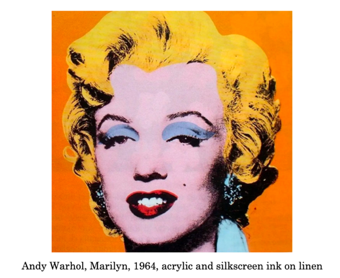
Image description: Andy Warhol’s 1964 pop art portrait of Marilyn Monroe, created with acrylic and silkscreen ink on linen. Monroe’s face is rendered in pink tones with bright yellow hair, blue eyeshadow, and red lips, set against a vivid orange background. The bold colors and high-contrast style are characteristic of Warhol’s work.
And the meaning is different from any the photo had. Of course, meaning in great art is contestable and contested (as is the premise that an artwork is great). But note what some experts say about the complex message(s) Warhol’s Marilyns convey. On one level, those vivid, larger-than-life paintings are celebrity iconography, making a “secular, profane subject” “transcendent” and “eternal.” But they also function as a biting critique of the cult of celebrity, and the role it plays in American life. With misaligned, “Day-Glo” colors suggesting “artificiality and industrial production,” Warhol portrayed the actress as a “consumer product.” And in so doing, he “exposed the deficiencies” of a “mass-media culture” in which “such superficial icons loom so large.” Out of a publicity photo came both memorable portraiture and pointed social commentary.
As with Marilyn, similarly with Prince. …
In the above extract, Justice Kagan provides a compelling explanation of why the Andy Warhol, Marilyn series of works was transformative, noting that “On one level, those vivid, larger-than-life paintings are celebrity iconography… But they also function as a biting critique of the cult of celebrity, and the role it plays in American life.” Justice Kagan sees the Andy Warhol, Prince series as the same. Do you agree? Is that enough?
Justice Kagan criticized the majority for its failure to recognize the genius of any Warhol and the degree to which Goldsmith’s photo of Prince was transformed:
There is precious little evidence in today’s opinion that the majority has actually looked at these images, much less that it has engaged with expert views of their aesthetics and meaning. … The description is disheartening. It’s as though Warhol is an Instagram filter, and a simple one at that (e.g., sepiatinting).
Justice Kagan clearly believed that the Warhol Prince series of works are significantly transformative and that they do serve a purpose distinct from the original work—does this suggest that whether appropriation art qualifies as fair use will always just be a question of the artistic sensibilities of the relevant judge or judges? The majority opinion tips its hat to the Bleistein aesthetic neutrality principle, but do you think that the difference of opinion between the dissent and the majority in Warhol suggests that judges and juries can’t avoid making aesthetic judgments in fair use cases?
Justice Gorsuch’s concurring opinion injects a different kind of factual ambiguity by suggesting that the Andy Warhol Foundation might still prevail if the Warhol Prince works were found to be not substantially similar to Goldsmith’s original photo:
The Court today does not even decide whether the Foundation’s image of Prince infringes on Ms. Goldsmith’s copyright. To uphold a claim of infringement under the Copyright Act, a court must find the defendant copied elements of the plaintiff’s work that are themselves original. Feist Publications, Inc. v. Rural Telephone Service Co., 499 U. S. 340, 361 (1991). As part of this process, a court must isolate and vindicate only the truly original elements of a copyrighted work. The plaintiff must usually show not only a similarity but a “substantial” similarity between the allegedly infringing work and the original elements of his own copyrighted work. And even when two works are substantially similar, if both the plaintiff’s and the defendant’s works copy from a third source (reworking, say, a traditional artistic or literary theme), a claim for infringement generally will not succeed. In this case, we address none of these questions or other elements of the infringement standard designed to ensure room for later artists to build on the work of their predecessors.
This is curious because although the District Court did not address the issue, the Court of Appeals rejected the Foundation’s argument that the Prince Series works were not substantially similar to Goldsmith’s photograph. The concurrence calls to mind Judge Easterbrook’s opinion in Kienitz v. Sconnie Nation LLC, 766 F.3d 756 (7th Cir. 2014) discussed in another chapter.
Notes and questions
(1) Is transformative use still the heart of fair use under the first factor and more generally?
It seems so, but with a more carefully calibrated understanding of what transformative use entails. In the wake of Campbell, some courts had found fair use based on only modest degrees of transformation, or differences of purpose that were highly specific: if you define purpose narrowly enough, you can always come up with a different purpose. Compared to these cases, the majority in Warhol raises the bar on the degree of transformation required for fair use. How did this shift come about? Justice Sotomayor argued that Campbell’s oft-quoted passage defining transformative use as one that alters the first work “with new expression, meaning, or message” cannot be taken to approve of literally any shift in meaning or message, or any overlay of new expression, no matter how small: “Otherwise, ‘transformative use’ would swallow the copyright owner’s exclusive right to prepare derivative works.”
Warhol addresses the ambiguity left by Campbell by providing a yardstick against which to assess whether some transformation is enough. It does this by focusing on whether the defendant’s use serves a “purpose distinct from the original, or instead superseded its objects.” (emphasis added).
Framed in this way, the defendant’s ability to point to some “new expression, meaning, or message” is still important in the analysis of fair use, but the existence of new expression etc., merely informs the ultimate question of whether the defendant’s use served a purpose that was sufficiently distinct from the original that it should be seen as fair use. Accordingly, Justice Sotomayor’s majority opinion emphasized that
[whether an] allegedly infringing use has a further purpose or different character … is a matter of degree, and the degree of difference must be weighed against other considerations, like commercialism. Although new expression may be relevant to whether a copying use has a sufficiently distinct purpose or character, it is not, without more, dispositive of the first factor. (emphasis added)
The majority opinion uses the term “matter of degree” four times, so it is fair to say that this was an important point.
(2) Does Warhol solve the puzzle of separating infringing derivatives from transformative uses?
The majority opinion in Warhol tried to resolve questions about the relationship between transformative use and the right to make derivative works based upon the copyrighted work. One of the reasons Justice Sotomayor gives for insisting that the new use must be different enough to serve a purpose distinct from the original is that:
an overbroad concept of transformative use, one that includes any further purpose, or any different character, would narrow the copyright owner’s exclusive right to create derivative works. To preserve that right, the degree of transformation required to make “transformative” use of an original work must go beyond that required to qualify as a derivative.
In other words, if a new use is substantially different by virtue of new expression, meaning or message, such that it serves a purpose distinct from the original work, it crosses the threshold from infringing derivative work to non-infringing fair use.
In contrast, Justice Kagan’s dissenting opinion contained a long exegesis on the role of copying in art, music, and literature and emphasizes the importance of allowing one artist to build on the work of another. Her point was well made, but as the majority observed, the dissent “offers no theory of the relationship between transformative uses of original works and derivative works that transform originals” other than to say that this is a question for the fourth fair use factor.
(3) Is post-Warhol transformative use narrowly confined to “targeting” the original for commentary or criticism?
After explaining that transformative use was a matter of degree and discussing the relevance of commerciality (addressed below), the Warhol majority came back to the question of justification. Justice Sotomayor explained that “… the first factor also relates to the justification for the use.” Justice Sotomayor described both a “broad sense” and a “a narrower sense” of justification. She noted that broadly speaking a use with “distinct purpose is justified because it furthers the goal of copyright.” Elaborating on justification in the narrower sense, she said, “a use may be justified because copying is reasonably necessary to achieve the user’s new purpose” and gave the example of parody. She also noted in addition that “other commentary or criticism that targets an original work may have compelling reason to conjure up the original by borrowing from it.”
In an article written just after the Warhol decision, Shyam Balganesh and Peter Menell attempt to shift the focus of the first factor away from “transformative use”, to the question of “independent justification.” Independent justification means, they contend, that the second user must provide a rationale for the borrowing beyond mere convenience or free riding, and that the copier must explain why targeting this work was necessary. See Shyamkrishna Balganesh & Peter S. Menell, Going ‘Beyond’ Mere Transformation: Warhol and Reconciliation of the Derivative Work Right and Fair Use, 47 Columbia Journal of Law & the Arts 413 (2024).
Arguably, Balganesh & Menell are reading Warhol more restrictively than it is written. At no point does the majority say that both justification in a broad sense and justification in a narrow sense are required. In footnote 21 Justice Sotomayor says “targeting is not always required” in a context that indicates that it will often be present. This makes sense. Many of the uses that have a sufficiently distinct purpose such that they pose no threat of expressive substitution will achieve that purpose because they have a specific reason for employing the original work that goes beyond “I can make it better.”
Responding to Balganesh & Menell, Pamela Samuelson wrote:
Under the fair use doctrine of United States copyright law, targeting an earlier author’s work to criticize or comment on its contents is a well-established justification for using part or all of that author’s work. Some assert that the Supreme Court narrowed the range of viable fair use justifications to this kind of targeting in Andy Warhol Foundation for the Visual Arts, Inc. v. Goldsmith. This seriously mischaracterizes the Court’s ruling, as Warhol itself identifies several types of cases in which fair uses were justified on other grounds. This view also ignores that criticism and comment are only two of the six favored uses identified in § 107, which codified the common law fair use doctrine as part of the Copyright Act of 1976 (1976 Act). … The Court’s Warhol decision importantly reaffirmed that a second author’s “transformative” purpose in using an earlier author’s work for a different purpose than the original may support a finding of fair use, which may include, but is not limited to, targeting the earlier work for criticism or comment. This reaffirmation is notable because critics of broad interpretations of transformative purposes had wanted the Court to abjure it.
See Pamela Samuelson, Justifications for Fair Uses, 2025 Wisconsin Law Review 1047.
To be fair to Balganesh & Menell, they appear to be using the term targeting in a more general sense, one that invokes the link between the copier’s stated purpose and the specific work chosen. Criticism or commentary are obvious examples of such a link, but not the only game in town.
(4) What other justifications for fair use are there?
Samuelson argues that Warhol did preserve a flexible, context-sensitive fair use doctrine in which different purposes, noncompetitive markets, public benefits, and other considerations could justify fair use, asserting that beyond commentary and criticism, “a multitude of justifications exists for second authors and other users in making fair uses of earlier authors’ works.”
As Samuelson explains, the Warhol majority approvingly discussed at least five justifications beyond narrow commentary and criticism of the plaintiff’s work: Google’s reimplementation of Java interfaces in a new computing environment; artistic use of commercial imagery to comment on consumerism; Google Books’ digitization and indexing of millions of books to make information locatable; a newspaper’s reproduction of photographs that were themselves central to a public controversy; and consumers’ noncommercial time-shifting of television programs under Sony. Beyond Warhol, Samuelson notes that the expressly favored purposes in § 107 go beyond criticism and comment. News reporting, teaching, scholarship, and research uses are strong candidates for fair use if the amount copied is minimal and/or alleged market harm is speculative. Samuelson also argues that courts have found, and should continue to find, justification in evidentiary uses in biographies, histories, documentaries, litigation, and governmental proceedings; uses that promote public access to information, including search, indexing, and text analysis; and uses that enable competition and continuing technological innovation, especially reverse engineering, interoperability, and reuse of functional software interfaces.
(5) What is the relevance of commerciality after Warhol?
The majority in Warhol placed a renewed emphasis on commerciality as a consideration within the first fair use factor, but it is not clear what this adds to Campbell. Justice Sotomayor described commerciality as “an additional element of the first factor.” However, she also endorsed Campbell’s holding that “the more transformative the new work, the less will be the significance of other factors, like commercialism, that may weigh against a finding of fair use.” In other words, as Justice Sotomayor said: “the commercial nature of the use is not dispositive. But it is relevant.”
Balganesh & Menell argue that Warhol placed “commerciality and transformativeness … on a sliding scale fulcrum.” The “sliding scale fulcrum” metaphor implies that justification and commerciality are discrete sub-elements of factor one, weighed against each other on a common scale. There is some loose language in Warhol to support this: the majority describes commerciality as “an additional element.” But there is no firm evidence beyond that that a “sliding scale fulcrum” is what the majority intended. There is certainly no support in the text of the Copyright Act for the notion that justification and commerciality are discrete and equivalent sub-elements of factor one.
Note that Section 107(1) names commerciality as an attribute of the purpose and character of the use, introduced by “including,” not as a variable standing opposite it. Any discussion of transformativeness and commerciality sitting on a “sliding scale fulcrum” is problematic because the balancing §107 contemplates runs between the four factors rather than inside any one of them.
The idea that justification and commerciality are discrete and equivalent sub-elements of factor one is also not supported by the caselaw. Campbell’s formulation, holding that transformativeness reduces the significance of commercialism, is a claim about salience rather than about offsetting weight and correspondence. Warhol itself lists commercialism as one of several “other considerations,” not as the opposing term a fulcrum would require. The more coherent reading of Warhol is that commerciality might be evidence bearing on justification rather than a counterweight to it, since whether the copier stood to profit informs whether the proffered reason for targeting the plaintiff’s work was substantive or a post hoc gloss on convenience and free riding.
(6) Should we focus on the use or the accused work?
Justice Kagan’s dissenting opinion in Warhol focused on the transformative nature and artistic merit of the Warhol paintings, whereas the majority (and Justice Gorsuch’s concurrence) focused on the specific use: licensing the image of Prince for use in a magazine cover devoted to Prince. The majority’s focus on the use is supported by the text of Section 107, it literally says “the purpose and character of the use.” However, focusing on the use has the interesting implication that, as Sotomayor notes “The same copying may be fair when used for one purpose but not another.” Focusing on the transformativeness of the use rather than the work leaves open the possibility that the original Warhol Prince series could be considered sufficiently transformative in a context where its commentary on the nature of celebrity was more pronounced than its potential substitution of the market for images of Prince on magazine covers. Justice Gorsuch’s concurring opinion elaborates on this point:
… while our interpretation of the first fair-use factor does not favor the Foundation in this case, it may in others. If, for example, the Foundation had sought to display Mr. Warhol’s image of Prince in a nonprofit museum or a for-profit book commenting on 20th-century art, the purpose and character of that use might well point to fair use. But those cases are not this case. Before us, Ms. Goldsmith challenges only the Foundation’s effort to use its portrait as a commercial substitute for her own protected photograph in sales to magazines looking for images of Prince to accompany articles about the musician. And our only point today is that, while the Foundation may often have a fair-use defense for Mr. Warhol’s work, that does not mean it always will. Under the law Congress has given us, each challenged use must be assessed on its own terms.
Does focusing on the use of the defendant’s work so narrowly threaten to make fair use litigation overly fact specific? Or is this a reasonable distinction to draw in a context where the Warhol works may be exhibited as individual pieces of art or included in a Warhol collection? What latitude should we give the appropriation artist to promote her work by making posters, engaging in advertising, etc.?
(7) Recall that Section 103(a) provides in relation to derivative works and compilations that “… protection for a work employing preexisting material in which copyright subsists does not extend to any part of the work in which such material has been used unlawfully.” If Warhol’s art was non-infringing fair use when he made it, but infringing non-fair use when licensed to Condé Nast for the cover of a magazine, how does Section 103(a) apply? Is Orange Prince now in the public domain, or just in the public domain when it is on the cover of the Condé Nast commemorative issue? Does this suggest we should rethink the “use versus the work” debate, or should Congress revisit section 103(a)?